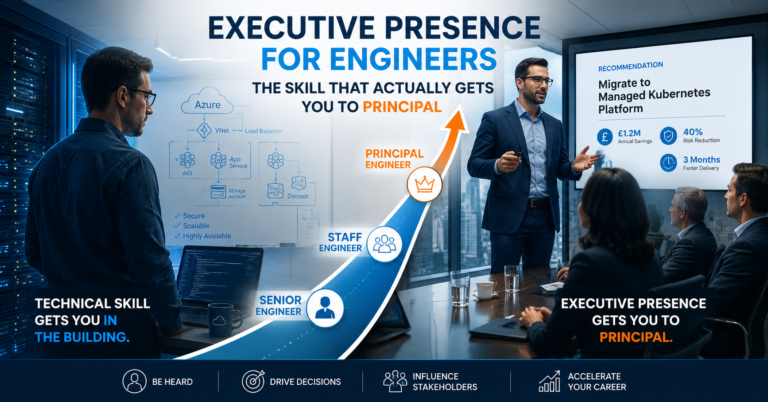

The engineer who knows everything about the billing pipeline is one of the most valued people in the organisation. Everyone knows their name, their Slack messages get instant replies, and their opinions carry weight in every technical conversation. They are also, statistically, one of the least likely engineers in that organisation to reach Staff or Principal level. Senior Cloud Engineers in the UK earn between £90,000 and £130,000. Staff and Principal Engineers command £130,000 to £180,000 or more. That gap, which represents up to £90,000 per year in additional base salary before equity and higher bonus percentages, stays permanently out of reach for many Senior engineers who are excellent at their jobs. The reason most of them plateau has nothing to do with technical ability and everything to do with a structural trap they helped build without realising it.
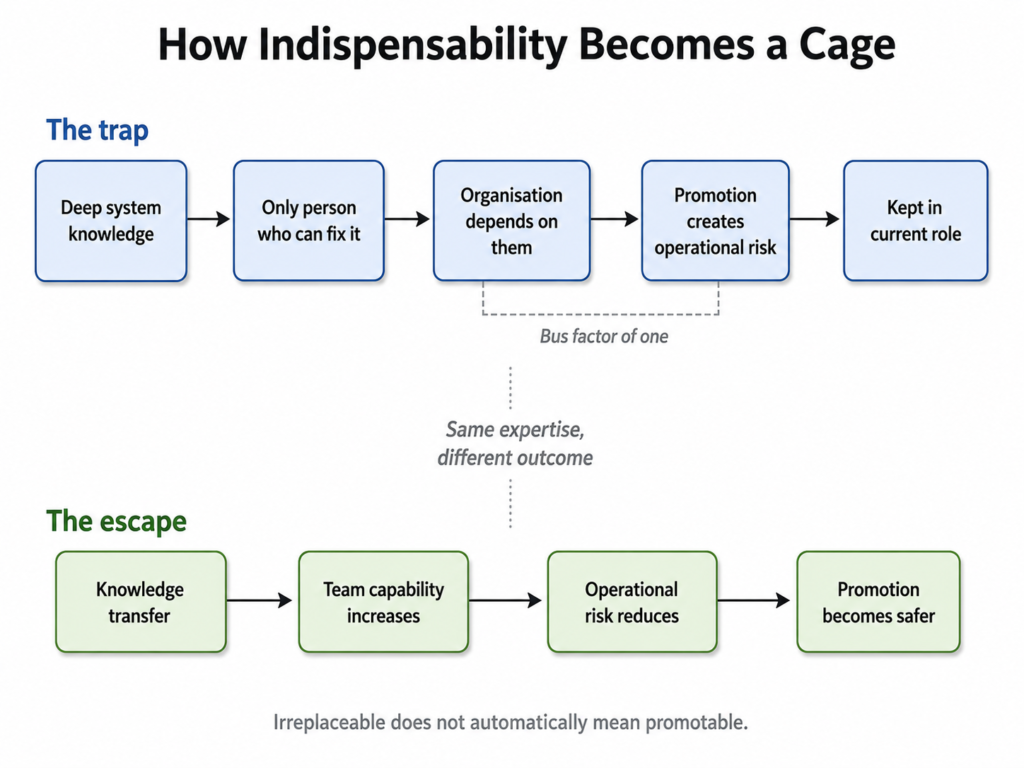
The traditional instinct at Senior level is to accumulate knowledge and guard it carefully. If you are the only person who understands how the Kubernetes cluster handles traffic routing at peak load, or how the legacy integration with the payments provider actually works, you become irreplaceable. Irreplaceable, the thinking goes, means secure. It is a rational-feeling response to an uncertain market, and it is almost completely wrong at this career stage. Organisations do not promote people whose departure from their current role would create a crisis. They keep them exactly where they are, tell them they are brilliant, and give them strong performance reviews that never quite translate into a promotion. The best engineer on the team often stays the best engineer on the team, for years, because the most logical thing for the organisation to do is leave them in position.
The fix requires a specific inversion: the deliberate, strategic transfer of accumulated knowledge is not giving away your leverage. It is demonstrating the exact behaviour that Staff and Principal promotion committees reward. Engineers who have made this transition describe the same shift, from being the expert that other people depend on, to being the person who makes other engineers more capable. That shift is what separates Senior from Staff in the UK market. It is also, as it happens, what separates a team with a bus factor of one from a team that can survive a fortnight without its most senior engineer. This post covers how to make that shift deliberately, visibly, and in a way that builds your career rather than quietly draining it.
The Mechanism: Why Indispensability Becomes a Cage
Understanding the trap requires understanding how promotion decisions are made at Senior level and above. Promotion is not purely a reward for past performance. At its core it is a risk and throughput calculation: will moving this person into the next role increase organisational output and reduce operational risk? When you are the single point of knowledge for a critical system, the honest answer to that question is no. Moving you creates a gap nobody else can fill. The organisation benefits more from your continued presence in your current role than from your promotion. So it keeps you there, even as it promotes colleagues who are technically less capable but whose departure would leave nothing behind except well-documented, well-understood systems.
This plays out constantly across the UK cloud engineering market. When one person becomes the only keeper of certain knowledge, it is not a compliment but a risk classification. The response to a risk classification is to contain it, not to elevate it. Promotion would move the risk. Leaving you in place manages it.
The trap has a technical name: the bus factor, sometimes called the truck factor or the lottery factor. It measures the minimum number of team members who would need to become unavailable before a project stalls. Research examining popular open-source software projects found that 46 percent had a bus factor of one and a further 28 percent had a bus factor of two. Three-quarters of those projects were, in structural terms, one person’s absence away from serious disruption. Enterprise cloud teams are not meaningfully different. A team of ten engineers can still have a bus factor of one if only one person truly understands the production networking configuration, the incident escalation path, or the state management logic in the Terraform estate. Critically, bus factor is independent of team size: a large, well-staffed organisation can be just as fragile as a startup if knowledge is concentrated in the same way.
There is a darker irony in this for the engineer living it. Research into key-person risk notes that a critical engineer may feel indispensable in ways that negatively affect their relationship with their employer and teammates, who may be simultaneously dependent on them and resentful of that dependency. The cage has a ceiling and uncomfortable walls.
How Organisations Reward the Wrong Behaviour
Individual knowledge hoarding rarely happens in isolation. Most organisations actively reward the behaviour they claim to want eliminated, through a dynamic that leadership researchers call hero culture. The hero is the engineer who resolves the critical production failure at eleven at night. They receive the all-hands shout-out, the manager praise, the visible recognition that signals the organisation values their uniquely capable intervention. What the organisation rarely examines is why the intervention was necessary in the first place, and what structural conditions ensured that only one person could provide it.
Google’s Site Reliability Engineering practice is explicit about the cost of this pattern. Its guidance on heroism states that celebrating individual rescue acts masks the systemic problems that made the rescue necessary, which ensures those problems are never fixed. The hero grows more essential. The system grows more fragile. And the hero’s promotion case grows thinner with every incident they resolve alone, because their value is being demonstrated in precisely the way that prevents their advancement.
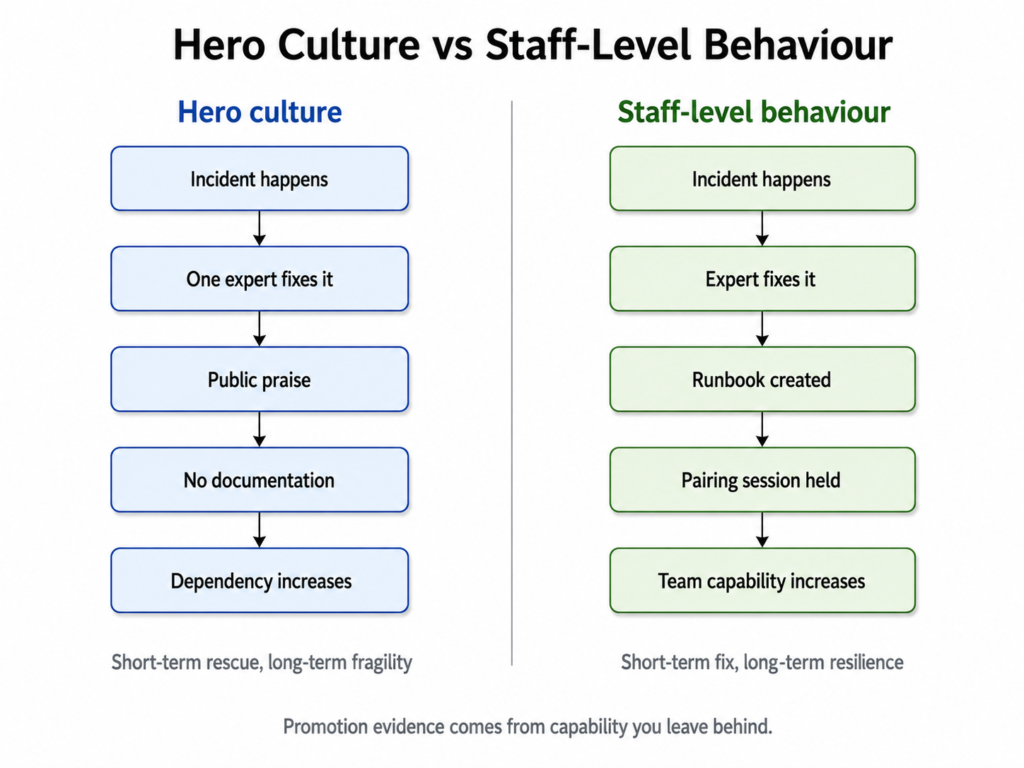
The cloud environment is particularly susceptible because delivery pressure routinely deprioritises documentation and knowledge sharing. When a team is under pressure to ship, writing runbooks and pairing with less experienced engineers are the first casualties. Over eighteen months, a highly capable Senior engineer who operates this way has often become the single point of knowledge for a large and growing surface area, entirely through the accumulation of valued work done without adequate transfer. The ambition that built the expertise has quietly also built the cage.
This is the split worth naming clearly: both individual behaviour and organisational enablement contribute. Engineers hoard partly because the organisation rewards hoarding. Fixing it requires the individual to change behaviour and the organisation to stop celebrating the wrong things. The engineer reading this can only control one of those two, and it is the more important one.
What Staff and Principal Actually Require
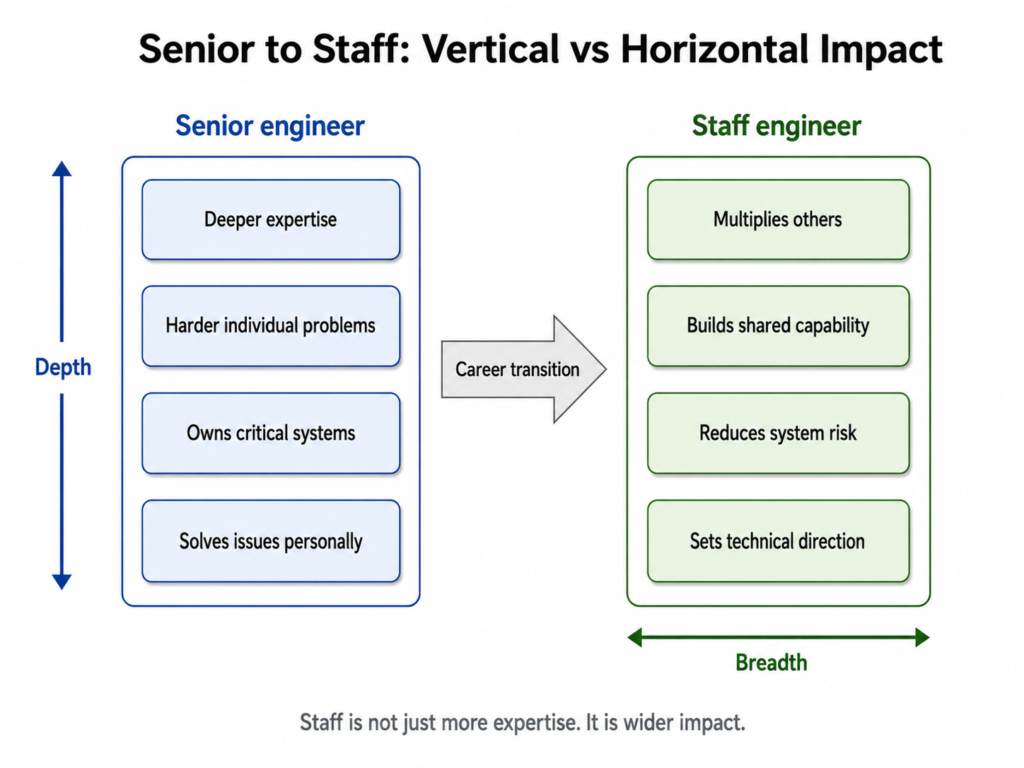
The transition from Senior to Staff is not a continuation of the same trajectory at higher velocity. It is a different job. Will Larson’s work on the Staff engineering role identifies four archetypes: the Tech Lead who guides a team’s technical execution, the Architect who shapes direction across a critical domain, the Solver who addresses the organisation’s thorniest problems, and the Right Hand who extends executive capacity. None of these archetypes is “the person who privately holds critical knowledge that nobody else can access.”
The shared expectation across all four is achieving goals partly through the work of others. Tanya Reilly, in The Staff Engineer’s Path, puts the anti-indispensability requirement directly: do not become a single point of failure where the team cannot function when you are unavailable. Her prescription is concrete. If something is yours alone to fix, insist on pairing. Write the code that establishes the new pattern, then hand the implementation to someone else. The goal is not to avoid expertise but to ensure it propagates, so that organisational capability grows rather than concentrating in one place.
This is also why the high-stakes performance skills covered in our guide to performing under pressure as a cloud professional matter most precisely at this career transition. The visibility you earn in a crisis becomes a Staff-level credential only if the systems and knowledge you used in that crisis are documented and transferable afterward. The engineer who resolves the incident and documents nothing has demonstrated Senior competence. The engineer who resolves the incident, writes the runbook, and pairs with a colleague on the failure mode the following week has demonstrated Staff behaviour, and will be called again next time for a different reason.
The career inflection point is a reversal of direction. Impact growth up to Senior level is primarily vertical: deeper expertise, harder individual problems. From Staff level upward, impact growth is primarily horizontal: empowering other engineers, multiplying team capability, setting the conditions under which the organisation can function without any single person being indispensable. The promotion committee is not looking for evidence you can go deeper. It is looking for evidence you can go wider.
The Knowledge Transfer Playbook
The practical mechanics of knowledge transfer are not complicated. What makes them hard is doing them deliberately and visibly enough that they register as leadership rather than disappearing as background work.
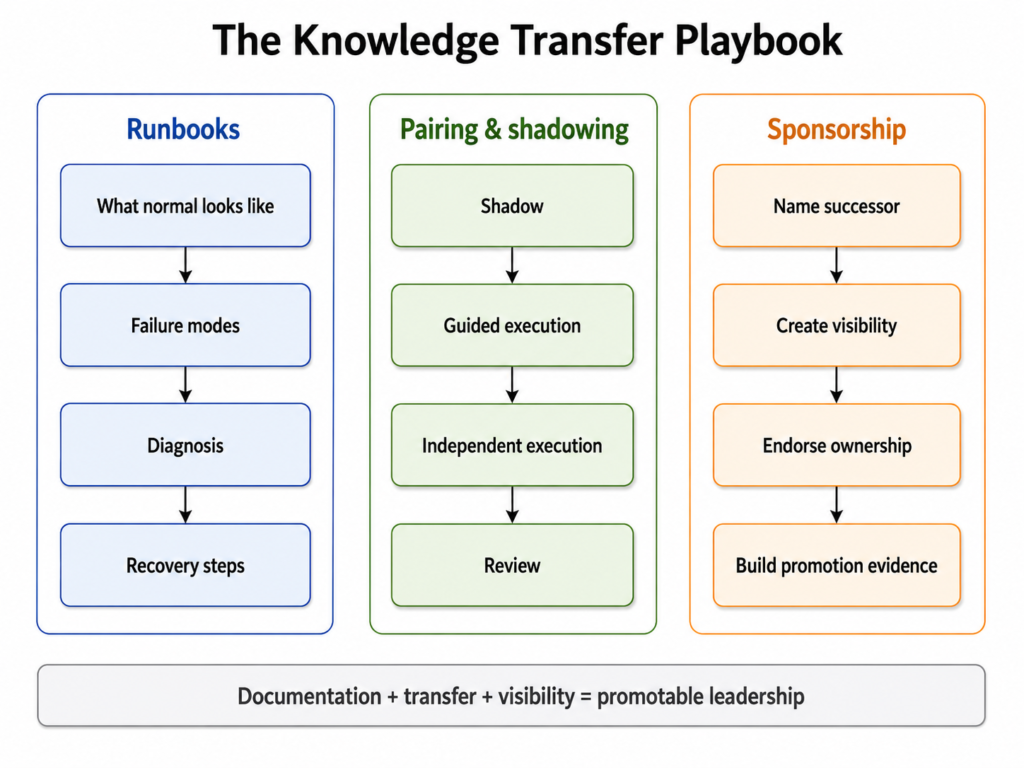
Runbooks as reputation capital. A well-constructed runbook is one of the highest-leverage artefacts a senior engineer can produce, and it is a direct reputational signal to anyone who reviews your promotion case. The Google SRE practice estimates that teams with documented playbooks resolve incidents roughly three times faster than teams relying on individual expertise. The DORA research programme, drawing on data from tens of thousands of engineering teams across multiple years, found that teams with high-quality documentation were more than twice as likely to meet or exceed their performance targets. Writing the runbook for your highest-risk system is not a hygiene exercise. It is a signal to your manager, your manager’s manager, and any promotion committee that you understand what mature engineering looks like and are actively building it. A credible runbook covers what the system does, what normal looks like, what failure modes exist, how to diagnose each one, and how to resolve it without needing to call the person who wrote it. That last criterion is the test: if someone else cannot follow it during an incident without your presence, it is not finished.
Pairing and shadowing as structured succession. Tacit knowledge, the instinctive judgement calls that experienced engineers make without conscious awareness, is the hardest category to transfer and the most dangerous to leave concentrated. Pairing is the transfer mechanism for this category precisely because the act of explaining judgement calls in real time, while someone else watches, surfaces them and makes them available for documentation afterward. Pick one colleague and make them your explicit successor for the knowledge area where you are the current single point of failure. Run the programme in stages: they shadow you first, then perform the task with you observing, then perform it independently with you reviewing afterward. This is not training in the generic sense. It is a targeted programme to raise your team’s bus factor from one to two, and it is visible work that directly supports your promotion case.
Sponsorship as force multiplication. Our post on technical mentoring as career capital covers the distinction between mentorship and sponsorship in detail, but in the context of the indispensability trap, sponsorship is the higher-leverage choice. Mentorship is sharing what you know. Sponsorship is actively creating opportunities for someone else to demonstrate capability in contexts where it will be observed by people with influence. When you endorse a colleague’s readiness to take ownership of a system you currently own alone, and you do so in writing to their manager and in cross-functional forums where it will register, you are simultaneously transferring knowledge, building a successor, and demonstrating exactly the judgement that Staff-level committees reward.
The critical caveat, flagged by Tanya Reilly in her widely cited “Being Glue” talk, is that coordination and transfer work has a documented history of becoming invisible, particularly for women and under-represented engineers who are disproportionately asked to carry it without formal recognition. The solution is not to avoid the work but to frame it explicitly. Write the pairing plan down. Include it in your performance conversation. Make the connection between the knowledge transfer and your promotion case explicit to your manager before the calibration cycle begins, not after it ends.
The Business and Governance Case
For Senior engineers working toward Staff, understanding how organisations view key-person risk at the board level makes the personal career argument more legible, and makes it easier to frame knowledge transfer as strategic leadership rather than personal development housekeeping.
UK financial services firms operating under FCA and PRA operational resilience rules are now required to map the people, processes, technology, facilities, and information needed to deliver each important business service. The FCA’s published guidance explicitly requires firms to understand their key-personnel dependencies and succession arrangements as part of this mapping. A cloud process that functions only because one engineer holds the relevant expertise informally is, in regulatory terms, an unmitigated concentration risk. Engineers who understand this, and who frame their knowledge transfer work as a response to it, are speaking the language of operational risk management. That is Staff-level fluency.
The UK Corporate Governance Code 2024, effective for financial years beginning January 2026, requires boards of premium-listed companies to declare the effectiveness of material controls. Controls that rely on individual knowledge rather than documented process are precisely the kind of “assumed accountability” this requirement is designed to surface. Cloud engineers working in large UK enterprises or regulated sectors who can connect their documentation culture to board-level governance requirements are making the Staff-level argument in terms that resonate with CFOs and CTOs, not just engineering managers.
Beyond financial services, the cost of knowledge concentration falling away is well documented. Research on UK employee replacement costs puts the average figure for a professional earning over £25,000 at more than £30,000, covering recruitment, onboarding, and lost productivity during the ramp period. For a Senior Cloud Engineer earning £90,000 to £130,000, the real figure is considerably higher, and the institutional knowledge component is the part that cannot be fully replaced by any new hire, regardless of their skill level.
Career Progression: The Senior-to-Staff Timeline
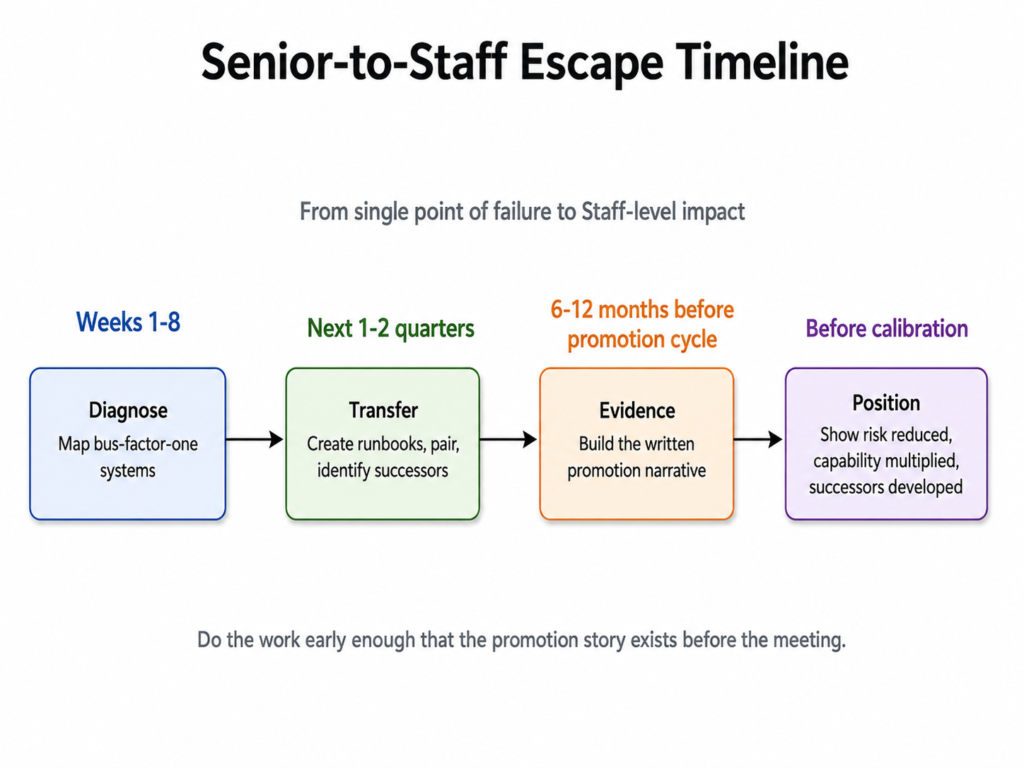
The roadmap for escaping the indispensability trap runs across three overlapping phases, each with distinct deliverables and a clear connection to the promotion case you are building.
In the first phase, covering the next four to eight weeks, the task is diagnosis. Map every critical system you touch against a single question: if you were unavailable for two weeks, what would break and who would be blocked? The systems where the honest answer is “everything” or “nobody else knows” are your bus-factor-one liabilities. Naming them precisely is the precondition for addressing them, and sharing that map with your manager frames you as someone thinking about organisational risk rather than individual role security. That framing shift matters: it is the difference between presenting yourself as a Senior engineer doing their job and presenting yourself as a Staff-level thinker identifying systemic exposure.
In the second phase, covering the next one to two quarters, the task is deliberate transfer. Begin with the highest-risk system and write the runbook. Identify your succession candidate for that system and run a structured pairing programme. Document decisions and the rationale behind them, including the tacit knowledge that everyone on the team “just knows.” Frame all of this explicitly as leadership work in every performance conversation. Engineers who plateau at Senior often do this work quietly. Engineers who reach Staff do it loudly enough to be counted in their own calibration meeting.
In the third phase, covering the six to twelve months before your target promotion cycle, the task is converting transfer into a promotion narrative. The evidence a Staff committee needs is not a list of systems you no longer own alone. It is a narrative of judgement exercised, capability multiplied, and organisational risk measurably reduced. That narrative needs to exist in writing, connected to business outcomes, before the calibration meeting happens, not emerging from it for the first time.
This is also the moment to test whether your current organisation has a functional Individual Contributor ladder above Senior. Accumulating more Senior-level credentials does not unlock Staff-level conversations, as explored in our post on the cloud certification plateau. If there is no pathway at the next level in your current organisation, the knowledge transfer work you have completed and the documented track record it produces become your strongest external market credential. The indispensability that traps you internally can be reframed as proven scope and maturity for a hiring manager elsewhere.
Common Pitfalls
The most common mistake is doing this work invisibly. Engineers who understand intellectually that they need to transfer knowledge often do so quietly, because self-promotion feels uncomfortable and because the work itself is unglamorous. The result is that the transfer happens but nobody in a position to accelerate the promotion knows it occurred. Visibility is not the same as self-aggrandisement. It is the professional obligation to ensure that work done in the organisation’s interest is counted as such.
A second pitfall is treating knowledge transfer as a one-time event. Writing a single runbook and running one pairing session raises your bus factor from one to marginally above one, for a single system. The target is a structural change in how you operate: defaulting to documentation, defaulting to pairing, defaulting to ensuring that every significant decision exists somewhere outside your own head by the end of the sprint in which you made it.
A third pitfall is accepting the “too valuable to promote” conversation as a compliment rather than a diagnostic. If your manager tells you that you are too valuable in your current role to be moved, the appropriate response is a direct negotiation about a defined backfill plan and a specific promotion timeline. If neither is offered with any real commitment, that is useful information. The knowledge that makes you irreplaceable internally is also valuable externally, and the organisations most likely to pay at the Staff or Principal level are typically the ones who have a ladder capable of supporting the role.
ROI Analysis
The financial case for escaping the indispensability trap is significant, and the cost of staying in it compounds annually.
The gap between Senior and Staff/Principal in UK cloud engineering runs from £40,000 to £50,000 per year in base salary alone, moving from the £90,000-£130,000 Senior band to the £130,000-£180,000 Staff/Principal range. In London-based technology organisations with equity and performance bonuses, the total compensation gap frequently reaches £60,000 to £100,000 per year or more. An engineer who plateaus at Senior for three years rather than progressing forgoes between £120,000 and £300,000 in gross compensation at the conservative to mid-range estimate, before accounting for the higher bonus percentages and equity grants that are typically tied to the promotion itself. Over five years, the figure for an engineer at a London-based technology employer can comfortably exceed £300,000.
The time investment in knowledge transfer is modest by comparison. A thorough runbook for a complex system takes eight to sixteen hours to produce initially, with ongoing maintenance of two to four hours per quarter. A structured pairing programme for a succession candidate runs to two to three hours per week across a quarter. The total annual investment sits in the range of sixty to one hundred hours of focused effort. Against a career opportunity worth £40,000 to £50,000 per year that this work is designed to unlock, the payback period is measured in days of working time, not months of sustained effort.
Next Steps and Action Items
- This week: identify the three systems where you are the current single point of knowledge. Write down the answer to “what breaks if I am unavailable for two weeks?” and share it with your manager as a professional risk discussion.
- This month: begin the runbook for the highest-risk system. Identify your succession candidate for that system and agree a pairing structure with them.
- Next quarter: complete the knowledge transfer for your first system. Document the process and frame it explicitly in your performance conversation as organisational risk reduction and demonstrated leadership.
- Before your next calibration cycle: ensure your manager has, in writing, the narrative of what you transferred, who you developed, and what risk you reduced. That narrative should exist before the calibration meeting, not emerge from it.
- Ongoing: default to documentation and pairing. Every significant decision should exist somewhere outside your own head by the end of the sprint in which you made it.
Useful Links
- IT Jobs Watch: Senior Cloud Engineer salary trends (UK)
- IT Jobs Watch: Principal Engineer salary trends (UK)
- Staffeng.com: Will Larson’s Staff Engineer archetypes
- DORA: Documentation quality as an engineering performance predictor
- Google SRE: The case against hero culture in engineering teams
- Google SRE Workbook: On-call practices and runbook guidance
- FCA: Operational resilience requirements for UK financial services firms
- Tanya Reilly: Being Glue, on invisible transfer work and career risk
- LeadDev: Engineering leadership research and Staff+ development
- Levels.fyi: UK technology total compensation benchmarks