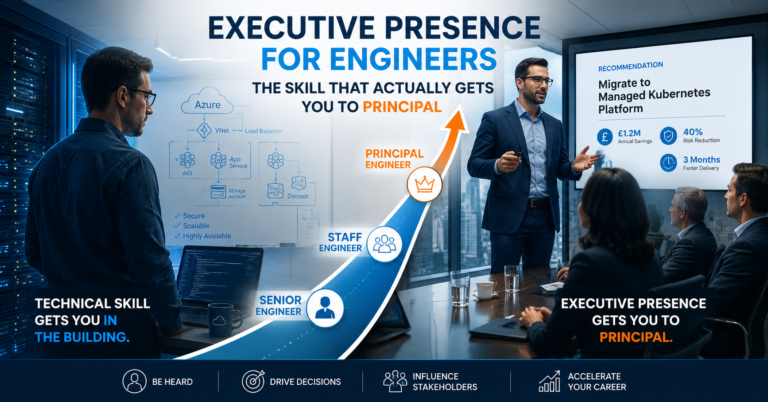

Pull up any Principal Cloud Engineer job posting in the UK and you will find something consistent. After the stack requirements (Kubernetes, Terraform, multi-cloud architecture) there is almost always a requirement that reads something like “proven experience mentoring engineers and raising the technical bar across the team.” Pull up a Senior Cloud Engineer posting at the same company and you will typically find a softer version of that requirement, or none at all. That distinction is not cosmetic. Data from IT Jobs Watch puts the UK median for a Senior Cloud Engineer at around £68,750, while Principal Engineer roles carry a median of £80,000, with upper-quartile positions in London regularly reaching beyond £100,000. According to Robert Half’s 2026 UK Technology Salary Guide, 70 per cent of UK IT hiring managers are actively paying more for professionals whose skills extend beyond the purely technical. The gap between Senior and Principal, between where most experienced engineers plateau and where the market pays meaningfully more, runs to roughly £10,000 at the median and £20,000 to £30,000 at the upper end. Mentoring is not the only thing separating those two levels, but for the majority of senior cloud engineers, it is one of the most consistently underinvested.
Most engineers approaching the five-to-eight-year mark respond to stagnating progression the same way: another certification, a greenfield project, or waiting for a reorg to create the right opening. These are not bad investments, but they address technical credibility, which is largely assumed at Senior level. What hiring managers and promotion panels are actually evaluating at Principal and Staff level is a different question entirely: can this person raise the capability of everyone around them? Analysis of UK Principal Cloud Engineer job specifications from early 2026 shows mentoring or coaching listed as a core requirement, not a nice-to-have bullet, in roughly 90 per cent of postings. At Staff Engineer level, the figure is similarly consistent. The shift from aspirational to mandatory happens between Senior and Principal, and engineers who have not built a demonstrable track record of growing others will find themselves locked out of the next salary band regardless of their technical depth. Accumulating a fifth certification while no one outside the immediate team knows your name solves the wrong problem.
The mechanism for building that track record is more practical than most engineers expect, and the return is compounding in a way that certification alone is not. Research on what psychologists call the protégé effect shows that people who teach material to others learn it more deeply than those who study it for themselves, and for cloud engineers, that translates directly into technical fluency under pressure. Combine that with the internal visibility that comes from running knowledge-sharing sessions, and you have an investment that makes you more capable and more visible simultaneously. This post is a practical guide to starting that process, specifically for engineers who have never formally mentored anyone and are not sure where to begin.
The Gating Criterion Most Engineers Miss
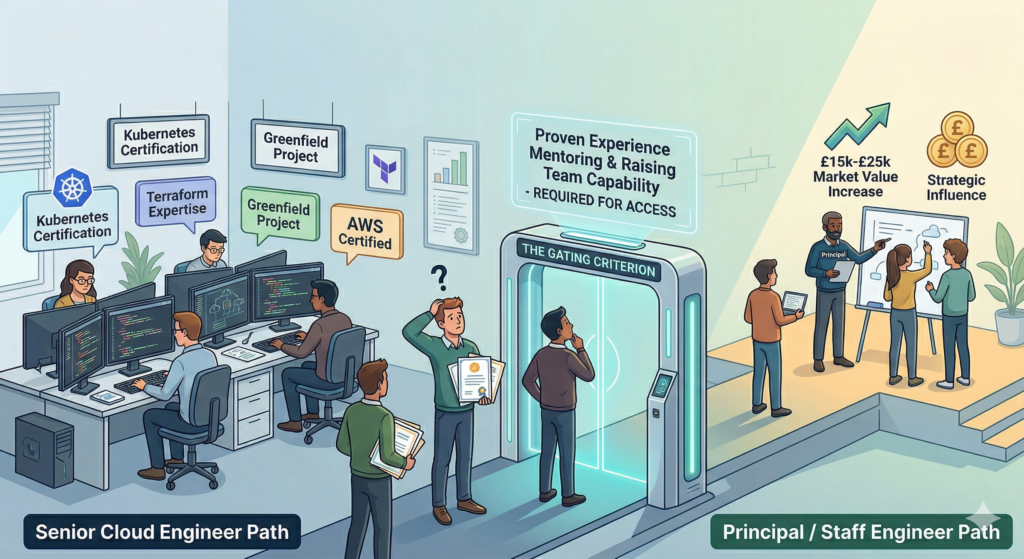
The salary differential is real but worth framing with precision. The £15,000 to £25,000 figure in the title represents the market differential between Senior and Principal or Staff, specifically the levels where mentoring moves from optional to required. It is not a direct causal premium. Nobody is paid £20,000 more because they mentored three people. The mechanism is structural: mentoring and knowledge-sharing are gating criteria for accessing the higher band, and the higher band pays more. The practical implication is the same, but the framing matters for how you invest your time.
Using data across IT Jobs Watch, Glassdoor, and Robert Half for 2025 and early 2026: Senior Cloud Engineers in the UK earn a median in the range of £68,000 to £73,000, with London roles averaging closer to £86,000. Principal Engineer roles carry a UK median of around £80,000, with London upper-quartile positions in the £100,000 to £120,000 range. Staff Engineer roles at senior-experience technology companies can reach £110,000 to £150,000. The jump from Senior to Principal represents approximately £10,000 at the median and £20,000 to £35,000 at the upper percentiles, which maps directly to the range cited in the title for engineers in London and the South East.
The job spec analysis makes the case more concrete than salary tables alone. D.C. Thomson’s Principal Cloud Engineer specification requires candidates to “provide technical leadership and guidance through coaching and mentoring, lead the sharing of knowledge and good practice, and assist in shaping career paths.” WRK Digital’s equivalent role lists “proven experience mentoring engineers and leading technical discussions” as a core requirement, not a soft skill. The University of Bath specifies “lead and develop a specialist team, providing coaching and capability development.” Across these postings, and dozens more sampled from early 2026, mentoring appears in the top three to five required attributes. At Senior level, the same attribute tends to appear in the second half of a job description or not at all.
Engineers who reach their mid-career years without building any evidence of growing others will find that a Principal-level interview process exposes that gap quickly. The question “tell me about a time you raised the capability of your team” is difficult to answer convincingly if the honest answer is that you have not, in any structured way, tried.
Why Teaching Makes You Better at Your Job
The professional case for mentoring is strong enough on its own, but the personal case, that teaching deepens your own technical capability, deserves equal attention, because it is the part that most engineers underestimate.
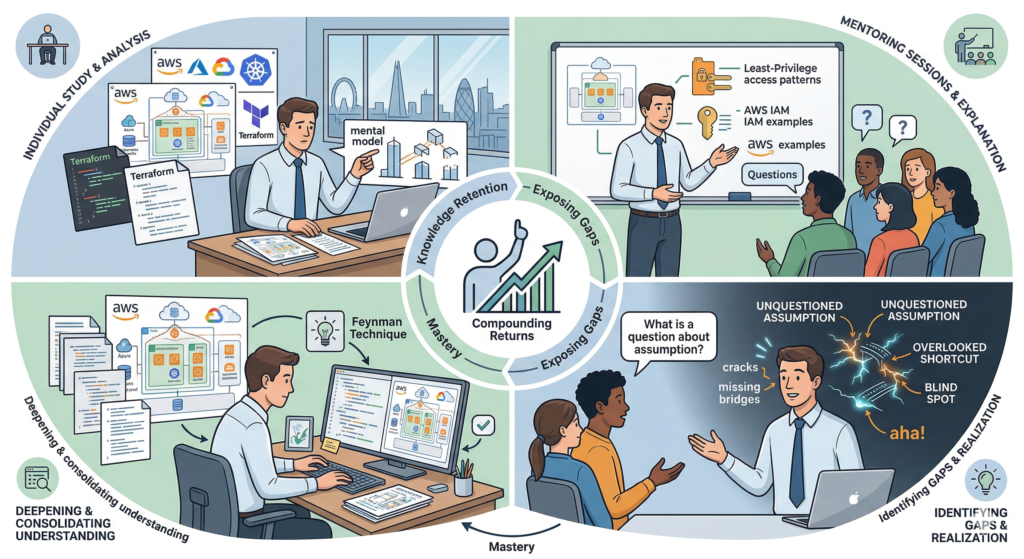
In 2009, researchers at Stanford’s Advancing Authentic Learning Lab studied students using an interactive tutoring system and found that those who believed they were teaching a virtual agent, rather than studying for themselves, spent more time on the material and retained substantially more of it. Subsequent meta-analyses extended that finding. Across 28 studies reviewed in a 2019 analysis published in Japanese Psychological Research, students who actually taught material showed a meaningful advantage in retention over those who studied it conventionally, with the advantage largest in face-to-face teaching conditions, which is directly relevant to one-to-one mentoring.
For cloud engineers, the mechanism is clear. When you architect a solution, you build a mental model that works well enough to ship. That model often contains assumptions, shortcuts, and gaps that experience has papered over. When you are asked to explain that same solution to someone who cannot rely on your experience to fill the gaps, those assumptions surface immediately. The engineer who has spent six months mentoring others through AWS IAM will handle an architecture review board discussion on least-privilege access patterns more fluently than someone with equivalent years of production experience who has never articulated their reasoning to a non-expert.
This is operationally identical to what Richard Feynman described as his approach to learning: explain a concept as if teaching a complete beginner, identify where the explanation breaks down, and return to source material to fill the gap. The difference with actual mentoring is that there is a real human on the other side of the conversation, which the research consistently shows produces better retention and deeper engagement than solo study techniques.
Kelsey Hightower, whose public teaching record through projects like Kubernetes the Hard Way helped establish him as one of the most cited practitioners in the cloud-native space, has been direct about this: explaining something publicly embeds the understanding in a way that private expertise does not. Tanya Reilly, in The Staff Engineer’s Path, draws the same distinction between giving advice and teaching: the former transmits information, the latter develops capability. One scales with the number of conversations you have; the other scales with the number of people you develop.
From Teaching to Technical Influence
The career compounding effect of mentoring is not limited to depth of knowledge. Internal teaching creates a category of visibility that individual technical work cannot replicate.
When you run a lunch-and-learn on Terraform module design patterns, or write an internal ADR on a multi-account networking decision and present it across three teams, you become visible to people who would otherwise have no reason to know your name. That visibility is the precursor to technical influence at the organisational level. The engineers who get invited to architecture review boards are rarely the ones with the best individual delivery records alone. They are the ones whose thinking is already trusted across teams because they have shared it openly.
This parallels a dynamic discussed in the post on open source contribution as a career multiplier: public technical investment creates compounding returns over time, because the reputation precedes the individual in contexts where nobody has direct experience of their work. The same logic operates internally. An engineer who has delivered a dozen lunch-and-learn sessions, created an internal cloud engineering onboarding track, and is known across four teams as the person who can explain Kubernetes networking clearly is already demonstrating what a Principal role requires: not just knowing things, but the ability to make others more capable.
Gergely Orosz, writing on developer promotion patterns at companies including Uber, notes that promotion packets for Staff-level engineers typically include documented mentoring relationships, internal training contributions, and evidence of written technical leadership alongside project delivery. Architecture decision records, RFCs, runbooks: the artefacts of someone who codifies and shares their thinking, not just someone who executes well. None of that requires a formal title change first. The evidence can be built before the promotion conversation begins, which means the conversation becomes a retrospective confirmation rather than a request.
The natural progression runs from internal tech talks to recognition as a subject-matter expert, to involvement in architecture discussions, to ARB candidacy. Each step is substantially easier if the previous one is already in place. Engineers who wait for the title before building the track record typically find that no one with the authority to grant the title has any reason to know who they are.
Where to Start: Finding Your First Mentee
For an engineer who has never formally mentored, the practical starting point is a platform that removes friction and requires no existing reputation. ADPList is free for both mentors and mentees, hosts a large global community, and the entry bar is deliberate expertise rather than public recognition. Committing to two sessions per month is a realistic starting point, enough to develop a genuine mentoring relationship without disrupting a full-time engineering role.
MentorCruise offers a more structured arrangement, where mentors retain around 80 per cent of the session fee and mentees commit to a monthly subscription. This suits engineers who want a more formal setup after a few sessions have built confidence. The platform is particularly strong for cloud and platform engineering mentoring relationships.
Within the UK professional context, the BCS Career Mentoring Network connects members across the technology sector and participation counts as formal CPD towards Chartered IT Professional (CITP) or Chartered Engineer (CEng) status. For engineers who have a longer-term interest in professional registration, mentoring through the BCS serves two purposes simultaneously.
For those wanting community-level involvement, the CNCF LFX Mentorship Programme runs three paid mentorship terms per year across projects including Kubernetes, Prometheus, Envoy, and Cilium. The programme is remote-first and open globally, reported 187 successful mentorship projects in 2025, and provides mentors with genuine community profile in the cloud-native ecosystem. The time commitment is heavier than informal one-to-one mentoring, but the community capital it creates is proportionally larger.
Internally, the most friction-free path is often a structured offer rather than waiting to be asked. Proposing a six-week onboarding programme for a new joiner, or volunteering to run a recurring technical session for your team, creates a mentoring relationship without either party needing to use that word. The output is the same: someone benefits from your knowledge, you develop your ability to transfer it, and both parties can point to a concrete outcome.
Structuring the Relationship to Generate Real Value

The most common failure mode for first-time mentors is treating sessions as consultations: the mentee arrives with a problem, the mentor solves it, the mentee leaves slightly more informed and entirely dependent. That arrangement is useful for the mentee in the short term and nearly useless for both parties over time. The mentor develops no coaching capability, and the mentee builds no independent problem-solving skill.
The GROW model (Goal, Reality, Options, Way Forward) provides a lightweight structure that prevents this pattern from taking hold. At the start of a relationship, the Goal question surfaces what the mentee is actually trying to achieve, not just the immediate question they arrived with. The Reality assessment establishes their actual position relative to that goal. Options opens a range of paths rather than prescribing one. Way Forward produces a specific commitment before the next session.
In a cloud engineering context: a goal might be moving into a platform engineering role within twelve months; the reality assessment might reveal solid Terraform skills but no exposure to internal developer platform tooling or cross-team architectural influence; options might include volunteering for a specific internal toolchain project, writing a design document on a relevant topic, or presenting at a team meeting on a technology the mentee has researched independently. The way forward is concrete: one action with a date attached.
The time commitment required to run this well is less than most engineers assume. Two hours per month, comprising one session of 45 to 60 minutes plus preparation and follow-up, is sustainable alongside a demanding full-time role. Starting with one mentee and maintaining that cadence consistently for three to six months before considering a second is the most practical approach. Consistency across a shorter period is worth more than an ambitious commitment that lapses after two months.
Making the Track Record Visible
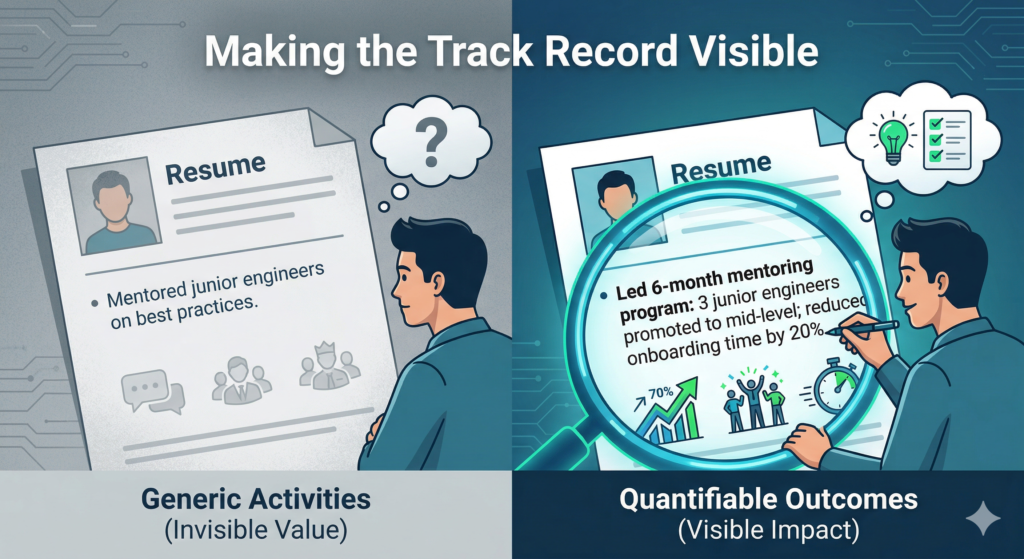
Mentoring generates career capital that does not automatically show up where hiring managers look. Documenting it matters.
On a CV, mentoring activity belongs under the relevant employer role, framed in outcome terms. “Mentored four junior cloud engineers through AWS Solutions Architect Associate preparation; three of four achieved the certification within six months” is specific and credible. “Established a bi-weekly cloud engineering knowledge-sharing programme; delivered twelve sessions to thirty-plus attendees across four teams covering Terraform module design, Kubernetes security hardening, and cost optimisation” demonstrates both consistency and organisational reach. Neither requires inventing results. Both require tracking what you are actually doing.
As discussed in the post on building a professional profile that reflects your true capability, engineering CVs that rely solely on project delivery and certification lists look identical to hundreds of other applications at Senior level. Mentoring and knowledge-sharing entries differentiate them structurally. They tell a Principal-level hiring panel that this candidate has already been operating, in part, at the next level.
On LinkedIn, the positioning is subtler but consequential. Adding “Technical Mentor” to a headline alongside cloud engineering specialisations costs nothing. Writing a reflective post about a lesson learned from a mentoring conversation, the kind of content that demonstrates active thinking about knowledge transfer rather than just technical output, creates inbound visibility from people hiring at Principal level. Recruiters filtering for Principal Cloud Engineers increasingly look for signals of leadership activity, not just technical keyword density.
For contractors, the case is additionally practical. A visible profile demonstrating community teaching and technical thought leadership supports an outside IR35 determination by evidencing genuine business independence. The contractor who runs external mentoring sessions, contributes to Cloud Native London talks, and publishes content is more clearly operating as an independent specialist than one whose profile consists exclusively of employment history.
Being Direct About the Ceiling
It is worth being direct about the limits of this argument. Mentoring alone does not produce a promotion to Principal. Technical depth remains the foundation. As explored in the post on why a fifth cloud certification rarely moves the needle, the ceiling on credential accumulation without demonstrable influence is well-documented. A Principal-level candidate whose only distinguishing activity is passing exams has not built the case the role requires.
Mentoring is the investment that converts existing technical capability into market value at the next level. Without the underlying technical depth, teaching others is not convincing. The honest version of the case is this: if you are a capable Senior Cloud Engineer who has been at that level for three or more years, the limiting factor in your progression to Principal is almost certainly not technical skill. It is the absence of visible evidence that you can operate at a scope larger than your own output. Mentoring builds that evidence more directly than anything else available, and unlike most career investments, it compounds: the engineers you develop become advocates, the sessions you deliver become reputation, and the track record you build becomes the material for a promotion conversation that would otherwise have no supporting evidence.
The investment to begin is modest. One mentee. Two hours a month. A commitment to keep notes on what you are doing and what the outcomes are. Six months of that, done consistently and documented properly, produces more differentiation in a Principal-level application than most engineers manage in two years of standard Senior-level work.
Next Steps
- Identify one person in your current team or network who would benefit from a structured monthly conversation and make a direct offer this week
- Create an ADPList mentor profile listing your cloud engineering specialisations and two or three specific areas where you can add value
- Review your company’s internal knowledge-sharing mechanisms and propose one session in the next four weeks on a topic you know well
- Document any existing informal teaching already happening in your current role: code reviews, onboarding support, design document reviews, and add it to your CV with outcome framing
- Look at the CNCF LFX Mentorship Programme opening dates if you want structured community involvement with open-source cloud-native projects
- Consider BCS membership if UK professional registration is a longer-term goal; the mentoring programme counts as formal CPD
Useful Links
- IT Jobs Watch: Cloud Engineer salary trends
- IT Jobs Watch: Principal Engineer salary trends
- Robert Half 2026 UK Technology Salary Guide
- CNCF LFX Mentorship Programme
- AWS Community Builders Programme
- BCS Career Mentoring Network
- ADPList: Free mentoring platform
- MentorCruise: Structured technical mentoring
- Cloud Native London meetup
- staffeng.com: Operating at Staff level