
Most cloud professionals make the employment model decision the wrong way. They see a £625/day contractor rate and assume it beats a £90,000 permanent salary. They see an AWS offer with RSUs and assume it beats anything on the market. They take the consultancy role because the Big 4 name looks good on a CV. Each of those decisions can be right, but made without understanding the full picture, each can cost you six figures over a decade. IT Jobs Watch data for early 2026 shows UK cloud architect day rates at a £625 median, which looks compelling until you subtract IR35 complexity, pension self-funding, and bench time. Meanwhile, a Principal Solutions Architect at AWS can earn £215,000 total compensation, but 80% of their initial equity grant vests in years three and four, creating a financial trap that makes switching costly precisely when it would be most valuable. The cloud employment model you choose shapes your career more than any single technology bet, any certification, or any platform specialism. This guide gives you the data to make it deliberately.
The problem is that most engineers evaluate employment models on a single dimension: today’s take-home pay. That approach misses five interconnected factors that compound over a career: total compensation including equity and pension, skill breadth versus depth trade-offs, progression ceiling by model, lifestyle realities versus the marketed version, and the long-term switching cost of each choice. A mid-level engineer at 3-6 years of experience who optimises for day rate today may find themselves with narrower skills, no pension, and limited leadership opportunities at 45. A senior engineer who joins a hyperscaler for the RSU premium may find themselves unable to leave at year two without forfeiting most of their equity. None of these outcomes are inevitable, but all of them are predictable. The four employment models available to UK cloud professionals (internal IT, consultancy, vendor, and contractor) produce fundamentally different career trajectories. Understanding the trade-offs at each career stage is the work this post does.
The clearest framework for evaluating employment models is to score them across five dimensions: financial return (immediate and long-term), skill development pace, progression ceiling, lifestyle sustainability, and switching optionality. No model wins on all five. The optimal choice depends on which dimensions matter most at your current career stage and what you are willing to trade against each other.
What the compensation data actually shows
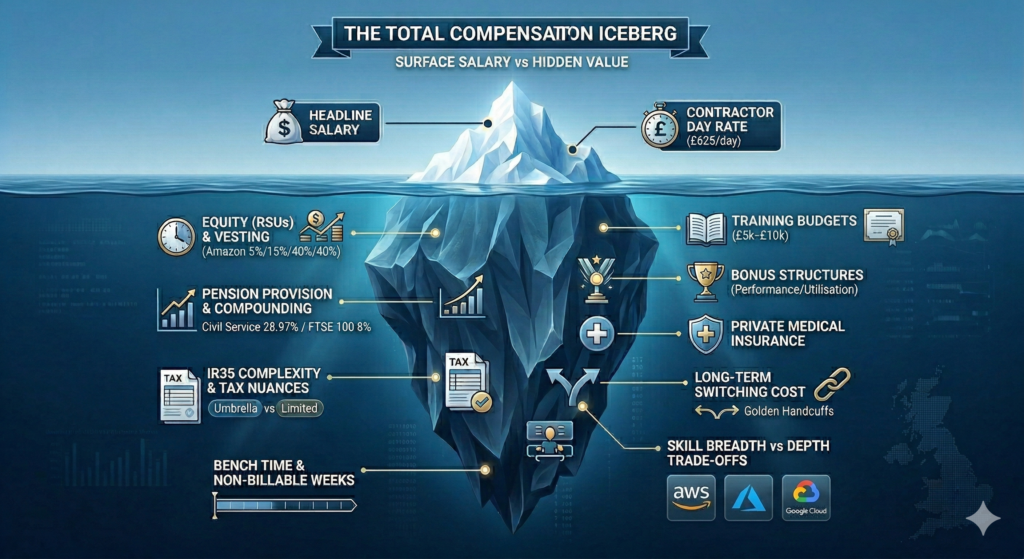
The salary gap between models is modest at mid-career and widens dramatically at senior levels. A cloud engineer with 3-5 years of experience earns roughly £60,000-£75,000 across internal IT, consultancy, and the lower vendor bands. The divergence accelerates from there.
Internal IT offers the most predictable compensation. IT Jobs Watch data (six months to March 2026) places the UK cloud engineer salary at a £70,000 median, with cloud architects at £85,000 nationally and £120,000-£140,000 in London at principal level. FTSE 100 employers typically contribute 5-10% pension, with financial services sometimes reaching 12-15%. Bonuses run at 5-15% for individual contributor roles, rising to 15-25% in banking. The total package at a major UK bank for a Senior Cloud Architect, including base, bonus, pension match and private medical, typically lands at £130,000-£160,000, which is more competitive than the headline salary suggests.
Consultancy pays less than most engineers expect at equivalent technical seniority. At the Big 4, a Senior Consultant with 4-6 years of experience earns £53,000-£68,000 base, a Manager £65,000-£85,000. Bonuses are utilisation-linked and modest at junior grades, running at roughly 3-10% of base depending on level and firm. Employer pension contributions run 3-6% at junior grades. The real consultancy compensation benefit is indirect: training budgets of £5,000-£10,000+ per head annually, certification funding, and an accelerated progression timeline that can move a capable engineer from Consultant to Manager in four years. The Big 4 name also confers external market value that compounds independently of salary.
Vendor roles (hyperscalers and mature SaaS companies) offer the highest ceiling by a significant margin. According to Levels.fyi UK data from January 2026, AWS Solutions Architects earn approximately £67,000 total compensation at L4, £120,000 at L5, £158,000 at L6, and £215,000+ at L7 (Principal). Google’s UK total compensation is higher still: a Senior (L5) Software Engineer earns a median of £222,000, with Staff (L6) reaching £250,000-£296,000. Microsoft sits between the two. The critical distinction is that 20-50% of vendor total compensation at senior levels is equity (RSUs), not cash, which introduces a different kind of risk and a powerful retention mechanism explored below.
Contracting looks lucrative on paper. A cloud architect billing £600/day for 46 working weeks grosses £138,000. The net picture is more complex. Outside IR35 through a limited company, take-home runs approximately £90,000-£96,000. Inside IR35 through an umbrella company (the more common status since the 2021 off-payroll reform), the same rate nets £72,000-£78,000, a gap of £15,000-£20,000 annually against outside-IR35 expectations. UK IT contract day rates have also softened: the cloud architect median fell 5.8% year-on-year to early 2026. Add 4-6 weeks of non-billable time per year, self-funded professional development, and professional indemnity insurance, and the net advantage over a well-compensated permanent role narrows substantially.
The pension gap most professionals ignore
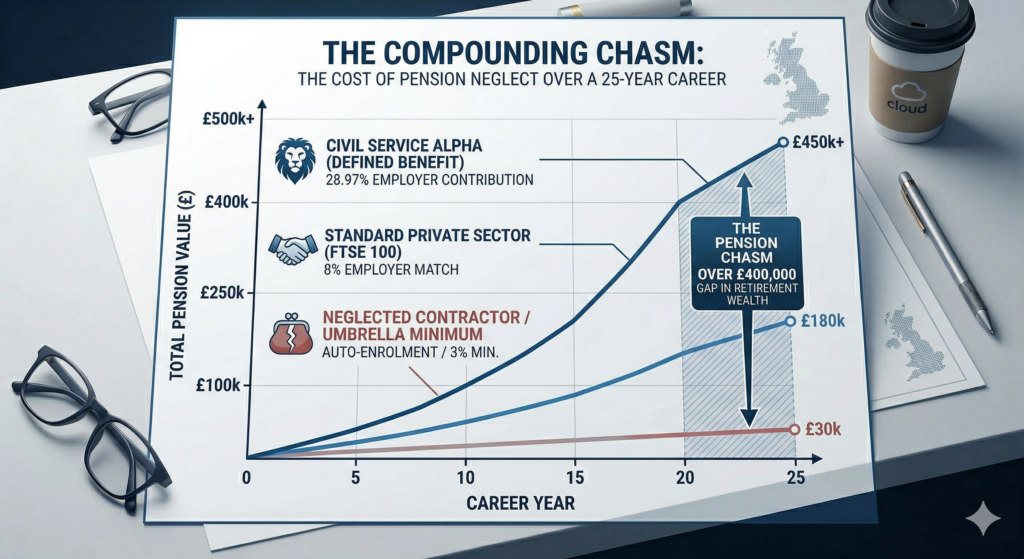
The single most underestimated factor in the employment model decision is long-term pension provision. Over a 25-year career, the difference between an employer contributing 8% and an employer contributing 3%, or contributing nothing, accumulates to £200,000 in nominal terms and £400,000-£500,000 with investment growth. That figure dwarfs most career decisions yet rarely features in how engineers evaluate job offers.
Public sector DDaT (Digital, Data, and Technology) roles carry an especially sharp pension advantage. The Civil Service Alpha scheme carries an employer contribution of 28.97% (confirmed for April 2024 to March 2027), while the NHS pension scheme runs at 23.7% employer. For a DDaT employee earning £50,000, the employer is contributing an additional £14,500 per year in pension value alone. These are career-average defined benefit schemes with CPI-linked revaluation, fundamentally different in security and value from private sector defined contribution arrangements. Against a reported £30,000 salary gap between government and commercial tech roles at senior levels, the pension provision narrows the total compensation gap considerably.
Contractors face the starkest pension position. Umbrella companies provide only the auto-enrolment minimum of 3% employer contribution, and limited company directors must self-fund entirely. The mechanisms are available: limited company directors can make employer pension contributions from pre-tax profits, but research consistently finds that only around 20% of self-employed people contribute meaningfully to private pensions. This is the contractor pension trap: the flexibility and autonomy are real, but the long-term financial cost of not addressing it is material. If you are contracting, treat pension as a mandatory operating expense and structure your limited company to contribute at the same effective rate as a FTSE 100 employer would.
How each model shapes your skills, and where it limits them
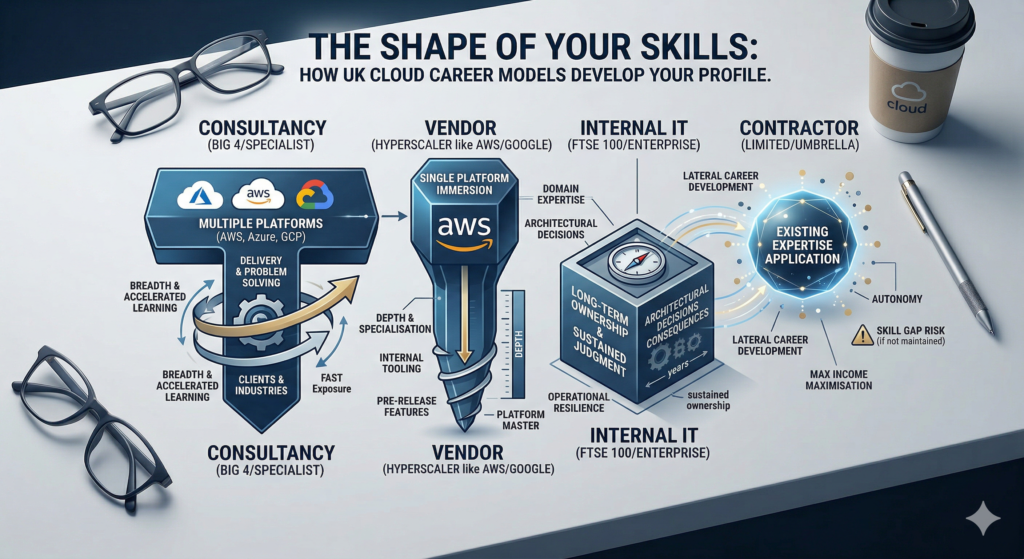
The employment model you choose produces a fundamentally different skill profile, and switching models later requires confronting the gaps it created.
Consultancy builds the broadest technical exposure fastest. Cloud consultants rotate across clients, industries, and platforms every 3-12 months, frequently touching AWS, Azure, and GCP within the first 2-3 years. The breadth is genuine and marketable. The limitation is depth: consultants are hired to deliver outcomes against a known solution approach, not to run production systems at scale and live with the consequences. Engineers who spend five years in consultancy typically have wide platform knowledge and strong delivery skills, but thinner operational expertise and less familiarity with the day-to-day engineering trade-offs of running infrastructure in anger.
Vendor roles produce the deepest single-platform specialisation available. Working at AWS means immersion in 200+ services, internal tooling, and pre-release features. The career portability concern is real but often overstated: core concepts (networking, IaC, CI/CD, security principles) transfer between platforms. What does not transfer cleanly is operational depth in specific tooling and APIs, and the recalibration typically takes 3-6 months of focused effort when switching hyperscalers. As explored in our post on multi-cloud architect versus single-cloud specialist career paths, the skill portability question is central to career-stage strategy. Vendor depth is most valuable when the market is hiring for that platform; multi-cloud breadth is most valuable when the market becomes uncertain or the platform falls from favour.
Internal IT develops domain expertise that neither consultancy nor vendors easily replicate: sustained ownership of architectural decisions and visibility of their consequences across years rather than projects. A cloud architect who has run a platform through three major incidents, two migrations, and a cost-reduction programme has judgment that cannot be fabricated. The limitation is breadth; internal teams work within their organisation’s technology choices, which may not reflect current market patterns.
Contractors typically enter with existing expertise and are hired to apply it, not to develop new skills. This model produces the most lateral career development through variety of client environments, but the least vertical development in any single direction. Contractors who do not actively and deliberately invest in new skills risk becoming expensive experts in patterns that are three to four years behind the market.
Access to emerging technology follows a clear hierarchy. Vendor engineers build services before public release. Partner-tier consultancies receive preview access and beta programmes. Enterprise internal IT teams access what their vendor relationship tier allows. Contractors depend entirely on their current client’s choices. If staying at the frontier of cloud capability matters to you, this hierarchy is a real consideration. Conversely, much of what enterprise clients need is implementation of well-established patterns, not cutting-edge services, and there is a significant market for engineers who know Terraform, networking, and security deeply rather than those chasing every new release. The certification maintenance strategy discussed in our strategic cloud certification guide is especially relevant for internal IT and contractor professionals who must manage their own development without the structured investment consultancies provide.
Progression ceilings and where most careers plateau
The uncomfortable reality is that most cloud engineering careers plateau at Senior regardless of employment model. The path beyond that level requires either explicit career management or a model that structurally supports advancement.
Internal IT offers the richest formal IC track at large employers: Senior, Lead, Staff, Principal, and (rarely) Distinguished or Fellow. According to LeadDev data, UK Staff Engineers earn a median of £92,262. Principal and Distinguished roles exist at FTSE 100 companies and major banks but are genuinely scarce. At mid-size organisations, the ceiling is often Senior or Lead with no formal track above, which means advancement requires moving laterally to a larger employer or switching model. Our cloud career progression guide covers how to plan this ladder deliberately, including the timeline and investment required at each level.
Consultancy offers the fastest title progression of any model, running from Analyst to Consultant to Senior Consultant to Manager in roughly eight years, but these titles map to different technical depth than engineering levels at hyperscalers. The Partner track is explicitly commercial and sales-oriented. The practical ceiling for an engineer who wants to remain primarily technical is Principal Consultant or Technical Director, typically with base compensation of £120,000-£160,000. Beyond that, the commercial component of the role increases whether or not you want it to.
Vendor IC tracks offer the highest potential ceiling but the most competitive promotion path. Amazon’s L7 (Principal) is frequently described by practitioners as “extremely difficult” to reach from internal promotion, with many Principals hired externally rather than promoted. The ceiling is there, but the path narrows sharply above Senior. For management tracks, consultancy backgrounds appear in an estimated 15-20% of UK CTO profiles, valued for commercial awareness and cross-industry perspective. Vendor alumni commonly become VP Engineering or CTO at companies deeply invested in their former employer’s platform, where operational rigour and product knowledge transfers well into leadership at AWS-native or Azure-native organisations.
Lifestyle realities versus the marketed version
Office and travel patterns have diverged sharply by model in 2025-2026. Amazon mandated five-day office attendance from January 2025, a policy opposed by 91% of employees in internal surveys. Microsoft and Google UK operate three-day hybrid baselines. Internal IT teams at most UK enterprises have settled on two to three days per week in the office. Contractors enjoy the greatest flexibility, with the majority working primarily remotely and fully remote contracts widely available.
Consultancy travel culture has transformed but not disappeared post-COVID. Pre-COVID Monday-to-Thursday weekly travel was the norm at Big 4. Client-site requirements have typically dropped to two to three days per week or every other week, but this is project-dependent, and the expectation of availability and responsiveness driven by 75-85% utilisation targets remains a defining feature of the model. The hours are real and should be factored into total lifestyle cost, not dismissed as manageable.
On-call burden falls most heavily on operational internal IT roles and vendor technical teams. AWS in particular carries significant on-call expectations for engineering positions. Consultants are rarely in formal on-call rotas unless in managed services engagements. Contractors can decline on-call unless it is explicitly contracted and separately compensated. This is a meaningful quality-of-life differentiator that rarely features in compensation comparisons.
Career switching patterns and the golden handcuffs problem
The most common transition in UK cloud careers is consultancy to internal IT, typically after 3-5 years. Ex-Big 4 cloud consultants moving into Head of Cloud, Enterprise Architect, or Cloud Transformation Lead roles frequently secure a 20-40% salary increase in their first industry move. The consultancy exit is well-understood, well-supported, and predictably rewarding. Average consultant tenure at Big 4 runs 2-4 years, and only 1-2% of analysts reach Partner.
Vendor to internal or startup is the second most common flow. AWS alumni are actively sought for their operational discipline. Google and Microsoft alumni are valued for product thinking and scale experience. These transitions typically lead to senior architecture or engineering leadership at companies invested in the former employer’s ecosystem.
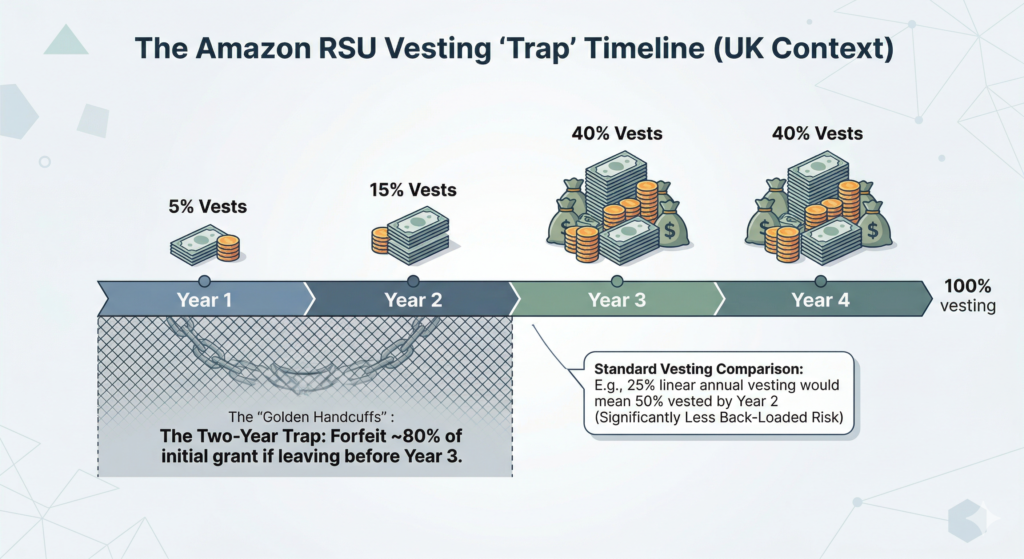
The most complex transition is vendor to anything else, because of how equity vesting is structured. Amazon’s back-loaded RSU schedule vests at 5%/15%/40%/40% over four years, meaning 80% of an initial grant vests in years three and four. Leaving before year three means forfeiting the bulk of that equity. Amazon offsets early-year shortfall with signing bonuses, but the structure creates what practitioners call the “two-year trap”: you are financially incentivised to stay, but years one and two are often the period when learning velocity is highest and the temptation to move is strongest. Microsoft and Google use 25%-per-year front-loaded vesting, which makes departure less financially painful at any point but still creates retention pressure through ongoing refresh grants. There is always unvested equity on the table, and when a four-year grant fully vests, total compensation can drop meaningfully without a compensating refresh.
The “permanent to contractor” move is common in the mid-30s and should be planned rather than reactive. Reed describes the typical pattern: learn the ropes as a permanent employee, switch to contracting to maximise income, return to permanent leadership in your 40s. The reverse, moving from contractor to permanent at senior leadership level, is harder because contractors lack the sustained delivery track records, people management experience, and internal political capital that permanent roles at leadership level require.
Choosing by career stage
At 3-6 years (making your first deliberate model choice):
If breadth and speed of learning are the priority, consultancy at a Big 4 or strong specialist firm gives you the widest exposure and a structured development path in the shortest time. The salary sacrifice relative to a well-paid permanent role is real but the career optionality purchased is high. If domain depth and stability matter more, particularly if you have a strong sector preference, a senior-track permanent role at a well-resourced enterprise gives you sustained ownership and the pension provision that consultancy and contracting cannot match at this stage. Contracting at 3-6 years is typically premature unless you have a niche specialism (specific platform, compliance framework, or migration pattern) that is in active demand.
At 7+ years (re-evaluating the current model):
The re-evaluation question is usually one of three: Is the current model still growing me? Is the compensation commensurate with market? Is the lifestyle sustainable? Senior engineers who have plateaued in internal IT and want to recalibrate market value often find that 2-3 years in consultancy or a vendor role resets their commercial positioning and salary expectations. Engineers who have spent their career in consultancy and want to go deeper in a single domain, building genuine operational expertise rather than project-level knowledge, typically find internal IT or a vendor role satisfying in ways consultancy cannot be. Contracting becomes a compelling option when you have a proven, in-demand specialism and the financial resilience to tolerate income volatility.
The decision framework in practice
The employment model that fits is the one that aligns your current priorities with what each model structurally delivers. Vendor roles offer the highest financial ceiling but require single-platform depth, tolerance for back-loaded equity, and (at AWS) full-time office attendance. Consultancy accelerates breadth and professional network at the cost of utilisation pressure and below-market compensation relative to technical depth. Internal IT provides sustainable compensation, domain expertise, and the pension provision that every other model requires you to replicate manually. Contracting maximises short-term earning potential and autonomy but demands disciplined pension self-funding, IR35 navigation, and tolerance for income volatility that compounds meaningfully over a career.
The factor that most consistently surprises professionals who have made these transitions is the pension gap. A 25-year difference between an 8% employer match and self-funding can exceed £400,000 in retirement wealth. That figure should appear in every employment model comparison alongside the headline salary. The employment model decision is not just about what you earn this year; it is a compounding choice whose consequences accumulate across decades.
Next steps
Regardless of your current model, three actions are worth taking this month. First, calculate your actual total compensation including pension, equity, and benefits. Most professionals know their base salary and overestimate how far it goes. Second, assess where your skills sit in the breadth-depth spectrum and whether the current model is moving you in the direction you intend. Third, if you are contracting or considering it, model the pension gap explicitly rather than assuming you will fund it later. The market conditions in UK cloud hiring in 2026 are strong enough that deliberate model choice is more valuable than it has ever been, and the cost of an unconsidered one is higher than most engineers realise.
Which model fits you right now?
The framework above covers a lot of ground. If you want a faster route to a starting point, work through the questions below. It takes about a minute and produces a recommendation with the key watch-outs for your situation. Use it as a prompt for further research, not a final answer.
Useful Links
- IT Jobs Watch: Cloud Engineer Salaries and Contractor Rates
- IT Jobs Watch: Cloud Architect Contractor Day Rates
- Levels.fyi: AWS Solutions Architect UK Compensation
- IPSE: IR35 Spotlight 2025
- IT Contracting: HMRC Joint PAYE Liability for Umbrella Companies (April 2026)
- Civil Service Pension Scheme: Employer Contribution Rates
- Crunch: IR35 Current Status 2025
- LeadDev: Staff, Principal, and Distinguished Engineers Explained
- PublicTechnology: £30K Gap Between Government and Commercial Tech Salaries