Most cloud engineers rule out retail tech within thirty seconds of seeing the salary bands. A senior cloud engineer at ASOS earns £70,000-£90,000 in London. The equivalent role at a Tier 1 investment bank pays £85,000-£110,000. That visible £15,000-£30,000 gap is real, it is documented across IT Jobs Watch, Hays, and Morgan McKinley, and it represents the single biggest reason why experienced engineers write off one of the UK’s most technically sophisticated engineering ecosystems without a second look.
What that comparison misses is what happens on the first Friday of November. When Black Friday traffic arrives, ASOS processes 167 million customer requests in 24 hours. Tesco’s payment infrastructure handles millions of concurrent transactions. Ocado’s warehouse robots receive positioning updates ten times per second while the e-commerce platform simultaneously scales to absorb demand spikes of ten to twenty times the normal load. The engineering problems involved in designing, testing, and operating those systems are not a step down from finance. In some respects, the peak-trading engineering challenge is harder. The difference is that in retail, it happens once a year at a known date rather than continuously at unpredictable intervals.
This playbook covers what cloud engineers in UK retail and e-commerce actually earn, which twelve employers run the most significant engineering operations, which technical skills command premiums, and how the career trajectory compares to the financial services path we explored in Part 2 of this series. The sector has invested over £2 billion annually in technology infrastructure, and the skills it demands are increasingly specific, increasingly valued, and not as widely understood as they should be.
What UK Retailers Actually Pay Cloud Engineers
Retail-specific cloud engineering salary data is scarce. The figures below are triangulated from IT Jobs Watch’s March 2026 benchmark (median £70,000 for cloud engineers across all UK sectors), Hays 2026 Salary Guide data, and Glassdoor listings from major retail employers, adjusted for the 10-15% retail sector discount that appears consistently across recruitment market sources.
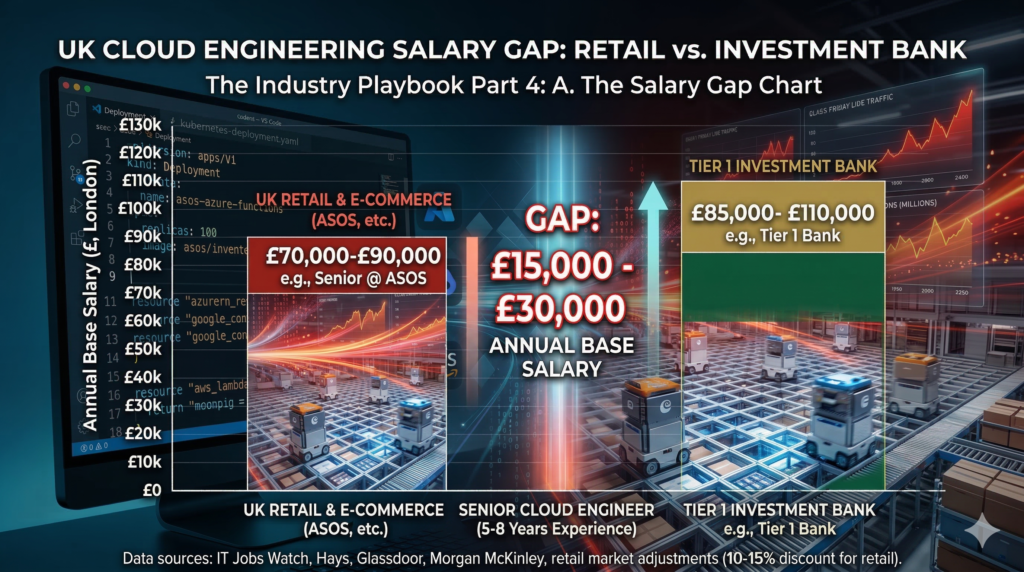
At mid-level, a cloud engineer with three to five years of experience earns £50,000-£65,000 in London, or £42,000-£55,000 outside the capital. Senior engineers with five to eight years of experience command £70,000-£90,000 in London and £58,000-£75,000 elsewhere. At staff or principal level, typically reached after eight to twelve years with demonstrated impact beyond individual delivery, the London range is £85,000-£110,000. Cloud architects with broad responsibility for platform decisions sit at £90,000-£120,000. Contract rates for equivalent seniority run £450-£600 per day at senior level and £600-£800 per day for architects and principal engineers.
These ranges are gross base salary. Most major retailers add 8-15% through bonuses. Hays reports that 65% of UK tech employers now include performance bonuses, and the largest retailers are reliable members of that group. Private healthcare is almost universal at senior levels. Pension contributions from employers typically range from 3-8%, which is materially better than the statutory minimum but below what investment banks offer. Equity and restricted stock units remain rare outside technology-native retailers like THG and Moonpig.
The salary gap relative to financial services is real, but it narrows considerably when total compensation is compared rather than headline base salary. It narrows further when factoring in the qualitative differences: better work-life balance outside peak trading, a consumer-facing product with genuine visibility, and broader technical scope across infrastructure, data engineering, ML, and in some cases robotics and IoT.
The Employers Running UK Retail Cloud Engineering
Azure dominates UK retail cloud adoption, though the landscape is more varied than that single fact suggests.
The largest Azure-committed retailers form a significant cluster. ASOS operates entirely on Azure under a confirmed five-year partnership, with approximately 800 engineers across 70 engineering teams building on Azure Functions, Cosmos DB, and Service Bus. The platform serves 23 million active customers with a “cloud first, Azure first” architectural constraint that has been in place since their full migration began in 2013. Marks and Spencer built its “Beam” data platform on Azure Synapse Analytics and Databricks, running 100+ applications through its Onyx web platform and actively hiring staff-level engineers for a petabyte-scale Data and AI Platform. Boots completed what was reportedly the largest SAP-to-Azure migration ever undertaken, covering 100 terabytes of data under a seven-year strategic Azure partnership with Walgreens Boots Alliance. Currys selected Accenture and Avanade to migrate 2,000+ servers and 200+ applications to Azure, with the programme targeting completion in 2025.
Two retailers have made Google Cloud their primary platform. John Lewis Partnership signed a £100 million, five-year GCP deal in 2023, building its Digital Platform on GKE with Terraform and GitLab CI. The platform handles £2.5 billion in annual online trade and delivers approximately 10,000 releases per year, a maturity level that few retailers in the UK can match. Auto Trader migrated its entire operation to GKE with an Istio service mesh and BigQuery analytics, serving 55 million cross-platform visits monthly with deployments taking under five minutes.
The largest grocers run multi-cloud or hybrid strategies. Ocado Technology operates its warehouse robotics on a private OpenStack cloud while using AWS for e-commerce microservices and GCP for analytics through BigQuery and Looker, employing 2,700 technologists across 13 retail partners globally. Tesco runs a hybrid strategy across Azure and AWS with approximately £2 billion in annual ICT spend. Sainsbury’s combines Azure for platform engineering, AWS for its groceries-online PaaS, and GCP for customer analytics across 1.2 billion transactions per year spanning the Argos, Nectar, Tu Clothing, and Habitat brands. THG operates its own infrastructure company, Ingenuity Cloud Services, across 35+ global data centres, and recently partnered with Google Cloud to bring Vertex AI into its commerce platform. Moonpig runs fully on AWS, using Lambda, SageMaker, and CloudFront to handle 300+ orders per minute at peak, and has replatformed to composable commerce on commercetools.
The Technical Skills That Set Retail Cloud Engineers Apart
The skills that command premiums in retail are distinct from what general cloud engineering roles emphasise, and understanding that distinction is the difference between positioning yourself as a generic hire and positioning yourself as a specialist.
Composable commerce and MACH architecture is the sector’s defining architectural shift of the past three years. MACH stands for Microservices, API-first, Cloud-native, Headless, and it represents the move away from monolithic commerce platforms like SAP Commerce Cloud or Magento towards orchestrated best-of-breed services. Moonpig and John Lewis have adopted commercetools for headless commerce. M&S uses Bloomreach for personalisation. The supporting tech stack for these architectures runs on TypeScript, React, Next.js, GraphQL, Apache Kafka, and event-driven patterns using AWS EventBridge or Azure Service Bus. A principal software engineer role at a major UK retailer was recently advertised at up to £90,000 plus bonus with MACH and event-driven architecture listed as the primary skill requirement. Familiarity with the MACH Alliance ecosystem and composable architecture patterns now functions as informal credentialing at interview, even without formal certification.
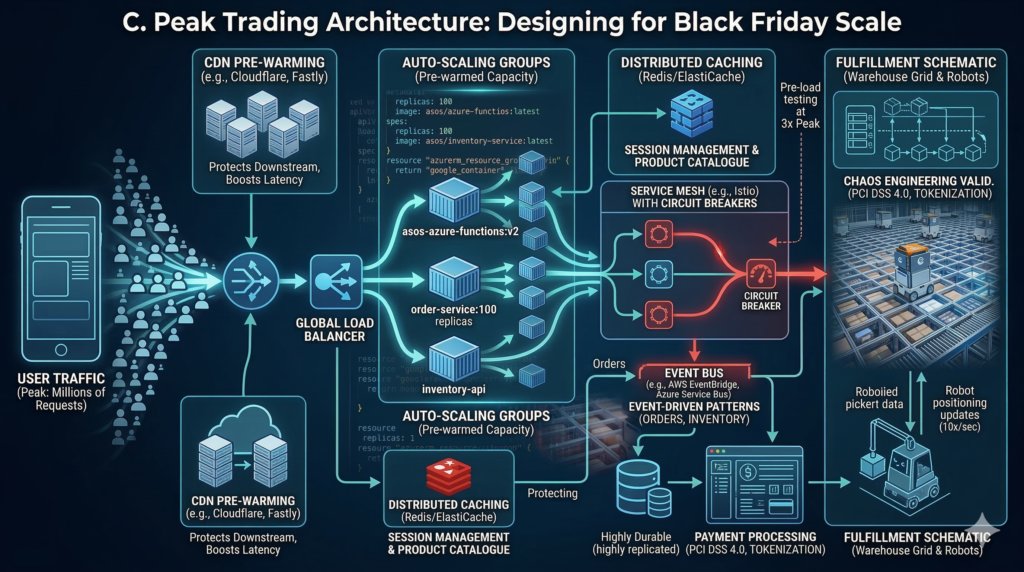
Peak-trading engineering is the skill that most clearly distinguishes retail from any other sector. In 2015, one in five UK retail websites crashed on Black Friday under load. Modern retailers have responded by building engineering practices specifically around seasonal scale. Load testing at three times expected peak is considered the minimum, not a ceiling. The standard toolkit includes auto-scaling groups with pre-warmed capacity, CDN pre-warming across Cloudflare, Fastly, or Akamai, Redis and ElastiCache for session management, circuit breakers to protect downstream services, and chaos engineering practices to validate failure modes before November arrives. According to industry data, 77% of retailers implement code freezes of one to two weeks before Black Friday and through the Christmas period. Engineers who can design, test, and operate platforms through these events and document what they learned are carrying a career asset that is difficult to replicate quickly.
Data platform engineering for personalisation and retail media has grown rapidly as an employer priority. Tesco’s Clubcard programme covers 22-23 million UK households and delivers over one billion personalised offers per week through the dunnhumby-powered analytics infrastructure. M&S is actively building a petabyte-scale data platform on Azure. The capability stack spans Snowflake, Databricks, BigQuery, dbt, and model deployment via SageMaker or Vertex AI. Retail media networks, where retailers monetise their first-party data by selling advertising access to brands, are an emerging engineering priority: Tesco’s partnership with LiveRamp and The Trade Desk drove a 60% year-on-year increase in first-party addressable media investment. Cloud engineers who can bridge the infrastructure and data layers are well-positioned.
Payment infrastructure and PCI DSS 4.0 compliance rounds out the retailer-specific skill premium. PCI DSS 4.0 became fully mandatory in March 2025, and it is substantially more demanding than its predecessor. The standard explicitly accommodates cloud-native security controls, mapping physical firewall requirements to AWS Security Groups, Azure NSGs, and GCP firewall rules. New requirements include MFA for all access to cardholder data environments, automated detection of unauthorised payment-page script changes targeting Magecart-style card-skimming attacks, and continuous monitoring with twelve months of audit log retention. Engineers who understand tokenisation architecture, network segmentation via VPCs, and integration with payment providers like Stripe, Adyen, or Worldpay carry a measurable premium at interview. Buy-now-pay-later also comes under FCA regulation from 15 July 2026, adding checkout integration complexity for any retailer using Klarna, Clearpay, or similar services.
Certifications and Their ROI in Retail
The Hays 2026 Salary Guide reports that cloud certifications generally add 18% to earnings, with AWS Solutions Architect Professional and CISSP commanding uplifts of up to 25%. IT Jobs Watch data shows Azure certifications appearing in 6.72% of cloud engineer job advertisements and AWS in 6.13%, broadly reflecting the Azure dominance in UK retail.
The optimal certification stack for a retail cloud career is clear. Your primary cloud certification should match your target employer: Azure Solutions Architect Expert for the Azure cluster (ASOS, M&S, Boots, Currys), GCP Professional Cloud Architect for John Lewis or Ocado, where the scarcity premium is real given fewer certified professionals, and AWS Solutions Architect Professional for Moonpig or the AWS-heavy parts of Sainsbury’s and Tesco’s estates. The Certified Kubernetes Administrator carries universal value across all UK retail cloud roles, with holders earning 18-25% more than uncertified peers in platform engineering positions. As discussed in our guide to Kubernetes certification career value, the CKS (Certified Kubernetes Security Specialist) commands the highest premium of the three, at 25-35% above general positions. The HashiCorp Terraform Associate is arguably the highest-ROI certification in the retail stack given the exam costs only $70 and Terraform appears in virtually every platform engineering job listing from John Lewis to Sainsbury’s.
The certification maintenance burden is worth calculating before committing. AWS, Azure, and GCP certifications have different renewal timelines and costs, and holding multiple certifications across platforms can become expensive in time if not managed strategically. Our certification maintenance strategy guide covers how to manage a multi-vendor portfolio without letting the maintenance overhead consume your development time.
Career Progression and How It Compares to Financial Services
The retail tech career path is less formalised than financial services but offers meaningful upward mobility for engineers willing to build domain expertise alongside technical depth.
A mid-level cloud engineer (£50,000-£65,000) typically progresses to senior in three to four years in retail, which is broadly comparable to financial services timelines. The divergence becomes visible above senior level. Retail has fewer staff and principal-level positions proportionally, reflecting flatter team structures and smaller overall engineering organisations compared to major banks. ASOS Glassdoor reviews consistently note that promotions slow after a certain level. Financial services offers more formalised progression frameworks.
Where retail holds an advantage for career breadth is in the scope of problems engineers encounter. An engineer at ASOS or Ocado works across the full stack of infrastructure, microservices, data engineering, ML, and increasingly IoT, within a product context where their work is immediately visible to millions of consumers. A cloud engineer at a Tier 1 bank often works in a much narrower domain, governed by extensive change management processes and regulatory constraints that can slow both delivery and learning. For engineers who want to develop into architects or CTOs, the breadth of retail experience is valuable. For those targeting maximum compensation at senior individual contributor level, financial services remains the higher-paying path.
Consultancy offers a third option worth considering for engineers who want structured career progression alongside retail clients. A senior consultant working across retail transformation programmes earns £70,000-£100,000 base with clearer promotion frameworks than internal retail roles, and accumulates exposure across multiple retailers’ architectures simultaneously. The trade-off is a client-facing workload and less direct ownership of product outcomes.
For engineers currently in retail tech, the most productive 12-month investment in career progression is a combination of a principal cloud certification, CKA, and demonstrable peak-trading engineering experience documented through case studies or public talks. This combination positions an engineer to move up internally or to command the upper end of the senior salary range when moving to a new employer.
The Regulatory Architecture Engineers Need to Understand
Understanding the compliance landscape is not optional for retail cloud engineers working on payment, customer data, or checkout systems. It shapes architectural decisions, audit requirements, and the value you bring in design conversations.
PCI DSS 4.0’s March 2025 full enforcement date means cardholder data environment design is now a live concern for any engineer touching payment infrastructure. The key architectural implication is scope management: every resource that touches cardholder data expands the CDE boundary and increases audit costs. Tokenisation at the point of capture, rigorous network segmentation via VPCs, and strong MFA controls are not optional extras but architectural requirements. Engineers who can design with scope minimisation in mind and explain the rationale to product and commercial stakeholders carry disproportionate value in retail engineering teams.
UK GDPR’s retail implications extend well beyond cookie banners. The Age Appropriate Design Code imposes heightened protections for services likely to be accessed by under-18s, which in practice covers almost every consumer retailer. The right to erasure demands architectural capability to purge customer data comprehensively across every platform, including backups and analytics stores. The Digital Markets, Competition and Consumers Act 2024 introduces enforceable bans on fake reviews, drip pricing restrictions, and subscription cancellation requirements arriving in Spring 2026, all of which translate into technical delivery requirements that engineering teams need to anticipate.
Getting Into Retail Cloud Engineering: What the Interviews Are Like
Retail tech interviews are significantly less gruelling than financial services or FAANG, and that is not a criticism. Glassdoor data puts ASOS and Ocado interview difficulty at 2.8-2.9 out of 5, compared to a typical FAANG rating of 3.5-4.0. ASOS uses a technical interview with two senior engineers followed by a practical coding challenge focused on building features from scratch, with no AI tools permitted during the session. Ocado runs a Codility assessment of three questions over ninety minutes, followed by an assessment day that includes pair programming, architecture discussion, and a cultural interview. Some candidates report warehouse tours at Hatfield HQ as part of the senior hiring process, which gives a useful grounding in the operational context the technology supports.
The system design component of retail cloud interviews has specific patterns worth preparing for. You should expect questions around auto-scaling for peak traffic events, distributed caching strategies for product catalogue and session data, event-driven architectures for order management, and payment processing reliability under load. Demonstrating understanding of the Black Friday engineering challenge, even in broad terms, signals domain credibility that generic cloud engineering candidates often lack.
CVs and LinkedIn profiles for retail cloud roles benefit from quantified outcomes that are consumer-facing where possible: the scale of systems operated, traffic volumes supported, cost savings delivered through infrastructure optimisation, and participation in peak trading events.
Key Takeaways
UK retail cloud engineering pays less than financial services at every seniority level, and engineers who have accurately quantified that gap and still choose retail are making a rational decision, not an uninformed one. The sector offers a technically sophisticated environment, particularly at employers like Ocado, ASOS, and John Lewis, where the architecture challenges rival anything available in finance. Azure expertise applies directly to the majority of the employer landscape. CKA and Terraform Associate are the certifications with the most consistent value across employers. Peak-trading engineering capability is the differentiating skill that retail cloud roles reward and that engineers from other sectors rarely bring without deliberate development.
For engineers who want consumer product visibility, seasonal rather than year-round intensity, broad technical scope, and a sector where the MACH architecture revolution is actively reshaping engineering roles, UK retail tech in 2026 is one of the more interesting career destinations available.
Useful Links
- IT Jobs Watch – Cloud Engineer UK Salary Data
- ASOS Tech Blog – Engineering at ASOS Scale
- Google Cloud – Auto Trader UK Case Study
- Google Cloud – Ocado Case Study
- CNCF – Ocado Case Study
- M&S Engineering Blog
- Sainsbury’s Engineering Blog
- PCI DSS 4.0 Overview – PCI Security Standards Council
- FCA – BNPL Regulation Confirmed