
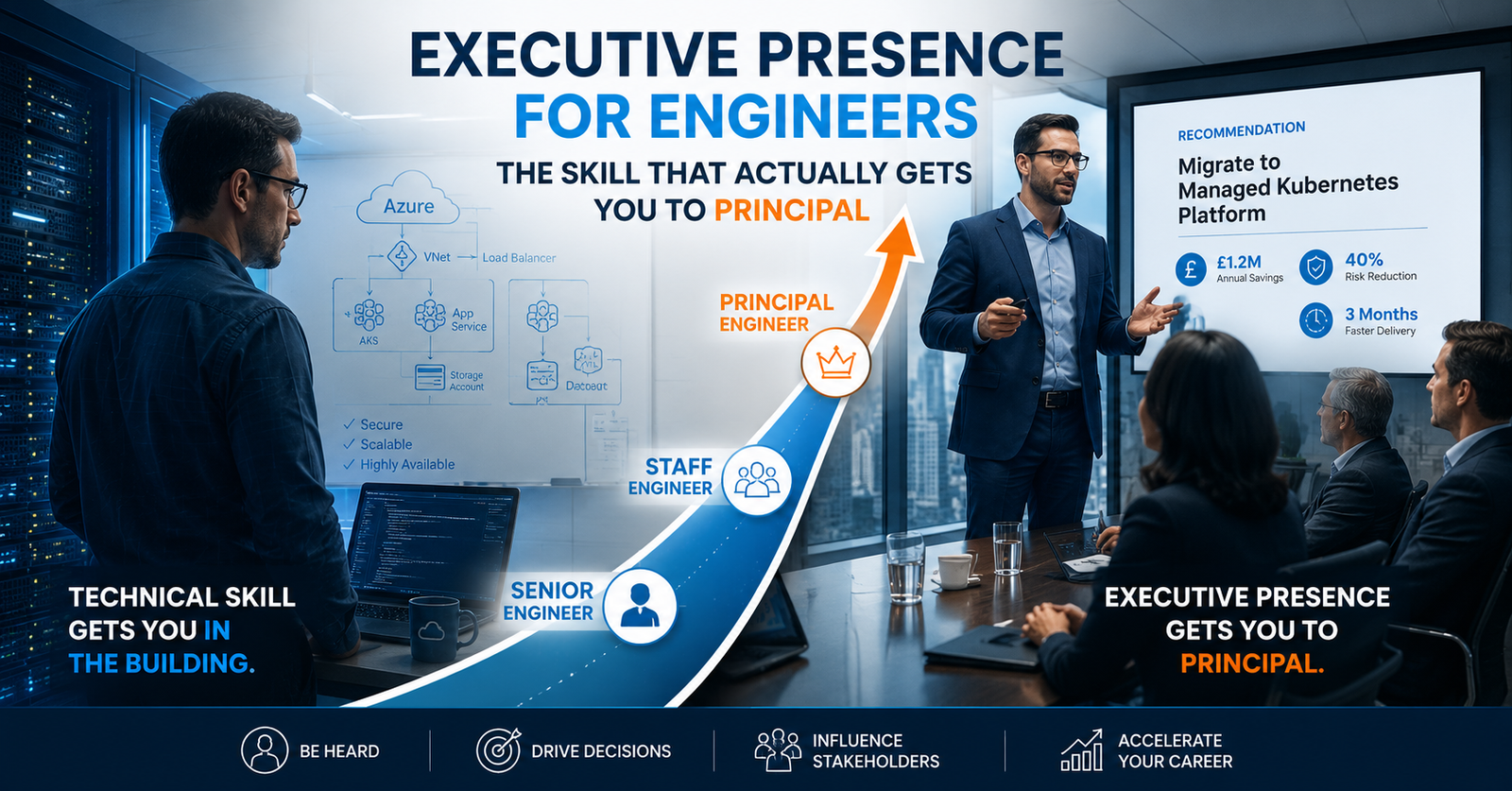
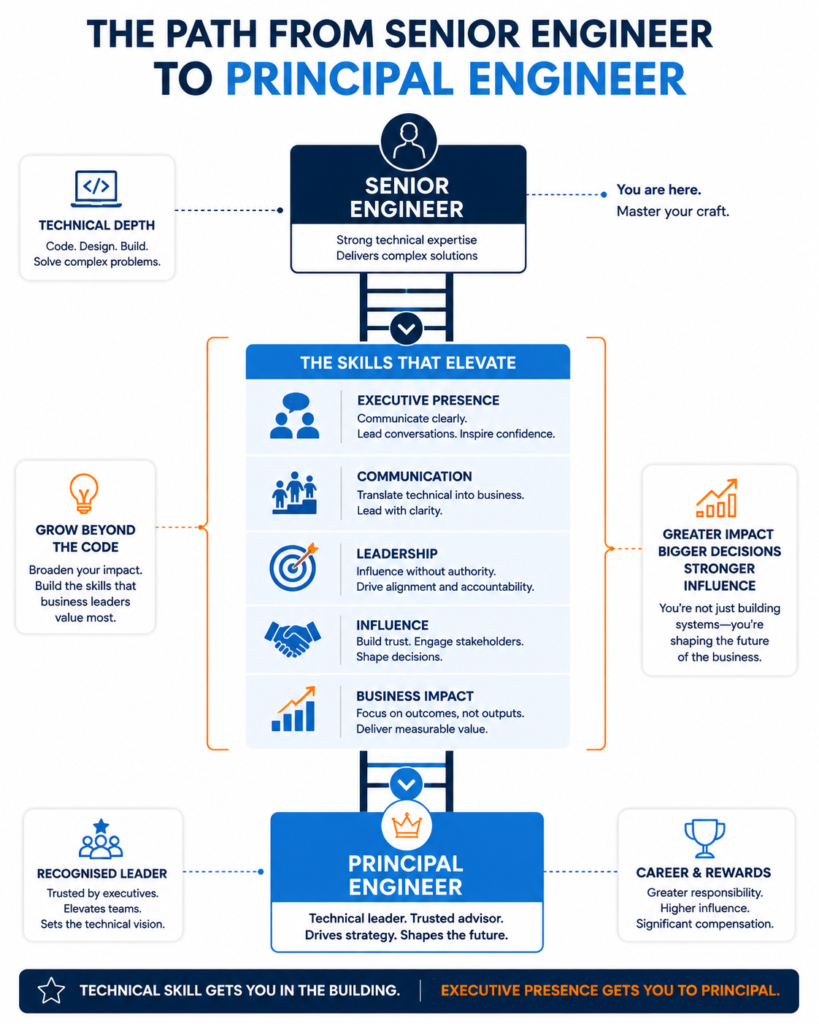
A Senior cloud engineer can hold five certifications, ship flawless infrastructure for three years, and still watch a colleague with a thinner CV get promoted to Principal first. The difference usually shows up in a room the more qualified engineer has rarely been invited into: the steering committee. Employers price this openly. On IT Jobs Watch, adverts for Principal Engineer cite “Technical Leadership” in 21.70% of listings and interpersonal or communication skills in around 10%, both close to double the rate seen in Senior Software Engineer adverts. Executive presence for engineers is not a soft add-on to a promotion case. For most Senior engineers sitting around £90,000 to £100,000, it is the specific gap between where they are and where the next 20 to 30% sits.
Most Senior engineers prepare for their first steering committee update the way they would prepare for a design review: maximum technical depth, build steadily to a conclusion, defend every decision if challenged. It is almost exactly the wrong instinct. Practitioners who sit in these rooms every week describe the same failure pattern, an engineer gets five slides into a thirty-slide deck before a VP interrupts asking what they are actually recommending, and the meeting derails from there. Will Larson, who has coached this transition at Stripe, Uber and Calm, notes that presenting a problem with no proposed answer quietly makes an executive wonder whether they need a more senior person in the room instead. Get this wrong two or three times and a manager quietly stops offering the slot, not out of malice, but because the meeting has limited time and a track record of derailment costs the whole team credibility.
The fix is not charisma. It is structure borrowed from management consulting: lead with the recommendation, then the supporting argument, then the detail only if asked. One Senior engineer who rewrote a stalled infrastructure business case around a single opening sentence stating the ask went from being talked over in steering committee to running the monthly platform update solo within eight months, a shift that lined up with her move from £92,000 to £128,000 at promotion. What follows sets out the two frameworks worth learning, the staged way to get exposure to this setting without being thrown in cold, and the roadmap from first five-minute slot to trusted voice in the room.
The Principal Pay Gap Nobody Puts in a Job Description
IT Jobs Watch does not recognise “Staff Engineer” as a normalised UK job title, so Principal Engineer is the closest UK proxy for the top individual contributor rung, and the numbers are worth sitting with. Over the six months to 1 August 2026, the site places the median UK Principal Engineer salary at £90,000, rising to £100,000 in London and £85,000 outside it, up around 20% year on year. Senior Software Engineer sits at £75,000 nationally over the same window. That £15,000 median gap alone would be worth chasing, but it understates the real jump, since these are UK-wide medians blending sectors as different as aerospace, defence and public sector cloud work. In London fintech and scale-up environments specifically, Staff and Principal-level cloud engineers routinely land in the £130,000 to £180,000-plus range, and that is where the shift in required skills becomes impossible to ignore.
Look at what the adverts themselves ask for. “Technical Leadership” appears in 21.70% of Principal Engineer adverts against roughly 4.55% for Senior Software Engineer, a near five-fold jump. “Social Skills (Interpersonal, Communication)” appears in around 10% of Principal adverts against 5.72% for Senior. “Mentoring” appears in 13.58% of Principal adverts. None of that is about writing better Terraform. Hays’ UK career advice team makes a similar point in plainer language, arguing that professionals who combine technical depth with leadership, communication and stakeholder influence are best placed to see a pay rise, while technical skill alone increasingly plateaus. At the economy-wide level, the Skills Builder Partnership’s Essential Skills Tracker, produced with the CIPD, Edge Foundation and KPMG, put the annual cost of the UK’s low essential skills, including communication, at £22.2 billion in 2022, comparable to the cost of low numeracy. The Principal pay gap is not hidden. It is priced into the advert. Most engineers simply never learn to read that part of it.
Two Frameworks Executives Already Expect You to Use
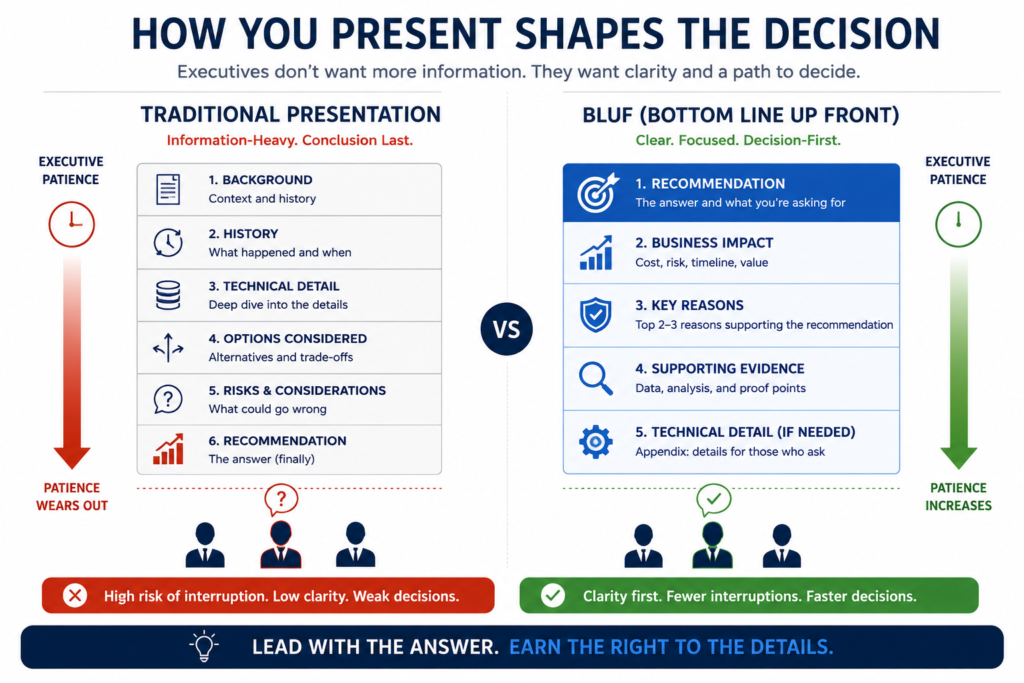
The good news is that the skill executives are implicitly grading for is learnable and has a name. Barbara Minto, the first woman McKinsey hired directly from business school, built what became known as the Pyramid Principle: state the conclusion first, support it with a small number of mutually exclusive, collectively exhaustive arguments, and hold the detail in reserve. The military shorthand for the same instinct is BLUF, bottom line up front. Will Larson, who wrote the widely read Staff Engineer and has presented to executive rooms across three companies, recommends every engineer adopt at minimum a lighter version of this called SCQA: state the Situation, name the Complication that has changed it, ask the Question that follows, then give the Answer. Only if feedback says your updates are hard to follow should you reach for the fuller Pyramid structure.
The distinction matters more in a live steering committee than it ever does in a written document, because a written business case can build patiently to its conclusion and still be read in full. A spoken update rarely gets that luxury. If your recommendation is sitting on slide 23 of a 30-slide deck, you are gambling that nobody interrupts before you get there, and in a room full of VPs with their own agendas, somebody always does. Leading with BLUF removes that risk entirely. Whatever else gets asked, the room already has your answer.
This is not about compressing your thinking, it is about resequencing it. The technical reasoning that justified a platform migration or a security remediation does not disappear under BLUF, it moves from the opening to the appendix. State what you are recommending and what it costs or saves in the first sentence. Follow with the two or three reasons that matter to this specific audience, chosen for what a CFO, a COO or a CISO in the room actually cares about, not for technical completeness. Keep the architecture diagram and the full risk register ready, but only bring them out if asked. Practised well, this structure does something else useful too: it signals, before you have said anything technical at all, that you already know where the conversation is going to end up. That is most of what executive presence looks like from the outside.
From Peer Reviews to Steering Committees: What Actually Changes
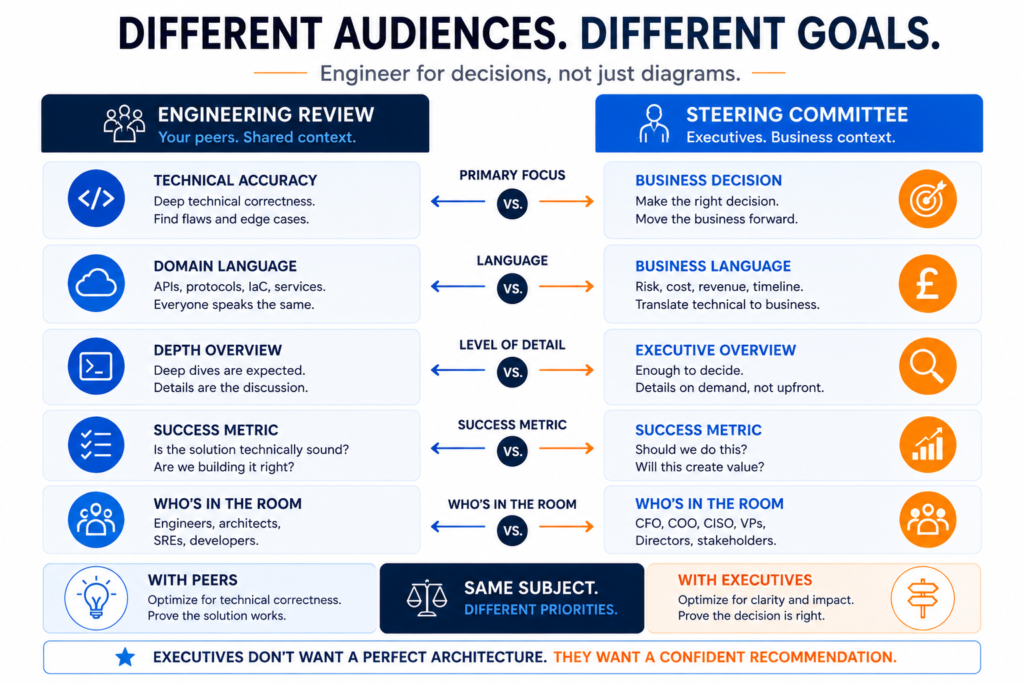
Presenting to fellow engineers and presenting to a VP who does not write code are different skills wearing the same word. With peers, you are optimising for technical correctness, since the room shares your vocabulary, catches errors in your reasoning, and rewards precision. With a non-technical steering committee, you are optimising for a decision, and the room is translating everything you say into cost, risk, revenue or time whether you frame it that way or not. A question that sounds like an attack, such as why something took three sprints, is usually a request for that translation layer back to a decision the executive owns, not a challenge to your competence. LeadDev’s distinction between in-team and out-group communication captures this well: with peers there is no need to simplify context, while with stakeholders the technicality and background you can assume varies enormously and has to be judged afresh each time.
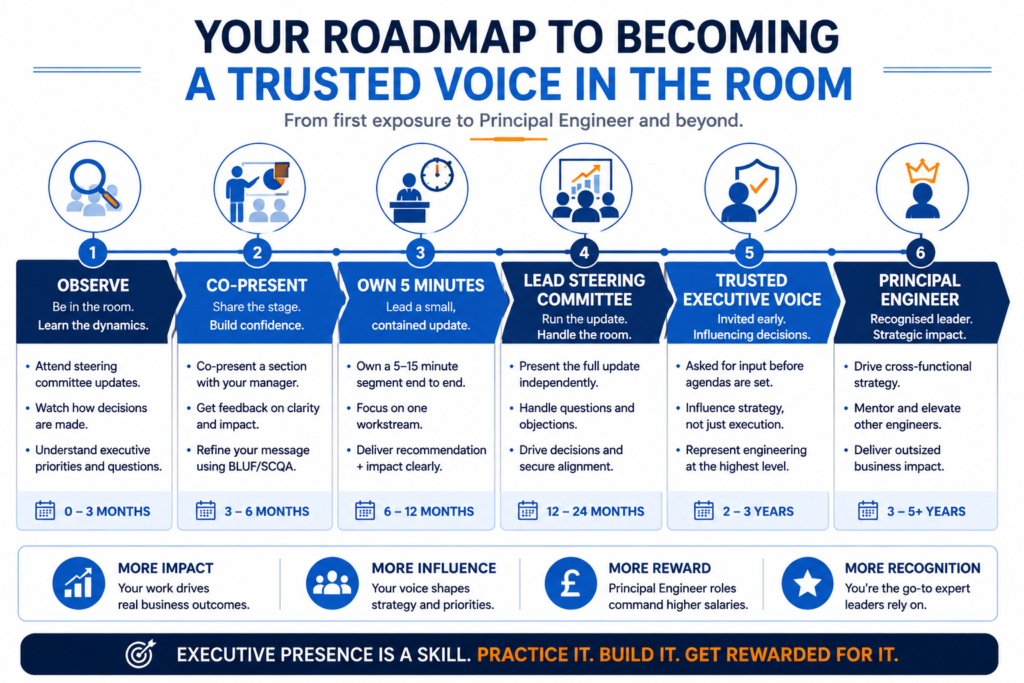
The practical shift most Senior engineers need is not more polish, it is more deliberate exposure, built in stages rather than attempted cold. The first stage is simply being in the room without presenting, sitting in on a manager’s steering committee update, watching how questions actually get asked and answered, noticing which slides get skipped entirely. The second stage is co-presenting, where a manager takes the overall framing and hands the engineer two or three minutes on their own section, the lowest-risk way to get a first data point on how you perform under that kind of scrutiny. The third stage is owning a small, contained update end to end, perhaps five minutes on an existing agenda covering a single workstream, rather than the full quarterly review. GitHub’s engineering organisation runs something close to this deliberately, a weekly executive availability review where, according to engineer Ross Brodbeck, every engineering VP is gathered in the room, and for many presenters it is the first time they have stood in front of that audience at all. The fourth stage, and the one that actually correlates with the Principal-level skill mix on IT Jobs Watch, is running the update solo and fielding unplanned follow-up questions without a script, the moment where the skill covered in our piece on performing under pressure stops being theoretical and starts being tested live, in front of the people who decide your next promotion.
The salary and portfolio evidence for treating this seriously is not abstract. Nash Squared’s Digital Leadership Report 2025, based on responses from 924 UK technology leaders among a global sample of over 2,000, found that 68% of technology leaders now sit on their organisation’s operational board or executive committee, the highest proportion recorded since 2017. That is where technical influence increasingly gets exercised, and it means Senior engineers who never get comfortable in that room are cutting themselves off from where their own function’s decisions actually get made, not just from a promotion tickbox. The portfolio evidence worth building through each of these four stages is concrete and collectable: a record of every steering committee slot held, what the ask was, what the outcome was, and any feedback from the executive stakeholders in the room. That evidence is exactly what a promotion panel, most of whom have never seen your code, can actually assess. A pull request history proves you can build the system. A track record of steering committee updates that led to funded decisions proves you can be trusted to represent it.
Where this tends to go wrong is when engineers try to skip straight to the fourth stage, walking into their first unaccompanied VP update with no prior exposure and treating it like a bigger version of a sprint review. The frameworks above help considerably, but they do not substitute for having watched the room work a handful of times first.
The Business and Leadership Skills Around the Presentation
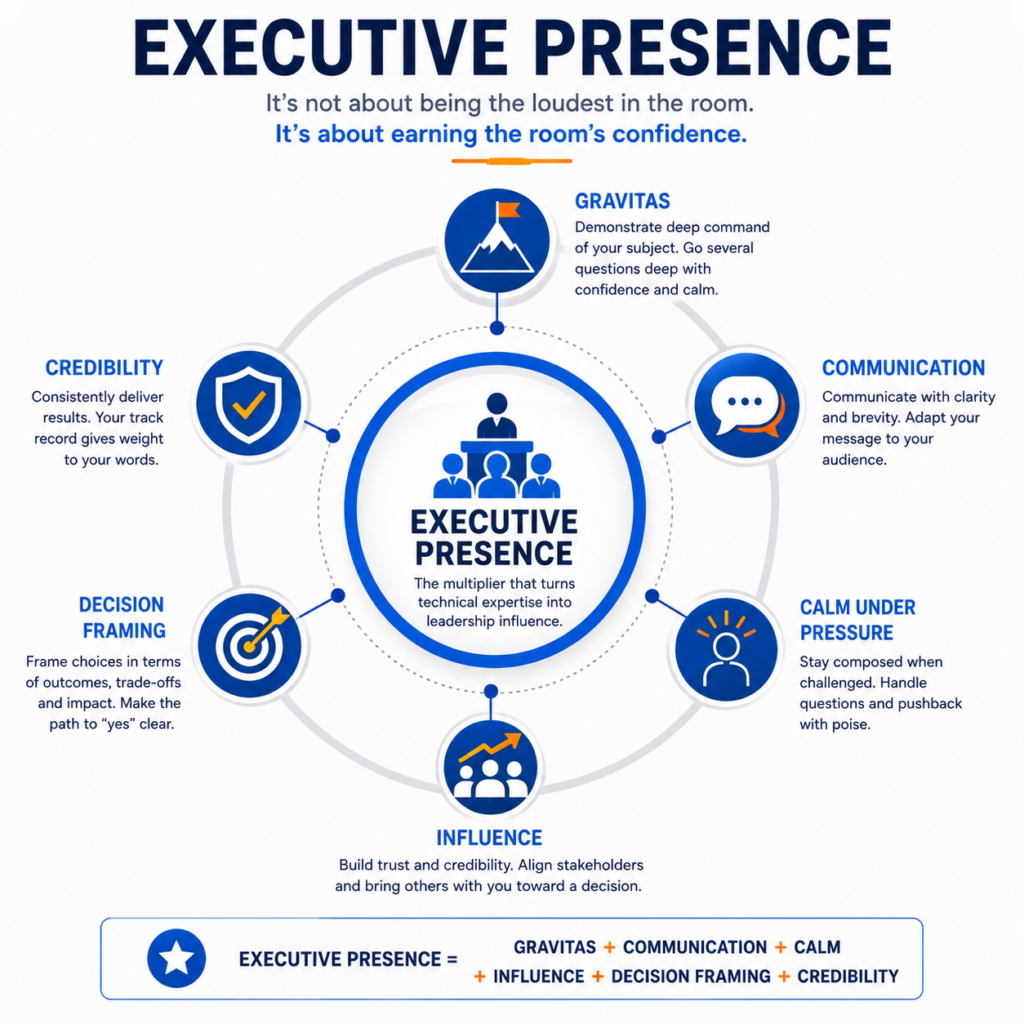
Executive presence itself has been studied directly, separate from the mechanics of any one presentation. Research from Sylvia Ann Hewlett and Coqual, formerly the Center for Talent Innovation, surveyed several thousand professionals and put executive presence at roughly 26% of what senior leaders say actually drives the next promotion decision. Broken down further, in a survey of 268 senior executives, 67% said gravitas, essentially demonstrating deep command of your subject and the ability to go several questions deep under pressure, mattered more than communication style, which took 28% of the vote, or appearance, which took a mere 5%. Two things are worth taking from this rather than over-reading it. First, this is US and global research, not UK-specific, and the concept itself lacks a single validated definition, so the 26% is best treated as a tiebreaker rather than the whole story: roughly three-quarters of a promotion decision still rests on subject-matter depth, delivery record and organisational relationships. Second, gravitas outweighing polish two to one is welcome news for engineers who assume presence means becoming a different kind of person. It does not. It means being able to answer the sixth follow-up question as calmly as the first.
That calm is easier to build in a room that already has some psychological safety in it, and the mechanics of the Q&A itself matter as much as the slide structure. Google’s Project Aristotle, which analysed over 180 internal teams across more than 250 attributes, found psychological safety, defined by Amy Edmondson as a shared belief that the team is safe for interpersonal risk-taking, was the single most important factor in team effectiveness, ahead of dependability, structure, meaning or impact. In a steering committee context this cuts both ways: an engineer who treats every hard question as a threat to be defended against signals the opposite of safety, while a room that treats every uncertain answer as a trap trains its presenters to hide problems rather than surface them early, which helps nobody. The stronger move under a sceptical or hostile question is to depersonalise it, respond to the content rather than the tone, and if pushback continues, name it directly: noting that there seem to be some concerns and asking what is driving them resets the exchange from confrontation to problem-solving.
None of this develops in isolation from how you handle the people around you day to day. The same IT Jobs Watch data that shows Technical Leadership and communication rising sharply between Senior and Principal adverts also shows Mentoring appearing in 13.58% of Principal listings, and the connection is not a coincidence. Engineers who have already spent time explaining decisions to junior colleagues, the discipline covered in our piece on technical mentoring as career capital, arrive at their first steering committee already practised at reading a room’s actual level of understanding and adjusting on the fly. That is the same underlying skill, aimed at a different audience with a different vocabulary but the same need for translation.
Your Roadmap from First Slot to Trusted Voice in the Room
The path from first exposure to being a trusted voice at the top table follows a reasonably predictable shape, and treating it as a roadmap rather than a hope makes it far more likely to happen on a useful timeline.
In the first three to six months, the goal is exposure and structure. Ask your manager directly for a co-presenting slot on the next steering committee update, or for five minutes on an existing agenda to cover a single workstream, rather than waiting to be offered the whole session. Rewrite your next status update using BLUF: state the ask in the first sentence, then the two or three reasons that matter to that audience, with everything else held in reserve. If a non-technical colleague can accurately repeat your recommendation back after hearing it once, the structure is working.
Over six to twelve months, the target shifts from structure to range. You should be able to hold your own five to fifteen-minute slot without a manager present, handle at least one truly unplanned follow-up question without freezing, and have started pre-aligning with one or two attending stakeholders before the meeting itself, the practice Will Larson calls nemawashi, sending an early draft to someone in the room and asking what they would change before you are in front of everyone. By this stage you should also be able to point to two or three specific presentations where a decision was actually made in the room as a direct result of your update, not just where you happened to be present.
In the one to three-year range, the shift is from presenting well to being asked for, invited into discussions before the formal agenda is set because your read of the business framing is trusted, not just your read of the technical detail. This is usually where the salary conversation catches up properly, moving from the £90,000 to £100,000 Senior band into the £130,000-plus Principal band, particularly in London fintech and scale-up environments where the wider range extends past £180,000. It is also the point where some engineers actively choose a specialised IC track over people management, and others start testing interest in the broader leadership path, covered in more depth in our guide to cloud leadership roles and the executive career path.
By three to five years, realistic outcomes split along that same fork: either a Distinguished or Fellow-level individual contributor role where your presence in the room is assumed rather than negotiated each time, or a genuine move toward VP or Director-level responsibility, where presenting to the board stops being an occasional skill and becomes the default mode of the job.
Building the Skill Without Waiting to Be Thrown In
None of the stages above require waiting for a promotion cycle to start practising. The lowest-risk starting point is simply asking. Most managers are relieved rather than territorial when a Senior engineer requests a co-presenting slot, since it reduces their own exposure risk on a topic they may understand less well than the engineer doing the work. Where no natural agenda slot exists yet, ask for five minutes specifically, framed around a single decision rather than a general update, which is far easier for a busy steering committee to grant than an open-ended session.
Preparation itself should be lopsided: heavy on substance, light on rehearsal of exact wording. Practitioners who coach this transition are consistent on this point, and it runs against most engineers’ instincts. An executive who has rehearsed a presentation many times over and can recite it word for word tends to freeze at the first interruption, because a memorised script has no branch for an unexpected question, while a presenter who has internalised the data and the recommendation but not a fixed script can absorb a redirect and keep moving. The practical version of this: script and rehearse only your opening sentence, the one that states your recommendation, know your supporting data cold, and treat everything after that as a conversation rather than a performance. Build in a pause every two or three minutes rather than presenting straight through, which both signals confidence and gives the room natural places to interrupt without derailing you.
Pre-alignment does more work than most engineers expect. Sending a draft or a summary to one attending stakeholder in advance and asking directly what they would change surfaces objections before they become public pushback, and it means at least one person in the room is already primed to support your framing when the questions start. Where the setting allows it, circulating the detailed write-up ahead of the meeting itself, and reserving the live session purely for discussion and questions, tends to produce noticeably better meetings than presenting detail live for the first time.
Deliberate practice outside the room matters too, and the UK has reasonably accessible options for this specifically. Toastmasters clubs run across the UK for around £8 to £10 a month and are built around impromptu speaking, known within the organisation as Table Topics, which is close to the best available proxy for handling an unplanned steering committee question under mild social pressure. Internal options, such as brown-bag sessions, mentoring schemes, or simply asking to shadow a colleague’s executive update before attempting your own, cost nothing beyond the time.
The ROI maths
Set against the realistic cost, the case is not close. Toastmasters membership runs to roughly £100 to £120 a year. The time cost of deliberately seeking two or three co-presenting slots and preparing properly for each is perhaps ten to fifteen hours across a year, well inside normal professional development time most UK employers already expect. Set that against the salary evidence above: a Senior to Principal move that shifts a UK cloud engineer from the £75,000 to £95,000 national median band into a £130,000-plus London or fintech Principal band is worth £35,000 to £55,000 a year, recurring, for as long as that person stays at that level or above. Even a conservative view, crediting executive presence with only a fraction of that jump alongside technical scope and delivery record, still puts the payback period for a year of deliberate practice at well under a month of the resulting salary increase.
Where Senior Engineers Still Get This Wrong
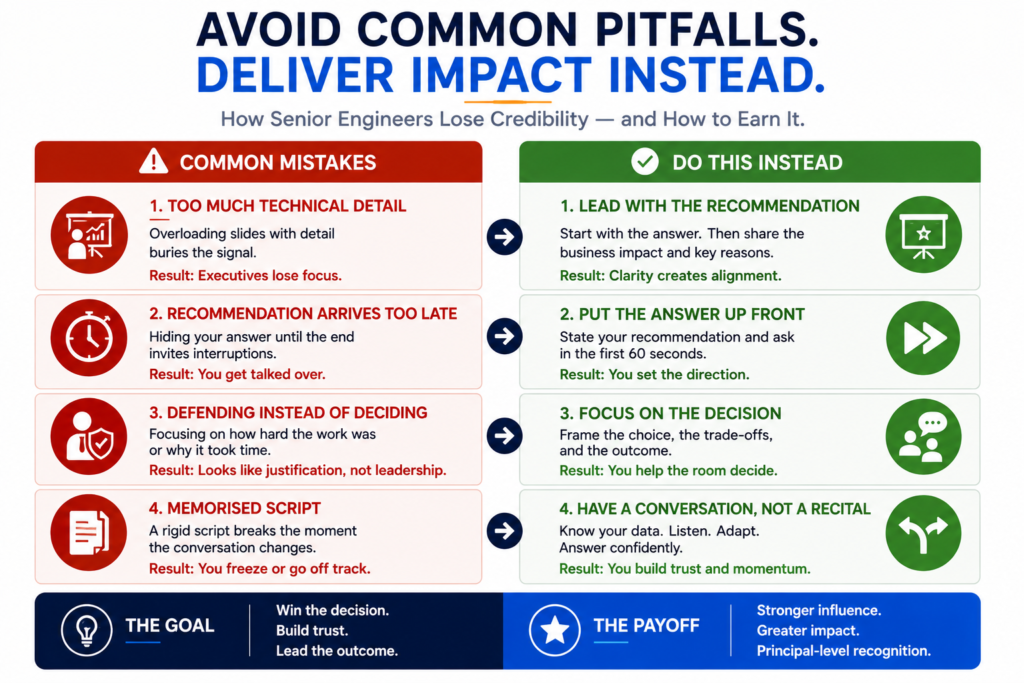
Even engineers who understand the frameworks intellectually tend to trip on a small, repeatable set of mistakes the first several times they present live. The most common is treating an interruption as a failure rather than the normal shape of the meeting. A VP asking what you are recommending on slide five of a thirty-slide deck is not derailing your presentation, they are telling you where your answer should have been. BLUF exists specifically so that whatever gets asked, your recommendation is already on the table.
The second is bluffing rather than admitting uncertainty. Executives in these rooms ask pointed questions because they are used to pattern-matching answers against what they already know, and a confident-sounding answer that does not hold up under one further question costs far more credibility than a direct admission that you do not know yet, paired with how and when you will find out. The third, related mistake is defending the volume or difficulty of the underlying work rather than making the case for the decision in front of the room. Every minute spent explaining how hard something was is a minute not spent explaining what should happen next, and a steering committee is there to decide the next thing, not to audit the effort behind the last one.
The fourth, and the one that catches engineers who have prepared conscientiously, is over-rehearsing to the point of memorising a fixed script. It produces a presentation that looks polished in isolation and falls apart the moment the room does not follow the planned order, which, in a live steering committee, it almost never does.
What Changes When You’ve Got This Right
The shift is measurable well before it shows up in a job title. On the delivery side, look for steering committee updates that end in a specific decision or funded action rather than a polite acknowledgement, and for a shrinking gap between how long you planned to speak and how long the meeting actually needed you to. On the business side, track whether your updates are increasingly cited by others, such as a director referencing your framing in a later meeting you were not even in, which is a strong signal your reasoning has become the default way the business thinks about that topic. On the career side, the metrics that matter are concrete: how many steering committee or leadership offsite slots you have held in the past twelve months, whether you have been invited back to present again by the same stakeholder unprompted, and whether internal panels are describing you using language like “represents the team at leadership level” rather than purely technical descriptors. Salary movement from the Senior band toward £130,000-plus Principal territory is the lagging indicator that follows once the others are consistently true, not the leading one to chase directly.
This week:
- Ask your manager for a co-presenting slot on the next steering committee update, or five minutes on an existing agenda for a single workstream.
- Rewrite your next written or verbal status update using BLUF: recommendation first, then two or three supporting reasons, detail held in reserve.
This month:
- Identify one stakeholder who will attend your next update and send a short pre-read, asking directly what they would change.
- Look into a UK Toastmasters club nearby, or an internal speaking or mentoring programme, specifically for impromptu Q&A practice.
- Start a simple record of every executive-facing update you give: the ask, the outcome, and any feedback received, to use as promotion evidence later.
Executive presence for engineers is not an innate trait some people have and others do not. It is a specific, practisable skill with a clear route from first five-minute slot to trusted voice at the top table, and on the current UK numbers, it is one of the highest-value skills a Senior cloud engineer can choose to build deliberately.
Useful Links
- IT Jobs Watch: Principal Engineer salary data
- IT Jobs Watch: Senior Software Engineer salary data
- Hays UK: Top skills report
- Nash Squared: Digital Leadership Report 2025
- Will Larson: Present to executives (StaffEng)
- LeadDev: Communication resources
- Harvard Business Review: The New Rules of Executive Presence
- Google re:Work: Understand team effectiveness
- Toastmasters International
- Management Consulted: The Pyramid Principle explained