
Seventeen per cent of UK employers now expect AI to shrink their headcount within the next twelve months, and a quarter of those expect cuts above 10 per cent, according to the CIPD’s autumn 2025 Labour Market Outlook. At the same time, PwC’s 2026 UK AI Jobs Barometer found that workers with verified AI skills now command a wage premium of 34.2 per cent, up from just 11 per cent the year before. Both statistics are true simultaneously, and both apply directly to cloud engineering. The uncomfortable reality behind the impact of AI on cloud jobs in the UK is not a simple story of replacement or safety. It is a sorting mechanism, and which side of it you land on depends on decisions you are making, or avoiding, right now.
The traditional response to this uncertainty has been to either panic or dismiss it entirely. Engineers who panic tend to chase every AI certification and prompt engineering course going, collecting credentials without a coherent strategy, while their actual role responsibilities stay untouched. Engineers who dismiss the risk point to strong cloud salaries and rising demand for platform engineers, and conclude that nothing fundamentally changes for people already established in the profession. Both responses miss what the underlying data actually shows: cloud engineering is bifurcating into roles AI increasingly handles unsupervised and roles AI makes considerably more valuable, and most professionals have not yet worked out which category their day-to-day work actually sits in.
The framework that resolves this is PwC’s two-track model, applied specifically to cloud infrastructure work. Roles that AI “professionalises,” where automation removes routine tasks so human judgement becomes the differentiator, are growing twice as fast in job postings and paying wages rising 42 per cent faster than roles AI “democratises,” where the job itself becomes easier and more accessible to non-specialists. One Bristol-based platform engineer moved from a generalist AWS operations role into infrastructure governance and cost architecture within fourteen months of recognising this shift, taking her salary from £78,000 to £112,000 in the process. The rest of this piece sets out how to make the same move deliberately rather than by accident.
The UK Cloud Market in the AI Era
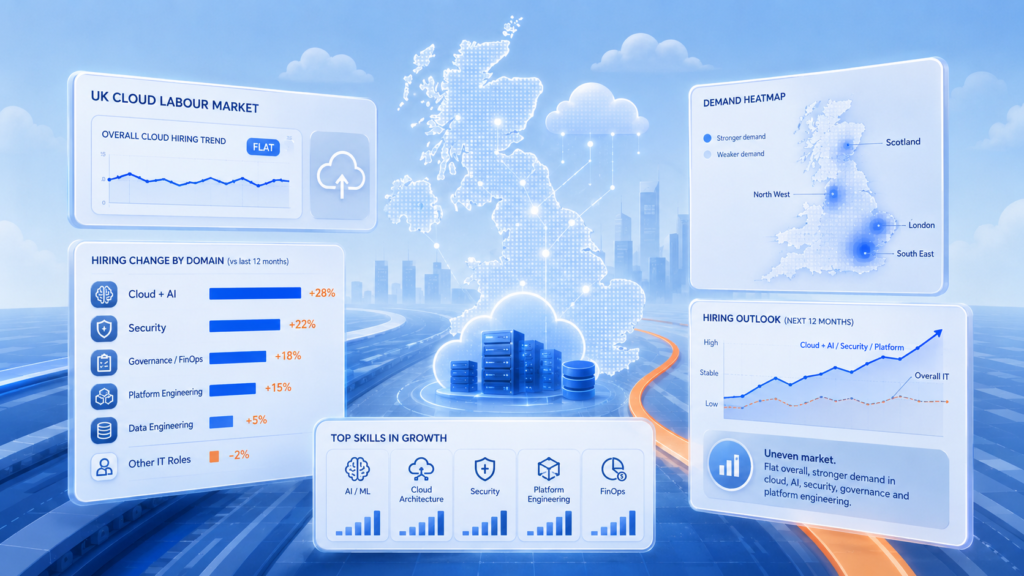
The headline UK labour market numbers are sobering. ONS vacancy data put UK job openings at 711,000 in the first quarter of 2026, the lowest level since early 2021, with 2.6 unemployed people for every vacancy compared with 1.9 a year earlier. Cloud engineering has not been immune. CompTIA’s State of the Tech Workforce UK 2026 projects net tech employment growth of just 1.02 per cent for the year, a figure that would have looked anaemic during the 2021 to 2022 hiring boom.
Within that flat overall picture, the distribution is sharply uneven. Cloud and DevOps roles are one of the few categories where REC and KPMG data shows demand holding up, alongside cybersecurity and AI or data engineering. AI-related job postings in the UK grew 61 per cent year on year, from 112,000 to 180,000 in 2025, and specialist AI role growth is now outpacing the overall jobs market by roughly eight to one globally, according to PwC. The pattern is not that cloud jobs are disappearing. It is that generic cloud operations postings are shrinking while postings combining cloud infrastructure with AI, security, or governance responsibility are multiplying.
Global tech layoffs reinforce the point from the other direction. GitLab cut 14 per cent of its workforce in June 2026 explicitly to fund AI infrastructure investment, while Cisco eliminated close to 4,000 roles the same month while openly stating the decision was about reallocating resources toward AI and security rather than cost-cutting. Neither company is cutting its most senior cloud architects or its AI infrastructure engineers. They are cutting the layers of routine operational and administrative work that AI tooling now performs at a fraction of the cost.
The Two-Track Framework: Where AI Helps and Where It Replaces
Google Cloud’s DORA 2025 State of AI-Assisted Software Development report offers the clearest operational lens on this split. AI adoption among technical professionals has reached 90 per cent, and more than 80 per cent report genuine productivity gains. But the same report found that AI adoption correlates with higher instability, more change failures, and longer recovery times in organisations without mature platform engineering practices. DORA’s conclusion, drawn from nearly 5,000 respondents, is that AI acts as an amplifier rather than a solution: it accelerates strong engineering cultures and magnifies dysfunction in weak ones.
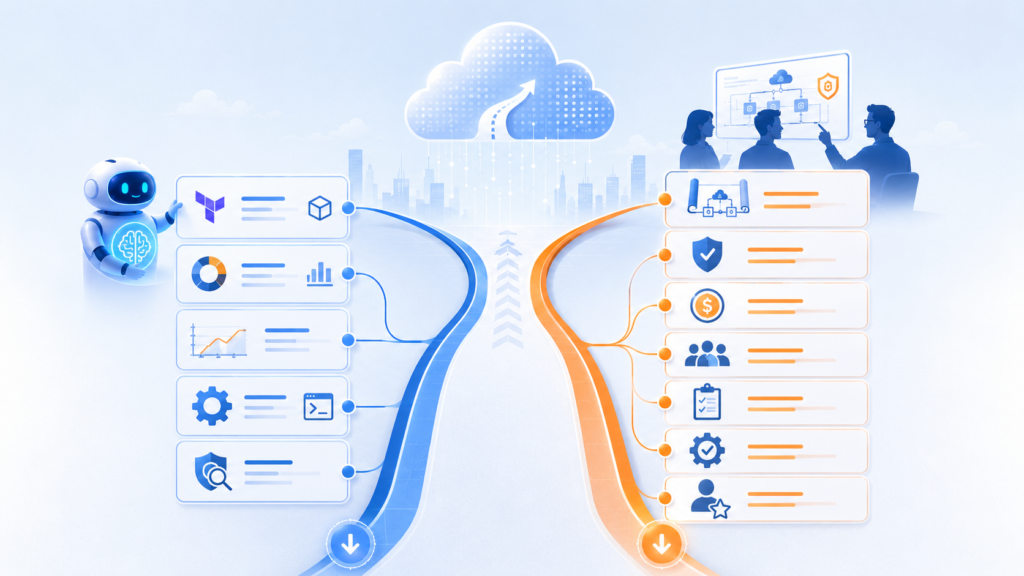
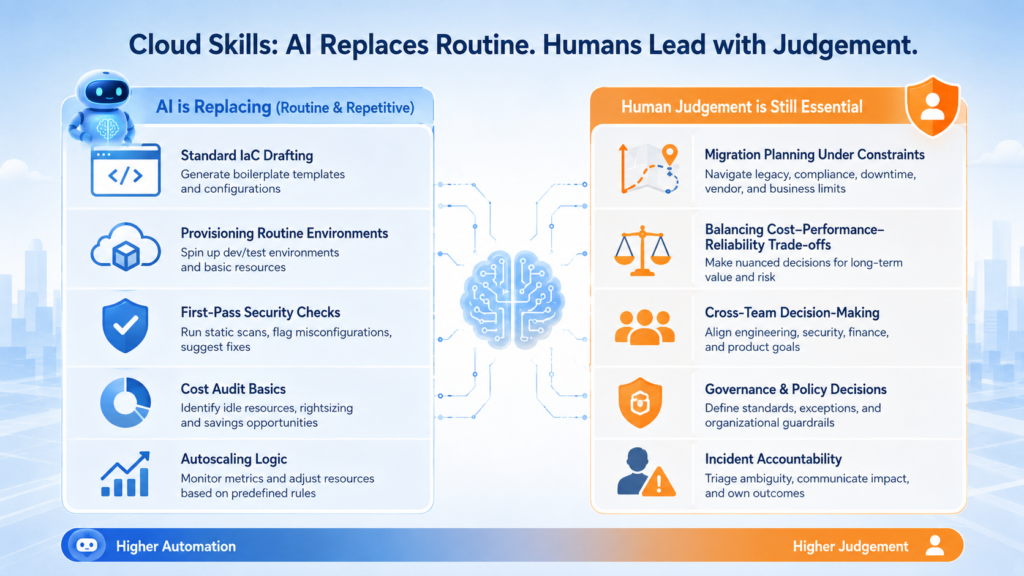
Map that finding onto specific cloud tasks and the two tracks become concrete. On the democratised side, generative tools now reliably handle instance right-sizing recommendations, boilerplate infrastructure-as-code generation for common patterns, misconfiguration and basic security detection, standard auto-scaling logic, and first-pass dashboard creation from resource usage data. These are exactly the tasks that used to occupy the first two or three years of a cloud engineer’s career, and they are precisely the tasks AI performs adequately without supervision.
On the professionalised side sit the tasks that resist automation because they require contextual judgement rather than pattern matching: designing architecture against specific and often conflicting business constraints, balancing cost, performance, and reliability trade-offs that have no universally correct answer, coordinating across security, compliance, and application teams with competing priorities, handling migrations complicated by undocumented legacy dependencies, and owning accountability when a production system fails at 3am. PwC’s global analysis of entry-level roles found that AI-exposed junior positions are now seven times more likely to require traditionally senior skills such as leadership and judgement than positions with lower AI exposure. The apprenticeship model that used to teach these skills gradually, over years of routine work, is compressing, and cloud professionals who have not deliberately built judgement-heavy experience are more exposed than their job titles suggest.
Which Cloud Skills AI Is Actually Replacing
The salary data makes the two-track split unambiguous once you look at role composition rather than job titles alone. Robert Half’s 2026 Salary Guide, drawn from the US market, shows network and cloud engineers at a median of $132,000, sitting notably below AI and ML engineer roles at $170,750 and DevOps engineers focused on pipeline reliability at $145,750. The same pattern holds in the UK figures already cited: specialist AI role postings up 61 per cent while general cloud operations postings stay flat. The gap is not really about the word “cloud” in the job title. It reflects how much of a given role’s actual work sits in the professionalised category.
At Mid-Level (£60,000 to £90,000), the risk is concentrated in exactly the tasks that traditionally justified this band: writing standard Terraform modules, provisioning routine environments, and running manual cost audits. Engineers who spend most of their week on these tasks are competing against tools that do them faster and more cheaply. The defence at this level is deliberately moving toward tasks with ambiguous requirements, multi-system dependencies, or organisational politics attached, since none of those compress well into a prompt.
At Senior (£90,000 to £130,000), AI functions as a genuine amplifier rather than a threat, provided the engineer’s value has already shifted from execution to design. Senior engineers who use AI to accelerate infrastructure-as-code drafting, security scanning, and documentation, while retaining ownership of architectural decisions and stakeholder trade-offs, are the clearest beneficiaries of the wage premium data. Our guide to the AI-augmented cloud engineer career path sets out the specific tooling fluency that separates engineers who direct AI from engineers who compete with it.
At Staff and Principal level (£130,000 to £180,000), an entirely new demand stream has opened that barely existed three years ago: the infrastructure work required to run large-scale AI and ML workloads. GPU cluster management, distributed training infrastructure, model serving architectures, and feature store engineering are cloud engineering problems with an AI dimension that most practitioners trained before 2023 have limited direct exposure to. UK Cloud Skills Report data from 2025 already puts the shortage of engineers who can do this work at a meaningful multiple of available roles, and it is one of the few segments of the market where demand is expanding faster than supply can fill it.
Distinguished and Fellow-level engineers (£180,000 and above) increasingly operate as the accountable human in AI-assisted delivery pipelines. As DORA’s AI Capabilities Model makes clear, the organisations converting AI adoption into real performance gains are the ones with clear governance policies, healthy internal data ecosystems, and defined trust boundaries for AI-generated output. Someone senior has to own that governance layer, define what AI-generated infrastructure code is and is not acceptable for production, and take responsibility when it goes wrong. That accountability function cannot be automated, because accountability requires a human who can be held to account.
The Human Skills That Keep You on the Professionalised Track
PwC’s global findings on the wage premium are explicit that the biggest financial rewards go to people who pair AI fluency with judgement, not to those who simply add a tool name to their CV. For cloud professionals, that pairing shows up in five specific capabilities that sit outside the technical skill set entirely.
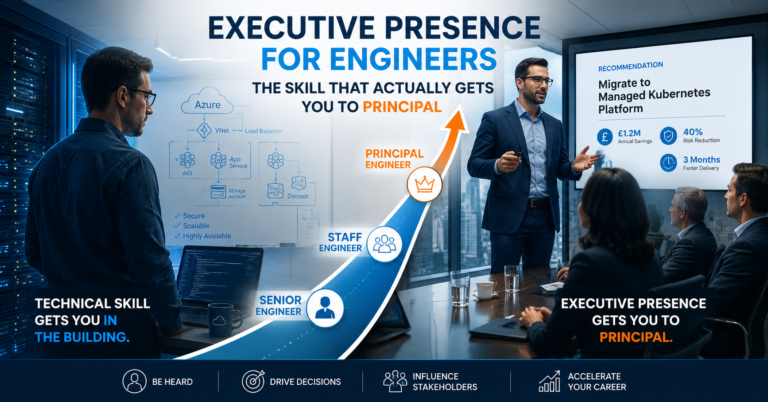
Executive communication is the first and most underrated. As AI absorbs routine implementation work, the engineers who get promoted are increasingly the ones who can explain a £40,000 cost overrun or a proposed architecture change to a CFO or a board in language that does not require a networking background. This was already true before AI accelerated the shift, but the compression of junior-level apprenticeship work means engineers now need to develop this skill years earlier than previous cohorts did.
Business case writing follows directly from this. An engineer who can quantify the return on a proposed platform investment, in pounds and in weeks, is far harder to replace than one who can only describe the technical merits. The certification plateau that many mid-career professionals hit is frequently a symptom of over-investing in technical proof points while under-investing in this kind of commercial fluency.
Stakeholder management and cross-functional coordination matter more, not less, as AI tooling proliferates across security, finance, and application teams simultaneously. Someone has to reconcile the security team’s AI-driven vulnerability scanner, the finance team’s AI-driven cost forecasting tool, and the platform team’s AI-assisted deployment pipeline when their outputs conflict, which they regularly do. That reconciliation work is judgement-heavy by definition and sits squarely in the professionalised category.
Budget ownership, including ownership of AI tooling spend itself, is emerging as a distinct skill in its own right. UK and EU engineering organisations are notably more cost-conscious about AI tool spending than their US counterparts, with finance teams frequently pushing back on subscription costs that seemed trivial a year earlier. Engineers who can make the case for AI tooling investment with a clear cost-benefit argument, rather than assuming the value is self-evident, are increasingly the ones trusted with larger budgets generally.
Strategic thinking and technical mentoring round out the list. Our piece on technical mentoring as career capital explores why teaching others has become one of the highest-leverage activities available to senior engineers, and that leverage has only increased as AI compresses the informal apprenticeship pathways that used to develop junior talent organically.
Your Career Roadmap and Implementation Strategy
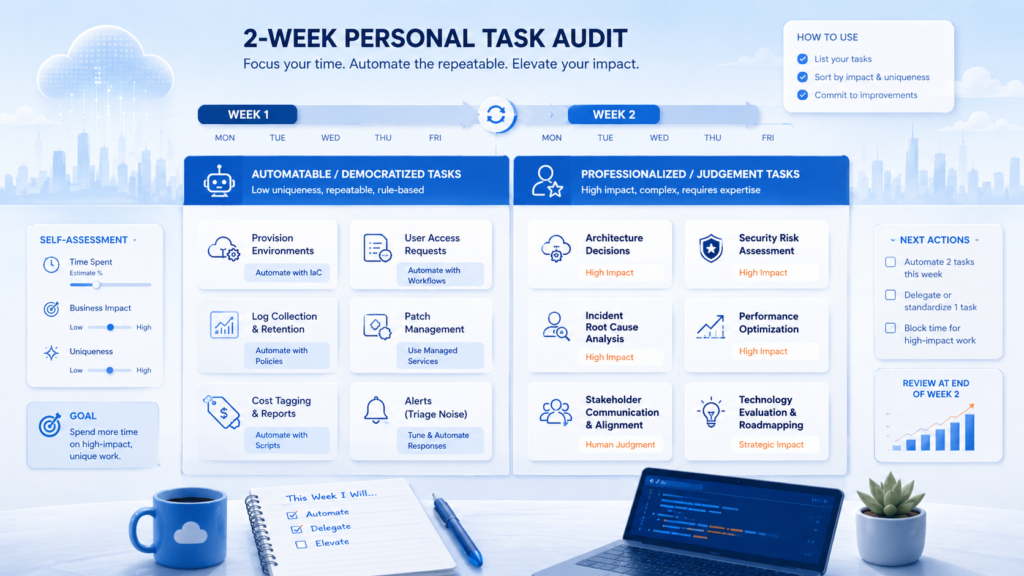
The first six to twelve months should focus on an honest audit of where your current role actually sits on the two-track spectrum, followed by a deliberate shift in how you spend your time. Track your own work for two weeks and categorise every task as either democratised, meaning AI could plausibly do it today with light supervision, or professionalised, meaning it requires context, trade-off judgement, or accountability that AI cannot provide. Most engineers are surprised by how much of their week falls into the first category. Use that audit to negotiate scope changes with your manager, request involvement in one AI infrastructure or platform governance project, and build fluency with at least one AI coding or infrastructure assistant well enough to direct it rather than merely use it.
Over one to three years, the goal is a visible track record in professionalised work at your target level. For most Senior engineers, that means moving from executing infrastructure changes to owning architectural decisions with documented trade-off reasoning, taking ownership of a governance or cost accountability function, and building a portfolio that demonstrates judgement rather than just technical execution. Salary expectations should track the data: engineers who make this transition successfully are seeing the 20 to 30 per cent uplifts associated with Staff promotion, on top of the 34.2 per cent AI skills wage premium PwC identified nationally.
The three to five year horizon requires a genuine choice between two viable paths, both AI-resilient for different reasons. The IC path toward Staff, Principal, or Distinguished engineer concentrates on judgement, architecture, and increasingly on AI infrastructure specialisation given the shortage in that segment. The leadership path toward engineering management and eventually the C-suite concentrates on the stakeholder management, budget ownership, and organisational judgement that PwC’s data shows growing in value precisely because AI cannot replicate it. Neither path is safer than the other. Both require the deliberate skill-building set out above rather than passive seniority.
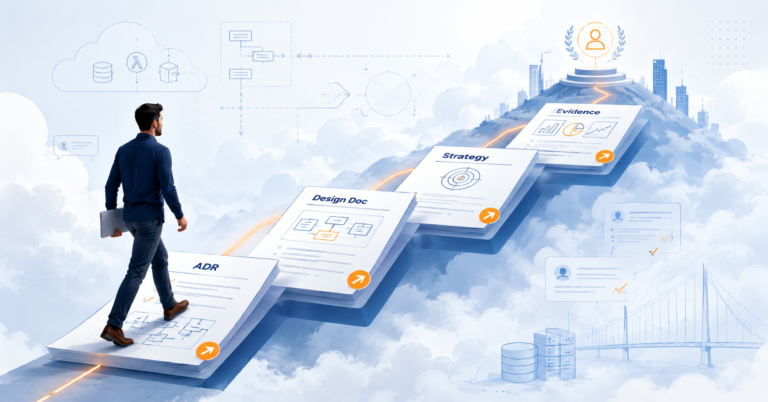
On implementation, learning strategy should weight formal AI infrastructure training lower than hands-on exposure. Volunteering for one AI-adjacent project, whether that is GPU cluster provisioning, a model-serving pipeline, or an AI governance policy document, teaches more in three months than a certification does in the same period. Portfolio building should shift from certification badges toward documented decisions: a written architecture decision record that shows judgement under real constraints does more for your market position than a fifth cloud certification. Networking through CNCF working groups, techUK’s AI and cloud communities, and internal cross-functional projects builds the visibility that judgement-heavy roles depend on, since these roles are rarely filled through cold applications alone.
Success Metrics, Common Mistakes, and the Investment Case
How to measure whether you are winning
Technical metrics worth tracking include ownership of at least one AI-augmented infrastructure or governance project, fluency with the AI coding or infrastructure assistants your organisation has standardised on, and a portfolio of documented architectural decisions rather than certificates alone. Business impact metrics include quantified cost savings or velocity improvements you can attribute directly to your work, ideally expressed the way a CFO would recognise them. Career advancement metrics are the clearest signal: salary movement toward or beyond the 34.2 per cent AI skills premium, title progression that reflects judgement responsibility rather than tenure, and recruiter interest specifically citing your governance or architecture experience rather than your certification list.
Where cloud professionals go wrong
The most common mistake is treating an AI certification as equivalent to AI fluency. A certificate demonstrates you can pass an exam about prompt structures. It does not demonstrate you can direct an AI coding assistant inside a legacy Terraform codebase without introducing instability, which is the actual skill employers are paying the premium for. The second mistake is assuming seniority alone provides protection. DORA’s findings are explicit that AI amplifies existing organisational and individual weaknesses as readily as it amplifies strengths, meaning a senior engineer who has quietly drifted into routine execution work is more exposed than a mid-level engineer who has deliberately built judgement-heavy experience. The third mistake is adopting AI tooling without governance, which the DORA AI Capabilities Model identifies as the single clearest predictor of whether AI adoption improves or damages delivery stability. Engineers who position themselves as the person who builds that governance layer, rather than simply another user of the tooling, capture disproportionate value from the transition.
Is the upskilling investment worth it
The time investment for a meaningful shift toward professionalised work is typically three to six months of deliberate project selection and skill-building alongside your existing role, rather than a separate course of study. The financial investment is modest by comparison with previous certification cycles, often limited to the cost of one AI infrastructure specialisation course in the £300 to £600 range plus the opportunity cost of choosing governance-adjacent projects over more familiar execution work. Against that investment, the expected return is the 34.2 per cent national AI skills wage premium at minimum, rising toward the sector-specific peaks PwC recorded, alongside materially improved job security in a UK market where vacancies overall fell 43 per cent between 2022 and 2025. Payback, measured in salary uplift alone, typically arrives within twelve to eighteen months of the role change taking effect.
What To Do This Week
- Track your own work for two weeks and categorise each task as democratised or professionalised using the framework above
- Identify one AI infrastructure, governance, or cost accountability project at your current employer and ask to be involved
- Install and use an AI coding or infrastructure assistant daily for two weeks, focused on directing it rather than simply accepting its output
- Draft one architecture decision record for a recent piece of work, documenting the trade-offs you weighed rather than just the outcome
- Book time with your manager to discuss scope changes toward professionalised responsibilities, using specific examples from your task audit
The impact of AI on cloud jobs in the UK is real, measurable, and already visible in the salary and vacancy data. It is not, however, evenly distributed, and it rewards deliberate positioning far more than it punishes cloud engineering as a discipline. The engineers thriving through this transition are not the ones with the most AI certificates. They are the ones who moved early toward the judgement, governance, and accountability work that AI cannot yet touch.
Useful Links
- PwC 2026 UK AI Jobs Barometer
- CIPD Labour Market Outlook, Autumn 2025
- Google Cloud DORA 2025 State of AI-Assisted Software Development
- ONS Vacancies and Jobs in the UK Bulletin
- Robert Half 2026 Salary Guide
- TechCrunch: The running list of 2026 AI-cited tech layoffs
- Reed Cloud Engineering Salary Data
- IT Jobs Watch
- Hays UK Salary Guide
- CNCF