

Forty-six per cent of newly hired employees fail within eighteen months. That is not a junior hire problem. Leadership IQ’s study tracking 20,000 new hires found the same failure rate at Senior and Staff level, where the stakes are highest. For a cloud engineer stepping into a Senior role at £90,000-£130,000, or a Staff or Principal position at £130,000-£180,000, failure represents a salary reset, a CV setback, and months of momentum lost. The figure that should concern experienced engineers more than the failure rate itself is what actually drives it. Technical skills account for just 11% of those failures. Attitude, relationships, and cultural misalignment drive the remaining 89%. The engineers who fail are not underqualified. They are moving at the wrong speed, in the wrong direction.
The default response to joining a new role at senior level is to get busy. There are systems to understand, backlogs to attack, and an implicit pressure to justify the salary quickly. Engineers who follow this instinct often make the same error: they apply the patterns and frameworks from their last organisation before they have properly read this one. The architecture looks familiar, so they reach for solutions they know work. The team practices look inefficient, so they propose restructuring within weeks. The problem is that familiarity is not context. Moving quickly without understanding why the current state exists is how capable engineers become expensive lessons for the businesses that hired them.
A structured 90-day approach changes this outcome. Not a generic HR document with vague quarterly milestones, but a deliberate framework that treats the first 30 days as a diagnostic, the second as relationship-building, and the third as bounded delivery. Engineers who follow this pattern earn the context to act effectively, build the relationships that amplify their work, and avoid the technical overreach that characterises most failed senior transitions. One Staff Engineer at a UK fintech described spending their entire first 30 days reading post-mortems and design documents before proposing a single change. Within six months they had restructured the team’s incident response process with near-unanimous buy-in. The engineers who skipped that diagnostic phase are rarely around long enough to see the outcome.
What Is Actually at Stake
UK cloud engineers change roles frequently. Ravio’s 2026 Compensation Trends Report puts average UK tech tenure at just over two years, which means most Senior and Staff engineers will face this transition three or four times across a decade. Each one is high-stakes in both directions.
The salary context makes the stakes concrete. Morgan McKinley’s 2026 UK Salary Guide puts London Cloud Architects at £95,000-£130,000 base. IT Jobs Watch shows SRE median advertised salaries at £77,500 and Cloud Architect at £85,000 nationally. At the top of the market, Levels.fyi data for Senior Engineers at London-based premium employers shows total compensation reaching £96,700-£172,500. These are expensive hires, and expensive hires carry pressure to deliver quickly.
A failed eighteen-month tenure has a concrete cost for the individual: a salary reset that typically takes twelve to eighteen months to recover from, equity and bonus entitlement forfeited at tenure milestones, and a short tenure on the CV that requires explanation in every subsequent interview. The positive trajectory is equally concrete. Engineers who navigate the first 90 days well access broader scope, budget ownership, and the strategic visibility that drives Staff and Principal promotions. The difference between the two outcomes has almost nothing to do with technical ability and almost everything to do with how the transition is managed.
Diagnose Before You Deliver
Michael Watkins introduced the concept of the “break-even point” in The First 90 Days, defining it as the moment where the value a new hire creates equals the value they consume. For a senior technical hire, that point typically falls at around six months. Everything before it is investment. The question is what you invest in.
Watkins’ STARS model gives the first and most important diagnostic. Are you joining a Start-up (building from scratch), a Turnaround (rescuing something failing), an Accelerated-growth organisation, a Realignment (redirecting something that has drifted), or a Sustaining-success business? Each situation demands a different early approach. A turnaround rewards faster technical intervention. A sustaining-success organisation punishes it. Getting this diagnosis wrong in the first 30 days sends you in the wrong direction for the remaining 60.
The learning agenda is the practical output of this diagnostic. Before optimising anything, an experienced engineer joining a new role should be able to answer three sets of questions: what shaped the current state of this system and team (the past); what is actually working versus actually problematic versus merely unfamiliar (the present); and where the real priorities sit, not just the stated ones (the future). Engineers who arrive with answers to these questions rather than with the questions themselves skip the phase that makes their answers relevant.
The Technical Audit: Five Domains, One Discipline
The first 30 days in a cloud engineering role should include a structured assessment across five domains. The discipline that holds all five together is consistent: document findings as questions, not verdicts. You are building a picture, not a reform programme.
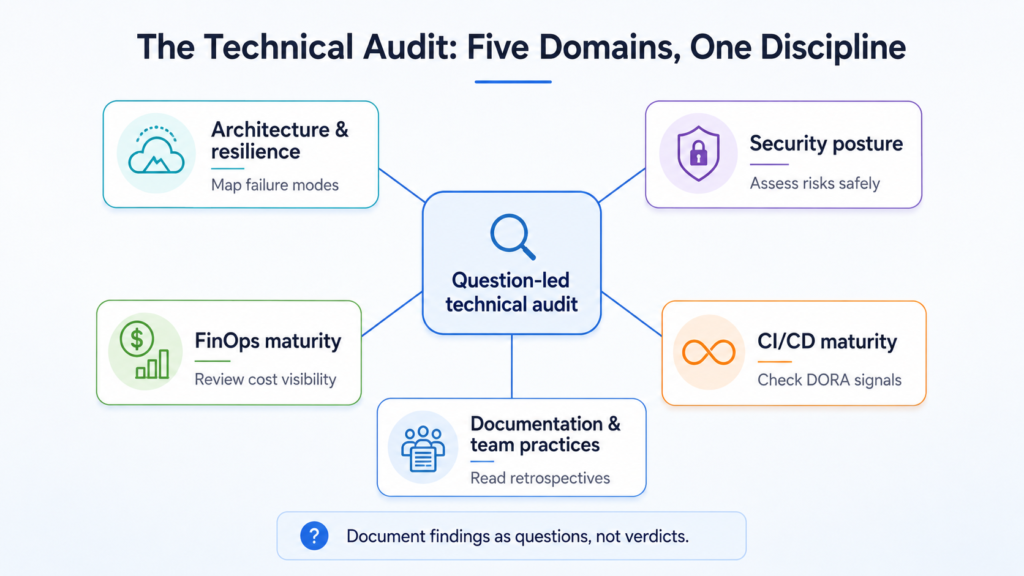
Architecture and resilience is the natural starting point. Map the system topology, understand where the shared-responsibility boundaries sit in practice rather than on paper, identify single points of failure, and review the SLA and uptime commitments the organisation has made. The post-mortems from the past twelve months are more revealing than any architecture diagram, because they show how the system actually fails rather than how it was designed not to.
Security posture is the domain where the “build nothing yet” discipline is hardest to follow, because security gaps feel urgent. Running the cloud-native security tooling and assessing IAM posture, encryption coverage, and network segmentation is the right move. The distinction to make is between genuine existential risks, which warrant immediate action, and configuration drift that has coexisted with the system for months, which warrants documentation and a structured proposal. Prowler and the major cloud-native security command centres give a baseline quickly without touching production.
FinOps maturity tells you how the organisation thinks about engineering quality as much as cloud spend. The FinOps Foundation’s Crawl/Walk/Run framework provides a fast diagnostic: tagging coverage below 80% indicates a Crawl-stage organisation; above 95% with automated drift correction indicates Run. Cost visibility is often where engineers can add early value without political risk, and understanding how organisations progress through these maturity stages is worth reading before your start date in our piece on FinOps evolution from cost control to strategic value.
CI/CD pipeline maturity tells you as much about engineering culture as technical capability. DORA metrics (deployment frequency, lead time, change failure rate, and mean time to restore) are the right lens. You are not benchmarking against industry averages in the first 30 days; you are understanding the organisation’s actual delivery rhythm before proposing changes to it.
Documentation and team practices are the final domain, and often the most revealing. Reading recent retrospectives and blameless post-mortems before forming opinions is not optional for engineers joining at senior level. Tanya Reilly, in The Staff Engineer’s Path, advises skimming meeting notes and Slack channels sorted by most-recently-created. They surface what is actually happening rather than what the org chart says is happening.
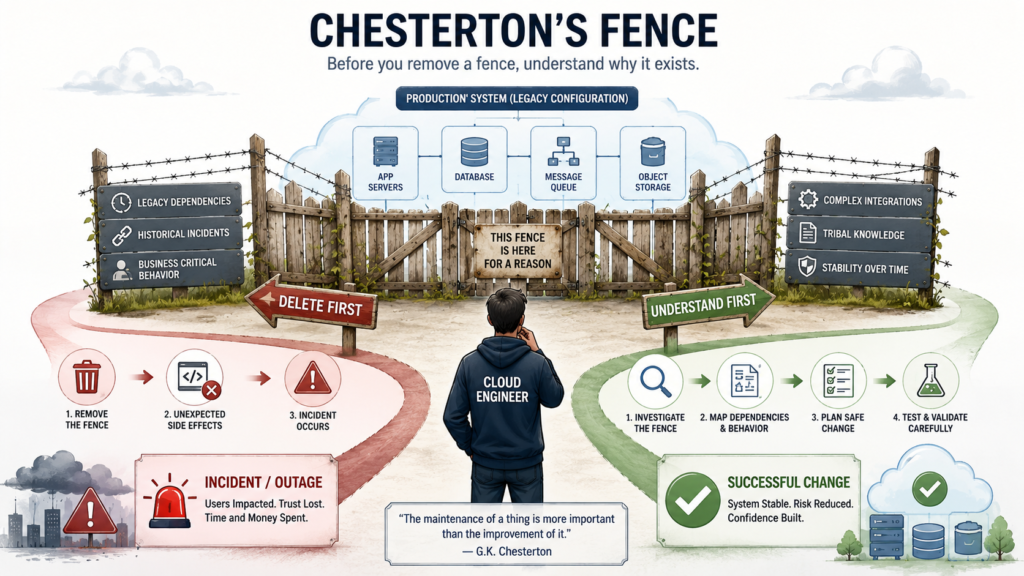
Chesterton’s Fence applies throughout this audit. The principle is simple: do not remove a fence until you understand why it was built. In engineering terms, this means never deleting “unused” configuration, security groups, or code before understanding what depends on them. Every legacy system has Chesterton’s Fences. The newcomer’s fresh eyes are valuable for spotting what long-tenured engineers have become blind to. The value is in documenting and raising those observations as questions. Acting on the assumption that the fence is pointless is how you bring down production.
Relationships and Credibility: The 89% That Actually Matters
Technical assessment is the easier half of the first 90 days. The research on why senior hires fail points consistently at something harder to measure and easier to neglect: the quality of relationships built in the first 90 days and the accuracy with which the engineer reads the organisation’s political landscape.
Formal org charts rarely capture real decision-making in engineering organisations. A principal engineer or long-tenured tech lead often carries more influence over implementation than their position suggests. Identifying the “natural historians”, the people who know why decisions were made three or four years ago, and scheduling time with them early in the first month is not optional at senior level. A power/interest mapping overlaid with a network view is more useful than either alone, because the people who need to support your ideas are rarely the same people who formally approve them.
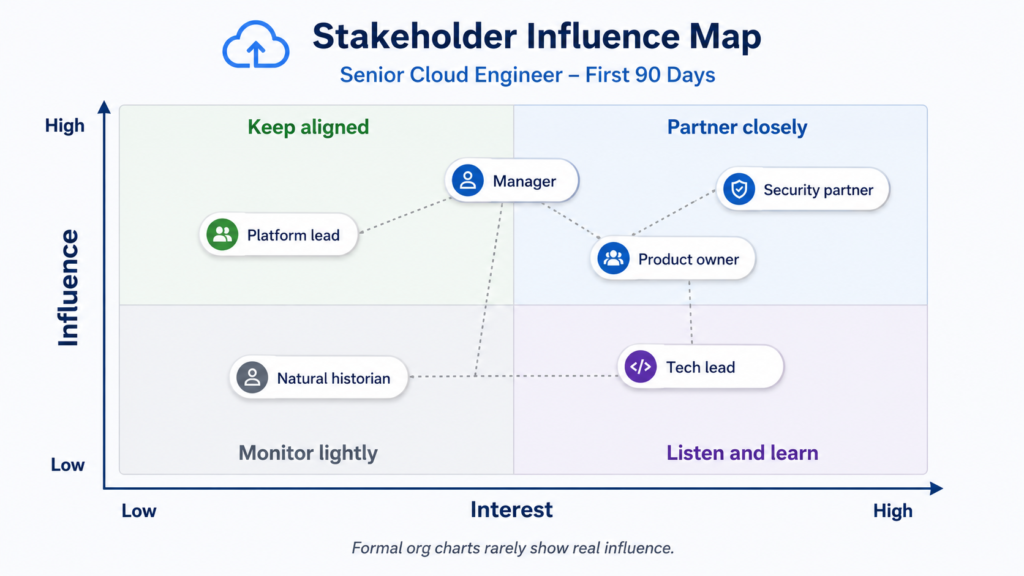
The senior and Staff credibility paradox is the core risk in this phase. You arrive with status conferred by your title and track record. Acting as though that status entitles you to override the context you have not yet earned is the most common failure mode for experienced engineers joining at a higher level. Will Larson names this “chasing ghosts”: applying frameworks and solutions from a previous employer so confidently that you misread the new environment entirely. The engineers who build credibility fastest in the first 90 days are those who ask better questions, not those who demonstrate they already have the answers.
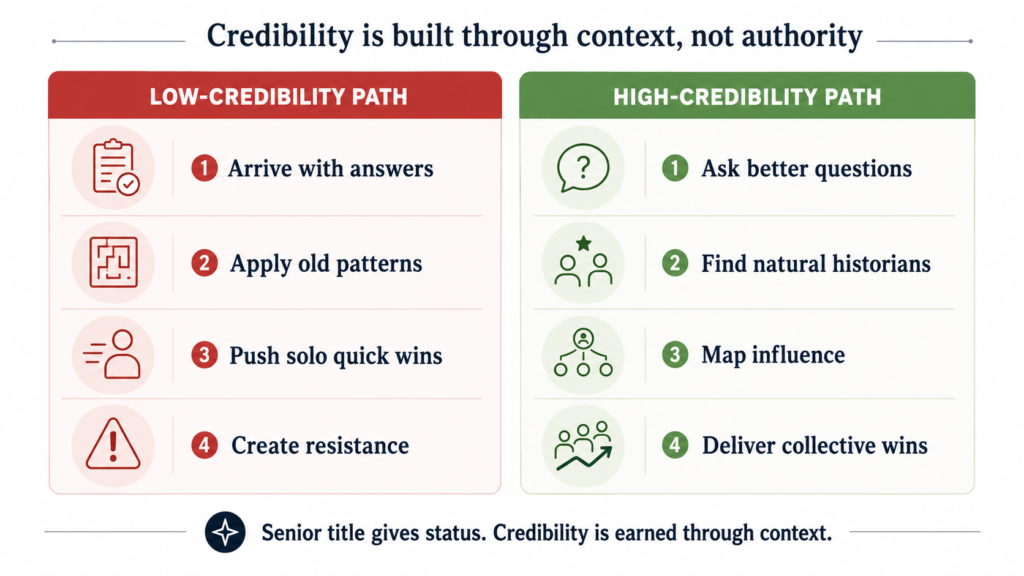
Specific questions make a measurable difference. Asking “Are there any technical decisions that came back to haunt us?” and “Are there interesting retrospectives or post-mortems I should read?” signals respect for the existing system’s history while pointing toward the organisation’s actual pain points. This dynamic of building influence through knowledge exchange rather than knowledge demonstration is exactly what our post on technical mentoring as career capital explores in depth: even in the newcomer role, curiosity earns credibility faster than authority.
The evidence on quick wins is worth engaging with carefully. The Corporate Executive Board’s “Quick Wins Paradox” study, tracking more than 5,400 new leaders, found that those overly focused on fast delivery exhibited five behaviours that damaged their standing: focusing too much on detail, reacting negatively to criticism, intimidating others, jumping to conclusions, and micromanaging. Leaders who outperformed their peers by as much as 60% pursued collective quick wins: visible improvements achieved with the team that respected the existing culture rather than bypassed it. Good early engineering wins look like fixing a noisy alert the team has tolerated for months, improving an onboarding document that everyone knows is inaccurate, or simplifying a pipeline step that slows every deployment. They are chosen against expectations agreed with your manager, not surfaced as solo heroics.
The dynamics differ significantly between external hires and internal movers. External hires carry a clean slate and fresh perspective but can take up to two years to reach the productivity of an equivalent internal candidate. The risk is over-indexing on patterns from the previous employer. Internal movers, whether promoted into broader scope or moving laterally, carry existing context but face peer rivalry and the residue of their previous role’s perception. A promoted senior engineer must consciously renegotiate relationships with former peers. Skipping this renegotiation leaves former peers treating you as a peer when your responsibilities have materially changed, which is an uncomfortable dynamic to correct months later.
Mapping the First 90 Days
A 90-day plan written on day one and never reviewed is not a plan. Treat this as a living document with three structured check-ins that recalibrate your approach as you learn more.
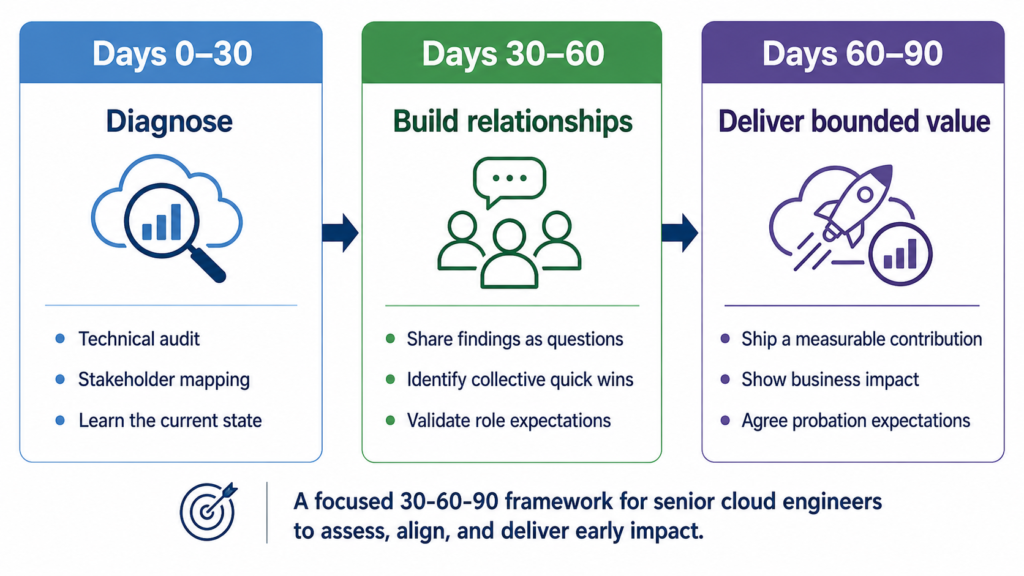
Days 0-30 have one deliverable: a clear, documented picture of the current state and the questions it raises. Run the five-domain technical audit. Book 1:1s with every peer, cross-functional partner, and natural historian you can identify, targeting ten to fifteen conversations in the first month. Co-create a written plan with your manager that includes SMART milestones, for example “complete stakeholder mapping for my domain by week 3” rather than “meet stakeholders.” For engineers with a long notice period at a previous employer, asking your new manager for reading material before you start compresses the diagnostic phase significantly. The post-mortems, architecture wiki, and team handbook are reasonable requests. The pressure of performing under scrutiny while absorbing an enormous volume of new context simultaneously is substantial, and worth preparing for explicitly, including the emotional dimension that our piece on performing under high-stakes conditions addresses directly.
Days 30-60 are for building relationships and surfacing findings. Share audit observations as questions rather than verdicts: “I noticed X: is there context here I am missing?” rather than “X needs to change.” Identify two or three collective quick wins in conversation with your manager, not unilaterally. This is also the window to assess whether the role was accurately described in the hiring process. Misalignment between the job description and reality is the leading stated reason for 90-day departures, according to Enboarder’s 2025 HR Leader Survey of 1,000 HR professionals. If the role has shifted materially, the 60-day mark is the structurally appropriate moment to raise it, constructively and specifically, not as a complaint.
Days 60-90 are for bounded ownership and delivery. Ship your first meaningful contribution, scoped to be well-understood and reversible where possible, and articulate it explicitly in terms of business impact rather than technical elegance. Engineers who can say “this reduced deployment failures by 30% and gives the team back two hours per sprint” at day 75 are outperforming those who say “I refactored the pipeline”, even if the underlying work is identical. By day 90, agree with your manager in writing what “good” looks like through the rest of the probation period. UK probation periods typically run three to six months and function as a mutual assessment. The targets for the remainder of that window should be specific, measurable, and set before the final weeks rather than during them.
Red Flags Worth Taking Seriously
Part of the first 90 days is honest assessment of whether the role is set up for success. Not every organisation that presents well in an interview process is one where a senior cloud engineer can thrive.
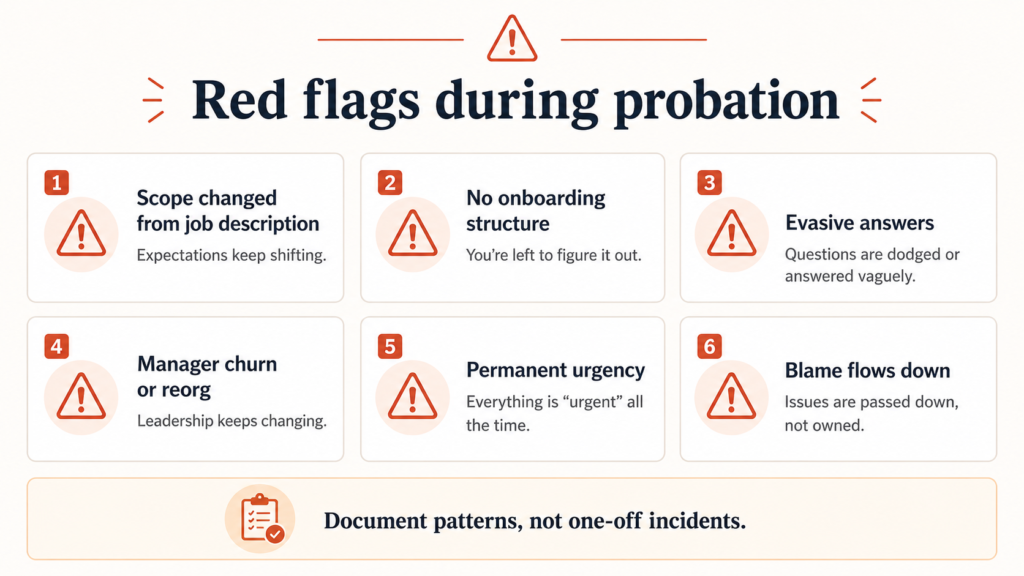
Warning signs that emerge within 30-60 days: the scope and priorities have shifted materially from the job description; onboarding has no structure, no assigned contact, and no clear plan; answers about team priorities or organisational structure remain evasive after repeated attempts to clarify; manager turnover is high or a significant reorg has been announced within weeks of your start date; urgency is chronic rather than situational, with constant fires that never appear to have a systemic cause; and blame flows down while credit flows up.
A practical cultural test is to ask how often deadlines shifted in the last six months, and why. Teams in stable, functional environments answer with specifics. Teams in dysfunctional environments describe perpetual urgency with no identifiable cause.
Document patterns rather than one-off incidents. Raise concerns at the 60-day structured check-in using specific, constructive framing. If multiple red flags persist, treat the probation window as the mutual assessment it is designed to be. Keeping your options open is not disloyalty: it is an accurate reading of what probation is for.
Measurable Success: What Good Actually Looks Like
The output of a well-managed first 90 days is measurable at each stage. By day 30, you should be able to articulate the three highest-priority technical challenges in your domain, name the key influencers whose support affects your work, and have a shared written understanding of expectations with your manager. If any of these is absent, escalate.
By day 60, a concrete collective quick win should be delivered and attributable to a specific business outcome, audit findings should be documented and shared with the relevant stakeholders in a neutral, question-led format, and the red flag assessment should be honest enough to inform a clear view of whether the role was accurately sold.
By day 90, you should have shipped one substantive contribution with measurable business impact, have agreed written expectations for the remainder of the probation period, and be able to identify your own influence network within the organisation. The career-trajectory indicators, including broadening scope, access to strategic conversations, and sponsor relationships forming, become visible in this window for engineers who navigated the first 60 days well, and notably absent for those who defaulted to heads-down technical delivery.
Common Pitfalls
Applying patterns from the last employer is the failure Will Larson calls “chasing ghosts.” The architecture that worked at the previous company worked in a specific context. The confidence that comes from a strong track record makes this harder to see, not easier, because familiarity feels like knowledge.
Moving too fast on technical debt is equally common. Every system has debt. Most of it has survived because something depends on it, or because the migration is already planned, or because the cost of removing it exceeded the benefit at the time. The engineer who arrives and immediately proposes replacing the legacy component is not demonstrating capability; they are demonstrating that they have not yet understood why the component still exists.
Optimising for visibility over collective value produces the quick wins that backfire. Wins chosen for their profile rather than their benefit to the team create the impression of momentum while building resentment. The Corporate Executive Board data is unambiguous: wins delivered by bypassing the team compound into credibility damage, not credibility gain.
Neglecting the informal network leaves significant intelligence gaps. The engineers who actually influence day-to-day decisions are rarely the same people who formally own them, and identifying this gap after three months rather than three weeks is a costly delay.
Misreading UK workplace communication norms is a specific and avoidable trap for engineers joining from more direct cultures. British engineering organisations tend to express disagreement through understatement: “that could be challenging” almost always means no, and “that’s interesting” rarely means interesting. Learning to decode this accurately is not a cultural nicety; misreading it leads to genuine misalignment that both parties experience as a performance problem.
ROI: The Cost of Getting This Wrong
A failed eighteen-month senior tenure has a concrete financial footprint. At a £100,000 base salary, the direct employment cost alone is approximately £150,000. Recruitment fees for senior cloud roles run at 15-20% of base salary, adding £15,000-£20,000 before factoring in onboarding time and the productivity deficit of a replacement hire. Total cost to the employer of a failed senior transition sits at £200,000-£250,000 in most estimates. The business knows this. The pressure it creates on the new hire is real and worth accounting for explicitly rather than absorbing unconsciously.
For the individual, the cost is measured in trajectory rather than employment cost. A salary reset to a lower-seniority role after a failed tenure typically takes twelve to eighteen months to recover from, assuming the next role is at the correct level. Engineers who lose six months of trajectory are not simply six months behind; they miss the compounding effect of earlier access to higher-leverage work, earlier sponsor relationships, and earlier promotion cycles.
The investment required to avoid this is trivial by comparison. A structured 30-day diagnostic, a written 90-day plan, and fifteen hours of relationship-building 1:1s in the first month are the primary inputs. The return, measured in trajectory rather than salary alone, is the difference between a transition that accelerates toward Staff and Principal and one that requires repair.
Next Steps
- Before your start date, request post-mortems, design documents, and the team handbook from your manager
- Write a personal learning agenda covering the past, present, and future of the system and team before day one
- Co-create a written 30-60-90 plan with SMART milestones at your first formal 1:1
- Map stakeholders by influence and interest, not just by org chart position; target ten to fifteen 1:1s in the first 30 days
- Run the five-domain technical audit across architecture, security, FinOps, CI/CD, and documentation before proposing sweeping changes
- Identify two or three collective quick wins in conversation with your manager, not unilaterally
- Assess red flags at 60 days and raise concerns constructively if the role has shifted from the description
- Set written expectations for the remainder of your probation period at the 90-day mark
Useful Links
- Michael Watkins: The First 90 Days (Harvard Business Review Press)
- Will Larson: Staff Engineer, Leadership Beyond the Management Track
- Tanya Reilly: The Staff Engineer’s Path (O’Reilly)
- LeadDev: Starting a new job as a Staff+
- The Pragmatic Engineer: Onboarding to a New Company
- FinOps Foundation: Maturity Model (Crawl/Walk/Run)
- IT Jobs Watch: Cloud Architect UK Salary Data
- Morgan McKinley 2026 UK Salary Guide: Cloud Engineering
- Robert Half 2026 UK Technology Salary Guide
- Ravio: Employee Tenure Trends in UK Tech 2026