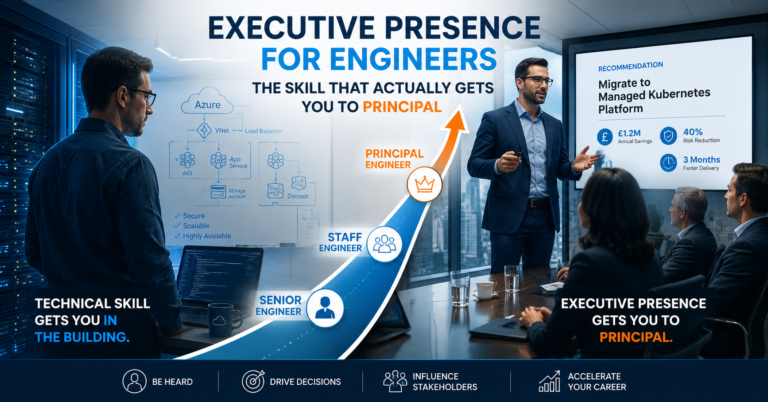

Senior cloud engineers in the UK spend an average of 392 hours a year in meetings. That is more than sixteen full working days. And yet meeting fluency, the actual skill of running rooms, driving decisions and translating technical judgement into organisational influence, is almost never taught, rarely mentioned in job descriptions, and almost entirely absent from the certification tracks that consume most engineers’ professional development budgets. According to the London School of Economics, unproductive meetings cost UK firms an estimated £50 billion a year. The engineers who make meetings count are disproportionately valuable. The ones who have not figured this out yet are sitting in those £50 billion of meetings, wondering why the Staff Engineer promotion keeps getting deferred.
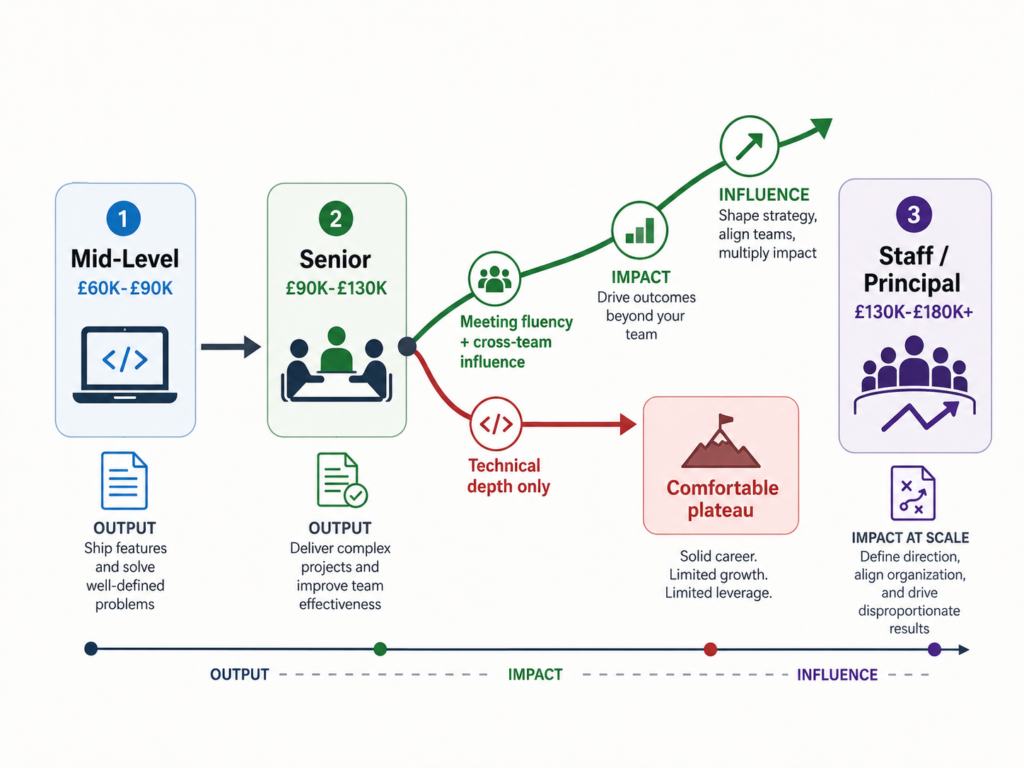
The traditional approach to career development in cloud engineering treats seniority as a technical accumulation problem. You collect certifications, deepen your Azure or AWS expertise, build a GitHub portfolio, maybe add a FinOps qualification. The assumption is that technical depth is the gating factor at every level. It is not. LinkedIn’s analysis of more than one billion members across two hundred countries identified communication as the single most in-demand job skill for two consecutive years, and its data shows that professionals with strong communication skills are promoted 11% faster than those without. The senior-to-Staff transition is where this gap becomes financially brutal. Mid-level engineers in the UK earn £60,000-£90,000. Senior engineers earn £90,000-£130,000. Staff and Principal engineers at well-levelled organisations earn £130,000-£180,000 in base salary, with total compensation at major tech and fintech firms reaching well beyond that. The skills that got you to senior are necessary but no longer sufficient to cross that threshold.
What actually gates the jump from senior to Staff is not another architecture specialisation or a Professional-tier certification. It is the ability to run an architecture review and reach a decision in one session, to lead a blameless post-mortem that produces real action rather than ritual blame-deflection, to walk into an executive briefing and translate a six-month infrastructure initiative into a two-minute business case, and to influence engineers in other teams who have no reason to take direction from you. These are meeting skills. They are learnable. The professionals who have internalised them in their mid-level years arrive at the senior-to-Staff boundary with a meaningful head start. Those who have not hit what engineering-career writers consistently call the senior plateau: a comfortable level with a reasonable salary, where the rules of advancement quietly changed without anyone explaining the new game.
Why the Senior Plateau Is a Meeting Problem
The senior engineer plateau is well documented in engineering-leadership writing. Senior is, by design, a terminal level in many organisations. You can be an excellent senior engineer for fifteen years. The promotion criteria above it shift in ways that most engineers are not explicitly told about. Output, the measure that got you to senior, gives way to impact, the measure that takes you beyond it. Impact at Staff and Principal level is almost always cross-team. It requires influencing people who do not report to you, building alignment across groups with competing priorities, and making your technical judgement visible to people who will never read your code.
The problem, as Penn State’s engineering education researchers put it plainly, is that engineers are promoted into roles requiring skills they were never formally trained in. Communication, stakeholder management and decision facilitation are not part of most engineering curricula. They are rarely part of early-career feedback. They do not appear on most promotion rubrics until the level where they become the gating factor. The result is that a large number of technically excellent senior engineers have no structured framework for meeting fluency at all, and mistake their discomfort with poor meeting culture generally (a reasonable complaint) for a reason not to develop the skill.
Benjamin Yolken, formerly of Google and Airbnb, describes the plateau precisely: the engineers who break through it write more, publish internal documents, author architecture decisions and post-mortems, and ensure their work is visible to people outside their immediate team. Writing is meeting fluency’s durable artefact. The engineer who runs the architecture review writes the ADR. The engineer who facilitates the post-mortem owns the written record. The one who presents the business case leaves the executive briefing with a decision in the minutes. These artefacts accumulate into the promotion evidence that Staff and Principal roles require.
The Framework: Four Communication Structures That Change Careers
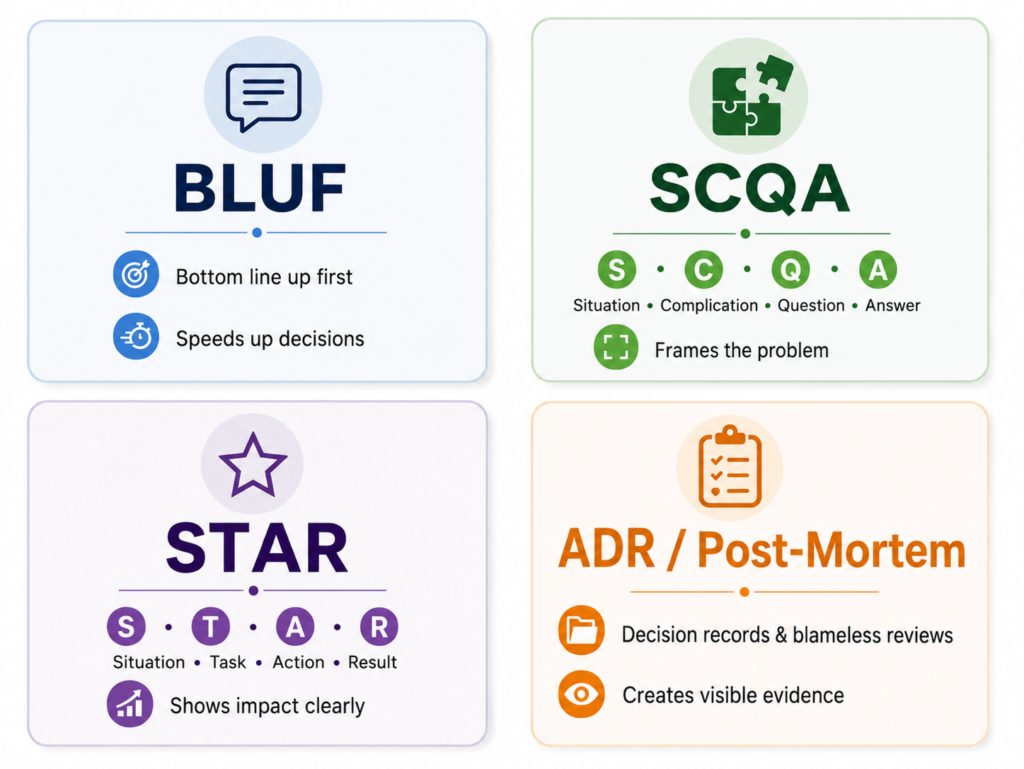
Meeting fluency is not a personality trait. It is a set of learnable structures. Four in particular have the widest application across every career stage in cloud engineering, from mid-level design reviews through to Principal-level executive briefings.
BLUF and the Pyramid Principle
The single most important communication shift a mid-level engineer can make is learning to lead with the answer. Most technical professionals default to building up: context first, then analysis, then conclusion. That structure works for a written thesis. It fails in a meeting with a CTO who has twelve minutes and three other priorities competing for attention.
The Pyramid Principle, developed by Barbara Minto at McKinsey in the 1970s, inverts the structure. State your recommendation or conclusion first. Group your supporting arguments logically. Present evidence beneath each argument. The military calls the same pattern BLUF: Bottom Line Up Front. The effect on meeting dynamics is immediate. Rooms that previously spent twenty minutes establishing context before getting to a recommendation begin reaching decisions in the first five minutes, then spending the remaining time on interrogation and refinement. That is a better use of everyone’s time, and the engineer who runs meetings this way becomes known as someone who moves things forward.
Adopt BLUF first in your written communication: status updates, design documents, incident summaries. The habit of leading with the conclusion transfers naturally to spoken communication in meetings, and the written practice develops the discipline to actually know what your conclusion is before you open your mouth.
SCQA for Framing Problems
Once you can lead with the answer, the next challenge is framing the problem in a way that makes your recommendation inevitable rather than contestable. The SCQA structure (Situation, Complication, Question, Answer) provides a four-beat narrative that works for architecture decision pitches, business cases and anything requiring buy-in from stakeholders who were not involved in the technical analysis.
The Situation establishes non-controversial context: what is true about the current state that everyone in the room already accepts. The Complication introduces the disruption: what has changed, or what is at risk, that makes the current state untenable. The Question surfaces what the audience should naturally be asking at this point. The Answer delivers your recommendation, which becomes the top of your Pyramid. The structure works because it brings the audience through the same logical journey that led you to your conclusion, without requiring them to have done the technical work.
In practice, a Staff-level engineer pitching a migration from legacy networking to Azure Virtual WAN does not open with “I recommend we adopt Azure Virtual WAN.” They open with the situation (we have twelve regional offices with independently managed network infrastructure), the complication (three of those regions have had connectivity incidents this quarter and the operational overhead is scaling with headcount rather than staying flat), the question (how do we consolidate without disrupting operations), and then the recommendation. The room is already oriented before the answer arrives.
STAR for Documenting Impact
BLUF and SCQA govern how you communicate in forward-looking contexts. STAR (Situation, Task, Action, Result) governs how you communicate what you have already done, and it is the structure that promotion packets, performance reviews and job interviews all reward.
The chronic failure mode for senior engineers trying to cross into Staff is describing their work in technical terms rather than impact terms. “I migrated the data platform to Databricks” is a technical statement. “I led the data platform migration to Azure Databricks, reducing query latency by 60% and removing a manual ETL dependency that had blocked three product teams for eighteen months” is a STAR statement. The impact is quantified, the scope is clear, and the cross-team benefit is explicit.
STAR discipline requires building the habit of documenting outcomes at the time, not reconstructing them six months later in a promotion conversation. Keep a running log of projects with outcome metrics: latency improvements, cost reductions, deployment frequency changes, on-call incident reductions. The engineers who arrive at promotion conversations with specific, quantified impact narratives ready to deploy have a structural advantage over those who cannot recall the figures under pressure. As our post on high-stakes performance for cloud professionals covers, the ability to perform clearly under pressure, including in promotion conversations, is itself a career differentiator.
Architecture Decision Records and Blameless Post-Mortems
The two meeting formats that most directly signal Staff-level capability to promotion committees are the architecture decision review and the blameless post-mortem. Both have written artefacts that outlast the meeting itself, and both require specific facilitation skills that most engineers never develop formally.
An Architecture Decision Record (ADR) captures one significant technical decision: the context that drove it, the decision itself, the alternatives that were considered, the trade-offs accepted, and the current status. AWS has documented implementing more than two hundred ADRs across production systems. The format matters less than the discipline: one decision per record, resolved within one to three review sessions, with a participant list under ten. The engineer who writes ADRs for their team’s architecture decisions is doing something most senior engineers do not bother with, and creating a paper trail of technical judgement that is legible to people who were not in the room.
Blameless post-mortems, codified by Google’s SRE team, focus relentlessly on contributing causes rather than individual fault. The structure is timeline, impact, contributing factors, action items with named owners, and lessons learned. Running a blameless post-mortem within 48 hours of an incident, publishing it widely, and following up on action item completion is a visible act of technical leadership. It demonstrates exactly the cross-team influence and written communication that Staff-level promotion criteria require. The DORA 2023 State of DevOps report, drawing on data from more than 36,000 professionals worldwide, found that high-quality documentation correlates with 25% higher team performance relative to low-quality documentation. The post-mortem is not administrative overhead. It is a performance lever.
Meeting Fluency Across Career Stages
The four frameworks above are not exclusively for Staff-level engineers working on promotion. They apply at every stage of the career ladder, with different meeting types requiring different emphasis.
At mid-level, earning £60,000-£90,000, the priority is being the clearest communicator in the room, not the loudest. Sprint planning, design reviews and code reviews are the training ground. Apply BLUF to every status update. Learn to separate your recommendation from your reasoning and lead with the former. Ask clarifying questions in design reviews that demonstrate architectural thinking rather than implementation detail. The promotion from mid-level to senior happens fastest for engineers who make their thinking visible.
At senior level, earning £90,000-£130,000, the focus shifts to facilitation. You are not just attending architecture reviews; you should be running them. You are not just participating in incident retrospectives; you should own the post-mortem write-up. This is where ADRs become a professional habit rather than an occasional exercise. The senior engineer who consistently produces clear ADRs, runs efficient architecture reviews that reach decisions, and publishes blameless post-mortems with genuine action items is already demonstrating Staff-level behaviour. The gap between that engineer and the Senior who attends the same meetings passively, waits to be asked for input, and leaves no written record is the difference between a promotion conversation happening in twelve months and one happening in three years.
At Staff and Principal level, earning £130,000-£180,000, the meeting types change again. Executive briefings, budget presentations, vendor negotiations and cross-organisational alignment sessions replace design reviews as the primary venue for influence. This is where SCQA becomes essential and where jargon becomes a liability rather than a credential. Research on technical communication consistently finds that jargon reduces perceived credibility with non-technical audiences: executives who do not understand a technical argument frequently attribute the confusion to the presenter rather than to themselves, and stop engaging. The Staff-level engineer who can walk into a board briefing, present a networking consolidation initiative as a risk-reduction and operational-cost argument, and answer questions in business language rather than infrastructure terminology has access to a room that most engineers never enter.
Business and Leadership Skills That Compound Meeting Fluency
Meeting fluency does not operate in isolation. The engineers who accelerate past the senior plateau combine it with a set of business and leadership capabilities that make their communication credible across organisational levels.
Business case writing is the most immediately transferable. Every significant infrastructure investment in a UK enterprise requires a written business case before budget approval, and most cloud engineers have never written one. The structure is not complicated: problem statement, proposed solution, costs (including people time, not just licensing), expected benefits quantified in financial or risk terms, alternatives considered, and recommendation. The engineer who can produce a credible business case for a networking re-architecture or a data platform migration is doing something most technical professionals cannot, and creating access to budget conversations that typically involve only senior management.
Executive communication, closely related, requires the additional skill of anticipating the questions that decision-makers ask before technical people think to answer them. Executives typically filter proposals through three lenses: does this make money, does this save money, or does this reduce risk. Every technical recommendation has an answer to at least one of those questions. The engineer who leads with that answer, rather than with the technical elegance of the solution, is speaking the language of the room. Our post on cloud careers for non-tech companies explores how this business fluency becomes particularly valuable in industries like retail and financial services, where cloud engineers sit alongside finance and operations stakeholders rather than within a pure technology function.
Stakeholder management, distinct from executive communication, is the ongoing discipline of keeping the right people informed at the right cadence without waiting for problems to escalate into meeting crises. The engineers who get promoted to Staff are disproportionately described by their managers as “never a surprise”: their stakeholders know what is happening, understand trade-offs before they become incidents, and trust the engineer’s judgement because that judgement has been communicated clearly and consistently. This is a meeting habit, not a personality trait. Weekly written updates, architecture decision previews before formal reviews, and post-mortem summaries shared with affected teams all contribute to the trust that makes cross-team influence possible without formal authority.
Career Progression Roadmap
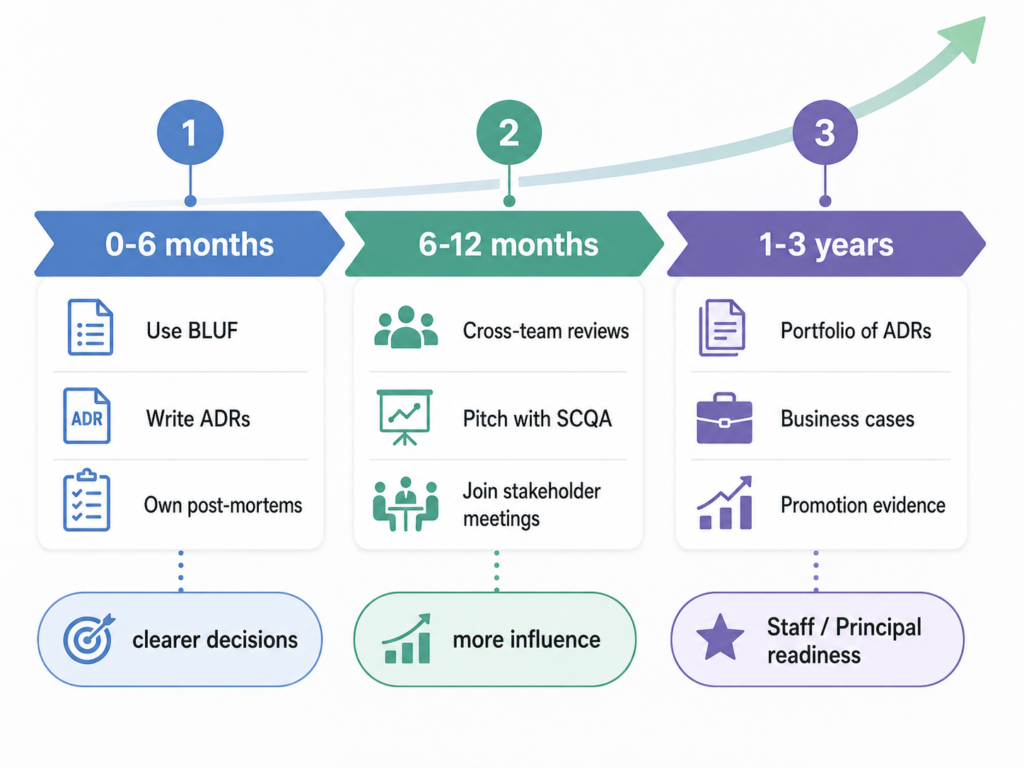
A realistic roadmap for building meeting fluency as a career asset runs across three phases, each with specific deliverables and career outcomes.
In the first six months, the focus is structural. Adopt BLUF for all written communication: design documents, status updates, incident summaries and ADRs. Run every standup update with the outcome first. Volunteer to write the post-mortem for the next significant incident your team has, regardless of whether it was your incident. If your organisation does not currently write ADRs, propose starting one for the next architecturally significant decision. You do not need permission to propose documentation. Measure your progress by the number of meetings you run that reach a decision, versus the meetings you attend that end inconclusively.
In the six-to-twelve-month window, expand scope. Identify two or three engineers on adjacent teams whose work intersects with yours and create deliberate opportunities to co-own a document or review. Use the SCQA structure to pitch one improvement initiative to your manager or skip-level, framing it in business rather than technical terms. Volunteer for at least one meeting that involves a non-technical stakeholder: a product manager’s quarterly review, a business unit’s capacity planning session, a vendor negotiation. These are the environments where the skills built in internal technical meetings transfer to the external influence that Staff roles require.
In the one-to-three-year window, the measure shifts from skill acquisition to demonstrated impact. By this point, an engineer who has been consistently applying these frameworks should have a portfolio of ADRs, post-mortems and business cases that constitutes concrete promotion evidence. The career outcomes at this stage depend partly on your organisation’s levelling structure. If you are at a company with genuine Staff and Principal rungs, earning £130,000-£180,000, this body of work supports a promotion case directly. If your organisation’s title structure is flat and the financial ceiling is around £90,000-£100,000 regardless of impact, the same portfolio is highly legible to external hiring managers and worth considerably more in a job move than in an internal negotiation.
Common Career Pitfalls
The most common mistake engineers make when they first encounter this framework is treating meeting fluency as an alternative to technical depth. It is not. At every level on the IC ladder, technical credibility is the foundation. BLUF does not compensate for an architecturally weak recommendation. A well-structured post-mortem does not substitute for the diagnostic capability that identified the root cause. The engineers who reach £150,000-£180,000 in Staff and Principal roles in UK cloud have both, not one or the other.
The second common mistake is waiting for a meeting problem to become painful before addressing it. The engineers who develop meeting fluency at mid-level arrive at senior with a head start on the skills that gate the next promotion. The ones who wait until they are stuck at senior are trying to learn facilitation, communication structure and executive translation simultaneously, while already frustrated by a plateau. The skills are learnable at any stage, but they take time to internalise and habit-form, and the compounding effect is strongest when development starts early.
Over-relying on certifications to signal progression is the third pitfall, and one worth naming directly. Our post on when certification ROI plateaus covers the data in full, but the relevant finding here is that additional certifications have diminishing returns above three to four in a single domain. The engineer who holds four Azure certifications and a CKA and is wondering why they are stuck at £90,000 rarely has a skills-gap problem. They have a visibility and communication problem. Another cert will not solve it.
ROI Analysis
The financial case for investing in meeting fluency is considerably stronger than for most professional development activities available to UK cloud engineers. A structured approach to building these skills, combining books on communication frameworks, focused practice in existing meetings, and deliberate volunteering for higher-stakes meeting types, costs approximately £200-£500 in reading material and perhaps fifteen to twenty hours of focused practice spread over six months.
The return is the senior-to-Staff or senior-to-Principal transition, which in UK cloud engineering adds £30,000-£50,000 to base salary and often a similar uplift in equity or bonus. At well-levelled firms in London’s financial and technology sectors, the total compensation uplift is larger still. The payback period on a £500 book investment that contributes to a £40,000 salary increase is measured in days of employment at the new level. No certification, however valuable, offers a comparable ratio.
The less visible return is career optionality. The engineer with meeting fluency, executive communication skills and a portfolio of ADRs and post-mortems is employable across industries and organisational types, not just in pure-play technology firms. Financial services, healthcare, retail and government all need cloud professionals who can operate in senior stakeholder environments. The meeting skills that unlock £130,000-£180,000 roles in tech are the same ones that command premium rates in industries where technical talent with business communication capability is scarce.
Next Steps
The actions below are concrete starting points, not aspirational suggestions. Pick the ones that apply to your current career stage and commit to them for ninety days before evaluating.
- Rewrite your next design document, status update or incident summary using BLUF: conclusion first, then reasoning.
- Volunteer to facilitate the next architecture review your team needs to run. Commit to producing an ADR as the output.
- Write a post-mortem for the last significant incident your team experienced, even if it happened three months ago. Publish it internally.
- Identify one meeting in the next month that involves a non-technical stakeholder and prepare for it using SCQA.
- Review your last three months of work and write three STAR statements, with quantified outcomes, ready to use in your next performance review or interview.
- If you have been at senior level for more than two years without a promotion conversation, request one explicitly. Use your STAR statements to frame the conversation. If the answer is that your company does not have a Staff track, treat that as useful information.