
Forty-seven per cent of UK IT leaders admit they are afraid to own mistakes at work, according to Adaptavist’s 2025 Digital Etiquette research across the UK, US, and Germany. That makes Britain statistically worse than both the United States (39%) and Germany (36%) on the single metric most likely to damage a cloud career: the ability to separate your accountability from your liability when something goes wrong. For cloud professionals sitting between £75,000 and £90,000 as senior engineers, this is not an abstract cultural observation. It is a financial problem. The engineers who cross the £100,000 to £130,000 threshold into principal and staff roles are not the ones with the deepest technical specialisms. They are the ones who learned to navigate organisational blame before it navigated them, and the gap between those two groups is learnable.
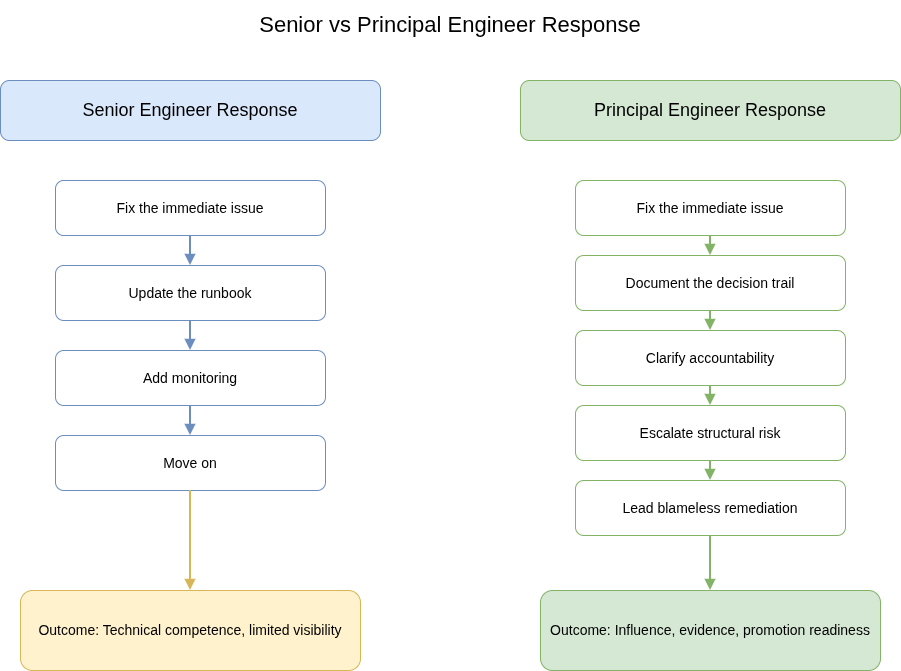
The standard response to being blamed for a failure is a technical one. Engineers improve runbooks, add monitoring, and sharpen their incident response. These are the right technical instincts and the wrong career instincts. The Uptime Institute’s 2025 Annual Outage Analysis found that 85% of outages attributed to human error trace back not to careless engineers but to flawed procedures, inadequate documentation, or staffing pressures created by budget decisions made well above the operations floor. Third-party providers account for roughly two-thirds of publicly reported major outages over the past nine years. Responding technically to a structural and political problem is precisely how technically excellent engineers plateau at senior level while less technically brilliant colleagues advance to principal and staff roles paying £20,000 to £30,000 more.
The career skill that separates £75,000 senior engineers from £100,000-plus principals has a name in the Site Reliability Engineering world: blameless culture. Building that culture around your individual practice, regardless of whether your organisation has adopted it, is one of the most financially significant moves available to you this year. A cloud architect at a UK financial services firm spent two years stuck at senior engineer before she began systematically documenting her risk escalations and architectural decisions in writing. Within eighteen months she had moved to a staff engineering role at a competitor at £115,000, partly on the strength of an Architecture Decision Record repository and a series of timestamped risk register entries that demonstrated, objectively, what she had flagged and what had been overruled above her. What follows is the playbook she used.
The Market Reality Behind the Senior-to-Principal Jump
UK cloud and platform engineering salaries have a deceptively flat appearance at the mid-to-senior boundary. According to IT Jobs Watch’s rolling medians to May 2026, a DevOps Engineer commands £70,000 at median, and a Senior Cloud Engineer sits at £75,000. The gap from senior to principal looks modest on paper but is anything but in practice: Principal Cloud Engineer reaches £100,000 at median, with Staff Software Engineers averaging £106,372 according to Indeed UK’s May 2026 data. At the top decile, principal and staff roles regularly reach £130,000 to £150,000, particularly in London financial services and regulated infrastructure environments. Hays UK places London cloud architect base salaries at approximately £80,000 to £97,500, with experienced cloud architects commanding contractor day rates of £550 to £700.
That £25,000 to £30,000 gap between senior and principal is significant, but what is more significant is what buys it. It is not Terraform expertise or Kubernetes certification depth. The senior engineer who plateaus typically has excellent technical output. The principal engineer who breaks through has excellent written output and a track record of influencing decisions above their direct team. The critical differentiator, as every serious analysis of the staff and principal engineering archetype concludes, is influence without authority: the ability to shape outcomes across teams and up the management chain without holding formal authority over any of them.
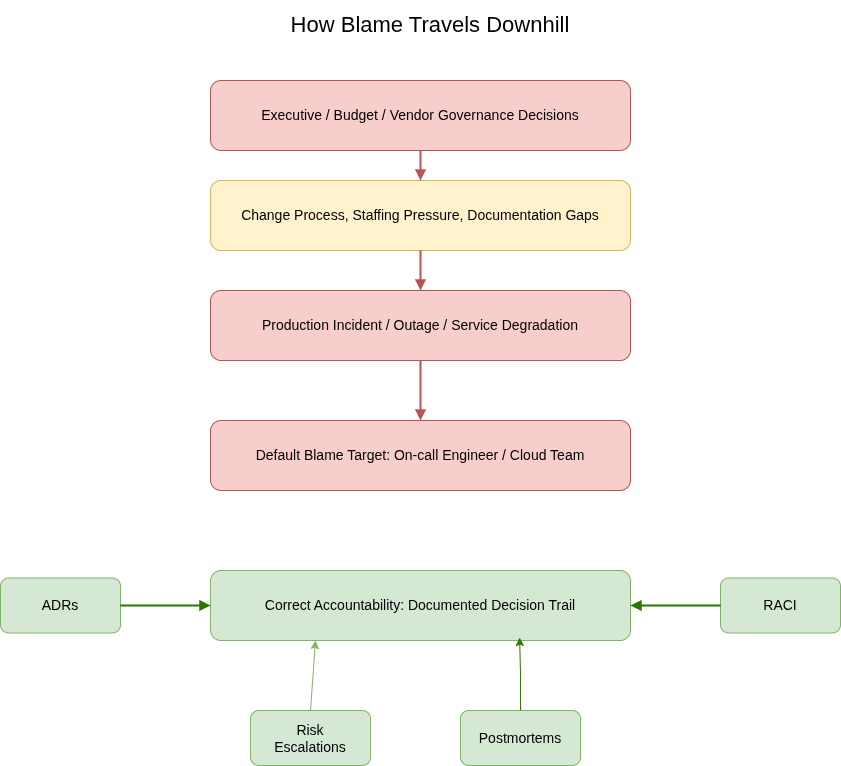
This matters directly for the blame problem. In a pathological organisation, the person closest to the incident gets blamed. In a well-run organisation, accountability flows to the decision that created the conditions for the incident. The engineer who has built a written record of their decisions, risks, and escalations has engineered their own protection. The engineer who keeps everything in their head is exposed every time something goes wrong.
Why Blame Travels Downhill and What the Data Actually Shows
Ron Westrum’s organisational typology, originally developed in healthcare and later adopted by the DORA research programme underpinning the State of DevOps reports, classifies organisations into three types based on how they handle information and failure. Pathological organisations are power-oriented: messengers are shot, failure is hidden, and responsibilities are shirked. Bureaucratic organisations are rule-oriented: responsibilities are narrow and failure prompts a search for who broke the rule. Generative organisations are performance-oriented: information flows freely, failure leads to inquiry, and responsibilities are shared. The DORA 2024 report reconfirms that generative culture is one of the strongest statistical predictors of software delivery performance, and that the change failure rate in elite-performing teams runs at 0-15% versus 46-60% in low-performing teams.
Most UK IT environments sit somewhere between pathological and bureaucratic, which is exactly what the Adaptavist research documents. When 42% of global IT leaders say their organisation prioritises speed over quality, and 39% say excessive workloads could cause a major incident, the conditions for misattributed blame are structural, not accidental. The Gigamon research adds a critical feedback loop: among leaders who recognise blame culture in their organisation, 94% say it directly slows the speed of incident reporting. Blame culture does not just damage individual careers. It extends outages and makes the next failure more likely.
The CrowdStrike Falcon Sensor incident of 19 July 2024 is the most instructive recent example at scale. Approximately 8.5 million Windows machines crashed globally due to a faulty sensor content update that bypassed adequate testing controls at the vendor level. The estimated cost to US Fortune 500 companies alone reached $5.4 billion. The UK’s Financial Conduct Authority subsequently issued explicit operational resilience guidance to UK regulated firms, requiring them to review change management processes for vendor-pushed software and content updates, and to phase releases rather than deploying globally in a single wave. The failure was in vendor governance and customer change management architecture. Yet in the weeks that followed, on-call engineers across the UK were fielding questions from executives about why “the team” had let it happen. The engineers who had documented their reservations about auto-update policies before that date emerged from those conversations with their reputations intact.
The Practical Playbook: Building Your Paper Trail
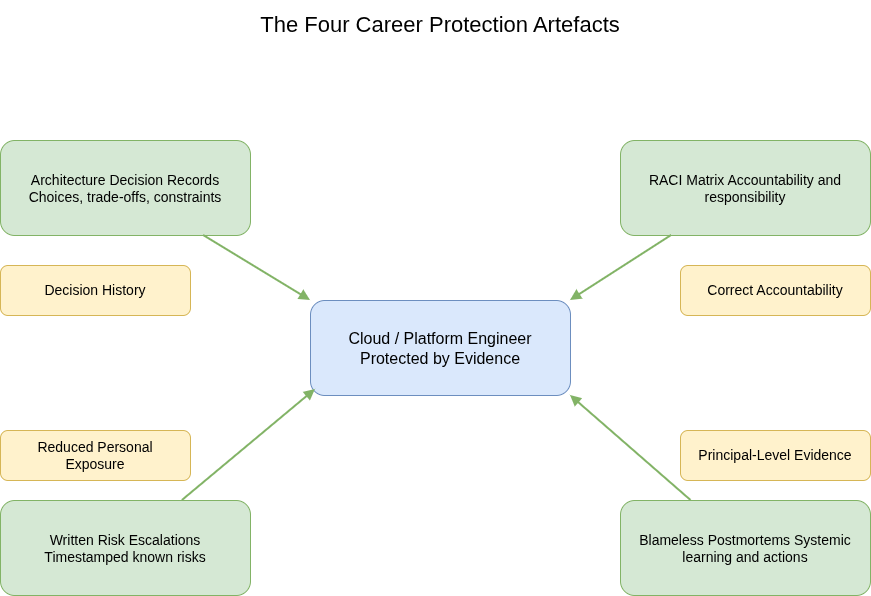
This is not about covering yourself or playing politics. It is about making the actual root causes of failures visible in a form that survives the incident. The Google SRE book puts it plainly: you cannot fix people, but you can fix systems and processes to better support people. The four artefacts below do exactly that, and they are the written output that distinguishes principal-level engineers from their senior counterparts.
Architecture Decision Records
An Architecture Decision Record is a short, immutable document that captures a significant architectural or operational decision, the context that drove it, the alternatives considered, and the trade-offs accepted. Michael Nygard popularised the format in 2011; both the Microsoft Azure Well-Architected Framework and AWS Prescriptive Guidance now recommend ADRs as standard practice. An ADR is append-only: once accepted, it is never rewritten, only superseded by a newer record. This is what gives it its career protection value. If a decision made two years ago contributes to a production incident today, the ADR shows who was consulted, what alternatives were proposed, what risks were documented, and what constraints existed at the time. You are never asked to defend a technical choice made by a past version of yourself in a vacuum.
The practical implementation requires minimal overhead: a Git repository of Markdown files named by date and decision is sufficient. The discipline is completeness. Every significant architectural choice, every approved-over-engineering-objection shortcut, and every “we would prefer X but budget constrains us to Y” decision needs its own ADR. The engineers who arrive at a post-incident review with an ADR repository covering twelve months of decisions are demonstrating the written-output behaviour that principal promotion panels look for, regardless of whether the promotion conversation has started.
RACI Matrices for Critical Changes
The Responsibility Assignment Matrix, as codified in ITIL and used across enterprise change management, distinguishes four roles for every activity: Accountable (one person, owning the outcome), Responsible (those who do the work), Consulted (those whose input is required), and Informed (those kept up to date). In incident management, the RACI converts “the cloud team caused the outage” into a factual record of who approved the change window, who flagged the risk, who owned the vendor SLA, and who made the call to proceed. You cannot always prevent bad decisions. You can ensure you are correctly placed on the RACI before the decision is made, and that the RACI itself is visible to at least one stakeholder above your immediate team.
The senior engineer who fills in RACI templates mechanically is following process. The principal engineer who uses the RACI conversation to surface the right Accountable person for a high-risk change, and ensures that conversation is documented in writing, is doing something different: managing upward risk. This is one of the clearest practical demonstrations of influence without authority, the behaviour that consistently separates senior from principal in promotion panel feedback.
Written Risk Escalations
A risk escalation email is one of the most underused tools in a cloud engineer’s career. The formula is straightforward: the risk (for example, “we are running the AKS cluster on Kubernetes 1.27, which reached end of support in November 2024”), the consequence if unaddressed (“unpatched CVEs from December 2024 onwards, with potential compliance exposure under our FCA operational resilience obligations”), the resource required to mitigate (“one sprint to upgrade, blocked on approval for a change window”), and the decision requested (“can you approve the change window for Q1, or formally accept the risk?”). Send it by email, not Slack. Email is timestamped, searchable, and admissible in a post-incident review. Slack threads get archived and deleted.
The escalation email serves two purposes simultaneously. It asks for the decision to be made at the correct level, and it creates a contemporaneous record that the risk was known, documented, and escalated. If the risk materialises after the decision-maker responds, you have a record of what they decided. If they do not respond, you have a record of that too. This is what the high-stakes performance skills covered in Under Pressure: The High-Stakes Performance Skill That Separates £90K Engineers from £150K+ Principals look like in practice: not performing under pressure after the incident, but reducing the pressure you absorb by distributing accountability correctly before it.
Blameless Postmortems
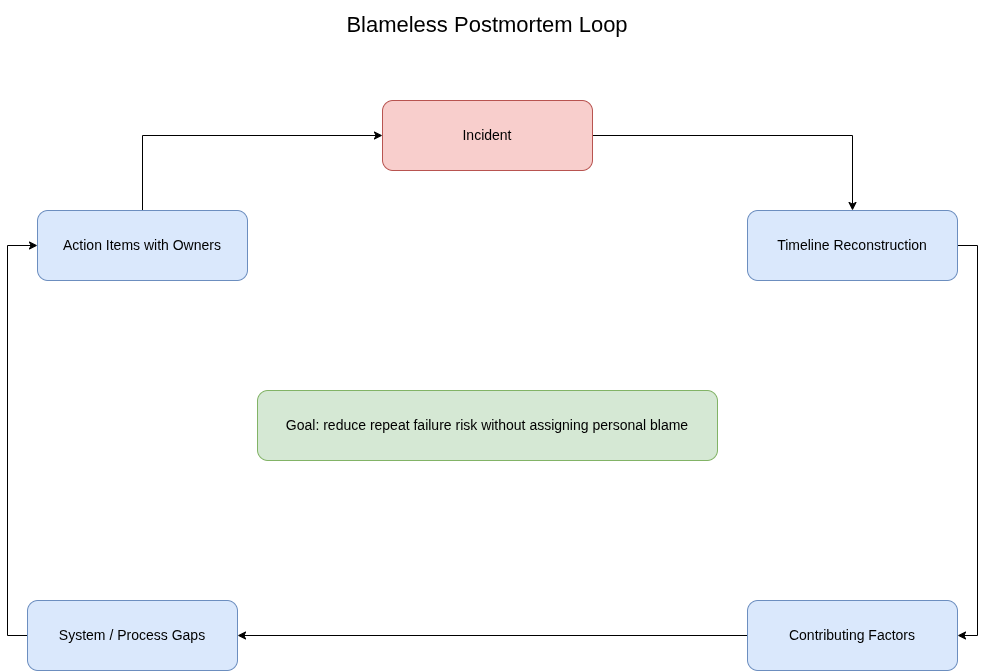
The Google SRE blameless postmortem format identifies contributing actions without identifying the actor as the cause. The investigation question shifts from “who broke it?” to “what allowed this to happen?” The postmortem documents the incident timeline, contributing factors, the impact, and, critically, the action items: each with an owner, a priority, and a due date. If your organisation does not have a postmortem culture, proposing the template is itself a principal-level move. You are influencing process across teams, creating institutional memory, and framing failure as systemic rather than individual. In UK regulated environments, this also aligns with FCA PS21/3 operational resilience requirements, which every FCA-regulated firm is legally required to demonstrate.
Business and Leadership Skills: The Narrative Is the Product
Technical documentation is necessary but not sufficient. The engineers who reach principal and staff level understand that the post-incident narrative is as important as the incident itself, and that it is shaped in the hours immediately following the event, not weeks later in a formal review.
At the senior level, the expectation is technical competence and honest reporting. At the principal level, the expectation shifts: you are expected to frame technical failures for non-technical stakeholders, to absorb organisational pressure without losing the factual ground of the situation, and to present a structured account that simultaneously explains what happened, acknowledges the organisational conditions that made it possible, and sets out a credible remediation path. Both the engineering-leadership version and the executive version of this narrative need to be true to the same facts. The ability to produce both from the same event, without overstating individual blame or understating organisational accountability, commands the £15,000 to £25,000 salary premium that separates senior from principal in UK market data.
Stakeholder management in a blame-culture environment also requires calibrated honesty about vendor risk. UK organisations that had documented their change management governance for vendor-pushed updates before July 2024 were in a materially different regulatory position after the CrowdStrike incident. The FCA required firms to demonstrate exactly this capability. Engineers who understand the compliance dimension of operational resilience, and who can translate that into architecture decisions, risk registers, and change management practices, are producing value that purely technical engineers cannot.
Budget and risk trade-off communication is a skill that is systematically underdeveloped at senior level. As covered in The Certification Plateau: Why Your 5th Cloud Cert Won’t Boost Your Salary, the engineers who plateau have often accumulated credentials without developing the ability to communicate the organisational cost of technical debt in terms that finance and executive leadership can act on. “We need to upgrade Kubernetes” does not move budgets. “We are carrying £180,000 of unmitigated compliance risk by running end-of-life Kubernetes nodes, and a three-sprint uplift costing £45,000 in engineering time eliminates it” does. That framing is the business skill that the market prices at principal level.
Career Progression Roadmap
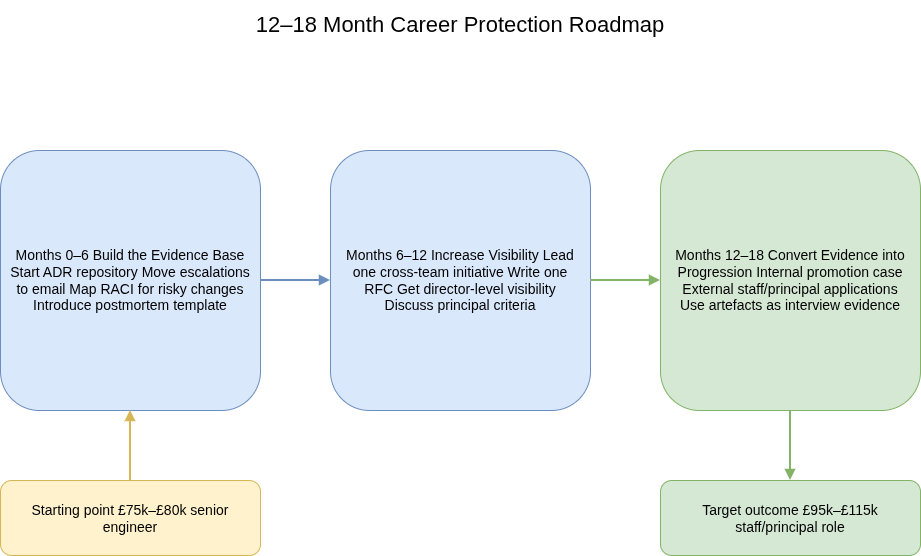
The starting position for most engineers reading this is the same: stuck at senior, doing excellent technical work, repeatedly underestimated in promotion rounds, and absorbing blame for failures with systemic causes. The roadmap below is calibrated for that starting point.
In the first six months, the focus is infrastructure. Build your ADR repository even if the organisation has no culture of it. Switch to email for risk escalations rather than Slack. Map the RACI for the two or three highest-risk changes in your area. Attend one post-incident review and propose the blameless format, framing it explicitly as a mean-time-to-recover improvement rather than a culture initiative. None of this requires permission from your organisation.
By twelve months, the goal is visibility above your immediate line manager. This means leading one cross-team initiative, writing a technical RFC or proposal that reaches director level, and having at least one documented conversation with your manager about what the promotion criteria for principal or staff look like in specific behavioural terms. If those criteria do not exist in writing, requesting them is itself the kind of initiative that gets noticed.
The one-to-three year view depends on whether your current organisation can actually promote you. If principal and staff tracks do not exist, or if the salary band for principal is capped below £90,000, the documentation work you have built is best understood as portable evidence for an external move. UK labour market data consistently shows a significant premium for changing employers: median earnings growth has historically run roughly twice as high for job changers as for stayers in comparable roles. Target compensation at the eighteen-to-twenty-four month mark for a cloud engineer currently at £75,000 to £80,000 who executes this roadmap: £95,000 to £115,000, either through internal promotion or a move into a staff or senior staff role. In London financial services or regulated infrastructure, add 10 to 15 per cent to the upper range.
Implementation Strategy
Learning the concepts is straightforward. Implementing them against organisational resistance is where most engineers stall. Three patterns work reliably.
First, frame every documentation practice as engineering best practice, not culture change. Architecture Decision Records appear in Microsoft’s Well-Architected Framework and AWS Prescriptive Guidance. RACI matrices are ITIL standard. Blameless postmortems are Google SRE practice. These are industry-standard engineering artefacts, not soft-skills interventions, and that framing gets past the instinctive organisational resistance to anything that sounds like transformation.
Second, start with your next incident, not your last one. Proposing a retrospective blameless review of a six-month-old incident is politically complex. Proposing a blameless postmortem template for the next significant incident is a process improvement. Agree the template before the incident happens; it is far easier to adopt when pressure is low.
Third, build your personal portfolio alongside any organisational artefact. Your ADR repository, risk escalation archive, and postmortem contributions are yours, not your employer’s. Maintain copies in personal cloud storage. When you interview for principal roles, this is your evidence base: not a certification list, but a demonstrated track record of architectural decision-making, risk management, and incident leadership. Contributing that template to GitHub, writing about your risk escalation practice, or presenting a case study at a CNCF or AWS User Group event converts private practice into a public signal of seniority. The approach mirrors exactly what Technical Mentoring as Career Capital documents: knowledge made visible is knowledge that pays.
Measuring Progress and Avoiding the Common Traps
The metrics that matter for this career path are not the ones most engineers track. Concrete targets for a twelve-month campaign: fifteen to twenty ADRs covering significant decisions across your main work areas; at least four written risk escalations sent to line management or above, each with a documented response; one blameless postmortem led or co-authored; one cross-team technical initiative with visible director-level exposure. These numbers represent roughly one ADR per working fortnight, one risk escalation per quarter, and a postmortem and initiative that together demonstrate the influence-radius behaviour that principal promotion panels look for. Most engineers do not gather this evidence deliberately, which is why most engineers cannot present it on demand.
The most common pitfall is over-investing in technical depth as the substitute for organisational visibility. Engineers who spend their twelfth year in cloud adding a third specialty certification while producing no written artefacts that circulate above their team are making a career allocation error. IT Jobs Watch confirms the point mechanically: Senior Cloud Engineer median (£75,000) versus Principal Cloud Engineer median (£100,000) is not a technical skill gap. Both cohorts have deep technical skill. It is an organisational breadth gap, and certifications do not close it.
The second pitfall is investing in documentation in a genuinely pathological organisation and expecting it to provide protection. It will not, reliably. In pathological cultures, documented risk escalations are sometimes used against the engineer who raised them. The Westrum self-assessment is worth doing honestly: score your team against the six DORA generative culture indicators. A score consistently below 2 means your documentation is most valuable as portable evidence for your next role. The threshold for leaving should be twelve months of documented escalations with no meaningful organisational response, or a single post-incident review in which your documented concerns were materially suppressed. The documentation is valuable either way: as protection if the culture improves, and as your next employer’s evidence base if it does not.
The ROI Case
The financial case is straightforward to calculate. If you are currently at £75,000 as a senior engineer and execute this roadmap over twelve to eighteen months, the target outcome is a principal or staff role at £100,000 to £115,000. The mid-point of that range represents a £32,500 annual improvement, compounding at every subsequent salary review. The investment is approximately two to three hours per week in documentation, escalation writing, and cross-team initiative work: roughly 130 hours over twelve months, costing no money and requiring no employer permission.
Compare this to the certification track. An AWS Solutions Architect Professional or equivalent advanced certification costs £350 to £500 in exam fees and 100 to 120 hours of study time. According to Hays UK salary guidance, advanced certifications deliver a premium of roughly 10 to 15% at mid-level, meaning £7,500 to £11,250 on a £75,000 base. Worthwhile as part of a broader development plan, but not the primary lever for closing the senior-to-principal gap. The payback period for the documentation playbook, assuming it contributes to a twelve-month promotion outcome, is approximately two weeks of post-promotion salary.
Next Steps
This week, open a Git repository or Notion page and write your first ADR. Choose a decision you made in the last month, document the context, the options you considered, and the trade-offs you accepted. Date it. This single action, repeated fortnightly, builds the principal-level portfolio evidence that certifications cannot replicate.
This month:
- Identify the one risk in your environment most likely to cause a production incident in the next quarter, and draft a risk escalation email with the risk, the consequence, the mitigation cost, and the decision required. Send it to your line manager. File a copy.
- Score your team against the six DORA generative culture indicators and record the result. Treat it as a leading indicator, not a verdict.
This quarter:
- Attend or watch a published blameless postmortem from Honeycomb, PagerDuty, or Etsy. Build your template before you need it.
- Identify one cross-team problem that crosses at least two team boundaries and draft a one-page RFC. Get it in front of a director or VP. This is the staff-engineer entry move.
If you have been at senior level for more than two years without a defined path to principal: test the market now. The principal engineer median sits at £100,000 as of May 2026 according to IT Jobs Watch. Your documentation portfolio is the interview artefact that gets you there, not a fourth certification.
Useful Links
- IT Jobs Watch – Cloud Engineer salaries UK
- IT Jobs Watch – Principal Engineer salaries UK
- Adaptavist – Blame culture in the tech industry (press release)
- Uptime Institute Annual Outage Analysis 2025
- Google SRE Book – Postmortem Culture (free online)
- Martin Fowler – Architecture Decision Records
- FCA – CrowdStrike outage: lessons for operational resilience