

About a quarter of UK employees report high levels of workplace silence, according to CIPD research. In engineering teams the figure is likely higher, not lower. Engineers are trained to be precise, to avoid making claims they cannot substantiate, and to defer to authority structures they did not design. Those instincts serve you well when you are debugging a distributed tracing issue at 2am. They work against you when you are the most technically informed person in a room where a bad decision is about to get made. Staying quiet in that moment is not humility. It is abdication, and it carries a cost that compounds across your career in ways most engineers do not register until they have been Senior for five years with no movement in sight.
The standard career advice tells you to keep your head down, do excellent work, and let the quality speak for itself. That advice is largely responsible for the plateau. Google’s Project Aristotle studied more than 180 teams over two years and found psychological safety, the freedom to take interpersonal risks and challenge ideas without fear, was the single strongest predictor of team performance. The DORA research programme, spanning tens of thousands of professionals across multiple years, found the same cultural norm predictive of software delivery performance. And yet McKinsey data shows that only 20% of organisations qualify as genuine “decision-making winners,” making high-quality, fast decisions consistently. The common thread in the failing 80% is not a shortage of technical expertise. It is a shortage of people willing to challenge a bad idea before it ships.
There is a four-part playbook for breaking the feedback trap. It covers reading the situation correctly before you speak, building a business case that lands with people who do not share your technical frame, choosing the moment to maximise impact and minimise unnecessary friction, and following through so that one feedback conversation creates a pattern of influence rather than a single uncomfortable incident. The engineers who reach Staff and Principal level in UK organisations, earning £130,000-£180,000 and above, are not the engineers who avoided difficult conversations. They are the ones who learned to have them well, and started early enough for it to compound.
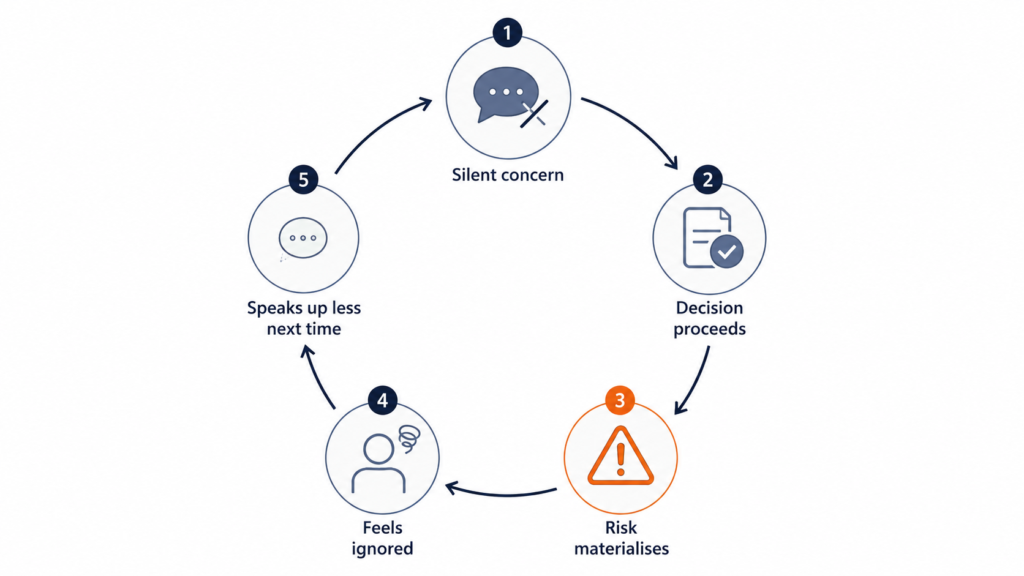
Why the Feedback Trap Exists
The Feedback Trap is not primarily about fear, though fear plays a part. The more powerful force is futility. CIPD research consistently finds that a sense of futility, the belief that speaking up will change nothing, is a stronger inhibitor of voice than anxiety about consequences. Engineers who have seen careful technical objections get overridden by a product manager with a deadline, or watched a well-reasoned RFC get shelved because it challenged the current architecture owner’s preferred approach, learn to calculate the cost-benefit in advance and conclude the cost is not worth it. The calculation feels rational. It is wrong.
Imposter syndrome compounds the problem at exactly the wrong point in an engineer’s career. A 2025 arXiv study of software professionals found the impostor phenomenon is associated with significantly lower wellbeing and is disproportionately common among experienced practitioners who, on paper, have the most grounds for confidence. The engineer who has been doing this for eight years and still second-guesses whether their architectural concern is “worth raising” is experiencing this pattern. The junior who hasn’t yet learned to doubt themselves raises it anyway, and occasionally catches something important.
British professional culture creates a third layer of complexity. UK workplace norms favour indirect, understated communication: “a few amends,” “something to think about,” “it might be worth considering.” Erin Meyer’s mapping of national communication styles consistently places the UK among the more indirect cultures in the professional world, particularly relative to the US, Netherlands, and Israel. The practical consequence for cloud engineers is that they may be giving feedback that doesn’t register as feedback, or receiving feedback that sounds like mild concern but actually means the project is in trouble. Both errors compound in regulated industries. The FCA now explicitly frames poor speak-up culture as a conduct risk, classifying serious bullying and harassment as misconduct across all SMCR-regulated firms from September 2026 and citing the link between silence and groupthink as a systemic vulnerability in financial services organisations.
The career cost of staying in the trap is concrete. Will Larson’s Staff Engineer is direct about the mechanics: “At most technology companies, you’ll reach Senior software engineer, the career level for software engineers, in five to eight years. Being promoted further is an exception rather than expected.” What makes someone the exception is not superior technical output. LeadDev’s research on Staff+ engineers found the three most commonly cited challenges were influencing and building relationships across the business, managing multiple high-priority priorities simultaneously, and navigating a rapidly changing business environment. None of those are coding problems. All of them require the ability to give and receive feedback across organisational lines, including upward. Engineers who stay quiet remain technically excellent Seniors. Engineers who learn to challenge constructively get pulled into planning conversations, decision rooms, and promotion slates.
Step One: Read the Situation Before You Speak
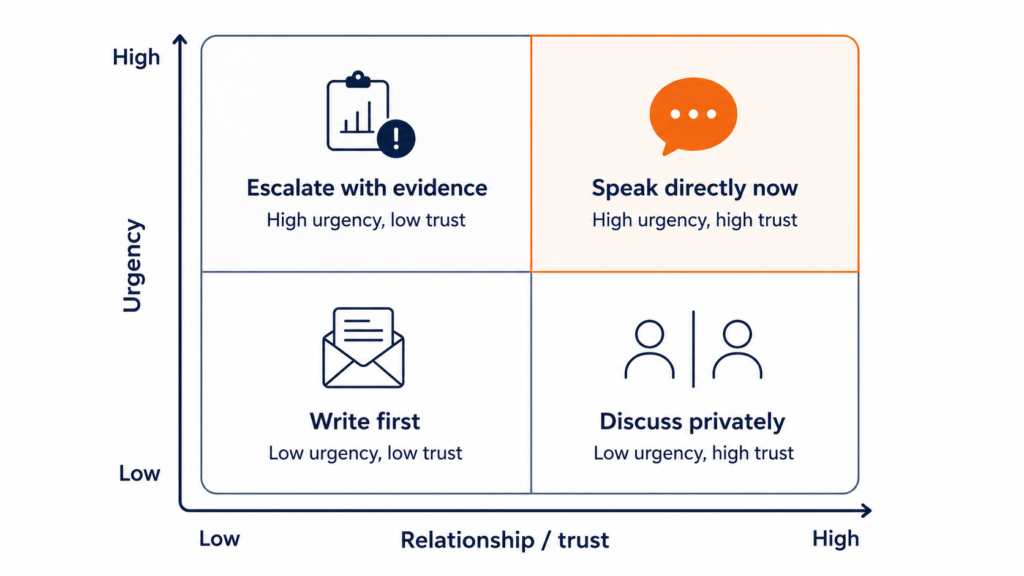
Not all feedback has the same risk profile, and treating a one-on-one with your manager the same as a cross-functional architecture review is a mistake that gets engineers burned. The first step in breaking the feedback trap is accurate situational assessment.
The variables that matter are relationship depth, reversibility of the decision, and your positioning in the room. Relationship depth determines how much interpretive goodwill you have with the recipient: a peer you have worked alongside for two years will receive a blunt observation differently from a stakeholder you met this quarter. Reversibility determines urgency. A concern about an architectural direction that has been committed to a roadmap but not yet built warrants a different level of directness than a concern about a live deployment that is actively causing incidents. Your positioning determines how your feedback will be received: a domain expert raising a concern within their domain carries more weight than a generalist raising the same concern outside it.
The Reitz and Higgins “Speaking Truth to Power” research, based on a five-year study and survey of more than 5,600 people across organisations, identifies five factors that determine whether speaking up works: conviction that your view has value, awareness of the political landscape, awareness of the social dynamics in the room, judgment about timing and framing, and honest assessment of the risk to yourself and others. Engineers who are technically excellent tend to score high on conviction and reasonably well on political awareness, but underestimate the social dynamics. The most senior person in the room hearing your feedback will filter it through their own agenda, their current pressures, and their read of your motives. Understanding that filter before you speak is not political cynicism. It is basic situational intelligence.
The practical output of this assessment is a simple decision: direct or indirect, now or later, in the room or in writing. For concerns that are time-critical, reversible, and within your domain, direct and immediate is usually correct. For concerns that are sensitive, involve power asymmetry, or require a business case to land properly, writing is usually more effective than speech. Executives and senior stakeholders read well-framed written analysis more carefully than they process verbal objections, particularly when the analysis respects their time and does not require them to hold a lot of technical context.
Step Two: Build the Case in Their Language
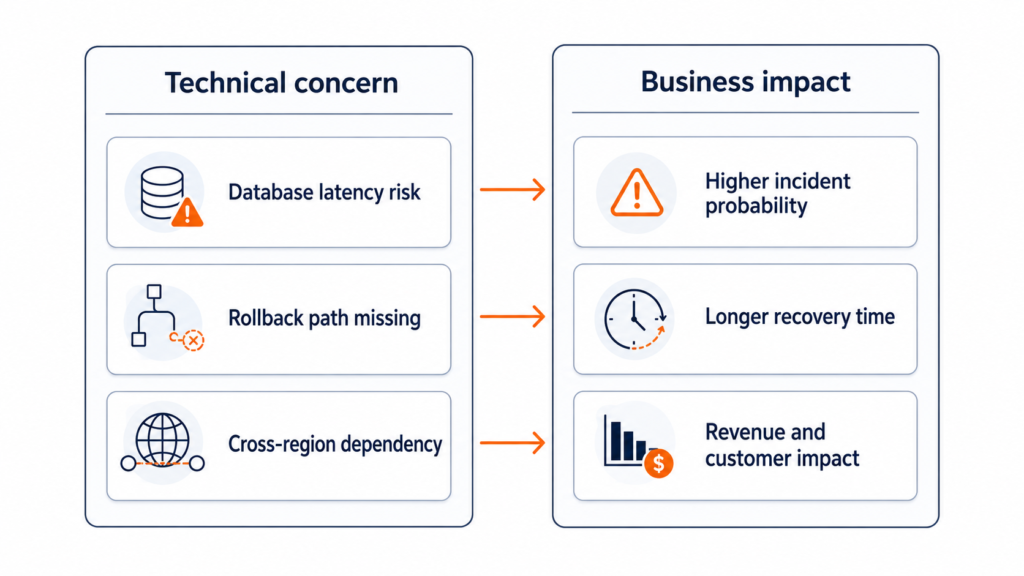
The most common reason technical feedback fails to land is that it is delivered in technical language to people who are making decisions in business language. “This approach introduces unacceptable latency at the database layer” is technically precise and strategically invisible. “This approach increases the probability of production incidents by approximately 60%, at an estimated cost of £50,000 per hour of downtime based on our current transaction volumes” is the same concern, framed for the people who will decide whether to act on it.
This translation is not dumbing down. It is a precision exercise in a different register. PMI research found that for every £1 billion invested in projects, approximately £75 million is at risk due to ineffective communication. The engineers who can speak fluently across both registers, technical and commercial, are the ones who get asked into the rooms where resource allocation decisions are made. The connection between this skill and salary progression is not incidental. As explored in our post on making your technical work visible to the people who control career decisions, the ability to translate technical impact into business terms is one of the clearest markers of readiness for Staff-level responsibility.
The SQCA framework, developed by Will Larson for senior engineering communication, gives the translation structure: Situation (what is the current state, briefly), Complication (what has changed or what is the risk), Question (what decision is needed), Answer (your recommendation). It maps to how executives process information, leading with context, surfacing the tension, and getting to the point. A three-paragraph written summary using this structure, shared before a decision meeting rather than raised verbally in it, consistently lands better than a spontaneous objection because it gives the recipient time to think and arrive at the meeting already oriented.
Specific language patterns matter too. Replacing “this won’t work” with “this creates a specific risk I can quantify” shifts the conversation from confrontational to analytical. Attaching probabilities rather than absolutes, “a 60% probability of production incidents” rather than “this will definitely cause incidents,” makes your assessment feel calibrated rather than alarmist. Framing in terms of trade-offs rather than objections, “we can do this on this timeline if we accept this risk, or on this longer timeline with this risk profile,” gives the decision-maker agency rather than making them defend a position they have already committed to.
Step Three: Choose the Moment
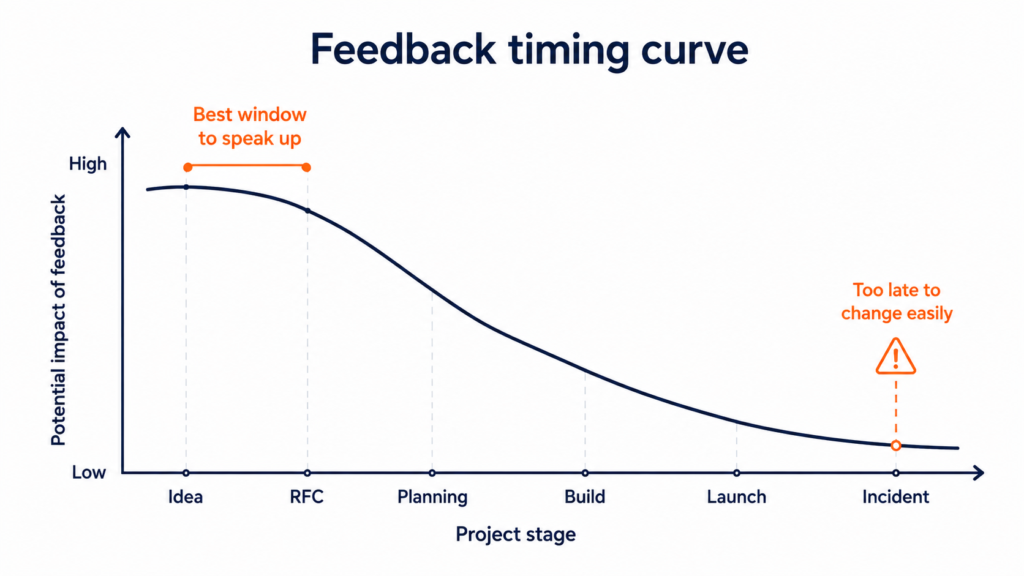
Timing is the most underrated element of effective feedback, and the one most engineers get wrong in a specific direction: they wait too long, until a decision has hardened, and then raise the concern in a context where the recipient has too much ego invested to change course.
The principle from the research is clear: deliver feedback as close to the triggering event as possible, while the decision is still open. In practice this means raising architectural concerns during the RFC or design phase, not during sprint planning when the approach has already been committed. It means flagging a delivery risk in a one-on-one before the status update to senior leadership, not during it. It means having the uncomfortable conversation about a colleague’s behaviour in your next regular meeting, not six months later when it has become a pattern that is affecting the whole team.
For upward feedback specifically, the timing question is more nuanced. The research on feedback backlash shows that overwhelming a manager or executive with feedback they did not solicit, or delivering it in a context where they feel ambushed, produces defensive rather than receptive responses. Asking permission, briefly, before delivering significant upward feedback changes the dynamic: “I have an observation about how our planning process is creating risk, and I would like five minutes to share it. Is now a good time?” creates a frame of consultation rather than confrontation.
The most dangerous timing mistake is the one that feels like wisdom: waiting until you are certain. Certainty about technical risk often comes too late to be useful. A concern raised at 70% confidence, clearly flagged as such, is more valuable than the same concern raised at 95% confidence two sprints after the ship date. Senior engineers who stay quiet until they are certain are often the engineers who say “I knew that was going to happen” after an incident they could have prevented. That is the feedback trap operating at full cost.
Step Four: Deliver and Follow Through
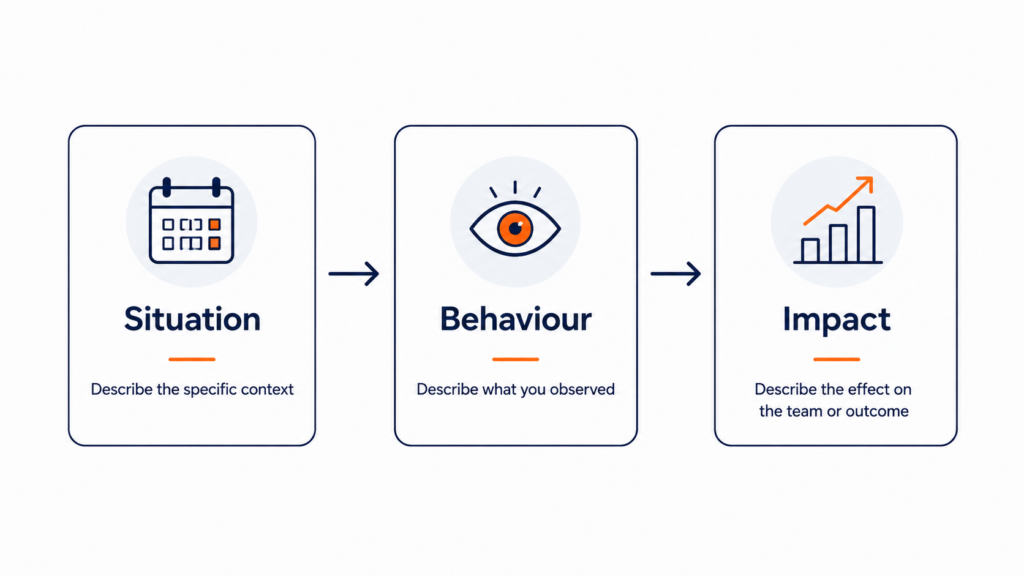
The SBI framework, from the Centre for Creative Leadership, is the most reliable structure for delivering feedback that does not trigger defensiveness. Situation describes the specific context. Behaviour describes what you observed, not what you infer about intent. Impact describes the effect on the team, the system, or the outcome. “During yesterday’s design review (Situation), the rollback plan wasn’t discussed before the proposal was merged (Behaviour), which means if this fails in production we have no tested recovery path and the incident duration will be significantly longer than necessary (Impact).” The structure keeps the feedback factual, depersonalised, and actionable.
The common failure mode that Kim Scott calls Ruinous Empathy is exactly the feedback trap by another name. Caring about someone enough to avoid telling them something they need to hear is not kindness. It is a failure to be useful to them. Engineers who avoid difficult feedback with peers are often protecting themselves, not the other person, because the conversation feels uncomfortable. The test is simple: if the information would help them do better work, improve the system, or protect their career, withholding it is self-serving, not considerate.
Follow-through is where most engineers drop the ball. A single feedback conversation, however well delivered, rarely changes a pattern. The engineers who develop genuine influence, the kind that gets recognised at Staff level and above, create a consistent pattern of constructive challenge over time, in code reviews, in retros, in RFCs, in one-on-ones. As discussed in our post on how teaching others compounds career value at the Senior and Principal levels, the most visible engineers in an organisation are typically the ones who raise the quality of thinking around them consistently, not the ones who produce excellent individual output quietly.
Blameless retrospectives are worth championing specifically because they create the structural conditions in which everyone’s feedback surfaces, not just the most senior person’s. Google’s SRE practice runs blameless post-mortems within 48 hours of a significant incident, operating on the assumption that everyone acted with the best intentions given the information they had and that the goal is to understand the system, not assign blame. The practical effect is that engineers who would otherwise stay silent about near-misses, process failures, and architectural concerns bring them into the open because the cultural frame makes it safe to do so. When you do not have that culture, you can still create the conditions locally, in your team’s retros, in your code review norms, in how you respond when someone raises a concern you disagree with.
The Career Case and Knowing When to Walk
The financial case for breaking the feedback trap is not speculative. Senior cloud engineers in the UK currently earn £75,000-£100,000 at the 75th to 90th percentile on IT Jobs Watch data. Staff and Principal roles, which require demonstrated influence and leadership rather than technical execution alone, sit at £130,000-£180,000 in base salary, and materially higher in total compensation at Big Tech employers where equity brings total packages into the £150,000-£300,000 range. The gap between Senior and Staff is not closed by more certifications or deeper platform expertise. IT Jobs Watch data shows that employers advertising Staff and Principal cloud roles are explicitly listing communication skills, mentoring, and stakeholder influence in their requirements alongside technical credentials.
The path from Senior to Staff is explored in detail in our analysis of what separates the engineers who reach Principal from those who plateau at Senior. The consistent finding is that engineers who develop influence skills early, and build a track record of constructive challenge, reach the point where they are “already operating at the next level” considerably faster than engineers who wait for the technical credibility to feel unassailable before speaking up. By that point, the engineers who started speaking up earlier have already been promoted.
Will Larson’s framing on sponsorship is important here. The transition from Senior to Staff rarely happens on merit alone. It requires someone at the right level of the organisation who will advocate for you in the rooms where headcount and promotion decisions are made. Sponsors, unlike mentors, advocate rather than advise, and they advocate for people whose judgment they have had the chance to observe. Engineers who stay quiet give potential sponsors nothing to observe. Engineers who give well-framed feedback in cross-functional settings, who challenge architectural directions with evidence rather than assertion, who raise delivery risks early enough that they can be managed rather than absorbed, give sponsors exactly the evidence they need.
The playbook above works when the organisation is fundamentally functional and the feedback trap is a personal habit. It does not work when the organisation’s culture actively punishes speaking up. CIPD data finds that approximately 40% of employees who raise concerns about serious misconduct experience retaliation. That figure is a useful threshold: if you are giving well-framed, business-anchored feedback consistently and experiencing either retaliation or sustained non-engagement, the limiting factor is the organisation, not your delivery.
Distinguishing between a fixable technique problem and a broken culture is itself a senior skill. The markers of a broken culture are consistent rather than situational: concerns raised well get ignored regardless of framing, decisions made without input from domain experts consistently, and raising risks is treated as obstructionism rather than due diligence. In regulated industries including financial services and central government, where cloud engineers often operate, a culture that actively suppresses technical voice is increasingly a regulatory risk as well as a career risk. The FCA’s 2025 data showed 2,347 allegations of non-financial misconduct recorded across roughly 1,000 wholesale financial firms in a single year, a 72% increase from 2021, and the regulator has been explicit that speak-up culture is now within scope.
If two consistent quarters of well-executed feedback produce no change in influence, visibility, or your manager’s engagement with your career ambitions, the highest-leverage move is finding an employer whose culture rewards voice. The feedback trap is a habit you can break. A culture that punishes speaking up is not your problem to solve.
Next Steps
Start with the lowest-stakes version of the behaviour change, not the highest. Pick one forum this week where you have the relevant technical context and a view you have been holding back: a code review, a retro, an architecture discussion. Use SBI to frame it. State your view at 60-70% confidence if that is where you are, and say so. Notice what happens.
In your next one-on-one with your manager, raise one technical or delivery concern that you have been carrying privately. Translate it into business terms before you go in: what is the risk in money or time, what is your recommendation, and what is the decision you are asking them to make. Use SQCA if that helps you prepare.
Begin a brag document this week if you do not already maintain one. Every piece of feedback you give that changes a decision, every risk you flag that gets mitigated, every technical concern you raise that prevents a production incident, goes in that document. It is the evidence base for the sponsor conversation and the promotion case. The feedback trap does not only cost you in the moment. It costs you at review time, because the work you did privately has no visible record.
- [ ] Identify one feedback you have been suppressing and deliver it this week using SBI
- [ ] Prepare one upward concern in SQCA format for your next one-on-one
- [ ] Start or update a brag document with feedback-driven outcomes
- [ ] Review your last three retros: were you the person raising the difficult observation, or staying quiet?
- [ ] Identify whether your team has a genuine blameless retro culture, and if not, propose one
Useful Links
- CIPD Employee Voice Factsheet: UK-specific data on workplace silence, voice, and the conditions that suppress it, including the finding that a quarter of employees report high levels of silence
- Google re:Work: Understand Team Effectiveness: the original Project Aristotle research, with psychological safety as the top factor in team performance
- Will Larson, Staff Engineer: Leadership beyond the management track: the canonical text on influence without authority and the Senior-to-Staff transition
- StaffEng.com: interviews with Staff and Principal engineers on the feedback and influence skills that distinguish the level
- Centre for Creative Leadership: SBI Feedback Model: the Situation-Behaviour-Impact framework with worked examples
- Kim Scott, Radical Candor: the care personally, challenge directly model and the Ruinous Empathy failure mode