

The most expensive career mistake a senior cloud engineer makes is rarely a bad hire. It is a slow one. It is eighteen months spent at a salary band that has quietly become the room’s ceiling, in a team that was never designed to grow beyond the level you joined at. According to Ravio’s 2026 Compensation Trends Report, average engineering tenure now sits at 2 years 11 months across European tech companies. Yet the salary premium from switching employers is consistently 15-30%, compared with 3-5% for internal annual reviews. That gap compounds. A senior cloud engineer who stays two years past the point of structural stagnation typically leaves £20,000-£40,000 on the table, and misses the Staff-level progression window that becomes progressively harder to reach from outside.
Most career advice responds to this by recommending harder work, more certifications, and better visibility. That advice is not wrong. But it is answering the wrong question. Personal performance cannot fix a structural ceiling. The engineer who has spent three years building deep AWS expertise in a team where cloud is treated as IT plumbing is not stalling because of what they know. They are stalling because of where they are. Recognising that distinction early, and acting on it without burning bridges, is what separates engineers who reach £130,000-£180,000 in their mid-thirties from those who reach it a decade later.
This post is for two readers. The first is already in a role that feels stuck, looking for an honest diagnostic before making a move. The second is evaluating an offer and trying to read whether the company’s growth narrative reflects its actual design. Both decisions depend on the same skill: reading the structure, not the story.
What the UK Market Is Actually Paying in 2025-2026
Before making any career decision, anchor yourself to current market data rather than the salary you negotiated two or three years ago.
IT Jobs Watch, which aggregates advertised salaries from UK job postings, reports the following 2026 medians: Cloud Engineer at £70,000, Cloud Infrastructure Engineer at £75,000, and Principal Cloud Engineer at £100,000. The upper quartile for Principal and Staff-level roles clears £130,000. Bristow Holland’s 2026 UK Infrastructure and Cloud Salary Guide places Senior Cloud Engineers and Infrastructure Leads at £70,000-£95,000 or above, with specialist and architecture-focused enterprise roles regularly exceeding that range. Morgan McKinley’s 2026 London Salary Guide puts the Cloud Engineer band in London at £65,000-£90,000. Hays reports that sector-wide UK IT pay is rising 7-8% in 2026, with AWS Solutions Architect Professional and CISSP credentials commanding uplifts of up to 25% on base salary.
At the upper end of the market, the FinTech sector illustrates what the ceiling looks like when it is genuinely absent. Levels.fyi verified compensation data shows senior engineers at Monzo reaching £173,000 total compensation at the L5 band, with median total comp around £111,782. That is not representative of the broader UK market. But it is the ceiling visible from the other side of a move out of traditional enterprise or public sector.
Three structural facts matter for engineers earning £90,000-£130,000 at Senior level. First, the biggest pay jumps in UK cloud come from sector shifts, not annual reviews. Moving from public sector or legacy enterprise into financial services, hyperscaler partner consultancies, or cloud-native product companies typically adds £10,000-£25,000 without a change in level. Second, the jump to Staff or Principal is earned through ownership: production decisions made, costs reduced, architectural calls that can be defended in retrospect. Tenure does not earn it. Third, the counter-offer data is consistent across career coaches and recruiters: most engineers who accept a counter-offer leave within twelve months regardless, because the structural problem that triggered the job search was never compensation.
The Structural Warning Signs
Career researchers distinguish four types of career plateau. Two are relevant here. The hierarchical plateau means there is nowhere to be promoted to because the org chart does not contain the level above you. The structural plateau means the organisation was never designed to grow technical careers, regardless of individual performance. Both are invisible on a job description. Both are readable in the organisation’s design if you know what to look for.
The clearest signal is a flat team with no senior technical authority above you. If you are the most senior engineer on the cloud team and the layer above is a non-technical IT manager or a Head of Infrastructure with no cloud background, there is no credible internal route to Staff or Principal. Promotions to those titles require someone in the room who can evaluate the work and defend the headcount. Without that person, the title cannot be granted meaningfully. The observation made by Engineers Rising captures this directly: in such a team, upward movement is contingent on someone above you retiring or leaving. That is not a progression path. It is a vacancy dependency.
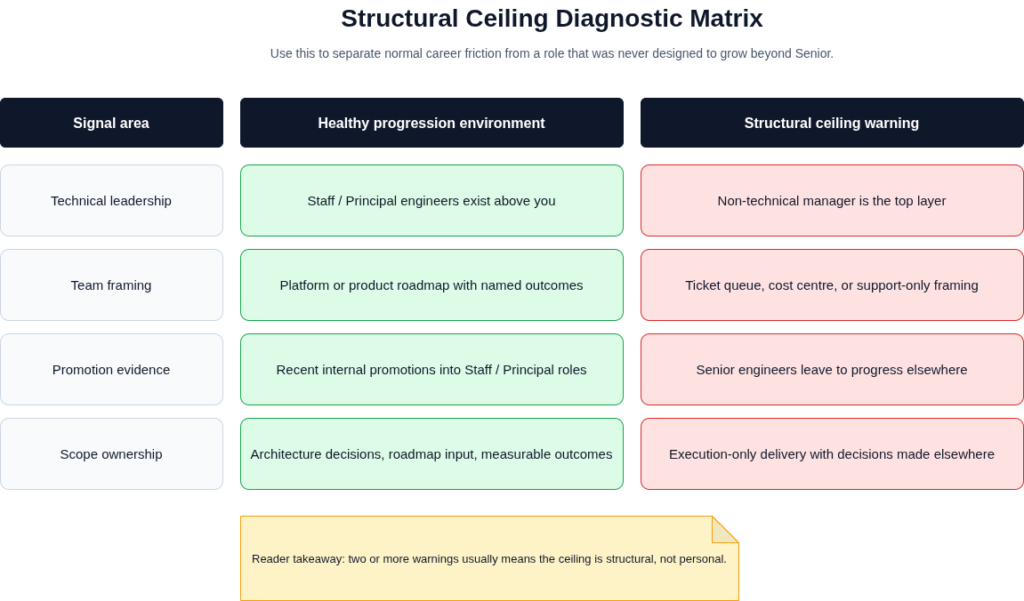
The second signal is how the cloud function is framed in the budget cycle. Cost centres receive cuts; platform and product functions receive headcount expansion. In organisations where cloud is treated as IT plumbing, measured purely on incident counts, ticket throughput, or spend reduction, there is no growth narrative for the team and no Principal-level scope to grow into. Contrast this with environments where the cloud or platform team owns a published technical roadmap, has named internal customers, publishes SLOs, and can demonstrate a measurable contribution to product velocity. The framing tells you what the ceiling is before any conversation about titles occurs.
No roadmap ownership is closely related. If the hiring manager cannot describe the team’s 12-month technical direction, or if that roadmap is managed entirely by a vendor or a separate architecture function that sits outside your team, the role is execution-only. Execution roles have a ceiling at Senior. Design and ownership roles do not.
Watch for internal mobility patterns too. Ask directly: when was the last engineer promoted to Staff or Principal from within this team, and where are they now? If the answer is vague, evasive, or accompanied by a gentle reframing of what those titles mean here, the level you are joining at is likely the level you will leave at. This question surfaces more structural information than any amount of discussion about “growth trajectory” or “learning culture.”
Organisational instability compounds all of the above. Two or more reorgs in a year, multiple manager changes for the role in the interview process, or recent VP and Director departures are consistent predictors that promotion cycles will be paused or reversed, regardless of individual performance. Structural disruption without a credible rationale and a clear end-state is not a temporary disturbance. It is an environment that will absorb your effort and return little.
Temporary Ceiling vs Permanent Ceiling: the Test That Matters
This is where senior engineers most often miscalibrate. A temporary ceiling and a permanent ceiling can look identical in the short term, and conflating them is how engineers either leave too early or stay too long.
A temporary ceiling is a function of timing. A recent reorg is still bedding in. A new engineering director has been hired and is six months into reshaping the job family structure. A budget freeze is tied to a specific fiscal cycle with a named end date. A Principal seat above you has just been filled, and the roadmap shows the function doubling headcount next year. Career development practitioners including Chrissy Scivicque frame the diagnostic this way: can you point to a specific, verifiable event in the next 6-12 months that changes the structural answer to your questions about progression? If you can, you may be at a temporary plateau.
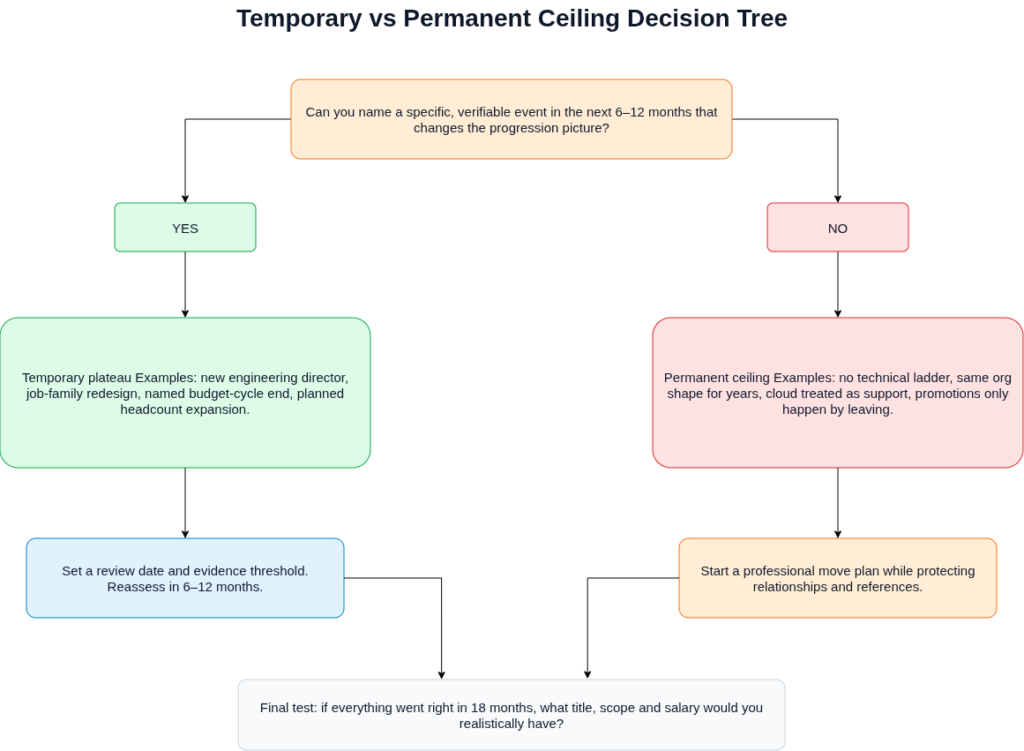
A permanent ceiling is a function of design. The org chart has been the same shape for years. The cloud function reports into a non-technical leader who has been in place for a decade. Senior engineers leave to be promoted elsewhere rather than internally. The company has no Staff or Principal title family at all. Or the business model does not require deep cloud capability – the cloud team is a support function, not a differentiator – and no business event in the next year will change that.
The honest version of the test: if everything went right over the next 18 months – your manager championed you, the budget expanded, the promotion cycle ran cleanly – what would your title and compensation actually be? If you can describe a credible answer with a specific salary and a named scope change, the opportunity is real. If the honest answer is “probably the same title and a 4% increase”, the ceiling is structural, and staying longer is not an investment. It is a cost.
Where the Ceilings Tend to Be, and Where They Do Not
No company type is uniformly good or bad for cloud career progression, but patterns hold clearly across the UK market.
Traditional public sector and Civil Service IT environments have structurally capped pay bands. Indeed data puts Senior Technical Lead salaries at HMG averaging around £77,000, constrained by Senior Salaries Review Body mechanisms that are deliberately resistant to market-rate adjustment. Cloud adoption in most central government departments has been managed through approved supplier frameworks, which means cloud engineering roles inside government frequently involve specification, procurement, and oversight rather than architectural ownership. That work is not without value, but it has a specific and visible ceiling.
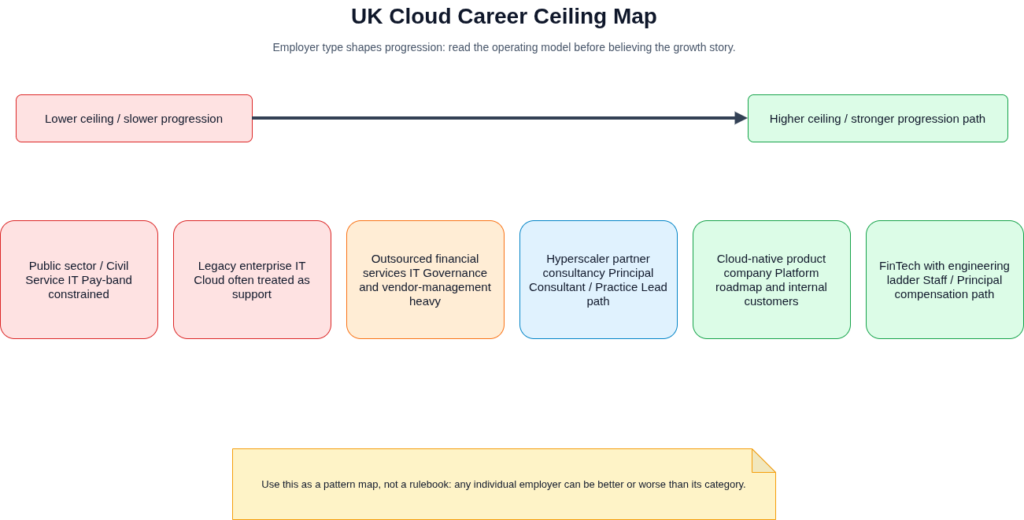
Legacy UK financial services IT follows a similar pattern for a different reason. Where cloud adoption has been managed through large managed-service contracts with systems integrators, the in-house cloud team often owns governance and vendor management rather than platform engineering. The ceiling is set by the outsourcing model. Senior engineers in these environments frequently find that the most effective move is lateral, into the consultancy or hyperscaler partner ecosystem rather than upward inside the incumbent.
UK-headquartered FinTechs with published engineering ladders are a consistent exception. Monzo’s published levels, Starling’s engineering culture as documented in Glassdoor reviews, and similar firms offer routes to Staff-equivalent compensation above £150,000 for engineers who reach that level internally. They are demanding environments, pace and expectation at Revolut and comparable firms are reported consistently as high by eFinancialCareers and community forums but the ceiling on the upside is structurally absent in a way that most enterprise environments are not.
Hyperscaler partner consultancies, the AWS, Azure and GCP advanced-tier partner firms where cloud is the core product offer a distinct but workable path. The route to Principal Consultant or Practice Lead is defined and repeatable. The tradeoff is client delivery pressure and limited equity participation. The ceiling is high; the track is a consultancy one rather than a product one, and engineers who know which they prefer will evaluate these roles accordingly.
Cloud-native product companies sit between these categories. The platform team is a first-class function with its own roadmap, headcount targets, and internal customers. Progression is more explicit than in traditional enterprise, and the compensation ceiling is set by market competition rather than pay-band policy.
How to Leave, UK-Specifically
If the diagnosis is permanent, execution matters as much as the decision itself. Senior cloud engineers carry reputational capital that compounds across a thirty-year career. How you leave has measurable consequences for what follows.
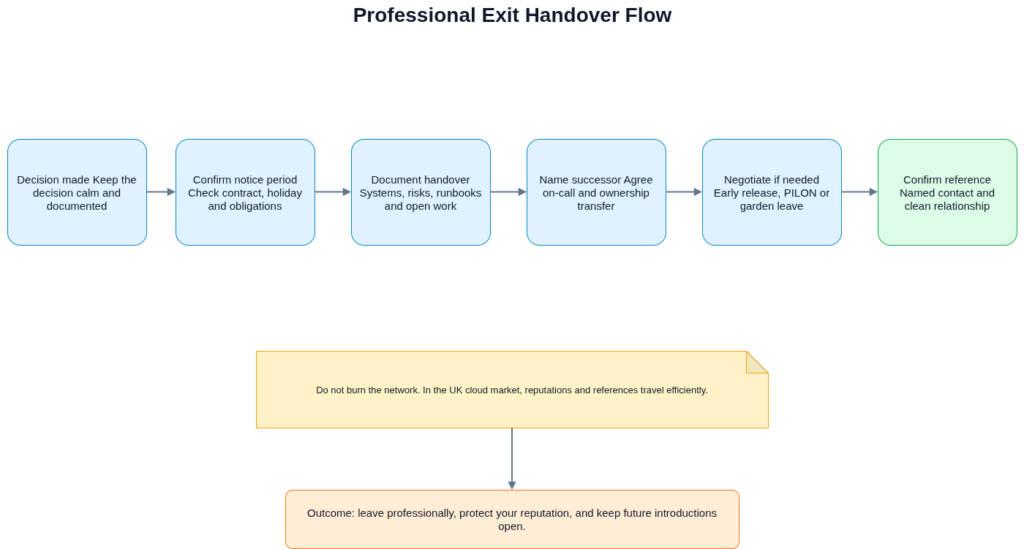
Honour your contractual notice. Senior UK cloud engineering contracts typically carry one to three months’ notice; architect and Principal contracts at larger organisations sometimes specify six. ACAS guidance and Reed’s published career advice are both clear that breaching notice puts your final pay, accrued holiday, and reference at risk. Robert Half’s UK resignation guidance is direct on this point: the professional relationship maintained through a clean notice period protects the testimonials and network introductions that have real long-term value. A graceful exit from a role that did not serve your career is still an asset. A fractured one is a liability.
Negotiate rather than unilaterally shorten. If the new role has a start date that falls inside your notice period, the right approach is a documented handover plan, a named successor for on-call responsibility, and a proposed early-release date. Employers regularly agree to garden leave or pay in lieu of notice, particularly when the alternative is an unproductive engineer working through a resentful final month. If they decline, work the notice. The cost-benefit of a clean reference far exceeds a few additional weeks.
Expect garden leave in competitive or senior roles. For Principal and Architect contracts at FinTechs and consultancies, garden leave is now standard and restrictive covenants are enforceable. Confirm the covenant dates in writing before your last day, and use the time to prepare for the next role rather than to rush the search that is already complete.
Manage the reference proactively. Before your last day, confirm by name and contact email who will act as your reference. A brief, factual resignation letter that explicitly offers transition support leaves the relationship in a position where a strong reference can be given twelve months later, well after the friction of the exit has faded. Reactivate your network three months before you intend to move. Senior cloud roles in the UK fill disproportionately through warm introductions and specialist recruiters including Hays, La Fosse, and Bristow Holland. Conversations held while still in role carry different weight than cold outreach made after departure.
The Financial Case for Moving at the Right Time
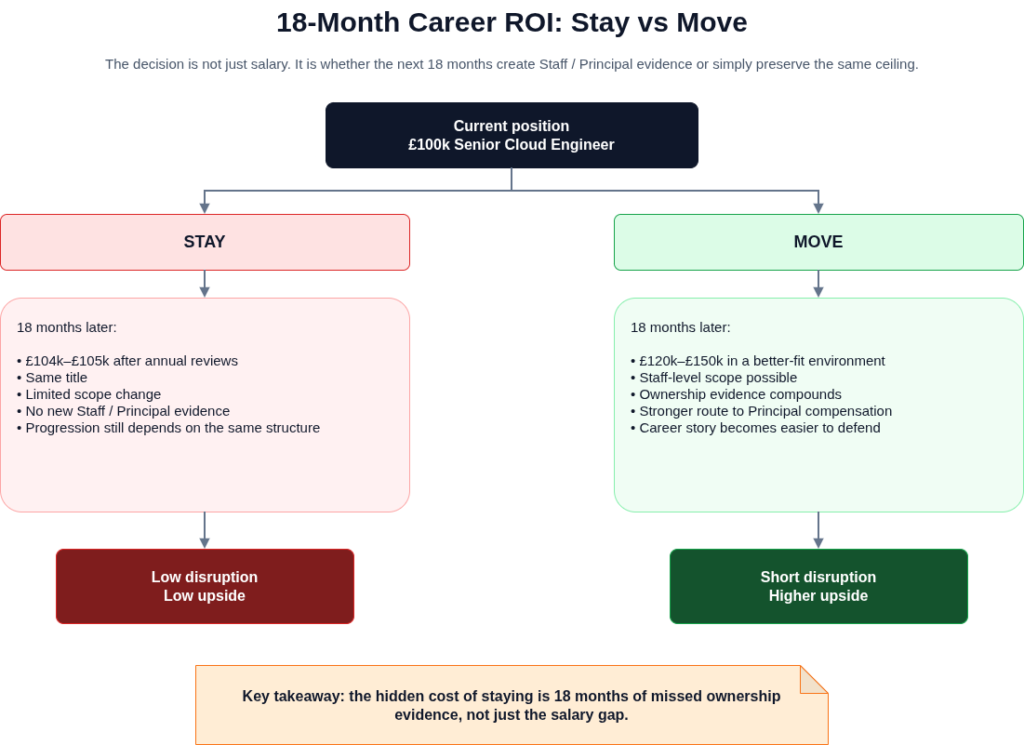
The ROI calculation on a well-timed move is straightforward. An engineer at £100,000 in a role with a structural ceiling might achieve £104,000-£105,000 through a strong internal review in the current market. The same engineer, moving to a cloud-native product company or FinTech at Staff level, enters a £120,000-£150,000 band sometimes higher when equity and performance bonuses are included. The friction costs of moving are real: notice period disruption, the adjustment period in a new environment, the 3-6 months before full productivity. Those costs are also, in most cases, recovered within the first year of the new salary. They never recover on their own if you stay.
The path to Principal where total UK cloud compensation reaches £140,000-£180,000 for the strongest roles requires building a track record of ownership decisions with measurable outcomes. That track record can only be built in an environment designed to give you the scope for it. If the current role is not that environment, the investment of another eighteen months there has a negative expected return.
If the diagnosis is a permanent ceiling, the next question is what you are moving into. Our UK cloud employment model guide breaks down the compensation, progression ceiling, and lifestyle trade-offs across internal IT, consultancy, vendor, and contracting roles, with 2026 salary data at each level. For engineers considering a move into cost governance and FinOps architecture, our FinOps career path post addresses the specific progression track in detail.
What to Do This Week
Apply the permanent-or-temporary test honestly. Write down the answers to three questions:
- Is there a credible technical authority above me with the budget and intent to promote?
- Is the cloud function framed as a platform with a roadmap, or as a cost centre with tickets?
- Can I name a specific event in the next 6-12 months that changes the structural answer?
Two negatives and a no is a permanent ceiling. A permanent ceiling does not improve with performance. It improves with a move.
If you are evaluating a new role, ask the hiring manager directly who the last engineer was to reach Staff or Principal from within this team, and where they are now. The answer tells you more than the job description, the stated growth opportunities, and the salary range combined.
If you have already decided to move, honour the notice, deliver a clean handover, and leave the relationship intact. The UK cloud market is small enough that reputations travel efficiently and reference calls are made more routinely than most engineers expect. The ceiling, when it is real, is rarely about you. Recognising that clearly and acting on it professionally is the career decision that compounds.
Useful Links
- IT Jobs Watch: Cloud Engineer Salary Trends UK
- IT Jobs Watch: Principal Cloud Engineer Salary Trends UK
- Bristow Holland: UK Infrastructure and Cloud Salary Guide 2026
- Morgan McKinley: Cloud Engineer Salaries London 2026
- Ravio: Employee Tenure Trends in Tech 2026
- CIPD: Benchmarking Employee Turnover
- Reed: What Is a Notice Period? UK Guidance
- Robert Half UK: Notice Periods Explained
- ACAS: Notice Periods and Pay
- Levels.fyi: UK Engineering Compensation Data