

Eighty-two percent of tech professionals feel close to burnout. You’re likely experiencing it now: the Sunday evening dread, the diminishing returns from extra hours, the growing gap between your current capabilities and the cloud skills employers actually pay premiums for. AWS and Azure certifications, multi-cloud architecture experience, FinOps expertise, security specialisation. Your LinkedIn feed shows former colleagues announcing new roles at £95,000, £110,000, £125,000 whilst you’re stuck at £75,000 wondering how they made the leap.
The traditional path forward looks impossible. Study for certifications after exhausting 10-hour workdays. Build portfolio projects competing with actual project deadlines. Contribute to open source when time permits. Acquire business communication skills somehow. Meanwhile, burnout intensifies, performance deteriorates, and the gap widens. Changing employers might add £5,000-£10,000 but doesn’t solve the fundamental problem: you need skills you cannot develop whilst working.
Strategic sabbaticals offer a different equation. Research from Great Learning shows professionals completing intensive upskilling programmes achieve average 65% salary increases. Those with 3-8 years experience see 93% average increases. Even senior professionals with 12+ years experience gain 41% on average. The pattern holds across hundreds of case studies: intentional career breaks delivering 20-40% salary improvements whilst simultaneously addressing the burnout crisis affecting 79% of UK employees.
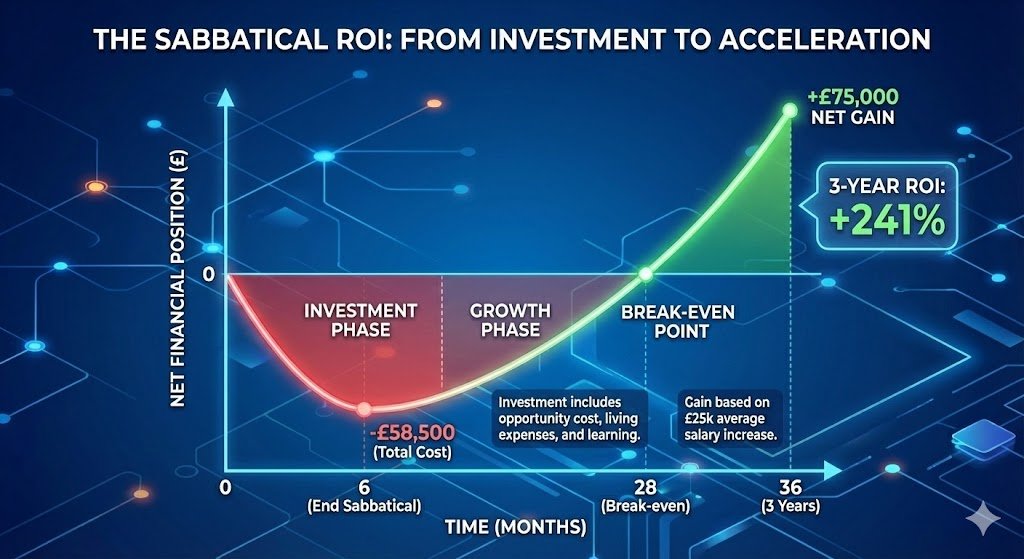
The mathematics work clearly. A six-month sabbatical costs approximately £21,000 (£18,000 living expenses plus £3,000 certifications and courses). Opportunity cost adds £37,500 if leaving a £75,000 role, bringing total investment to £58,500. A £25,000 salary increase recoups this in 28 months. Considering typical job tenure averages four years in technology, sabbaticals represent positive ROI investments that compress years of fragmented learning into focused months.
This isn’t theoretical. James left his £75,000 senior cloud engineer role, spent six months earning AWS and Azure Solutions Architect certifications whilst building three portfolio projects, and returned at £102,000. Sarah departed a £60,000 position experiencing severe burnout, focused three months on FinOps specialisation, and secured a £78,000 role with dramatically better work-life balance. Michael resigned from £85,000, invested four months in security certifications and open source contributions, and received multiple offers ranging from £108,000 to £118,000.
This guide provides the specific playbook these professionals followed. We’ll cover exact costs, month-by-month execution plans, certification sequences that deliver maximum ROI, portfolio projects hiring managers actually value, financial planning requirements, and re-entry strategies that position career breaks as competitive advantages rather than concerning gaps. The UK tech workforce median salary sits at £49,410, but cloud professionals with multi-cloud capabilities command £70,000-£95,000+. Sabbaticals bridge these gaps in months rather than years.
The Six-Month Sabbatical Blueprint
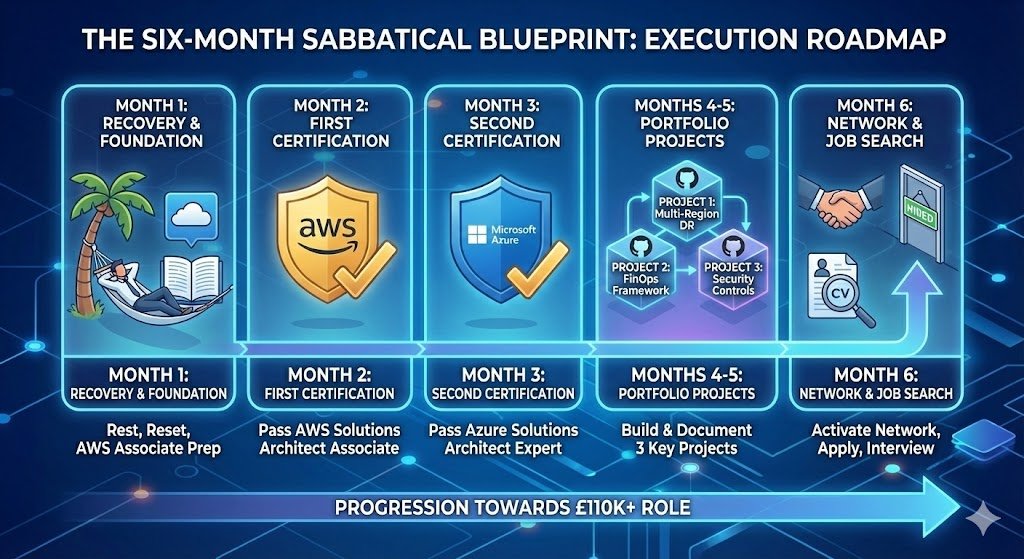
Month 1: Recovery + Foundation (£150 exam cost) Week 1-2: Complete disconnection from work. Sleep properly, exercise daily, reset from burnout that prompted this decision. Research confirms recovering from workplace stress requires time, but you’ll make substantial progress in two weeks with deliberate rest.
Week 3-4: Begin AWS Solutions Architect Associate study. Two hours daily reviewing course material, practising in sandbox environments. Purchase exam voucher (£150) and schedule for week 8. This deadline creates accountability.
Month 2: First Certification (£0 additional cost) Study 4-6 hours daily. Complete practice exams until consistently scoring 80%+. Pass AWS Solutions Architect Associate by week 8. This certification correlates with £12,000 average salary premium and positions you for £70,000-£85,000 roles if previously at £55,000-£65,000.
Begin Azure Solutions Architect Expert study immediately after passing AWS exam. Purchase exam voucher (£165). Schedule for week 14.
Month 3: Second Certification (£165 exam cost) Continue intensive Azure study. Multi-cloud capability commands 15-25% salary premiums over single-platform expertise. Enterprise roles increasingly expect both AWS and Azure fluency. Pass Azure Solutions Architect Expert by week 14.
You’ve now invested £315 in exams and proven you can acquire knowledge. Next phase proves you can apply it.
Month 4-5: Portfolio Projects (£500-£1,000 for hosting/tools) Build three substantial projects demonstrating multi-cloud architecture capabilities. These become your proof during interviews.
Project 1 (3 weeks): Multi-region disaster recovery architecture. Design and implement automated failover between AWS and Azure regions. Document RTO/RPO targets, cost analysis (run calculator showing £2,000 monthly infrastructure cost versus £5,000 for traditional DR), and recovery procedures. Deploy using Terraform. GitHub repository with complete documentation.
Project 2 (3 weeks): Cost optimisation framework. Build automated Savings Plan recommender analysing usage patterns and providing actionable recommendations. Implement for both AWS and Azure. Document business impact: “Reduces recommendation calculation time from 2 hours to 15 minutes, identifies average £2,000 monthly in unused resources.” This project directly demonstrates FinOps capabilities worth £70,000-£100,000 in dedicated roles.
Project 3 (2 weeks): Security controls implementation. Deploy zero-trust networking, secrets management, automated compliance checking for multi-cloud environment. Document security posture improvements with specific metrics. Contribute security enhancements to open source projects with “security” tags.
Each project includes comprehensive README documentation, architecture diagrams, cost analysis, and deployment instructions. These repositories become your portfolio, proving capability beyond certifications.
Month 6: Network Activation + Job Search (£200-£500 for conferences/meetups) Week 21-22: Update CV highlighting certifications, projects, GitHub contributions. Revise LinkedIn profile thoroughly. Write 2-3 technical blog posts explaining problems solved during project work. These posts demonstrate communication ability whilst raising visibility.
Week 23-24: Attend two industry conferences or meetups. Present lightning talks on project work if possible. Connect with 50+ cloud professionals on LinkedIn, particularly those working at target companies. Reach out to former colleagues mentioning upskilling focus.
Week 25-26: Begin strategic job applications. Target 15-20 specific companies whose cloud strategies align with your demonstrated capabilities. Research each company’s technology stack, cloud maturity, and hiring needs. Tailor applications highlighting relevant project work.
Total Investment: £21,000-£22,000
- Living expenses (6 months × £2,500): £15,000
- Certification exams: £315
- Learning resources (courses, books): £500
- Projects (hosting, tools): £1,000
- Networking (conferences, meetups): £500
- Buffer for unexpected costs: £3,685
Expected Return: £20,000-£30,000 Annual Salary Increase Senior engineer £75,000 → £95,000-£105,000 with dual certifications and proven multi-cloud capabilities. Mid-level professional £60,000 → £75,000-£85,000 with demonstrated portfolio projects. Platform architect £90,000 → £115,000-£130,000 adding security specialisation.
Payback period: 10-13 months at £25,000 increase. ROI over three years: £75,000 gain versus £22,000 investment equals 241% return.
High-ROI Certifications and Salary Positioning
AWS Solutions Architect Associate Cost: £150 exam | Study time: 100-120 hours | Timeline: 6-8 weeks Salary impact: £12,000 average premium (Global Knowledge 2024) Target roles: £70,000-£85,000 (from £55,000-£65,000 baseline) Why it matters: Most requested certification in job postings, validates multi-service architecture capability
Azure Solutions Architect Expert (AZ-305) Cost: £165 exam | Study time: 100-120 hours | Timeline: 6-8 weeks Salary impact: £10,000 average premium Target roles: £145,000+ globally (£70,000-£95,000 UK market) Why it matters: 95% of Fortune 500 use Azure, enterprise-heavy demand
AWS Certified Security Specialty + CISSP Cost: £150 + £700 exams | Study time: 200-300 hours | Timeline: 4-6 months Salary impact: Security architects £105,000-£130,000 (versus £80,000-£100,000 without) Target roles: Cloud Security Architect, Security Engineering Lead Why it matters: Financial services pay 20-30% premiums for security credentials
FinOps Foundation Practitioner Cost: £300 certification | Study time: 40-60 hours | Timeline: 3-4 weeks Salary impact: FinOps roles £70,000-£130,000 (68% skills gap creates demand) Target roles: FinOps Engineer, Cloud Cost Optimisation Specialist Why it matters: Emerging discipline with severe talent shortage
Multi-cloud combinations (AWS + Azure) command 15-25% premiums over single-platform expertise. Enterprise roles increasingly filter for both platforms in job requirements. Specialisations in security or FinOps create differentiation beyond standard cloud architect positioning.
Beyond Technical: Business Skills That Unlock £100K+ Roles
Technical depth gets you interviews for £70,000-£90,000 roles. Business communication skills unlock £100,000-£150,000+ positions. Staff and principal engineer roles expect you to translate technical decisions into business impact, present to executives, and influence organisational strategy.
Financial Literacy (2-3 weeks investment) Learn cloud economics beyond hourly pricing. Understand reserved instances, savings plans, and commitment discounts from CFO perspective. Study TCO calculations and ROI frameworks. Read public cloud company annual reports to understand their business models. This knowledge lets you speak credibly about budget implications.
Platform engineers discussing cost implications command £10,000-£20,000 premiums over peers with equivalent technical skills but no financial awareness.
Executive Communication (ongoing practice) Write technical content for business audiences. Practice explaining architectural decisions in 3-5 sentences rather than 3-5 pages. Watch earnings calls from tech CEOs noting how they frame technical capabilities as business advantages. Create architecture decision records documenting why you chose specific approaches, focusing on business outcomes.
These skills separate senior engineers (£90,000-£130,000) from staff/principal roles (£130,000-£180,000+).
Content Creation for Professional Brand Publish weekly technical content during your sabbatical. Write about problems you solved during project work. Explain concepts you learned whilst studying. Answer questions on Stack Overflow. Engage on LinkedIn thoughtfully. This builds visibility whilst crystallising your understanding.
Technical writing accelerates your own learning whilst creating inbound opportunities. Many £120,000+ roles emerge through professional network and visible expertise rather than job board applications.
Three-Month Accelerated Alternative
Not everyone can afford six months. A compressed sabbatical still delivers value if focused ruthlessly.
Month 1: Certification Sprint Choose ONE high-ROI certification (AWS or Azure Solutions Architect Associate). Study 6-8 hours daily. Pass exam by week 4. Total cost: £150 exam + £300 study materials.
Month 2: Portfolio Project Build one substantial project demonstrating certification knowledge. Multi-region architecture, cost optimisation tool, or security implementation. GitHub repository with comprehensive documentation. This proves application capability.
Month 3: Network + Job Search Update CV and LinkedIn. Write 2-3 technical posts about project work. Apply strategically to 20-30 positions. Target £10,000-£15,000 salary increase rather than £20,000-£30,000 from six-month sabbatical.
Total investment: £8,000-£10,000 (3 months expenses + certification + buffer). Expected return: £10,000-£15,000 annual increase. Payback: 8-12 months.
Three-month sabbaticals work best for professionals whose burnout hasn’t reached crisis levels and who need specific skill additions rather than comprehensive career repositioning.
Financial Planning: The Critical Foundation
Sabbaticals fail when money anxiety prevents focus. Calculate required savings precisely before resigning.
Essential Monthly Expenses Calculation Rent/mortgage: £X Utilities (electric, gas, water, internet): £X Council tax: £X Food: £X Transport: £X Insurance (home, contents, life): £X Mobile phone: £X Minimum debt payments: £X
Total monthly essentials: £X
Sabbatical Fund Formula (Monthly essentials × Sabbatical months) + (2 months buffer) + (Certifications + courses) = Required savings
Example for 6-month sabbatical with £2,000 monthly essentials: (£2,000 × 6) + (£2,000 × 2) + (£3,000 learning) = £19,000
Build this fund over 12-18 months through automated monthly transfers. If saving £1,200 monthly, you’ll reach £19,000 in 16 months. This discipline also builds habits you’ll need during sabbaticals: systematic progress toward goals despite lack of external pressure.
UK Savings Options (December 2025) Easy access savings accounts: 4.9% AER (instant access for emergency needs) Fixed-rate bonds: 5.2% AER (lock in rate but lose flexibility)
Park sabbatical funds in easy access accounts. Flexibility matters more than maximising returns since timing might shift based on work circumstances.
What NOT to Cut Never eliminate insurance, minimum debt payments, or other financial obligations. Sabbaticals should improve life quality, not create financial crisis requiring years to resolve. If you cannot save required amount within 18 months whilst maintaining all obligations, sabbatical timing isn’t right yet.
Re-Entry Strategy: Positioning Your Career Gap
How you frame your sabbatical determines whether hiring managers see competitive advantage or concerning gap.
CV Formatting Don’t hide the gap. Own it directly:
“Career Development Sabbatical | March-September 2025 Completed AWS and Azure Solutions Architect certifications. Built multi-region disaster recovery architecture (GitHub: username/dr-project), cost optimisation framework identifying average £2,000 monthly savings, and security controls implementation. Published 12 technical articles on cloud architecture patterns.”

This transforms absence into achievement. Hiring managers can evaluate concrete deliverables rather than speculating about gap reasons.
LinkedIn Profile Updates Add sabbatical as position with bullet points highlighting certifications, projects, and contributions. Connect with 50+ cloud professionals during final sabbatical month. Engage meaningfully on technical posts rather than broadcasting availability. Inbound opportunities emerge from demonstrated expertise.
Interview Positioning When asked about employment gap: “I took six months for intensive cloud architecture upskilling. I completed AWS and Azure Solutions Architect certifications, built three portfolio projects addressing multi-cloud challenges, and contributed to open source security tools. The break also addressed burnout I was experiencing, so I’m returning energised and with significantly upgraded capabilities.”
This positions sabbatical as strategic investment rather than desperate escape. Show GitHub repositories, discuss architectural decisions from projects, and demonstrate current knowledge throughout technical interviews.
Salary Negotiation Don’t anchor to previous compensation. You’ve invested £20,000+ and six months developing high-value skills. Research target role market rates using Levels.fyi, Glassdoor, and job posting salary ranges. Aim for 20-30% above previous salary. Your certifications, projects, and fresh perspective justify premium positioning.
If current salary was £75,000, target £95,000-£100,000 for roles requiring your new multi-cloud capabilities. Negotiate confidently based on market value you now provide.
Success Metrics: What Good Looks Like
Technical Achievements (Months 1-5) □ 2 major certifications completed (AWS + Azure or specialist combination) □ 3 portfolio projects on GitHub with comprehensive documentation □ 20+ open source contributions or 10+ substantial commits □ 5-10 technical articles published demonstrating expertise
Professional Visibility (Month 6) □ 50+ new LinkedIn connections in target domain □ 2 conference or meetup presentations delivered □ 500+ views per technical article average □ 5+ recruiter contacts or interview requests initiated
Financial Outcomes (Post-sabbatical) □ £20,000-£30,000 annual salary increase (6-month sabbatical) □ £10,000-£15,000 annual salary increase (3-month sabbatical) □ 3+ job offers within 8 weeks of active search □ Payback period under 12 months
Career Positioning □ Senior Engineer → Staff Engineer progression □ Single-cloud → Multi-cloud capability □ Generalist → Specialist (FinOps, Security, DevOps) □ Individual contributor → Technical leadership opportunities
Track these monthly. Falling behind signals needed adjustments before completing sabbatical.
Five Sabbatical Failure Modes
Eternal Student Syndrome Completing course after course without building projects. Certifications prove knowledge, projects prove capability. Organisations hire delivery capability. Spend 70% of time on applied work, 30% on formal learning.
Extended Vacation Disguised as Development Recovery month extends to three months. Projects remain perpetually “planned.” Six months pass with little deliverable. Solution: Weekly goal tracking and accountability partnerships.
Premature Return Financial anxiety drives accepting below-market first offer. You’ve invested £20,000 and six months developing high-value skills. Don’t waste investment by rushing return. Save for 8 months if planning 6-month sabbatical. Extra buffer removes pressure.
Skills-Market Mismatch Developing expertise market doesn’t value. Specialising in declining technologies or overly niche areas. Prevention: Research job postings extensively before committing. Build skills where demand exceeds supply.
Isolation Damage Sabbaticals remove daily workplace interaction. Some professionals struggle, particularly introverts or those living alone. Combat through: weekly meetup attendance, active online community participation, coworking spaces, regular calls with professional contacts. Isolation damages mental health and professional outcomes.
The ROI Reality Check
6-Month Sabbatical Investment Total cost: £58,500 (£37,500 opportunity cost + £18,000 living + £3,000 learning) Expected return: £25,000 annual salary increase Payback period: 28 months (2.3 years) Three-year profit: £75,000 – £58,500 = £16,500 net gain (28% ROI) Career velocity: Reach £100,000+ compensation 2-3 years earlier than without sabbatical
3-Month Sabbatical Investment Total cost: £29,000 (£18,750 opportunity cost + £9,000 living + £1,250 learning) Expected return: £12,500 annual salary increase Payback period: 28 months Three-year profit: £37,500 – £29,000 = £8,500 net gain (29% ROI)
Beyond financial returns: burnout recovery, restored passion for work, career control, improved wellbeing. Research shows structured sabbaticals deliver stress reduction persisting long after return. These intangible benefits often exceed financial gains.
Your Action Timeline
Months 1-3: Assessment Research target skills and market demand. Calculate required savings based on sabbatical length. Analyse job postings for certification and skill requirements. Study UK tech salary data for target roles. Decision checkpoint: Can you realistically save required amount? Will targeted skills deliver career advancement?
Months 4-15: Financial Preparation Save £1,200-£1,500 monthly toward sabbatical fund. Open dedicated savings account with 4.9% easy access rate. Track progress monthly. Consider side income to accelerate savings. Test your discipline: If you cannot save consistently, sabbatical execution will prove challenging.
Month 16: Detailed Planning Create month-by-month sabbatical plan detailing certification targets, project goals, networking activities. Schedule certification exams creating external deadlines. Identify 15-20 target companies and roles. Prepare resignation if self-funding or sabbatical proposal if negotiating with employer.
Month 17: Resignation/Approval Resign thoughtfully with generous notice. Document work thoroughly. Maintain relationships. Or present employer sabbatical proposal highlighting mutual benefits. Accept that some employers refuse, which clarifies whether to stay long-term.
Months 18-23: Execution Follow your detailed plan with discipline. Study daily, build projects consistently, network actively. Track weekly progress against objectives. Adjust if falling behind. Treat sabbatical like intensive bootcamp, not extended holiday. Connect learning to application constantly.
Month 24: Re-Entry Begin job search during final month. Polish CV, update LinkedIn, activate network. Apply strategically to target roles. Frame sabbatical positively: emphasise skills gained, projects completed, capabilities developed. Negotiate confidently based on market value. Don’t anchor to previous compensation.
Expected Timeline Planning to re-employment: 24 months total Active sabbatical execution: 3-6 months Career advancement achieved: 2-3 years earlier than alternative path Lifetime earnings impact: £300,000+ from accelerated trajectory
Final Decision: Should You Take a Sabbatical?
Take a sabbatical if: You’re experiencing genuine burnout requiring intervention. Specific skill gaps prevent career advancement you want. You can realistically save required financial buffer. Market demands skills you plan to develop. You have discipline for self-directed intensive work.
Don’t take a sabbatical if: You’re simply bored with current role (change employers instead). Financial situation prevents saving adequate buffer. Market doesn’t value skills you want to develop. You lack structure/discipline for self-directed work. Burnout stems from industry-wide issues rather than role-specific problems.
Sabbaticals challenge conventional career wisdom but data supports this path. Eighty-two percent of tech professionals experiencing burnout face this decision: push through deteriorating performance and wellbeing, or step back strategically to reset and upskill. Those choosing structured sabbaticals with clear objectives see 20-40% salary increases whilst addressing burnout that would otherwise persist for years.
Your career spans 30-40 years. Taking 3-6 months to dramatically accelerate trajectory represents 1-2% of total working time delivering 20-40% compensation increases. The question isn’t whether you can afford a sabbatical. The question is whether you can afford not to take one when facing burnout whilst needing skill advancement.
Useful Links
- Mental Health UK Burnout Report – https://mentalhealth-uk.org/burnout/ – Comprehensive UK burnout statistics and workplace stress analysis
- Great Learning Career Progression Report – https://www.greatlearning.in/ – Research on upskilling impact and salary increases across experience levels
- AWS Certification Paths – https://aws.amazon.com/certification/ – Complete AWS certification roadmap and exam details
- Microsoft Azure Certification Guide – https://learn.microsoft.com/en-us/certifications/ – Azure certification paths and requirements
- CompTIA State of Tech Workforce UK – https://www.comptia.org/resources/research/state-of-the-tech-workforce-uk-2025 – UK tech salary data and employment trends
- Global Knowledge IT Skills Report – https://www.skillsoft.com/resources/it-skills-and-salary-report – Annual certification ROI and salary premium analysis
- GitHub Open Source Contribution Guide – https://opensource.guide/how-to-contribute/ – Comprehensive guide to finding and contributing to open source projects
- Tech Returners Programme – https://www.techreturners.com/ – Structured return-to-work programme for career breakers
- Money Helper Emergency Fund Calculator – https://www.moneyhelper.org.uk/en/savings/types-of-savings/emergency-savings-how-much-is-enough – Tool for calculating sabbatical financial requirements
- FinOps Foundation – https://www.finops.org/ – Resources and certification for cloud financial management specialisation
Taking a sabbatical challenges conventional career wisdom, but the data supports this unconventional path. Eighty-two percent of tech professionals experiencing burnout face a decision: push through deteriorating performance and wellbeing, or step back strategically to reset and upskill. Those who choose structured sabbaticals with clear objectives see average salary increases of 20-40% whilst simultaneously addressing burnout that would otherwise persist for years.
The UK cloud market offers clear pathways from senior engineer roles (£70,000-£90,000) to staff and principal positions (£130,000-£180,000) for professionals demonstrating multi-cloud capabilities, security expertise, or FinOps specialisation. Sabbaticals compress the timeline for acquiring these high-value skills from years of fragmented evening study into months of focused development.
Your career spans 30-40 years. Taking 3-6 months to dramatically accelerate your trajectory represents 1-2% of total working time delivering 20-40% compensation increases. The question isn’t whether you can afford a sabbatical. The question is whether you can afford not to take one.