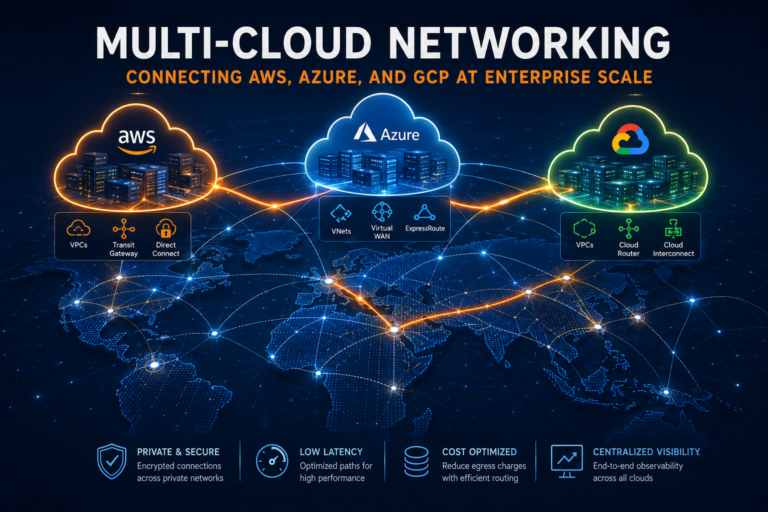
The enterprise infrastructure landscape has undergone a fundamental transformation, with 90% of organisations expected to adopt hybrid cloud by 2027. Yet many struggle with the operational complexity of managing applications across multiple cloud providers, each with distinct toolchains, security models, and deployment processes.
Google Anthos emerges as the most comprehensive solution to this challenge, delivering true workload portability across Google Cloud, AWS, Azure, and on-premises infrastructure through a unified Kubernetes-based control plane. With demonstrated ROI of up to 4.8x within three years and platform management time reductions of 40-55%, Anthos transforms multi-cloud from operational burden into strategic advantage.
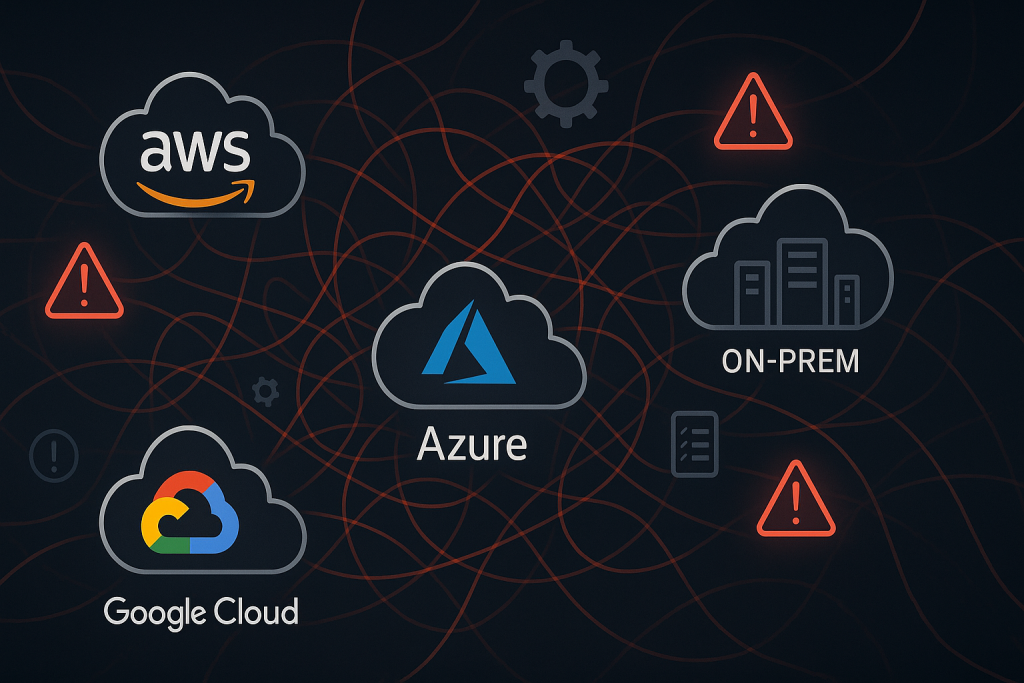
Unlike competitive offerings that extend single-cloud services to hybrid environments, Anthos was architected from inception for genuine multi-cloud portability, combining battle-tested open-source technologies with Google’s operational expertise.
The Multi-Cloud Imperative
Modern enterprises require infrastructure flexibility for compelling business reasons. Regulatory compliance often demands data residency controls, whilst vendor diversification strategies mitigate risks from service outages or pricing changes. Cost optimisation opportunities exist by leveraging different cloud providers’ strengths for specific workload types.
However, traditional multi-cloud approaches create operational silos. Teams develop cloud-specific expertise, security policies fragment across platforms, and applications become tightly coupled to provider-specific services. This complexity often negates the intended benefits of multi-cloud strategies.
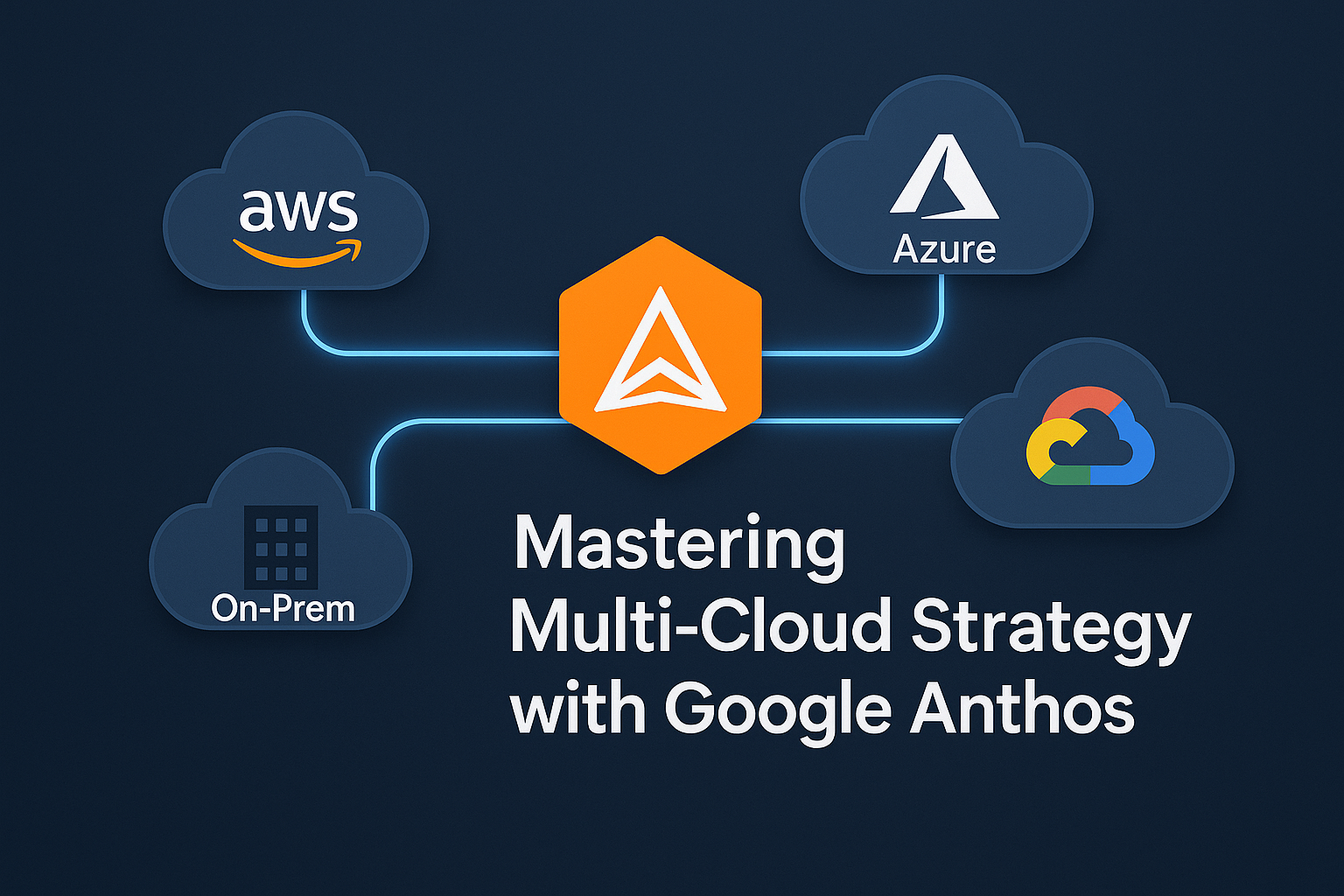
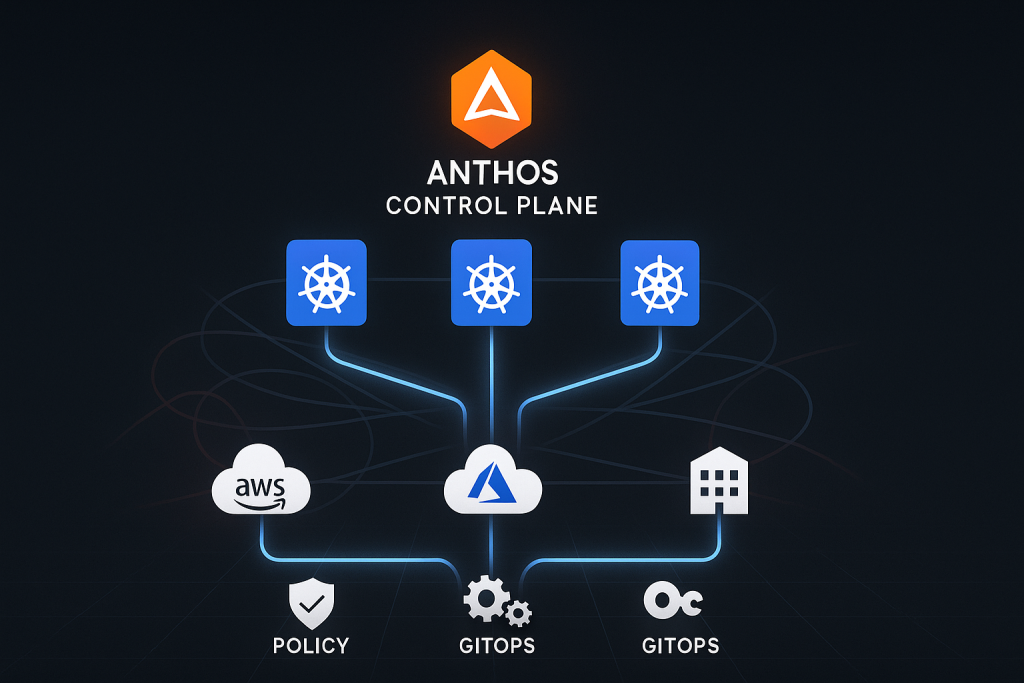
Anthos addresses these challenges by providing a consistent operational experience across all infrastructure types. Whether deploying to Google Cloud, AWS EKS, Azure AKS, or on-premises Kubernetes clusters, teams use identical tools, processes, and security policies.
Architecture Built for Consistency
Unified Kubernetes Management
At its core, Anthos leverages Google Kubernetes Engine (GKE) as the central orchestration layer, providing managed Kubernetes control planes that operate across diverse infrastructure environments. The platform implements a fleet management concept where clusters are logically grouped with principles of “sameness” and “trust.”
The Connect Agent serves as the critical bridging component, establishing secure gRPC over TLS connections between external clusters and the Google Cloud fleet host project. This architecture enables administrators to manage thousands of clusters across multiple clouds from a single console whilst maintaining strong security boundaries through Workload Identity Federation.
Key architectural benefits include:
- Centralised cluster lifecycle management
- Unified policy enforcement across environments
- Consistent security posture regardless of deployment location
- Single-pane-of-glass visibility for all workloads
Configuration as Code Through GitOps
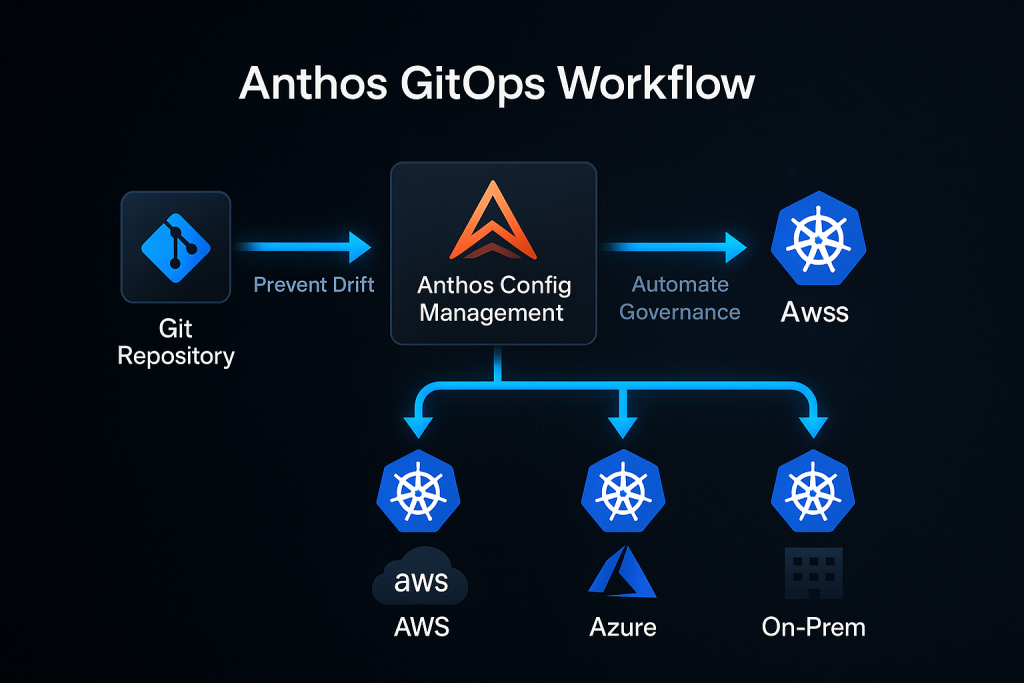
Anthos Config Management transforms infrastructure governance through declarative configuration management, enabling “configuration as data” approaches where Git repositories serve as authoritative sources for cluster state. The system includes three core components:
Config Sync provides git-based reconciliation, continuously monitoring repositories for changes and automatically applying updates across all managed clusters. This ensures configuration drift cannot occur, as the desired state is continuously enforced.
Policy Controller implements OPA Gatekeeper-based policy enforcement, validating all cluster operations against defined governance rules. Pre-built constraint templates support CIS benchmarks, Pod Security Standards, and Google Cloud best practices.
Config Controller enables Google Cloud resource provisioning through Kubernetes Resource Model (KRM), treating cloud resources as Kubernetes objects for consistent management experiences.
Recent architectural improvements include migration from ConfigManagement API to RootSync API with enhanced metric tracking and git-sync v4.0.0 implementation for improved efficiency and race condition fixes.
Service Mesh for Advanced Traffic Management
Anthos Service Mesh integrates Istio for comprehensive traffic management and security. The platform offers both self-managed and fully-managed options, with the managed variant leveraging Traffic Director for enhanced scalability.
The service mesh provides automatic mutual TLS (mTLS) certificate generation and rotation, fine-grained authorization policies based on service account authentication, and comprehensive observability through distributed tracing integration.
Multi-Cluster Services (MCS) and Multi-Cluster Ingress (MCI) enable service discovery and load balancing across cluster boundaries, supporting sophisticated deployment strategies including geographic distribution and disaster recovery scenarios.
Enterprise Security Spans All Environments
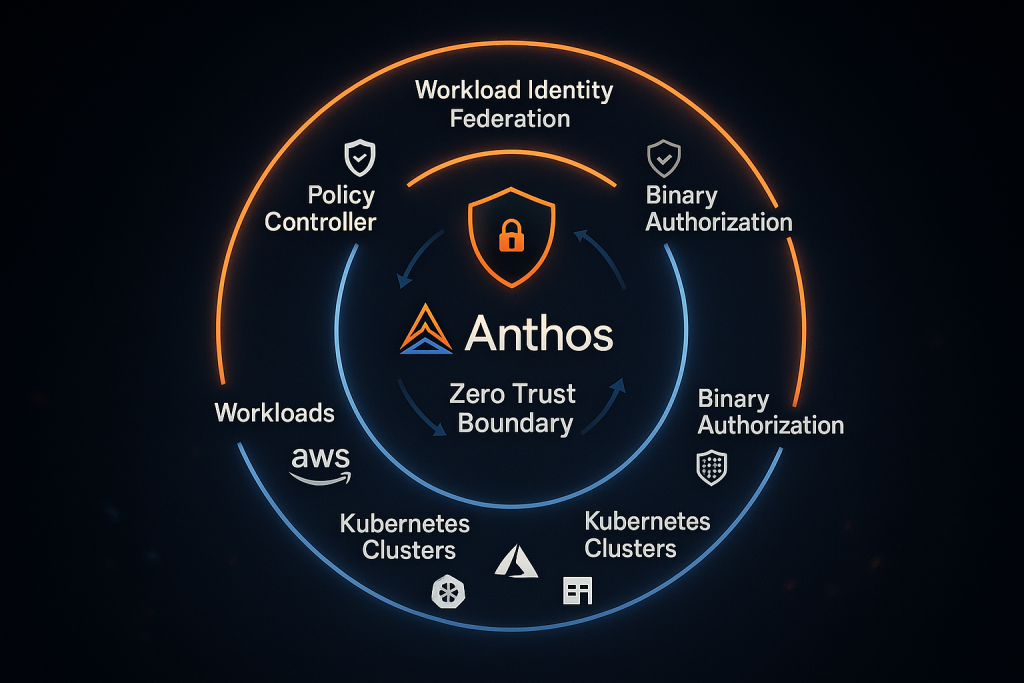
Security architecture in Anthos implements zero trust networking principles with the assumption that threats can originate from both internal and external sources. This approach provides defence-in-depth across all deployment environments.
Binary Authorization and Policy Governance
Binary Authorization provides deploy-time controls through admission controller webhooks that validate container images against cryptographic signatures from trusted authorities before allowing deployment. This ensures only approved and validated images can execute in production environments.
Policy Controller enables consistent security governance across all environments, enforcing over 200+ security policies with automated violation detection. Enterprise implementations demonstrate 90% reduction in policy violations through automated compliance checking.
Workload Identity Federation
Rather than managing long-lived credentials across multiple cloud environments, Workload Identity Federation enables cross-cloud authentication through trusted identity providers. This approach significantly reduces security risks whilst simplifying credential management across hybrid and multi-cloud deployments.
Service accounts in Google Cloud can be bound to Kubernetes service accounts, enabling applications to access cloud resources without storing credentials in container images or Kubernetes secrets.
Real-World Transformation Stories
UPC Polska: Accelerating Digital Transformation
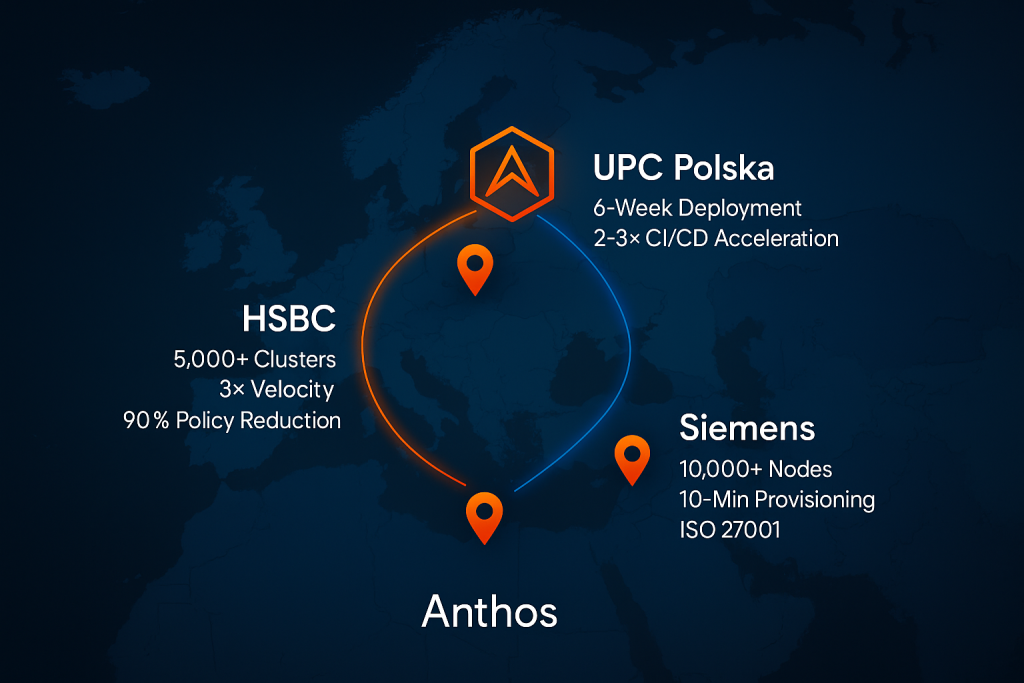
UPC Polska’s telecommunications infrastructure transformation exemplifies Anthos’s enterprise capability. Rather than starting with low-risk applications, they boldly chose to deploy their most business-critical customer service application first, completing implementation within six weeks.
Results included 2-3x acceleration of CI/CD pipelines and the ability to deliver personalised content to 1.5 million customers with improved scalability and resilience. The telecommunications company achieved faster feature delivery whilst maintaining strict reliability requirements.
HSBC: Managing Massive Scale
HSBC operates over 5,000 Kubernetes clusters across four cloud providers through Anthos, demonstrating the platform’s ability to handle enterprise-scale complexity. The financial services organisation implemented 200+ security policies with Policy Controller, achieving 90% reduction in violations whilst maintaining 3x increase in developer velocity.
This implementation showcases how Anthos enables organisations to scale operations without proportional increases in management overhead, maintaining consistent security and compliance postures across diverse deployment environments.
Siemens: Industrial Manufacturing Excellence
Siemens Industrial Manufacturing operates 10,000+ nodes across AWS, Azure, and Google Cloud, reducing cluster provisioning time from one week to 10 minutes through automated workflows. Their implementation maintains strict compliance with NIST 800-53 and ISO 27001 standards whilst enabling streamlined operational processes.
These real-world implementations consistently demonstrate 40-55% improvement in platform operating efficiency whilst enabling organisations to focus development resources on core business logic rather than infrastructure management complexity.
Strategic Implementation Approach
Phased Deployment Strategy
Successful Anthos adoption requires thoughtful implementation planning. Organisations should begin with proof-of-concept projects using representative workloads to build team expertise and demonstrate value.
Phase 1: Foundation (Months 1-3)
- Cluster provisioning and fleet registration
- Service mesh deployment with automatic sidecar injection
- Configuration management setup through GitOps workflows
- Team training and certification
Phase 2: Expansion (Months 4-9)
- Additional cluster integration across cloud providers
- Policy framework implementation and validation
- Monitoring and observability integration
- Security hardening and compliance verification
Phase 3: Optimisation (Months 10-18)
- Cost optimisation through workload placement strategies
- Advanced traffic management and canary deployment patterns
- Comprehensive automation of operational processes
- Performance tuning and capacity planning
Critical Success Factors
Implementation success depends on treating Anthos as a platform transformation initiative rather than simply a technology deployment. This requires investment in organisational capabilities, process standardisation, and cultural change management alongside technical implementation.
Executive sponsorship proves essential for driving cultural transformation and providing resources for comprehensive training programmes. Organisations achieving highest ROI invest early in team development and operational excellence frameworks.
Partnership with experienced system integrators can accelerate implementation whilst reducing risks associated with complex multi-cloud architectures. However, organisations must maintain internal expertise to avoid long-term vendor dependencies.
Cost Optimisation and ROI Analysis
Pricing Model and Investment Justification
Anthos follows a subscription model at £7,850 per month per 100 virtual CPUs, with recent updates introducing more flexible GKE Enterprise pricing starting at £0.0065 per vCPU per hour for cloud deployments. Whilst initial investment appears significant, Forrester Total Economic Impact research demonstrates ROI of up to 4.8x within three years.
Multi-Cloud Arbitrage Opportunities
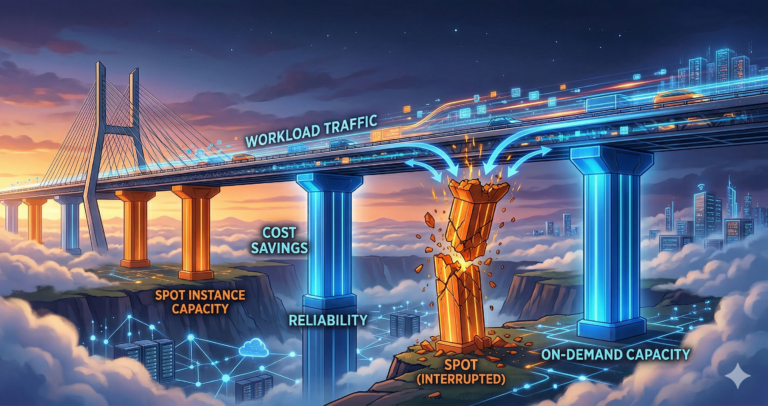
Cost optimisation strategies leverage multi-cloud arbitrage by deploying workloads on the most cost-effective infrastructure for specific requirements. Organisations can utilise spot instances for fault-tolerant workloads (achieving 60-91% savings), implement vertical pod autoscaling for optimal resource utilisation, and leverage regional pricing differences.
Total cost of ownership analysis reveals substantial savings through consolidated platform management, reduced need for multiple DevOps teams specialised in different clouds, and automation of operational processes. Enterprise customers report 20-40% infrastructure cost savings alongside significant improvements in developer productivity.
Competitive Differentiation
True Multi-Cloud vs Cloud Extensions
Anthos distinguishes itself through genuine multi-cloud architecture rather than cloud-specific extensions. Unlike AWS EKS Anywhere, which runs separate Kubernetes clusters without native multi-cluster integration, Anthos provides unified management with Multi-Cluster Ingress and Services for seamless cross-cloud operation.
Compared to Microsoft Azure Arc, which focuses on extending Azure services to other environments, Anthos offers broader multi-cloud compatibility with reduced vendor lock-in due to its open-source foundation. Whilst Azure Arc provides no additional cost for basic server management, Anthos delivers superior GitOps workflows and policy management capabilities.
VMware Tanzu excels within existing VMware ecosystems but lacks Anthos’s cloud-neutral approach and upstream Kubernetes compatibility. Red Hat OpenShift provides comprehensive enterprise Kubernetes capabilities but emphasises platform features over multi-cloud portability.
Gartner positioned Google as a Leader in the 2025 Magic Quadrant for Container Management, achieving a 92/100 solution score with recognition for extensive cloud-native capabilities across hybrid and multi-cloud environments.
Future-Proofing Through Innovation
AI Integration and Edge Computing
Google Cloud Next 2025 announcements emphasise AI integration with hybrid AI capabilities including Speech-to-Text On-Premises general availability and Gemini deployment through Google Distributed Cloud. The 7th-generation TPU (Ironwood) provides 5x compute performance improvements for large-scale AI workloads.
Edge computing capabilities continue expanding through Anthos for Bare Metal, enabling direct deployment on physical servers without hypervisor overhead for improved performance in edge locations. Enhanced support for specialised hardware configurations positions Anthos for industrial IoT and real-time automation scenarios.
Container-First Architecture Evolution
Long-term strategic direction focuses on container-first architectures with enhanced serverless integration through Cloud Run for Anthos, cross-cloud networking improvements, and AI-native operations including intelligent scaling and predictive maintenance capabilities.
Making the Strategic Decision
Evaluation Criteria
Organisations should evaluate Anthos within the context of multi-cloud strategies requiring vendor flexibility and operational standardisation. The platform provides maximum value for enterprises managing significant containerised workload volumes (>100 vCPUs sustained) with complex compliance requirements or vendor lock-in concerns.
Key decision factors include:
- Current Kubernetes adoption and container strategy maturity
- Multi-cloud requirements driven by compliance or business needs
- Existing DevOps team capabilities and training investment capacity
- Budget allocation for platform transformation initiatives
- Risk tolerance for vendor dependencies and lock-in scenarios
Implementation Readiness Assessment
Success requires comprehensive organisational readiness beyond technical capabilities. Teams need Kubernetes expertise, GitOps workflow familiarity, and security governance experience. Cultural readiness for platform standardisation and process automation proves equally important.
Organisations should conduct thorough assessments of current application architectures, identifying workloads suitable for containerisation and multi-cloud deployment patterns. Legacy application modernisation may require parallel investment in application refactoring initiatives.
Conclusion and Next Steps
Google Anthos represents the most mature and comprehensive multi-cloud application platform available today, enabling true workload portability whilst maintaining operational consistency across diverse infrastructure environments. The combination of proven open-source technologies, Google’s operational expertise, and genuine multi-cloud architecture creates compelling value propositions for enterprises seeking infrastructure flexibility without operational complexity.
The platform’s success stories demonstrate tangible benefits including accelerated development cycles, improved operational efficiency, and strategic flexibility that positions organisations for long-term competitive advantage. However, realising these benefits requires treating implementation as a comprehensive platform transformation initiative encompassing technical deployment, organisational capability development, and cultural change management.
For organisations ready to embrace container-first, multi-cloud strategies, Anthos provides the foundation for building resilient, scalable, and portable application architectures that adapt to evolving business requirements whilst maintaining operational excellence across all deployment environments.
Useful Links
- Google Anthos Official Documentation – Comprehensive technical documentation and getting started guides
- Anthos Config Management Guide – Detailed GitOps workflow implementation and best practices
- UPC Polska Success Story – Real-world enterprise transformation case study
- Forrester Total Economic Impact Study – ROI analysis and business benefits research
- Mastering Anthos Config Management – Advanced configuration management patterns and techniques
- Multi-Cloud Strategy Comparison – Competitive analysis of hybrid cloud platforms
- Anthos Service Mesh Deep Dive – Technical implementation guidance for service mesh deployment
- GKE Enterprise Pricing Guide – Current pricing models and cost optimization strategies
- Binary Authorization Security Guide – Comprehensive security implementation examples and demos
- Google Cloud Next 2025 Announcements – Latest platform updates and strategic roadmap information