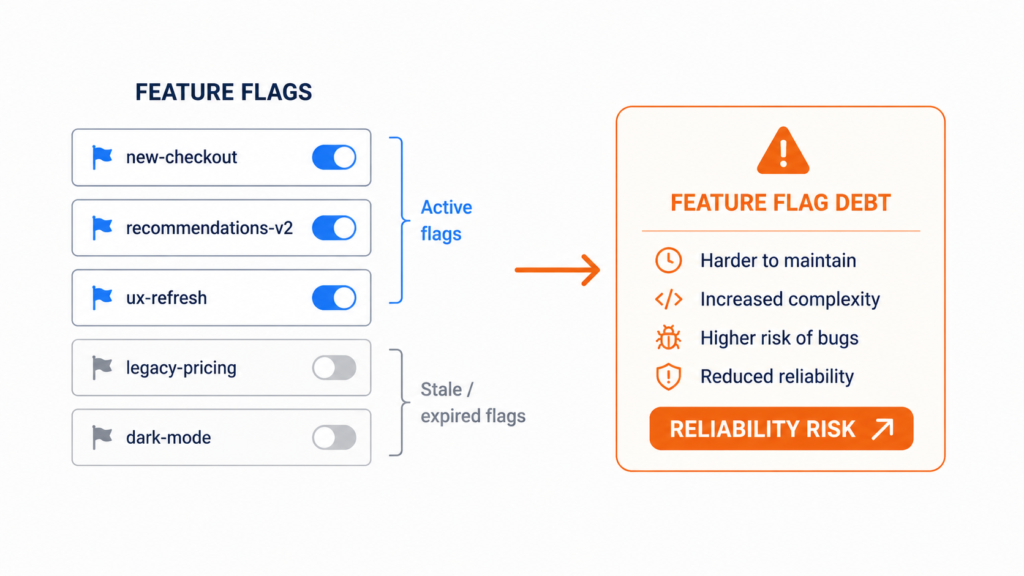
Every feature flag your team ships carries an expiry date nobody enforces. The pull request says “thirty minute experiment” or “gate for phased rollout,” and eighteen months later the flag is still live, evaluated on every request, owned by an engineer who left the company, and untested in combination with everything shipped since. This is not a hypothetical maintenance nuisance. It is where some of the industry’s most expensive failures actually originated: a reused flag cost Knight Capital more than $460 million in 45 minutes, and a forgotten one turned six Microsoft 365 apps into a silent account takeover pipeline in 2026. Reliability models account for known dependencies and deploy failure rates. They rarely account for the flag nobody remembers is there, and that gap is where feature flag debt actually lives.
Start with Knight Capital, because it settles the argument about whether this is theoretical. In August 2012, engineers repurposed an old configuration flag tied to dormant code from 2003 for a new order router. The deployment reached seven of eight production servers; the eighth kept its old build, where the reused flag reactivated code that had not run in nine years. Within 45 minutes the router built unwanted positions worth billions of dollars in notional exposure across 154 stocks. The SEC’s own account puts the loss at more than $460 million, and Knight was effectively acquired within months. The root cause was not a flag that failed. It was a flag that survived long enough to mean something different than when it was written.
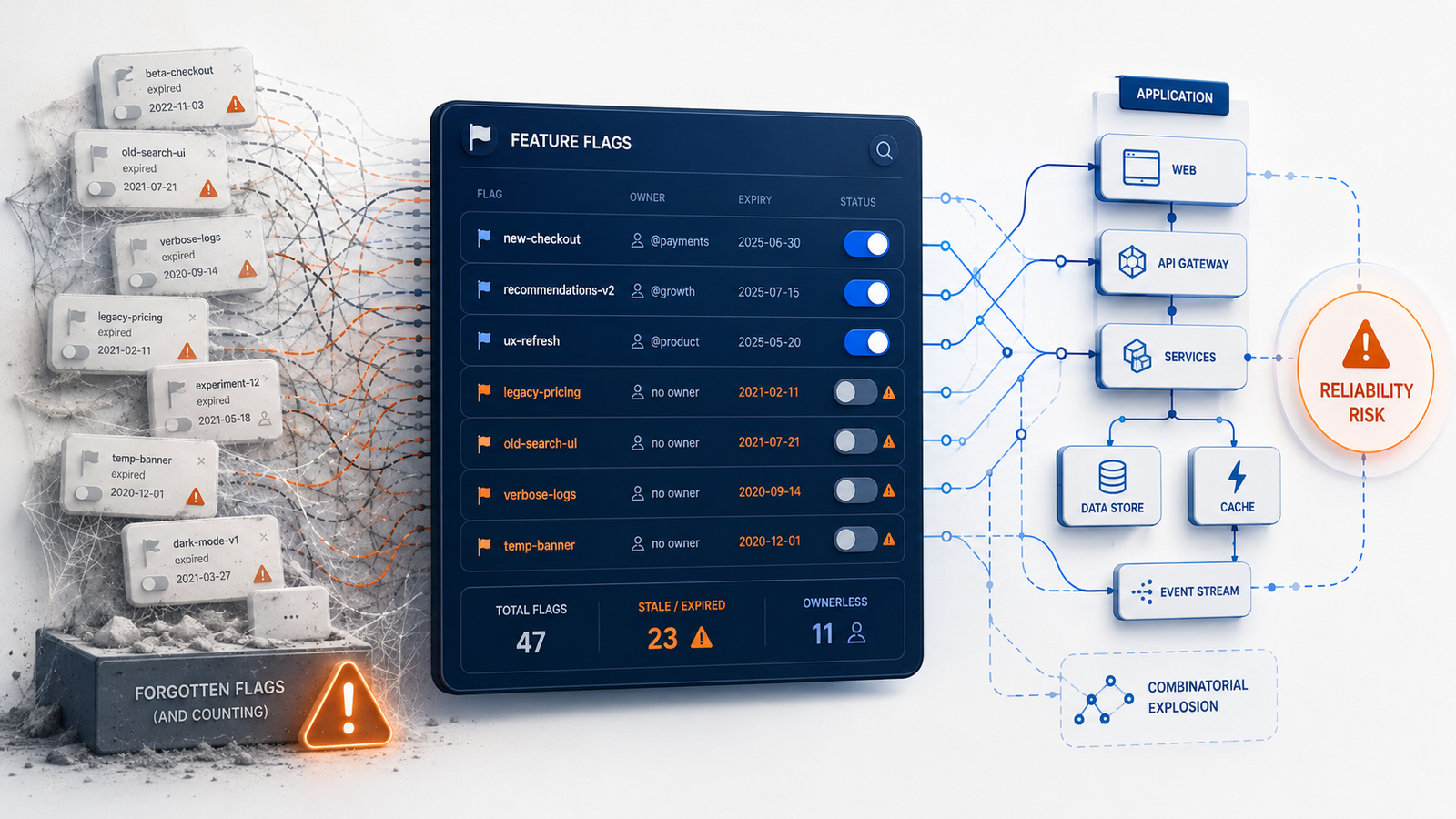
The instinct to treat this as a one-off ignores what the data says about flag lifespans generally. A 2021 study of Python open source projects, published in Empirical Software Engineering, found that 75 percent of feature toggles were removed within 49 weeks, meaning roughly a quarter outlived a year with no clear plan to retire them. A more recent longitudinal analysis of Kubernetes and GitLab, spanning eight and five years of history respectively, found median toggle lifespans of 734 days and 185 days, and confirmed that removals structurally lag additions in both codebases. Flag inventories do not stabilise. They accumulate. The researchers behind that study describe the outcome bluntly: flags become permanent not by design, but by neglect.
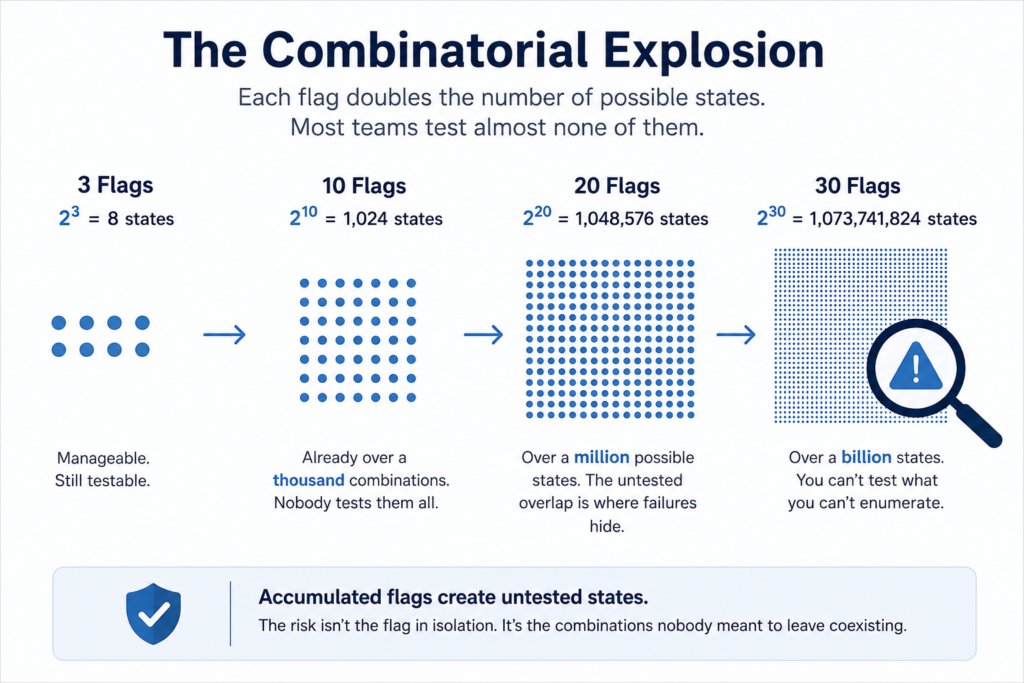
The reason accumulation matters is combinatorial, not aesthetic. Ten independent flags produce over a thousand possible runtime states; twenty exceed a million. Nobody tests all of them, and nobody claims to. Martin Fowler’s team, in one of the most cited pieces written on feature toggles, treats exhaustive testing of toggle combinations as effectively impossible once a handful accumulate. GitLab’s own public inventory currently runs to 435 active flags across its editions, which gives some sense of scale at a mature engineering organisation. Every flag in that inventory shares memory, database connections, session state, and routing logic with every other flag. The failure mode is rarely the flag in isolation. It is the untested overlap between two states nobody meant to leave coexisting, not unlike the way zombie cloud resources quietly drain budget long after anyone remembers provisioning them, except here the cost is reliability risk rather than a line item on an invoice.
It would be tidy to conclude that flags are simply dangerous, but the record does not support that either. In June 2026, security researchers disclosed that a debug flag left enabled in a shared Microsoft 365 SDK let any co-installed Android app silently harvest authentication tokens from Word, Excel, PowerPoint and three other apps, with no password or permission prompt required. That is a forgotten flag causing harm. A year earlier, Google Cloud suffered a seven-hour global outage after new quota checking code shipped without a feature flag at all, so a malformed policy update triggered an unhandled crash loop with no kill switch available. That is a missing flag causing harm. The honest reading is that a flag is a genuine reliability tool for exactly as long as someone owns its lifecycle, and a liability the moment that ownership lapses.
The financial scale behind this is not abstract either. Stripe’s widely cited developer survey put maintenance and technical debt at roughly 42 percent of an average engineering week, and McKinsey has separately estimated technical debt principal at up to 40 percent of the typical IT balance sheet. Flag debt sits inside those figures, and the platforms selling feature flags now treat lifecycle management as a product feature rather than an afterthought. LaunchDarkly documents a six stage retirement path from live flag to deleted code. GitLab flags any development toggle older than two milestones to the responsible engineering manager. Both approaches share the same underlying principle: a flag without an assigned owner and an expected removal date is not a temporary measure, it is an unscheduled one. Teams that already invest in mechanisms like deployment slot warming to make application rollouts safer rarely extend that same operational discipline to the flag left switched on after the rollout finishes.
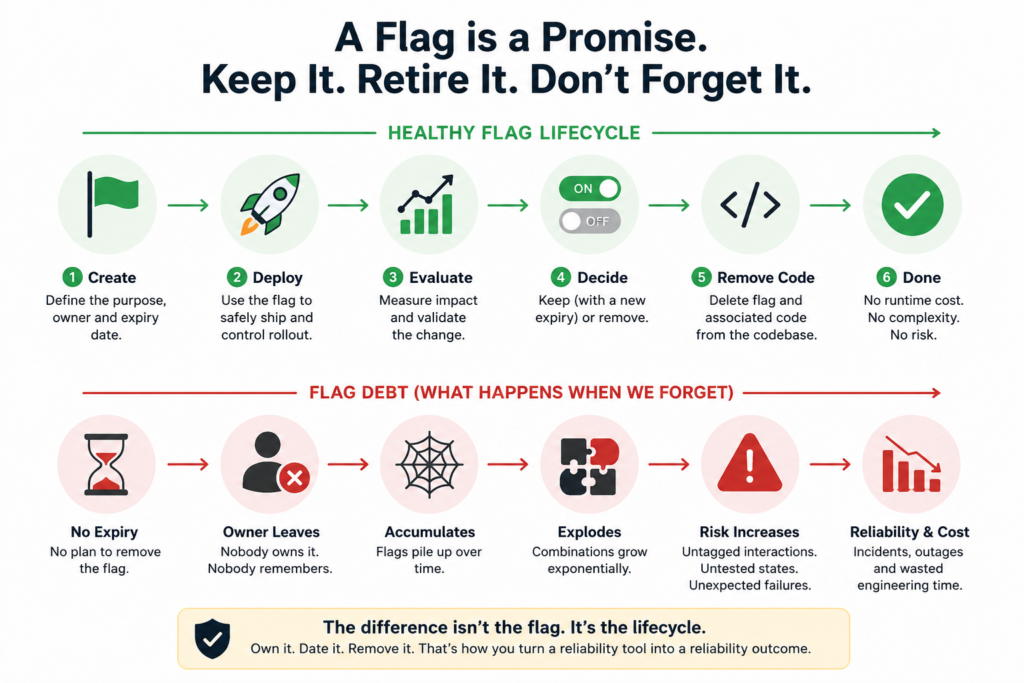
None of this argues against feature flags. It argues against treating them as costless. A flag is a promise to come back and finish the job, and most engineering organisations have no process that enforces that promise the way they enforce dependency patching or certificate rotation. The fix is not more tooling; most teams already have flag platforms with lifecycle features built in and unused. It is a policy decision: assign an owner and an expiry date at creation, ship the removal alongside the rollout rather than as separate future work, and audit the percentage of flags past their intended window on the same cadence applied to any policy that gets deployed without first being tested for blind spots. The next incident review that traces back to a forgotten flag will not be a surprise. It will be a debt that was never called in.
Useful Links
- SEC Administrative Proceeding: Knight Capital Americas LLC
- Martin Fowler: Feature Toggles (aka Feature Flags)
- Hoyos et al., On the Removal of Feature Toggles (Empirical Software Engineering, 2021)
- Feature Toggle Dynamics in Large-Scale Systems (arXiv)
- Uber Engineering: Piranha, Reducing Feature Flag Debt
- LaunchDarkly: Reducing Technical Debt from Feature Flags
- Enclave Security: FlagLeft Disclosure
- ThousandEyes: Google Cloud Outage Analysis, June 12 2025
- McKinsey: Tech Debt, Reclaiming Tech Equity