
Most architects treat UK data residency as a location question. The ICO, the FCA, and the NCSC do not. UK GDPR contains no requirement to store data on British soil. The FCA’s PS21/3 operational resilience regime does not mandate UK-only hosting. The NCSC explicitly supports OFFICIAL government data on standard public cloud. Yet UK enterprises routinely pay 15-30% sovereign cloud premiums for workloads that properly configured standard cloud handles adequately. Simultaneously, a significant number run NHS patient data, FCA-regulated records, or OFFICIAL-SENSITIVE government information through architectures that would fail a Transfer Risk Assessment under scrutiny. The UK government signed £894M of AWS contracts on a single day in December 2023. Most of that runs on standard public cloud, deliberately and correctly. Understanding why those deployments are compliant, and exactly where the line sits beyond which they would not be, is the foundation of every sound sovereignty architecture in 2026.
The failure mode runs in both directions. Over-scoping sovereignty requirements means paying cloud premiums for OFFICIAL-tier workloads that customer-managed encryption addresses adequately. Under-scoping them means NHS patient data or regulated financial records flowing through architectures that cannot survive a Transfer Risk Assessment or PS21/3 impact tolerance review. The hyperscalers have not simplified the decision. AWS launched a physically separate European Sovereign Cloud partition in January 2026. Azure offers policy-based sovereign controls layered on standard infrastructure, deliberately choosing not to separate. GCP takes a partner-managed key approach with, critically, no UK-specific partner. Three platforms, three fundamentally different architectural bets on what sovereignty means, none of which can be evaluated correctly without first understanding what UK regulations actually require.
This post maps those regulatory requirements to the architectural controls they demand, compares the sovereign offerings from AWS, Azure, and GCP, and provides a classification-driven framework for matching control intensity to data sensitivity. The MOD’s £400M Google Distributed Cloud contract at SECRET level, DWP’s data centre exit on standard AWS, and Yorkshire and Humber Care Record’s regional NHS patient data platform on GCP show what compliant, cost-effective sovereign architecture looks like across the UK’s most regulated sectors. The central finding: for most UK enterprises, the right answer is not a dedicated sovereign cloud product.
What UK Regulations Actually Require
The most consequential misconception in UK cloud architecture is that UK GDPR mandates domestic data location. It does not. Articles 44-50 govern how data can leave the UK, not a blanket prohibition on it doing so. Data flows freely to countries with UK adequacy decisions, all EU and EEA states, plus a growing list of third countries. For non-adequate destinations, organisations must use the UK International Data Transfer Agreement (IDTA) or EU SCCs with the UK Addendum, supported by a Transfer Risk Assessment.
That TRA process changed materially when the Data (Use and Access) Act 2025 received Royal Assent in June 2025. The new data protection test asks whether protection will be “not materially lower” than UK GDPR standards – replacing the post-Schrems II “essentially equivalent” threshold. This represents a modest easing: the direction of UK travel on international transfers is toward flexibility, not restriction. ICO guidance published in January 2026 introduced a three-step test for identifying restricted transfers, with full implementation guidance expected by Spring 2026. The ICO has been explicit: deploying to UK cloud regions alone does not eliminate transfer risk if the provider’s management plane operates from outside the UK. Compliance is holistic.
The FCA’s operational resilience framework (PS21/3) reached full compliance on 31 March 2025. Regulated firms must identify important business services, set impact tolerances, map all dependencies including cloud providers, and scenario-test their resilience. The FCA holds the firm responsible for remaining within impact tolerances even when a cloud provider fails. Critically, PS21/3 does not mandate UK data residency. FCA guidance FG16/5 requires “choice and control over jurisdictions where data is processed” and that encryption keys remain accessible to regulators, requirements that are achievable on standard public cloud with appropriate contractual and architectural protections. The PRA and FCA published further consultation papers in December 2024 proposing mandatory operational incident reporting and a central register of material third-party cloud arrangements, reinforcing visibility requirements rather than mandating sovereignty.
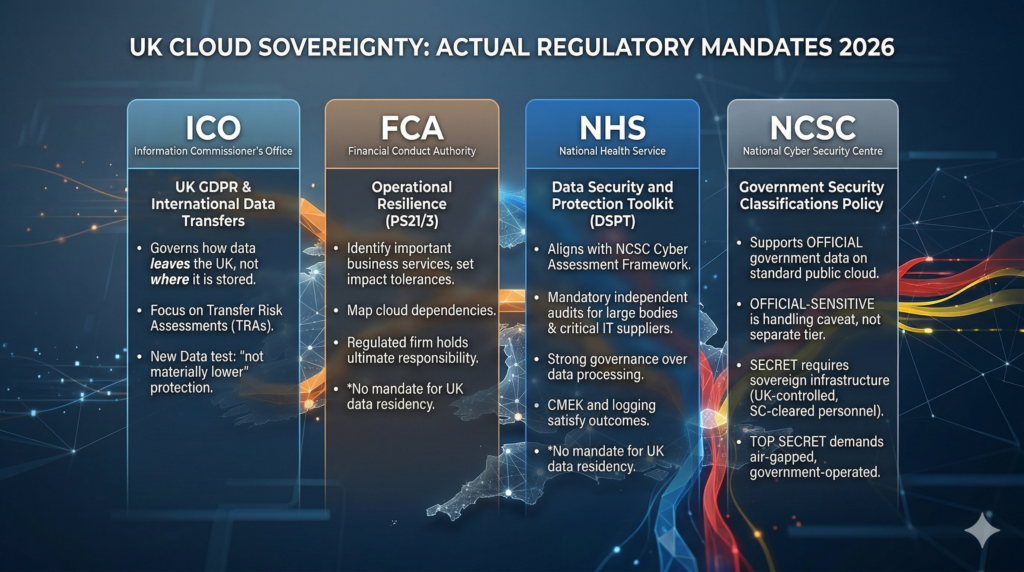
NHS DSPT Version 8, released September 2025, represents the most significant revision since the toolkit launched. It aligns with the NCSC Cyber Assessment Framework, introduces mandatory independent audits for large NHS bodies and critical IT suppliers, and introduces a maturity scale across 47 contributing outcomes. Category 2 organisations which includes cloud and IT suppliers to NHS bodies, now face mandatory independent audit for the first time. DSPT does not mandate UK data residency but effectively requires strong governance over data processing, with encryption and access control outcomes that public cloud with CMEK and comprehensive audit logging can satisfy.
The sharpest regulatory line sits at the MOD security classification boundary, governed by the Government Security Classifications Policy (updated July 2024). OFFICIAL data, roughly 85% of government information can go on public cloud; the NCSC explicitly supports this. OFFICIAL-SENSITIVE is a handling caveat, not a separate classification tier, and does not automatically require UK-only hosting. SECRET requires sovereign infrastructure: dedicated, secured, UK-controlled systems with SC-cleared personnel operating them. The NCSC states plainly that a public cloud service can protect data only according to the OFFICIAL threat model. TOP SECRET demands air-gapped, government-operated environments with DV-cleared staff.
The regulatory environment is also shifting at the legislative level. The Cyber Security and Resilience Bill, introduced November 2025 and currently progressing through Parliament, expands the UK’s NIS regime to cover managed service providers and data centres, introduces 24-hour mandatory incident reporting, and establishes penalties of £17M or 4% of global turnover. For cloud architects, this raises the floor on incident detection and reporting capabilities that must be built into sovereign-adjacent architectures.
The EU adequacy decisions for the UK were renewed in December 2025, valid until December 2031. This matters architecturally: data flows from EU organisations to UK entities remain valid under EU GDPR, which affects cross-border architectures for UK multinationals and financial services firms with European operations.
Three Platforms, Three Approaches to Sovereignty
Understanding the fundamental architectural differences between AWS, Azure, and GCP sovereign offerings is prerequisite to any platform evaluation. These are not variations on a theme, they represent genuinely different bets on what sovereignty should mean and how it should be delivered.
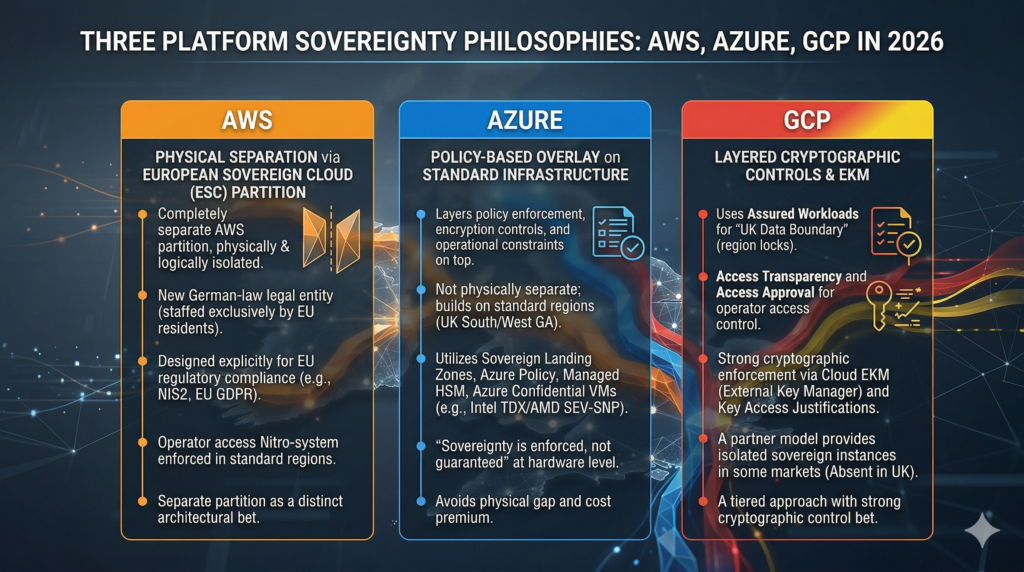
AWS: physical separation
AWS launched the European Sovereign Cloud (ESC) as generally available in January 2026, with its first region in Brandenburg, Germany. The architecture is the most aggressive approach of the three: a completely separate AWS partition, physically and logically isolated from all other AWS infrastructure, with its own IAM, billing, Route 53 name servers, and certificate authority. It is operated by a new German-law entity AWS European Sovereign Cloud GmbH, staffed exclusively by EU-resident personnel. Customer-created metadata stays within EU boundaries. Approximately 90 services were available at launch, including EC2, S3, Lambda, EKS, SageMaker, and Bedrock; CloudFront is not expected until Q4 2026.
The critical nuance for UK architects is that the ESC is open to all customers globally, including UK organisations but was explicitly designed to address EU regulatory requirements, principally EU GDPR, NIS2, and the specific sovereignty expectations of EU public sector bodies. A UK organisation routing data to the ESC’s German region would introduce cross-border data flows that complicate, rather than simplify, the UK GDPR Transfer Risk Assessment it was deployed to support. For most UK workloads, the London region (eu-west-2) with standard AWS controls, G-Cloud procurement, and the One Government Value Agreement is the more practical path, precisely because it avoids that cross-border complication. For OFFICIAL workloads requiring UK-specific location guarantees, standard AWS London with appropriate configuration is the intended path. For SECRET-level requirements, AWS Dedicated Local Zones offer single-customer, fully managed infrastructure deployable in customer-specified UK locations, effectively AWS infrastructure operated inside a customer’s own physical environment.
The Nitro System underpins AWS’s operator access claims for the London region as much as the ESC. By hardware design, there is no mechanism for any AWS employee to log in to EC2 hosts or access instance memory, regardless of privilege level. This was independently verified by NCC Group and is contractually binding in AWS Service Terms. It provides meaningful architectural assurance for OFFICIAL-SENSITIVE workloads without requiring a separate sovereign partition.
Azure: policy-based overlay
Microsoft rebranded its offering as “Microsoft Sovereign Cloud” in June 2025, with a tiered model that takes a deliberately different architectural approach from AWS. The Sovereign Public Cloud layers policy enforcement, encryption controls, and operational constraints on top of standard Azure infrastructure. This is not a physically separate environment. The architectural bet is that policy-based sovereignty is sufficient for most regulated workloads, while avoiding the service gap and cost premium that physical separation creates.
Sovereign Landing Zones, deployable via Bicep and Terraform templates, enforce data residency, encryption policy, and confidential computing requirements through Azure Policy. Azure UK South (three availability zones) and UK West (two availability zones) provide contractual data residency guarantees within the UK geography. Customer Lockbox gives customers explicit veto power over Microsoft engineer access requests, creating an approval workflow that Azure argues is operationally equivalent to hardware isolation. Managed HSM with customer-controlled keys, combined with Azure Confidential VMs (AMD SEV-SNP now GA, Intel TDX reached GA for selected regions in February 2026), provides the technical control layer.
The honest critique of this approach, which Microsoft does not dispute, is that “sovereignty is enforced, not guaranteed” at the infrastructure level. A policy can theoretically be overridden; a hardware boundary cannot. For most regulated UK enterprises the difference is academic, a well-governed policy-based control satisfies OFFICIAL and OFFICIAL-SENSITIVE requirements. For defence SECRET workloads, Azure Local (Sovereign Private Cloud) provides genuinely air-gapped deployment. The Microsoft Cloud Deutschland cautionary tale is instructive: that physically separate, T-Systems-trustee sovereign cloud was discontinued in 2022 after customers found the service limitations and costs unacceptable. Microsoft’s current architecture reflects those lessons.
GCP: layered controls, absent UK partner
Google Cloud’s sovereignty approach combines Assured Workloads, external key management, and a partner model that provides genuinely isolated sovereign instances in some EU markets. For UK enterprises, the picture is more straightforward: the Assured Workloads “UK Data Boundary” control package enforces resource deployment to the London region (europe-west2) via organisation policy constraints and restricts support personnel. Access Transparency logs all Google personnel actions on customer data with machine-readable justification codes. Access Approval requires explicit customer consent before access. Key Access Justifications, combined with Cloud External Key Manager integrated with Thales CipherTrust or Fortanix SDKMS, creates a cryptographic enforcement model where the customer’s external key manager evaluates every access justification and can automatically deny unjustified requests.
The significant limitation is that GCP has no UK-specific sovereign partner equivalent to T-Systems in Germany or S3NS/Thales in France. EU customers can access partner-managed sovereign instances with local personnel, locally managed keys, and national trust frameworks. UK customers must self-manage the EKM integration and do not have access to an equivalent locally governed offering. This is an architectural gap for organisations requiring the highest level of operational sovereignty short of air-gapped deployment.
GCP’s most significant UK sovereignty development is the £400M MOD contract awarded in September 2025 for Google Distributed Cloud in an air-gapped configuration at SECRET level. This is a commercially operated but physically isolated deployment, managed under UK law with UK-cleared personnel, rather than a standard cloud service. It demonstrates that hyperscaler technology can now serve SECRET workloads through genuinely sovereign deployment models – a capability that did not exist at this scale two years ago.
Technical Controls That Deliver Genuine Sovereignty
Architecture-level sovereignty rests on four technical pillars: encryption key control, operator access prevention, confidential computing, and audit logging. Each hyperscaler implements these differently, and the distinctions have material consequences for UK compliance architectures. Excellent supplementary guidance on implementing these controls within an Azure security architecture is covered in our Azure Cybersecurity Best Practices guide.
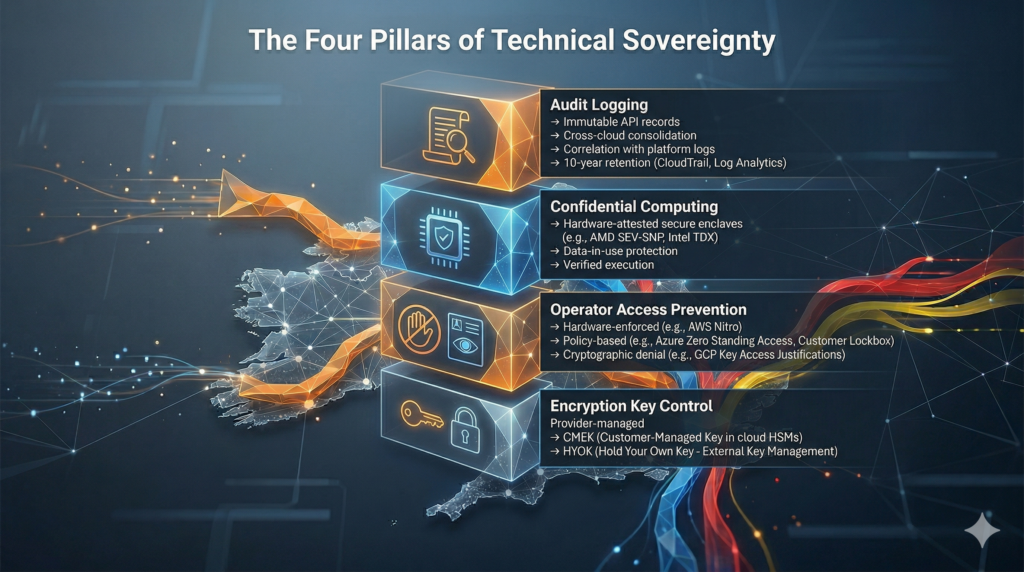
The encryption key hierarchy runs from provider-managed keys (simplest, least control), through customer-managed keys (CMEK) where key material lives in provider-managed HSMs but key policy is customer-controlled, to external key management (Hold Your Own Key) where key material never enters the provider’s infrastructure. AWS External Key Store (XKS) routes cryptographic requests through a customer-owned proxy to an on-premises HSM. GCP Cloud External Key Manager creates a reference in Cloud KMS pointing to external keys, with every decrypt request passing through the external system. Azure Managed HSM supports BYOK with FIPS 140-2 Level 3 validated hardware.
HYOK is genuinely powerful but its operational cost is frequently underestimated. AWS recommends sub-250ms round-trip latency to the external key manager. Microsoft warns with unusual directness that if Managed HSM recovery keys are lost, “all cryptographic material becomes unrecoverable. All data encrypted by that cryptographic material will be permanently lost.” HSM infrastructure requires high-availability operation, and any failure renders dependent cloud services unavailable. HYOK is appropriate when a Transfer Risk Assessment specifically identifies CLOUD Act exposure as unacceptable, when contractual obligations require demonstrable key sovereignty, or when regulatory frameworks mandate keys that have never resided in cloud provider infrastructure. For most OFFICIAL and OFFICIAL-SENSITIVE workloads, CMEK with strong key policies and access controls is architecturally sufficient.
Operator access prevention varies by provider architecture. AWS Nitro’s hardware-enforced isolation means there is genuinely no code path through which AWS personnel access EC2 instance memory or disk. Azure’s Zero Standing Access model relies on software enforcement with JIT elevation and Customer Lockbox approval workflows. GCP’s Access Approval plus Key Access Justifications model allows automatic cryptographic denial of access attempts that lack a valid justification code. All three approaches satisfy OFFICIAL and OFFICIAL-SENSITIVE requirements. The hardware versus software distinction becomes relevant only at SECRET level, where the threat model includes nation-state-level attacks on provider infrastructure.
Confidential computing matured significantly through 2025-2026. Azure Confidential VMs (AMD SEV-SNP, DCasv6/ECasv6 series) are GA with approximately 8% CPU overhead. Intel TDX VMs reached GA in February 2026 for selected regions. GCP supports AMD SEV, SEV-SNP, and Intel TDX across Confidential VMs, Confidential GKE Nodes, and Confidential Space for multi-party analytics. AWS Nitro Enclaves are available in all regions at no additional cost, providing cryptographically attested isolated compute environments with no persistent storage and no network access – used in production by financial services and healthcare organisations processing high-sensitivity data. Practical UK use cases centre on processing identifiable patient data in shared analytics environments, cross-organisational data processing without exposing raw records, and providing hardware-attested evidence of data-in-use protection for regulatory discussions.
Audit logging is natively comprehensive across all three platforms but requires supplementation for sovereignty-grade architectures. AWS CloudTrail with CloudTrail Lake provides up to 10 years of immutable, queryable API call records. Azure Activity Log covers control-plane operations, extendable to extended retention via Log Analytics. GCP Cloud Audit Logs are always-on for admin activity with 400-day immutable retention in the _Required bucket. What requires custom architecture across all platforms is cross-cloud audit consolidation for multi-cloud deployments, application-layer audit trails for data access within services, and correlation between platform logs and Access Transparency data for a complete operator access record.
Real-World Case Studies from UK Regulated Sectors
Department for Work and Pensions: AWS, UK Central Government
Scale Context: One of the UK’s largest government departments, serving approximately 20 million citizens and managing benefits expenditure exceeding £200 billion annually.
Challenge: DWP needed to exit a portfolio of legacy data centres while maintaining continuous operation of services critical to citizen welfare, and subsequently demonstrate cost-effective cloud operation to Treasury.
Solution Implemented: Large-scale migration to standard AWS using the London region, with a structured FinOps programme applied post-migration to optimise spend. Standard AWS controls with UK data residency through contractual commitments rather than sovereign cloud products.
Measurable Outcomes: 70% of services migrated to cloud, generating £90M in data centre cost savings. A subsequent FinOps optimisation programme reduced cloud consumption costs by 23%, achieving £8.7M in annual savings. DWP’s example is cited by the CDDO as a model for government cloud economics.
Source: AWS Public Sector Blog – DWP FinOps Journey
Yorkshire and Humber Care Record: GCP, NHS Regional Data
Scale Context: A regional Shared Care Record covering a population of 5.5 million across 13 NHS organisations and 900 GP practices.
Challenge: Connecting patient records across a fragmented regional NHS landscape to enable safe, timely clinical care while satisfying NHS DSPT obligations for personal health data.
Solution Implemented: Google Cloud Platform deployment in the London region, using BigQuery for analytics and GKE for workload orchestration. Assured Workloads UK Data Boundary control package enforces data residency. The architecture supports over 150,000 clinicians accessing integrated patient records.
Measurable Outcomes: Clinicians across the region access a unified patient record rather than siloed departmental systems, with the platform handling over 1 billion patient record views. GCP’s NHS DSPT-aligned controls satisfy information governance requirements without custom sovereign infrastructure.
Source: GCP Customer Story – Yorkshire and Humber Care Record
Leeds Teaching Hospitals NHS Trust: Azure, Clinical Systems
Scale Context: One of the UK’s largest teaching hospital trusts, with approximately 21,000 staff across five hospital sites.
Challenge: Migrating a complex, in-house Electronic Health Record to cloud infrastructure without service disruption to clinical operations running around the clock.
Solution Implemented: Microsoft Azure deployment in UK South and UK West regions, using Azure’s contractual UK data residency commitments and NHS-aligned compliance posture. Migration executed during live clinical operations.
Measurable Outcomes: EHR migration completed with minimal disruption to clinical operations. CDIO Paul Jones commented: “I thought we’d be talking days of unavailability, so for there to be so little disruption was amazing. The clinicians and frontline staff – I don’t think they’ve noticed, and that’s an absolute result.” Azure’s UK region commitments and NHS contractual frameworks satisfied DSPT requirements without dedicated sovereign infrastructure. LTHT has since extended the Azure deployment to its data platform, enabling integrated care records shared across Mid Yorkshire Hospitals NHS Trust.
Source: Leeds Teaching Hospitals completes migration to Azure – Microsoft UK Stories
Cost Analysis: When the Sovereign Premium Is Worth Paying
The sovereign cloud premium sits at 15-30% over equivalent standard public cloud deployments. AWS GovCloud runs approximately 20% more expensive than comparable standard region services, a useful benchmark for partition-based sovereignty costs. Full sovereignty with external key management and dedicated infrastructure can push toward 30%. AWS European Sovereign Cloud pricing was not publicly available at launch, but the separate-partition model with dedicated staff and infrastructure implies a significant premium over the London region.
Operational overhead frequently exceeds the compute premium. External key management infrastructure requires high-availability HSM operation, proxy or EKM connectivity management, and the operational acceptance that if external key infrastructure fails, all dependent cloud services become unavailable. Separate sovereign partitions require new IAM configurations, separate billing, parallel deployment pipelines, and management of service gaps. Applications may have hidden dependencies on global services, CloudFront, Route 53, CloudFront Functions that behave differently or are unavailable in sovereign configurations. This is not a region migration; it is running a parallel cloud estate.
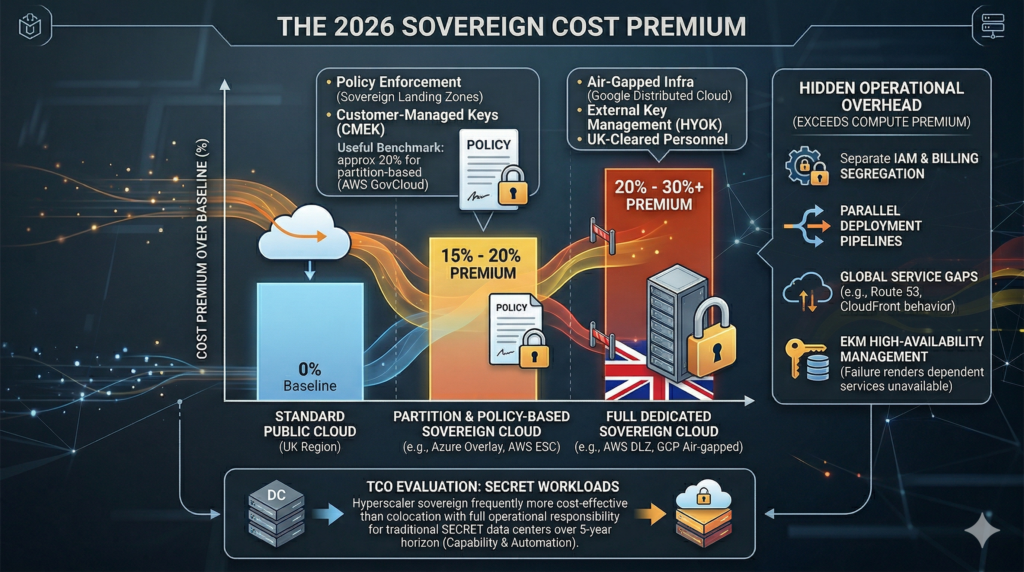
The right cost comparison is not sovereign cloud versus standard cloud. It is sovereign cloud versus colocation with full operational responsibility for everything except the physical building. Framed correctly, hyperscaler sovereign products are frequently more cost-effective than the alternative while delivering superior capability. For organisations currently running SECRET workloads in traditional data centres with manual change management and limited automation, cloud-based sovereign deployment – even at a 25% premium over standard cloud – typically delivers compelling TCO over a five-year horizon.
For workloads that do not require sovereign controls, the calculus is straightforward. DWP’s £8.7M annual saving from FinOps optimisation after migration to standard cloud demonstrates the opportunity cost of over-scoping sovereignty. The FinOps Evolution framework provides a practical model for quantifying cloud economics before committing to a sovereign architecture that constrains cost optimisation options.
Decision Framework: Matching Control Intensity to Data Classification
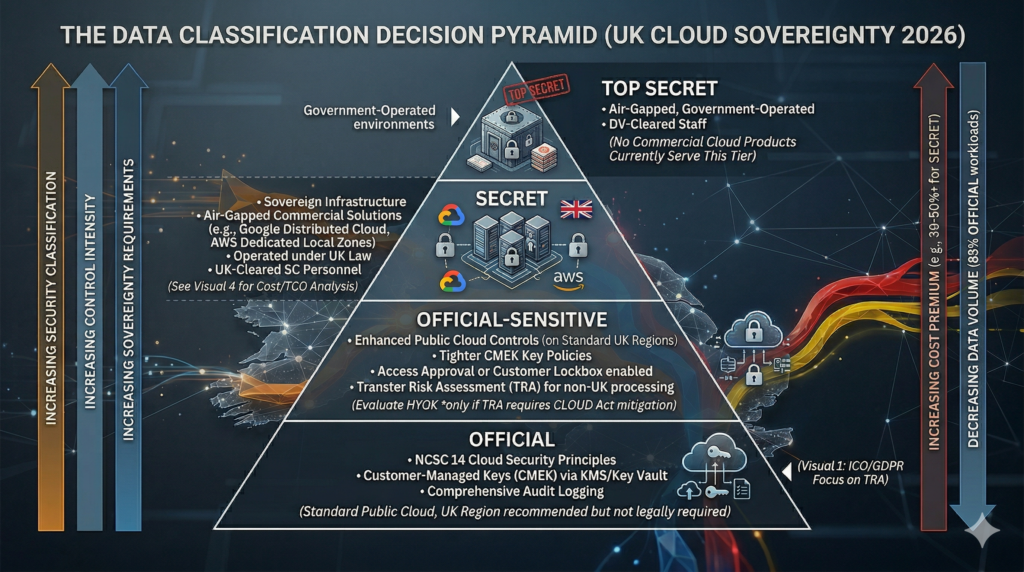
The starting point for any UK sovereignty architecture is data classification, mapped against the regulatory framework that applies to your organisation. The following framework is intended as a starting position that should be validated against your specific regulatory obligations, Transfer Risk Assessments, and threat model.
OFFICIAL (standard public cloud, UK region recommended but not mandated): Apply NCSC 14 Cloud Security Principles. Use CMEK with appropriate key policies and access controls. Implement comprehensive audit logging. UK region deployment eliminates transfer risk and simplifies governance, but is not legally required. No sovereign cloud product needed.
OFFICIAL-SENSITIVE (standard public cloud with enhanced controls): OFFICIAL-SENSITIVE is a handling caveat, not a classification tier, and does not automatically require sovereign infrastructure. Additional procedural and technical controls are appropriate: tighter CMEK key policies, Access Approval or Customer Lockbox enabled, extended audit retention, and documented TRA justifying the deployment. UK region strongly recommended. Evaluate HYOK only if your specific TRA identifies CLOUD Act exposure as an unacceptable residual risk.
SECRET (sovereign infrastructure mandatory): Public cloud cannot serve SECRET workloads, as the NCSC is explicit. The options are AWS Dedicated Local Zones, Azure Local (Sovereign Private Cloud), or Google Distributed Cloud in air-gapped configuration, all operated under UK law with SC-cleared personnel. The MOD’s architecture provides the reference pattern. Budget for 30-50% premium over standard cloud equivalents and significantly longer procurement timelines.
TOP SECRET: Air-gapped, government-operated environments under UK control with DV-cleared staff. No commercial cloud product currently serves this tier.
For FCA-regulated firms specifically, PS21/3 compliance does not place you on the SECRET tier path. Operational resilience, jurisdictional choice, regulatory data access, and supply chain oversight are achievable on standard public cloud with the right contract terms, operational architecture, and incident response capability. The questions to ask are: can you provide the FCA access to data within required timeframes, can you demonstrate impact tolerance compliance, and can you exit the cloud provider within an acceptable timeframe? These are architecture and governance questions, not sovereignty product questions. Our analysis of when not to go multi-cloud explores similar decision boundaries for organisations evaluating complex deployment models.
Organisations with hybrid environments where some workloads remain on-premises alongside public cloud deployment face additional sovereignty considerations covered in our hybrid cloud architecture guide, particularly around network path sovereignty and management plane segregation.
Implementation Roadmap
Phase 1: Classify and assess (Months 1-3)
Begin with data classification against the UK Government Security Classifications framework, applied to your organisation’s data inventory. For regulated sectors, layer your sector-specific framework on top: DSPT outcomes for NHS, PS21/3 important business service mapping for FCA-regulated firms, or MOD classification tiers for defence supply chain. For each data tier, document the regulatory obligations that specifically apply and identify the architectural controls they require. Conduct Transfer Risk Assessments for any data flows where UK standard cloud deployment would involve processing by personnel outside the UK. The output is a data classification map with control requirements per tier, not a decision on sovereign products, which comes later.
Phase 2: Architecture foundation (Months 4-9)
Design the sovereignty control stack for each data classification tier. For OFFICIAL workloads, implement CMEK, configure audit logging with appropriate retention, establish network segmentation to restrict management plane access, and document TRAs for your cloud provider relationships. For OFFICIAL-SENSITIVE workloads, layer Access Approval or Customer Lockbox, implement tighter key rotation policies, and establish your external key management capability if the TRA requires HYOK. For SECRET workloads, engage with cloud providers’ dedicated sovereign infrastructure teams early – procurement timelines for Dedicated Local Zones and Google Distributed Cloud are measured in quarters, not weeks. Establish a unified security operations capability that can correlate audit logs across the sovereignty control stack.
Phase 3: Workload migration and validation (Months 10-18)
Migrate workloads to the appropriate deployment tier, starting with OFFICIAL to prove the architecture and refine operational processes. Validate each deployment against its regulatory framework before moving to production: DSPT assessment for NHS workloads, a PS21/3 scenario test for FCA workloads, or a formal security accreditation for SECRET-tier deployments. Document the evidence package that demonstrates compliance – regulators and auditors increasingly expect this to be available on request rather than reconstructed retrospectively. Establish regular review cadence: classification decisions and TRAs should be revisited annually or when data flows change materially.
Strategic Recommendations
For UK enterprises evaluating sovereignty architecture in 2026, three recommendations are foundational.
Start from the regulatory obligation, not the product catalogue. Sovereign cloud products are a solution to a specific set of requirements, predominantly SECRET workloads, very high-sensitivity personal data processing or organisations where a Transfer Risk Assessment has specifically identified CLOUD Act exposure as unacceptable. Most UK enterprises have a minority of workloads that genuinely require sovereign infrastructure. Applying sovereign controls uniformly across all workloads inflates cost, limits service availability, and creates operational complexity that frequently degrades security outcomes.
Treat CMEK as the default, HYOK as the exception. Customer-managed encryption keys on AWS KMS, Azure Key Vault, or GCP Cloud KMS satisfy the data protection requirements of the overwhelming majority of UK regulated workloads. External key management is appropriate when your TRA concludes that key material must never enter the cloud provider’s infrastructure. This is a genuine architectural protection against CLOUD Act risk, but it comes with availability implications and operational overhead that must be explicitly accepted.
Platform selection for UK sovereignty is not primarily a features comparison. AWS’s separate ESC partition is EU-focused and does not directly serve UK standard deployments. Azure’s policy-based model is more mature and service-complete for UK regulated workloads but lacks hardware-enforced isolation. GCP provides the most sophisticated cryptographic control model with Key Access Justifications, but has no UK sovereign partner equivalent to its EU offerings. For most UK enterprise workloads, Azure has the most complete UK-specific compliance posture. For organisations requiring air-gapped sovereign infrastructure at scale, GCP’s MOD contract demonstrates a credible path. For SECRET-tier deployments requiring single-customer dedicated infrastructure, AWS Dedicated Local Zones provide a well-proven model.
The CLOUD Act tension is real but manageable through architecture. No technical control fully eliminates the legal risk that a US court could compel a US-headquartered provider to produce data held in foreign subsidiaries. HYOK-based external key management provides a meaningful cryptographic mitigation. Documented Transfer Risk Assessments demonstrate proportionate due diligence. And the pragmatic reality is that UK-essential public services, financial market infrastructure, and healthcare systems run on these platforms today, with regulators’ full awareness and engagement. The architect’s role is to match technical control intensity to data classification, not to solve an unresolved question of international technology law.
Useful Links
- UK ICO Guidance on International Data Transfers and the DUA Act 2025
- NCSC Cloud Security Principles
- FCA FG16/5 : Cloud and Third-Party IT Outsourcing Guidance
- NHS DSPT Version 8: Data Security and Protection Toolkit
- UK Government Security Classifications Policy (2024)
- Opening the AWS European Sovereign Cloud
- AWS Dedicated Local Zones
- Microsoft Cloud for Sovereignty Documentation
- GCP Key Access Justifications Overview
- Google Cloud Awarded Landmark Sovereign Cloud Contract with UK Ministry of Defence
- DWP FinOps Journey on AWS Case Study
- Leeds Teaching Hospitals completes migration to Azure
- Yorkshire and Humber Care Record – GCP Customer Story