

If you mention central government to most senior cloud engineers, you get a knowing grimace. The assumption is firmly established: the pay is worse, the technology is older, and the pace is slower. That assumption is not entirely wrong. A G7 technical architect at HMRC or DWP will earn £58,000 to £76,000 in base salary while a direct private sector equivalent might command £95,000 to £130,000. That gap is real, it compounds over time, and no amount of mission-driven language changes the arithmetic. But the engineers making a rational, considered decision to move into central government are not ignoring the numbers. They are doing better calculations than the ones everyone else stops at. When you add a 28.97% employer pension contribution, a DDaT pay framework allowance, structured career progression, and a security clearance that opens £120,000 to £160,000+ consulting and contracting opportunities the moment you leave, the spreadsheet looks considerably different.
Most cloud professionals who dismiss government roles never get to the second page of that spreadsheet. They compare gross salary figures and walk away. What they miss is a compounding set of benefits that take roughly three to five years to become visible, a set of career experiences that are impossible to replicate in the private sector, and a security clearance that functions as a career asset long after you return to market. This is not a post arguing that everyone should go into government. It is a post explaining who should, when the decision makes financial and strategic sense, and what you need to know before you accept an offer.
The central government cloud estate is not a backwater. DWP Digital is running one of the largest digital transformation programmes in Europe, building services used by 22 million people daily. HMRC’s Making Tax Digital programme is one of the most complex cloud migrations in UK public sector history. The Ministry of Defence is investing billions in its defence digital modernisation agenda, with cloud infrastructure at its core. The Government Digital Service and its successor function within the Central Digital and Data Office have shaped UK public sector technology standards that influenced private sector practice. Engineers who spend three to five years building cloud architecture at scale in this environment consistently report that the breadth of technical and stakeholder exposure accelerates their career trajectory in ways a narrower private sector role would not. The question is whether the salary sacrifice is worth it for you specifically, and that depends on where you are in your career, what you want to be able to do next, and how you value the pension and security clearance that come with the territory.
The Government Digital and Data Landscape
Central government cloud work is concentrated across a handful of major departments and agencies, each with distinct technology challenges and cultures. Understanding the landscape before you apply is essential because the experience you will accumulate, and the clearance you may require, varies substantially between them.
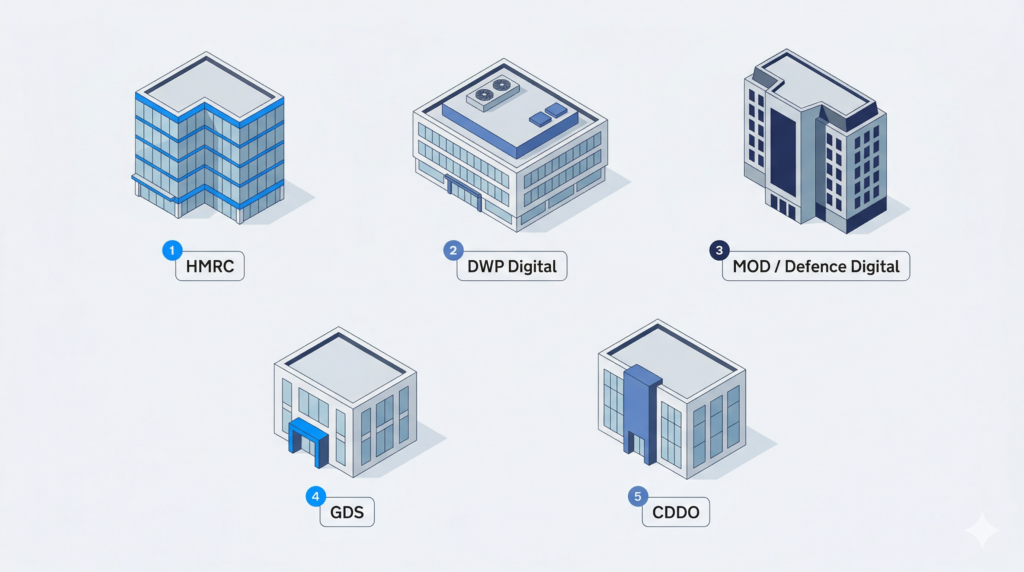
HMRC sits at the top of the list for cloud engineering complexity. The Making Tax Digital programme requires the management of tax data at a scale and sensitivity that has no private sector equivalent in the UK. The department runs substantial AWS and Azure estates and has been an early adopter of cloud-native architecture within government. Cloud architects at HMRC work on systems that must be simultaneously highly available, audit-compliant, and integrated with legacy mainframe infrastructure that cannot be switched off. If you want experience of legacy-to-cloud integration at genuine enterprise scale, HMRC offers it.
DWP Digital operates at massive user scale. The Universal Credit platform serves millions of claimants and is one of the most scrutinised digital services in government. The department has invested heavily in AWS infrastructure and has an active data engineering function. Cloud roles here tend to involve a high degree of cross-functional working with policy, operational delivery, and security teams, which builds the stakeholder communication skills that are difficult to develop in a purely technical private sector role.
The Ministry of Defence operates differently from civilian departments. Cloud work in MOD sits alongside significant on-premises and hybrid infrastructure requirements, and the security context is more intense. Defence Digital, the technology delivery arm, works on classified systems requiring SC and, for some programmes, DV clearance. The trade-off is that MOD experience opens a specific category of high-value consulting and contracting work that is inaccessible to engineers without cleared backgrounds.
The Government Digital Service and the Central Digital and Data Office operate at the policy and platform layer of government technology, setting standards, building shared platforms, and advising departments. GDS experience is valued by the consulting firms that support public sector clients and by international governments that look to the UK as a digital government reference point. If your ambition is advisory or consulting work in the digital government space, a GDS or CDDO role gives you credentials that are extremely difficult to acquire anywhere else.
The Intelligence Community, including GCHQ, MI5, and MI6, sits in a different category entirely. Technical roles in the agencies are advertised, do exist, and pay competitively by civil service standards, but the selection process is long, the lifestyle constraints are real, and the career paths are largely opaque to outsiders. Most cloud engineers considering government should focus on the civilian departments first.
The Pay Framework: What You Actually Earn
Government cloud salaries are structured around the Civil Service grading system, with a DDaT pay framework allowance on top of base pay for digital, data and technology roles. The combination matters because the base pay figure you see in a job advert is not the ceiling.
At Grade 7, which maps broadly to senior engineer or technical architect, base salaries run from approximately £58,000 to £76,000 depending on department and location, with London-based roles at the upper end. The DDaT allowance adds a capability-assessed, non-pensionable supplement on top of that base, which can range from £5,000 to £15,000 depending on your demonstrated proficiency level and the department’s implementation of the framework. A skilled G7 technical architect with strong DDaT assessment scores in a London department could be earning £85,000 to £90,000 in total cash compensation. When you eventually return to market, the credentials you have built are as important as the salary gap you have absorbed, which is why your professional profile deserves the same architectural thinking you apply to your technical work (see Your CV Is Your Architecture Document for a detailed framework on this). That is still below senior private sector benchmarks, but the gap narrows.
At Grade 6, which maps to lead architect or engineering lead, base salaries run from approximately £75,000 to £95,000. Senior Civil Service Pay Band 1, which covers Head of Technology and equivalent roles, starts at around £95,000 and reaches £130,000 for the most senior positions. The government has acknowledged ongoing recruitment and retention challenges in specialist digital roles, and the forthcoming review of the SCS pay framework specifically cites digital transformation leadership as an area where adjustments are being considered.
The number that most private sector engineers do not adequately account for is the pension. The Civil Service Alpha scheme carries an employer contribution of 28.97% of pensionable pay. To understand what that means in practice, consider that the typical private sector employer contributes 5% to 10% into a defined contribution pension. An engineer earning £70,000 in government receives a pension contribution equivalent to approximately £20,000 per year on top of their salary. Their private sector counterpart earning £100,000 with a 7% employer contribution receives £7,000. The pension alone closes much of the visible salary gap when you account for total compensation. The Institute for Fiscal Studies has found that including pension value in public-private comparisons increases the public sector compensation premium by up to nine percentage points.
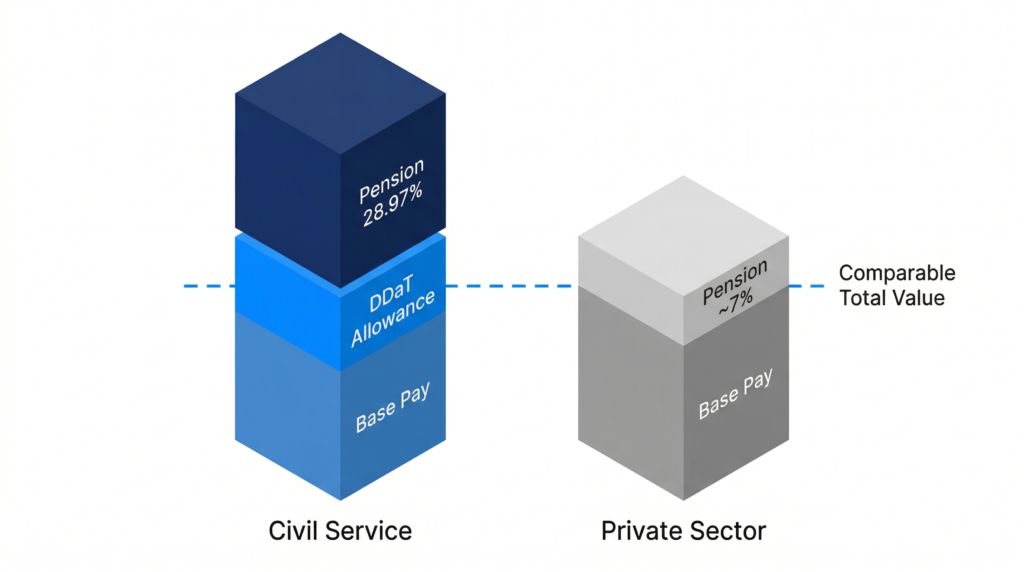
This does not mean you should ignore the base salary gap. If you have significant financial commitments tied to a high gross salary, the take-home reduction on a government role is real and immediate. But if you are mid-career, building long-term wealth, and have the flexibility to absorb a salary step for three to five years, the total compensation picture is more competitive than it initially appears.
The Security Clearance Premium
Security clearance is the most undervalued career asset that central government provides, and engineers consistently underestimate how transferable it becomes.
Most civil service cloud roles require Baseline Personnel Security Standard checks as a minimum. Government departments handling sensitive data, including HMRC, DWP, and the Home Office, typically require Security Check clearance, commonly known as SC, for cloud engineering and architecture roles. MOD and intelligence-adjacent roles require SC as a baseline and DV clearance for the most sensitive programmes.
SC clearance takes a minimum of six weeks to process, requires five years of UK residency, and involves criminal records checks, a credit check, and security vetting. Once granted, it is valid for ten years for permanent employees. You cannot apply for SC independently. An employer must sponsor you. This creates a structural asymmetry: engineers who already hold clearance are immediately deployable on sensitive contracts, while those without it require a waiting period that many programmes cannot accommodate.
The private sector and consulting market for SC-cleared cloud engineers is substantially more lucrative than the civil service roles that granted the clearance in the first place. Research from specialist defence and government technology recruiters indicates that SC-cleared professionals can earn up to 35% more than their non-cleared equivalents in the private sector, where consulting firms and system integrators working on government contracts are paying £90,000 to £140,000 for cleared technical architects in permanent roles and £500 to £700 per day for SC-cleared cloud contractors outside IR35. DV-cleared engineers command higher premiums still, operating in a thin market where demand consistently exceeds supply.
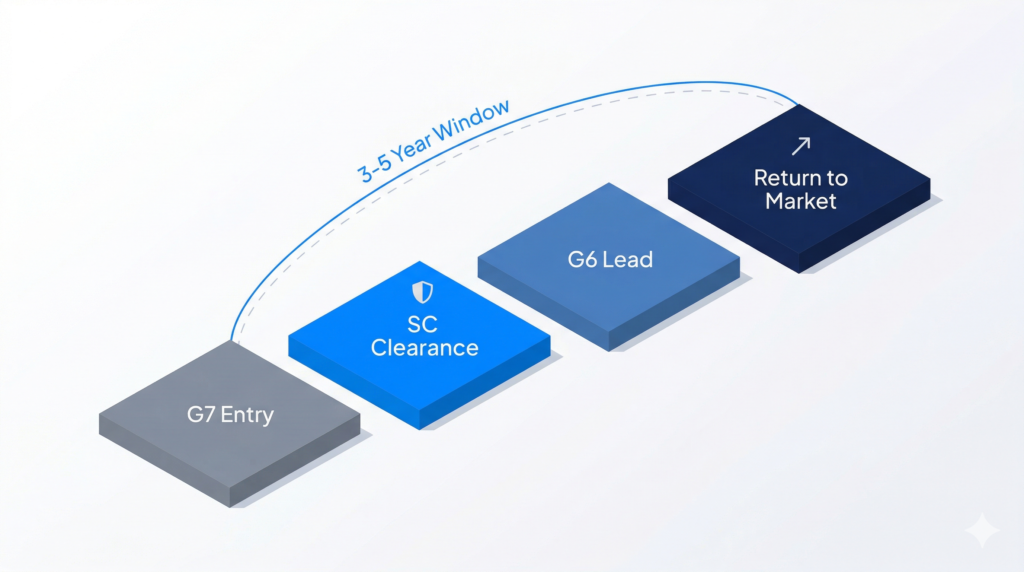
The strategic logic for a mid-career engineer follows clearly from the numbers. Spend three to five years in a government role, accumulate SC clearance and substantial public sector cloud experience, and return to market with credentials that place you in a segment of the private sector where competition is significantly reduced. The salary you deferred during your government tenure is recoverable, typically within twelve to eighteen months of returning to market, and the cleared status remains a differentiator for the duration of its validity.
DV clearance requires ten years of UK residency and a substantially more intensive vetting process including a detailed interview, character references, and financial scrutiny. It can take six months or longer to obtain. Engineers who pursue MOD and intelligence-adjacent roles are making a longer investment, but the DV premium on return to market is proportionally larger, particularly in the defence and national security consulting sector.
The Technical Skills That Government Builds
Government cloud work develops specific technical capabilities that are difficult to acquire elsewhere. Not all of them are cutting-edge, and it is worth being honest about where government lags, but the breadth and the constraints-driven engineering thinking are distinctive.
Legacy integration is the defining technical challenge across most large government departments. HMRC runs COBOL-based systems that predate cloud computing. DWP has decommissioned some legacy infrastructure but still manages a complex estate of older platforms that cannot simply be replaced. Engineers who learn to build cloud-native services that integrate reliably with mainframe and legacy systems develop skills that are in high demand from the major consulting firms and system integrators who work on government modernisation programmes. Pure cloud-native engineers who have never had to design an integration layer for a forty-year-old batch processing system find this work significantly harder than those who have lived it.
Compliance-driven architecture is another distinctive competency. Government cloud work is shaped by the Government Security Classifications policy, the Cyber Essentials Plus framework, NCSC security principles, and in some departments, alignment with ISO 27001 and additional data protection requirements. Designing cloud architecture within these constraints, including classified network segmentation, data sovereignty requirements, and audit logging at scale, builds a rigorous approach to security architecture that translates well to regulated industries in the private sector. Financial services, healthcare, and defence contractors all look for engineers with public sector compliance experience.
The scale of government data engineering is often underestimated. HMRC processes tax records for tens of millions of individuals and businesses. DWP manages benefit payment data at population scale. The data platform and data governance challenges at this scale are not commonly encountered outside central government and the very largest commercial organisations. Engineers who lead cloud data platform work in these environments are building demonstrable experience of production data architecture at a scope that is difficult to replicate and easy to articulate to future employers.
Where government does lag is in adoption speed and toolchain modernity. Procurement constraints mean that departments often use established platforms rather than the most recent services. A government cloud engineer in 2026 is less likely to be working with the latest AI/ML infrastructure services than their counterpart at a technology company. If your primary career objective is to stay at the frontier of cloud tooling evolution, government is not the right environment. If your objective is to develop architectural depth, compliance rigour, and stakeholder complexity, it is.
The Career Progression Framework
Civil service progression is structured but not automatic, and understanding the framework before you join is important for setting realistic expectations.
Entry at G7 for an experienced cloud engineer is the standard starting point. Promotion to G6 typically takes three to five years and requires demonstration of technical leadership, team development, and the ability to influence across departmental boundaries. SCS progression is both slower and more competitive, with a much smaller pool of available positions and a selection process that emphasises leadership, strategic communication, and budget responsibility alongside technical credibility.
The DDaT capability framework defines the progression path for technical roles in more detail than the generic civil service grades. Moving from practitioner to expert to lead level within the framework requires documented evidence of technical achievement, peer validation, and formal capability assessment. Engineers who engage actively with the framework, maintaining a portfolio of technical work and seeking formal assessment, progress more quickly than those who treat it as a bureaucratic formality.
The more important progression question for most engineers considering government is not how quickly they will be promoted within the civil service, but when and on what terms they will return to the private sector. The optimal government tenure for most cloud engineers is three to five years. Shorter than three years and you may not obtain SC clearance, accumulate sufficient architectural experience, or pension accrual worth having. Longer than five to seven years without progressing to SCS level and the risk of technical currency erosion increases. Government does not expose engineers to the rate of tooling change that characterises hyperscaler environments, and the gap with private sector practice widens the longer you stay.
The engineers for whom government offers the best long-term career outcomes are those who join at G7 in their late twenties or thirties, progress to G6, obtain SC or DV clearance, and return to market at senior architect or lead level with a cleared background, five years of large-scale public sector delivery experience, and the pension accrual of those years effectively banked. That trajectory, when executed deliberately, is materially better than the alternative of remaining in private sector employment at the same seniority level throughout.
Business and Leadership Skills
Central government builds a specific category of professional capability that is difficult to acquire in the private sector and that translates directly to senior roles in consulting, regulated industries, and leadership positions.
Stakeholder complexity in government is unlike anything most private sector engineers encounter. A cloud architecture decision at DWP can involve technical teams, policy advisers, ministers’ private offices, the Cabinet Office, spending review processes, and public accountability through parliamentary scrutiny. Engineers who learn to navigate this environment, presenting technical decisions clearly to non-technical stakeholders under political pressure, develop communication and influence skills that make them significantly more effective in any senior leadership context.
The ability to perform under this kind of pressure is a career differentiator that is explored in depth in Under Pressure: The High-Stakes Performance Skill, and government provides the conditions in which that capability develops quickly.
Business case writing is a formal competency in government that is informally developed in the private sector. Government cloud investment requires Treasury Green Book compliant business cases with structured options appraisals, risk registers, and benefits realisation frameworks. Engineers who lead these processes understand how to present technical investment decisions in terms of financial value and risk that finance and executive leadership require. This is a directly transferable skill to any organisation making significant cloud investment decisions.
Procurement and supplier management experience is another government-specific competency. Central government procures cloud services and system integration through frameworks including G-Cloud, Crown Commercial Service agreements, and major programme contracts. Engineers who have been on the buying side of these relationships understand what good looks like, which makes them valuable to the suppliers and consulting firms that operate on the selling side.
Making the Decision: Who Should Go and Who Should Not
Government cloud careers make strong sense for cloud engineers who are SC or DV eligible, who have the financial flexibility to absorb a salary step, and who have a deliberate plan to return to market within five to seven years with cleared credentials and demonstrable public sector delivery experience. They are a particularly good option for engineers in their early to mid career who are willing to trade short-term salary for long-term career optionality, and for engineers who want to work at the scale and complexity that only the largest public sector programmes can offer.
If you are weighing government roles against non-technology-sector employers in the private sector, the considerations explored in Why Your Next Cloud Role Should Be at Tesco, the NHS, or HMRC are a useful comparison before making a final decision.
Government cloud careers make less sense for engineers already earning above £120,000 who would be taking a significant and financially consequential step backwards. They are poorly suited to engineers who are not UK residents of five years or more, for whom SC clearance is not immediately available. And they are the wrong choice for engineers whose primary professional objective is staying at the technical frontier of cloud tooling, where the pace of adoption in government cannot match commercial cloud-native environments.
The engineers who are most disappointed by government roles are those who joined for the mission narrative without a concrete plan for what the experience would enable. Those who are most satisfied are those who treated the tenure as a deliberate career investment with a specific set of objectives: SC clearance obtained, large-scale programme delivery demonstrated, pension accrual banked, and a return to market date approximately defined before they joined.
ROI Analysis
For a cloud engineer joining at G7 on £70,000 base with a £10,000 DDaT allowance, total cash compensation is £80,000. A comparable private sector senior engineer role might offer £100,000 to £115,000. The annual cash gap is approximately £20,000 to £35,000.
Against this, the Alpha pension employer contribution of 28.97% on £70,000 pensionable pay is approximately £20,300 per year. The total compensation gap narrows to between zero and £15,000 annually depending on private sector pension provision. Over five years, with pension accrual and the SC clearance premium factored in, the long-term financial position is broadly comparable or better.
The return to market value is harder to quantify precisely but is the most compelling part of the calculation. SC-cleared cloud architects returning from government are entering a smaller, better-paid market. A senior technical architect at G6 who returns to private sector consulting with active SC clearance and five years of large-scale government programme experience can reasonably target £120,000 to £150,000 in consulting or leadership roles, or £550 to £700 per day as a cleared contractor. If that trajectory represents a £20,000 to £30,000 annual uplift relative to where they would have been without the government tenure, the break-even on the salary deferral is reached within two to three years of returning to market.
Next Steps
If you are considering a central government cloud role, the practical actions are these:
- Check your SC eligibility. You need five years of continuous UK residency and a clean financial and criminal record. If there are any complications, understand them before applying rather than after receiving an offer.
- Identify which department aligns with your technical objectives. HMRC and DWP for legacy integration and data scale, MOD for cleared career development, GDS or CDDO for digital government policy and platform work.
- Search civil service roles on Civil Service Jobs and DWP Digital Careers directly, not through generic job boards, where government roles are frequently stale or misrepresented.
- Request a DDaT capability assessment briefing during interview. Understanding which proficiency level you would be assessed at determines a significant part of your total compensation.
- Model your pension carefully using the Civil Service Pension Scheme calculator before accepting an offer. The defined benefit accrual at 2.32% per year is the single largest financial differentiator versus private sector employment.
- Set a clear return-to-market horizon before you join. Three to five years is the optimal window for most engineers. Having that target in mind helps you stay technically current and avoid the career drift that affects engineers who stay too long without a plan.
Useful Links
- Civil Service Jobs
- DWP Digital Careers
- HMRC Digital Careers
- Government Digital and Data Profession Capability Framework
- Civil Service Pension Scheme (Alpha)
- Home Office DDaT Pay Framework Allowance
- UK Security Vetting (UKSV)
- IT Jobs Watch – SC Cleared roles
- Transforming for a Digital Future: 2022–2025 Roadmap
- Civil Service Grades and Pay Overview