

If you are a senior cloud or platform engineer at a UK enterprise right now, there is roughly a one-in-two chance your team has been restructured in the last 18 months. Platform engineering teams are being disbanded or reshaped at an uncomfortable rate: research presented at Fast Flow Conf in late 2025 found that 60-70% of platform engineering initiatives fail to demonstrate measurable business impact, with around half of platform teams disbanding or restructuring within 18 months of formation. Lloyds Banking Group ran its fourth restructure of the year through Platform 3.0 in February 2025. BT is reducing toward a target of 55,000 fewer roles by 2030, having already shed around 6,400 in the year to March 2025. GDS and CDDO merged again in January 2025, the second major reshape of central government digital inside four years.
Most career advice treats a reorg as a crisis to survive. The engineers who come out of restructures in better shape treat them differently as an environment to navigate, not a disaster to recover from. The difference is not luck. It is professional habits they built before the rumour mill started, and a clear-eyed decision framework they applied when it did.
This post covers what is actually happening in UK cloud and platform teams right now, the specific career risks that most engineers underestimate, and the practical steps that protect your trajectory whether you stay or leave. There are no general platitudes about “embracing change.” There are specific things you should be doing this week.
Why reorgs are happening at this rate
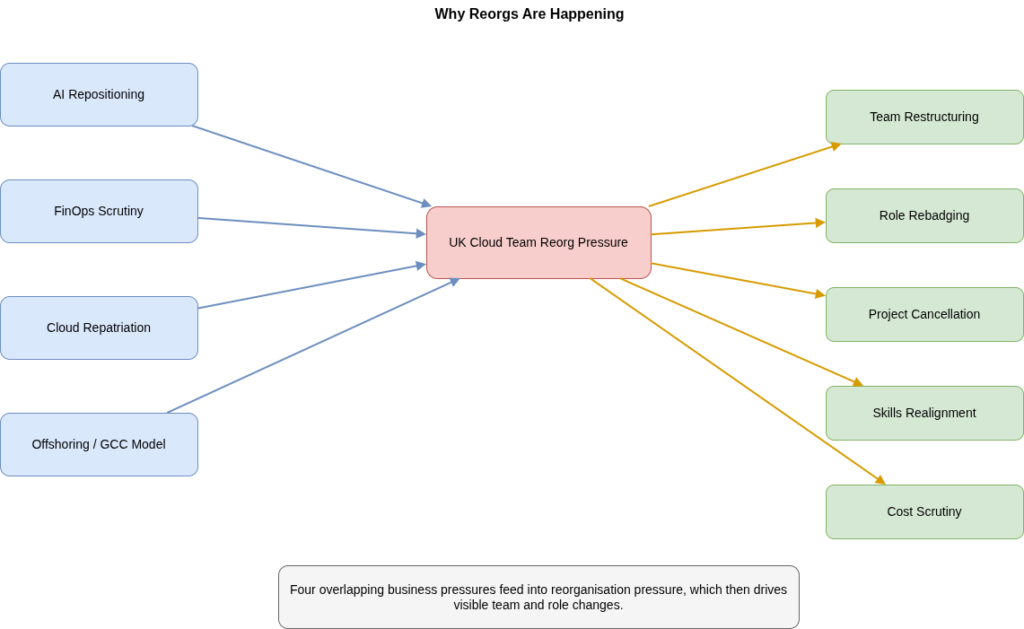
The wave of restructuring hitting UK cloud teams in 2025 and 2026 is not a continuation of the post-COVID correction. The drivers have shifted and they are worth understanding, because the driver determines what survives.
AI repositioning is the dominant force. Boards have set AI mandates that almost no enterprise IT function was structured to deliver, and the reflex is to flatten layers, redirect headcount toward AI platform teams, and deprioritise anything that lacks a credible AI story attached to it. Microsoft, AWS, and Cloudflare have all made significant cuts framed around reducing managerial layers and accelerating AI integration. UK enterprise customers feel the second-order effects through smaller account teams, renegotiated contracts, and partner ecosystems that themselves restructure.
FinOps discipline is the second driver. According to the 2025 State of FinOps Report, workload optimisation and waste reduction are the top priorities globally. When CFOs ask platform leaders to show unit economics and they cannot, teams that seemed essential six months ago get reframed as overhead. The “developer experience platform” that lacks a clear cost-per-deployment metric is a reorg target.
Cloud repatriation is reshaping teams in ways that are underappreciated. Research from Node4 found 97% of UK mid-market organisations planning to migrate at least some workloads out of public cloud, and a 2024 Barclays CIO survey indicated 83% of enterprises plan workload shifts from public cloud. If your team was built around a cloud-first, AWS-native mandate, a sovereignty-driven repatriation programme will reshape its purpose whether or not anyone uses the word “reorg.”
Offshoring to Global Capability Centres is the Lloyds pattern, and it is spreading. The Platform 3.0 announcement in February 2025 created around 1,200 “net new” roles while putting approximately 6,000 existing tech and engineering staff under review, with 300 engineering positions moved to the Lloyds Technology Centre in Hyderabad. The internal union BTU noted that many “new” roles were existing roles renamed and rebadged into new job families. This pattern is now standard across UK financial services.
The honest takeaway: reorgs are not a temporary disruption. They are the operating environment for senior cloud engineers in 2026, and planning around a 12-24 month cycle between restructures is not pessimistic, it is accurate.
What actually happens to your career during a reorg
The specific career risks engineers face during restructures are not the ones that get the most attention. Redundancy is the visible fear, but it is rarely the primary mechanism by which reorgs damage careers.
Visibility loss is the more common and more insidious risk. A new VP arrives with their own people and their own narrative. Your previous track record lives in a Confluence wiki no one is reading. Engineers who were 18 months into a strong promotion trajectory with their previous manager often find themselves reintroducing their work from scratch and the new leadership reads Slack threads and pull request descriptions rather than last year’s performance reviews.
Project cancellation removes your impact runway. The fastest decision a new leader makes is to deprioritise something. If you are the technical lead on a project that gets put “on hold for review,” your next six months of demonstrable output are at risk regardless of how well you perform. Engineers attached to “strategic legacy” platforms, the systems that keep the company running but carry no AI narrative are particularly exposed.
Reassignment outside expertise is a quiet career penalty that compounds. A reorg frequently moves people based on the boxes on the new org chart rather than their skills. A senior AWS networking specialist gets placed on a Kubernetes platform team. A long-time observability engineer is reassigned to a data platform group. The work is technically adjacent but the depth of expertise no longer applies, and senior engineers can find themselves performing at mid-level for 12 months while they rebuild context.
The promotion case evaporating is specific to the timing. If your reorg lands two months before a pay cycle, your years of work get summarised by a manager who has known you for six weeks. As engineering leadership practitioners have noted, it is genuinely difficult to build a strong promotion case for someone you do not yet know well. If you were within six months of a promotion, treat that window as under threat and act accordingly . Either accelerate the evidence base before the new manager arrives, or reset your timeline expectations and plan the re-run.
Selection pools are the legal mechanism worth understanding specifically. When UK redundancies are proposed, the employer must define a selection pool, the group of employees from which redundant roles will be selected. If your role is judged unique, you can be a “pool of one,” which is faster but legally riskier for the employer. If you are pooled with others, scoring criteria such as skills, performance and attendance are supposed to be objective. In practice, scoring can quietly favour engineers whose work aligns with the new strategic direction, which is precisely why being visible to new leadership quickly is a career-protective move, not political manoeuvring.
Reading the early signals
A reorg is rarely a surprise to anyone paying close attention. The signals that matter:
A hiring freeze that quietly extends is the most reliable indicator. Requisitions pulled for “prioritisation review” that never come back, backfills denied without explanation.
A new VP, director, or CTO almost always produces a reorg within their first 12 months. It is how new leaders demonstrate they are making changes.
Consultancy presence at senior levels: McKinsey, Deloitte, KPMG in the building working with your leadership, almost always precedes an organisational design recommendation.
Budget questions that become sharper. When your director starts asking for unit economics, cost-per-service breakdowns, or customer attribution for your platform work, someone above them is asking the same questions with more urgency.
Your manager goes quiet on context they used to share freely. This is counterintuitive, but managers who know a reorg is coming are explicitly told not to discuss it with their teams. Reduced transparency is information.
If three or more of these are present simultaneously, treat it as a 12-month countdown and adjust your professional behaviour now, not when the announcement lands.
Protecting your projects and your impact record
The single most protective move a senior engineer can make during a period of reorg risk is to attach their work visibly to a business outcome with an identifiable sponsor outside engineering.
“Reduces AWS spend by £400,000 annually,” “required for DORA compliance by January 2026,” and “underpins the new mortgage origination journey” survive reorgs. “Improves developer experience” generally does not, even when it should. The narrative around your work matters as much as the quality of the work itself and this is not cynicism, it is how new leaders with limited context make decisions under time pressure.
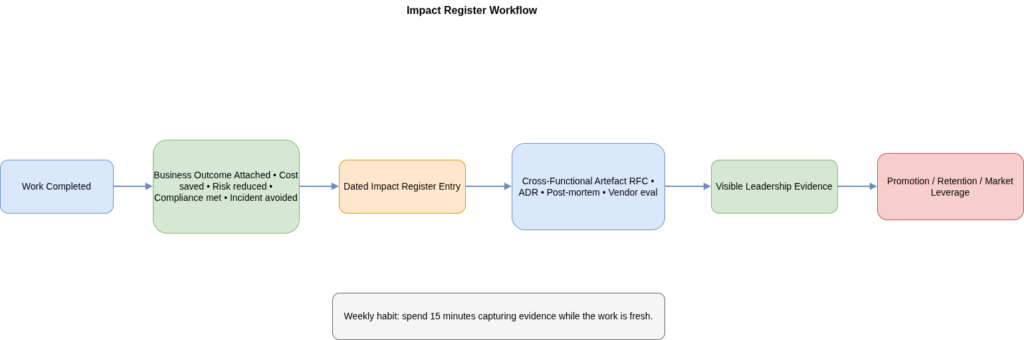
Keep a dated impact register. A short written record updated weekly, not at performance review of decisions made, incidents resolved, costs saved, and architecture documents authored is the most valuable professional artefact you can hand a new manager. It takes 15 minutes a week and removes the need to reconstruct your last 12 months from memory when it matters most.
Cross-functional artefacts make your work legible. Architecture review documents, RFCs, post-mortem authorship, and vendor evaluations are read by leadership outside your immediate team. Pull requests and Jira tickets are not. If all your impact lives in code review history, you have a visibility problem.
Avoid becoming a sole-knowledge holder on legacy systems. The instinct to protect your position by being the only person who knows how something works is understandable, but it backfires. In a reorg, sole-knowledge holders are sometimes protected and sometimes treated as a liability the organisation wants to remove at any cost. Spread the knowledge, write the runbook, pair on the critical path. Your value should be “I designed this and can build the next one,” not “I am the only one who can keep this running.”
This connects directly to what separates engineers who advance through restructures from those who stagnate: the habit of making their impact legible continuously, not as a crisis response. The same skills are discussed in our post on high-stakes performance. The ability to communicate clearly under pressure to leadership that does not have your context is worth £15,000-£30,000 in salary terms over a career, and it starts with daily professional habits rather than exceptional moments.
Establishing visibility with new leadership
The first six weeks under new leadership are more consequential than the following six months. Engineers who manage this transition well share a consistent pattern.
Request a 30-minute introduction meeting in the first two weeks. Bring a one-page summary of what you own, the business outcomes it drives, the top three risks you see, and one or two specific questions where you would genuinely value their perspective. Ask short, useful questions. Do not pitch yourself. Do not complain about the previous structure. Do not compare the new approach unfavourably to what came before.
Pick one early, visible deliverable that aligns with the new leader’s stated priorities. It does not need to be large. It needs to be obviously aligned and obviously delivered within the first 60 days.
Write decision records. Send weekly notes that summarise what you and your team did, what you learned, and what you are blocked on. This is not performance theatre, it is giving a new leader the context they need to advocate for you in rooms you are not in.
Be net-positive in public. You can be honest in one-to-ones and with trusted peers. In Slack, in all-hands sessions, and in any forum where new leadership can observe you, be the person who steadies the room. Scepticism expressed in the wrong channel is career-limiting in ways that are disproportionate to the comment itself.
Protecting your salary trajectory
Pay freezes during reorgs are common and are typically framed as “levelling consistency reviews.” If you are caught in one, the approach that works is not patience, it is paper.
Document the gap explicitly and in writing with your manager: “Based on market data and my last performance rating, my expectation for the next pay cycle was X. I understand the current freeze. I would like to agree now what evidence and timeline would support a correction once the freeze lifts.” This creates a record and signals seriousness without hostility. Managers who have been told to freeze pay can sometimes still make commitments about what the evidence threshold for a correction looks like.
Know your market rate precisely. As of 2026, senior cloud engineers in London earn £70,000-£100,000 base, with principal and staff roles reaching £120,000-£140,000+ at well-funded firms. Specialist roles in financial services, AI infrastructure, or regulated-sector compliance exceed this range. The London premium has narrowed to 15-25% above national averages. Use IT Jobs Watch, Reed Technology, and Morgan McKinley salary guides as anchor data for any pay conversation, not as an ultimatum but as shared reference.
The most important fact about salary stagnation during a reorg: engineers who survive a restructure with a frozen pay cycle typically experience 12-24 months of below-market growth. UK permanent tech salaries grew approximately 7.5% in the year to mid-2025 according to Totaljobs data. If you are frozen during this period, you are not standing still, you are losing ground in real terms. Engineers who change employers post-reorg typically recover a salary band within 6-12 months, often through a 15-25% step change at the point of move.
If you have been through the certification plateau where adding credentials stopped moving the salary needle, a reorg-driven freeze is the same dynamic in a different form. The mechanism for recovery is almost always external market pressure, not internal advocacy alone.
The UK legal floor: what it actually gives you
UK employment law gives senior engineers materially more runway than US at-will employment. Understanding it matters because most engineers do not until they need to.
Collective consultation is the most significant protection. When 20 or more redundancies are proposed at one establishment within 90 days, the employer must consult with employee representatives for a minimum of 30 days (for 20-99 redundancies) or 45 days (for 100 or more), and must notify the Secretary of State via Form HR1. From 6 April 2026, the Employment Rights Act 2025 doubled the protective award for failure to comply from 90 to 180 days’ full pay per employee. This is real financial leverage if the employer tries to shortcut the process.
Statutory redundancy pay is currently capped at £21,570 for those with 20+ years’ service, rising to £22,530 from April 2026. The first £30,000 of termination payments is income-tax-free. Payment in lieu of notice is fully taxable. These figures matter because many engineers assume their contractual enhanced package makes statutory rights irrelevant but the floor matters in negotiation because it defines the minimum the employer must pay before the conversation about enhancement begins.
Settlement agreements and protected conversations are increasingly how UK employers manage senior exits without going through a full redundancy selection process. A “protected conversation” under section 111A of the Employment Rights Act allows your employer to open termination discussions off the record. The contents are inadmissible in an unfair dismissal claim provided there is no improper conduct. If you are invited to one, do not respond immediately. Take time. Take legal advice. Your employer will typically contribute £500-£1,500 toward solicitor’s fees, use it. The initial offer is almost never the final one. Negotiable elements include the enhanced ex gratia amount, an agreed reference, the scope of any restrictive covenants, outplacement support, and the tax categorisation of different payment components.
TUPE protects you if your team is being outsourced to a managed service provider or your contract is transferring between providers. Your terms transfer with you. The case law around TUPE and AI-driven automation, where a new provider plans to deliver the same service with significantly fewer humans is still developing, but if your team is being transferred rather than dissolved, TUPE is worth understanding before you sign anything.
The stay-or-leave decision
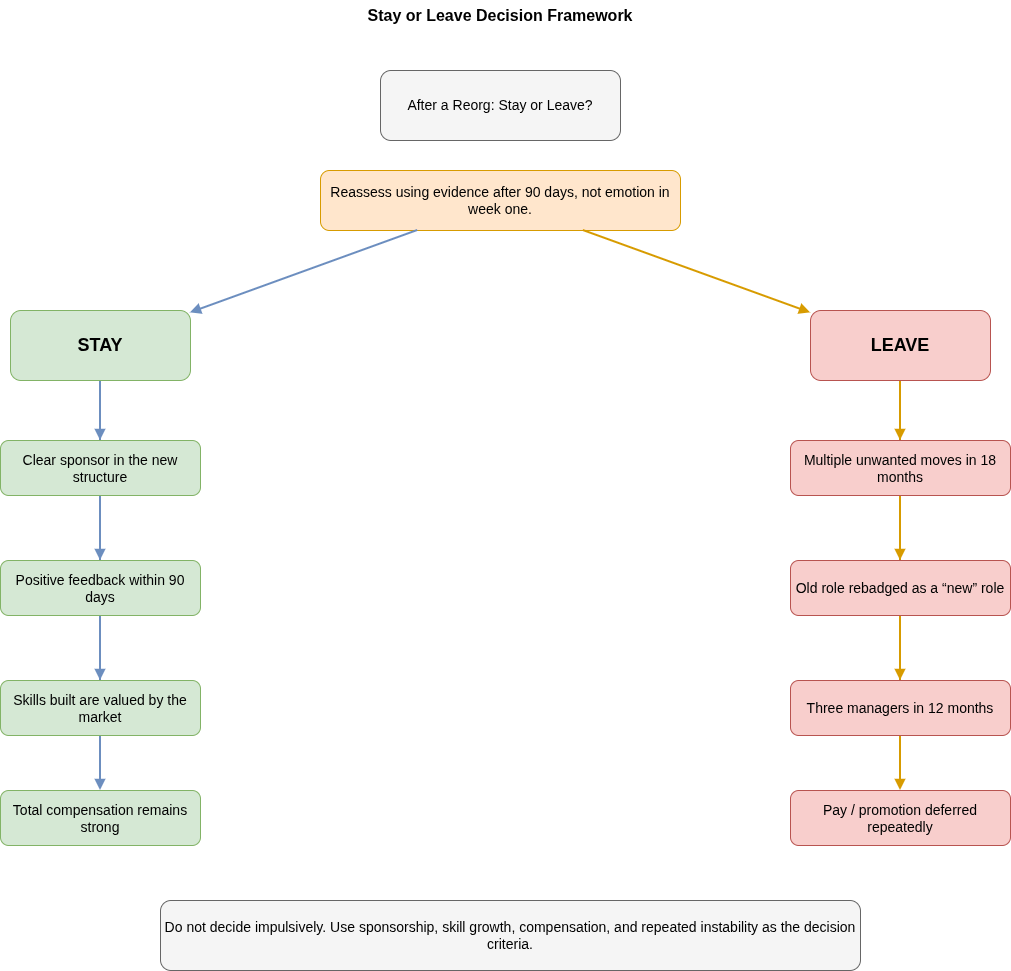
The decision to stay or leave after a reorg is one most engineers make too quickly, under emotional pressure, in either direction. A framework that holds up:
Stay if your work has a clear sponsor in the new structure and you can name them. Stay if the new leadership has, within 90 days, given you specific positive feedback or pulled you into something visible. Stay if the skills you would build in the next 12 months are ones the market is paying for and you cannot easily build elsewhere. Stay if your total compensation, including employer pension contributions of 5-10% common in UK enterprise roles, bonus, and any unvested equity materially exceeds what the external market is offering right now.
Leave if you have been moved twice in 18 months to teams that were not your choice and that sit outside your expertise. Leave if you are being asked to interview for “new” roles that look like your old role with a different name. The Lloyds Platform 3.0 pattern, criticised by the BTU union, is the clearest UK example. Leave if your manager has changed three times in 12 months. Leave if you have been told pay or promotion will be revisited “next cycle” for two consecutive cycles without movement.
The financial case for leaving is clearer than most engineers acknowledge. A 15-25% salary step at the point of a well-timed move, combined with avoiding 12-24 months of below-market growth during a freeze, can represent a £25,000-£50,000 swing in total earnings over a two-year period for senior engineers in the £90,000-£130,000 range. This is not a reason to leave impulsively. It is a reason to be clear-eyed about the financial cost of staying when the conditions for growth are genuinely absent.
If you are considering an employer type shift alongside a move, why non-tech companies like Tesco, the NHS, or HMRC deserve more serious consideration than most cloud engineers give them is worth reading, particularly for engineers in financial services facing the GCC offshoring pattern described above.
What to do this week
The engineers who navigate reorgs well share one characteristic above everything else: they treat reorg readiness as ongoing professional hygiene, not a crisis response. That means:
- Spend 15 minutes updating your impact register with dated, business-outcome-linked entries. Do this every week regardless of whether a reorg is visible.
- Audit your visibility: can your skip-level manager name two specific things you have delivered in the last quarter? If not, fix that within 30 days.
- Map your three largest current workstreams to a business outcome, a regulatory deadline, or a cost figure. If you cannot do this convincingly, your work is at reorg risk regardless of its technical merit.
- Keep your CV and LinkedIn profile current to within the last 90 days. Not because you are leaving, because the moment you need them is the worst time to write them.
- If three or more of the early signals described above are present in your organisation, have one external coffee a month. Not a job hunt. A conversation. You want a calibrated view of the external market before you need it.
A reorg is not a measure of your value as an engineer. It is a measure of your organisation’s strategic priorities, and those change. What you control is how prepared you are when they do.
Useful Links
- IT Jobs Watch – UK Technology Salary Data – Live salary benchmarking for cloud and infrastructure roles
- Acas – Redundancy Rights and Collective Consultation – Authoritative guidance on UK redundancy law
- Gov.uk – Statutory Redundancy Pay Calculator – Official calculator for statutory entitlement
- Employment Rights Act 2025 – Key Changes (Bird and Bird) – Summary of the April 2026 changes to protective awards and redundancy rights
- StaffEng.com – Being Visible – Will Larson’s framework for building visibility as a senior engineer
- LeadDev – How to Handle a Reorg as an Engineering Manager – Practical guidance for leads navigating restructures
- TUPE Regulations – Pinsent Masons Plain English Guide – What TUPE means for engineers in outsourcing transitions
- Fast Flow Conf – Platform Engineering Research – Source for platform team failure and restructure data