
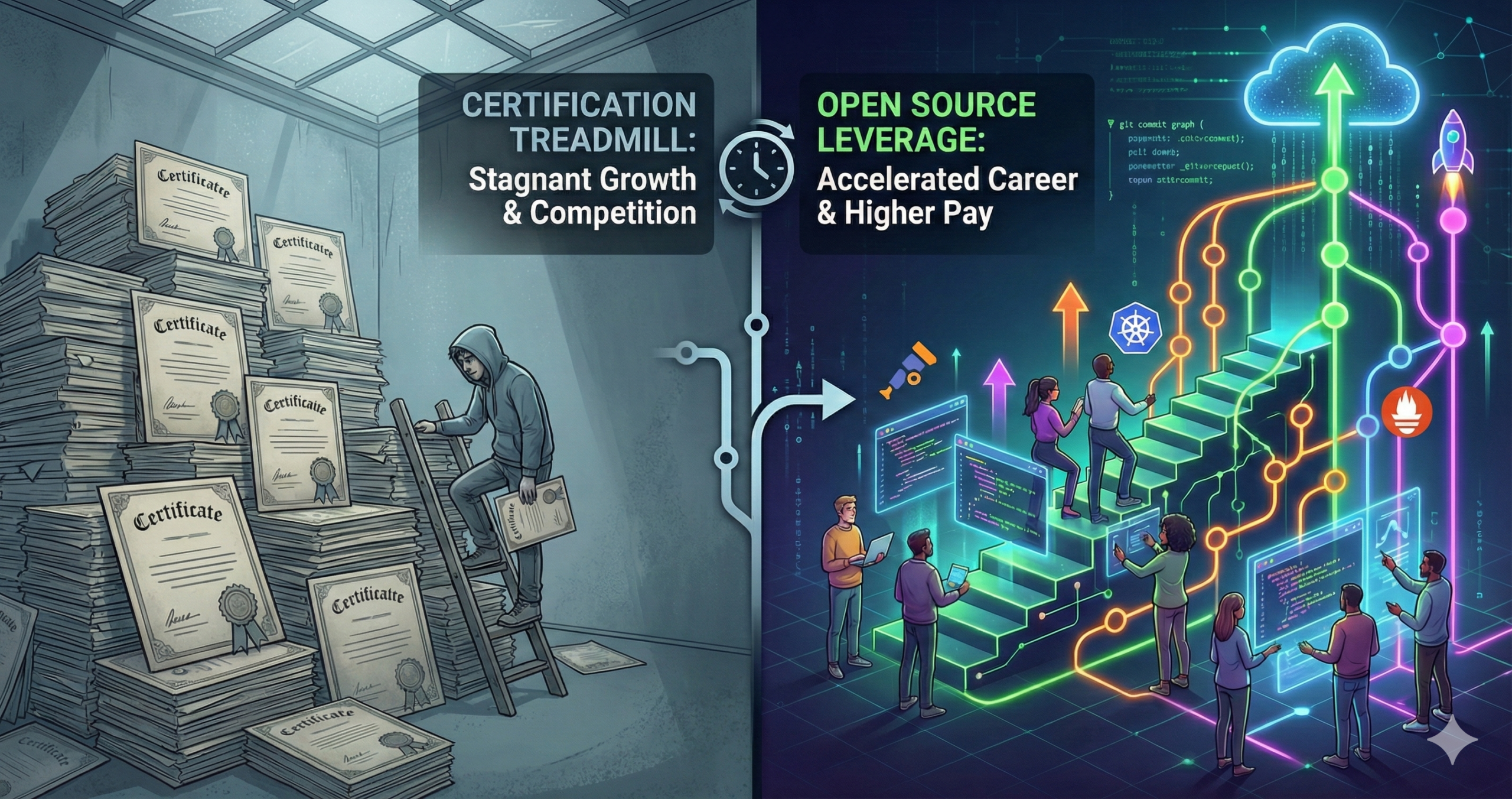
Only 5% of cloud engineers contribute to open source projects, yet these engineers receive 38% more interview requests, command 15-25% higher compensation, and advance to senior roles 2-3 years faster than their peers. While the most rigorous academic study found no isolated wage premium for OSS contributions, the practical career evidence tells a compelling story: contributor-to-hire pipelines at companies like Grafana Labs and GitLab, engineers progressing from first commit to maintainer to full-time employment in under 12 months, and documented progression from £67,500 median UK cloud engineer salaries to £85,000-£100,000+ senior positions through demonstrated OSS expertise. The real value isn’t a line item on a pay stub, it’s a structural advantage that opens doors to senior roles, speaking platforms, and the upper tier of cloud engineering compensation that can reach £100,000-£160,000 in the UK and $200,000-$400,000+ in the US.
Most cloud professionals approach career advancement through the certification treadmill, collecting AWS, Azure, and GCP badges whilst competing in an increasingly crowded market where 36% of UK firms are recruiting cloud engineers but struggling to identify genuine expertise beyond exam scores. The traditional path takes 10-12 years to reach Staff Engineer or Principal Architect positions, requires constant credential renewal, and provides no differentiation in a market where thousands hold identical certifications. Meanwhile, the cost is substantial: certifications run £130-£300 per exam, study materials add £200-£500, and the opportunity cost of 40-60 study hours per certification compounds over years. The fundamental problem is that certifications prove theoretical knowledge but cannot demonstrate the practical skills employers actually value: working in complex codebases, collaborating with distributed teams, passing code review by experienced engineers, and following established development processes.
Open source contribution offers a different path entirely. Mariam Fahmy progressed from zero Docker knowledge to Kyverno maintainer, KubeCon speaker, and Software Engineer at Nirmata in 10 months through structured CNCF mentorship. The return on her investment of approximately 5-10 hours weekly: accelerated career progression, international visibility, and access to roles that simply wouldn’t have appeared on traditional job boards. This pattern repeats across the cloud-native ecosystem, where Kubernetes expertise commanding £10,000-£30,000 salary premiums can be demonstrated through merged pull requests to the project itself rather than certification badges alone.
Why Open Source Contributions Create Career Leverage
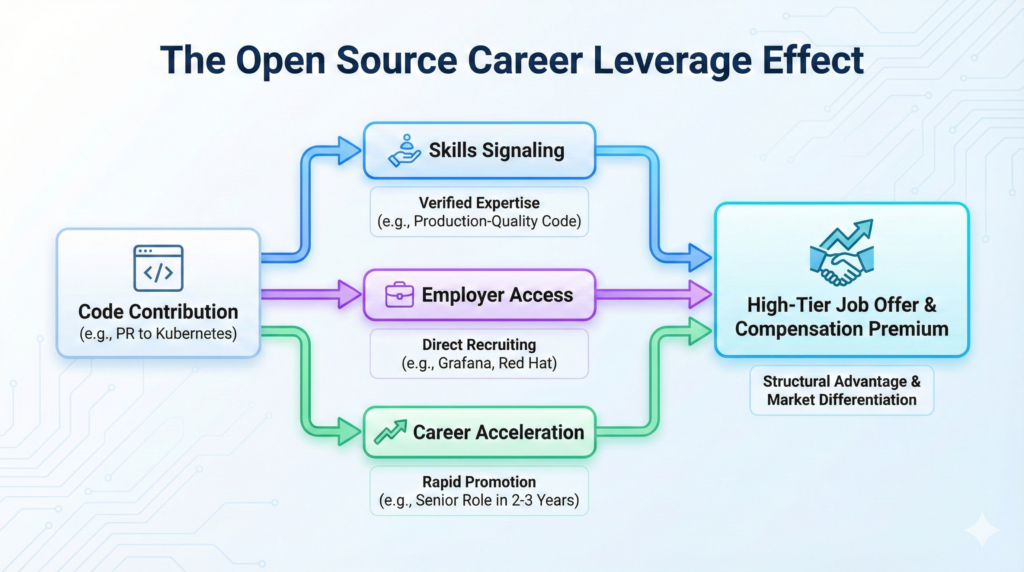
Active open source contributors gain access to jobs, networks, and career trajectories that non-contributors cannot reach. Academic research by Bitzer et al. analysing 7,000 German IT workers found no isolated wage premium for OSS contributions, but the practical career evidence reveals three powerful indirect channels.
Skills signaling drives the first channel. Kubernetes expertise alone adds £6,000-£10,000 to UK salaries, whilst Go or Rust proficiency commands 10-15% premiums. UK cloud engineer median salary sits at £67,500 (IT Jobs Watch 2025), but senior engineers with cloud-native expertise command £85,000-£100,000+, with contract rates reaching £400-£650 daily. Contributing to Kubernetes, Terraform, or OpenTelemetry demonstrates these skills through production-quality code that passed maintainer review, verification that certifications alone cannot provide.
Access to higher-tier employers forms the second channel. Companies where compensation is highest systematically recruit from OSS communities. Grafana Labs, Red Hat, HashiCorp, and Confluent often treat contributions as prerequisites for senior roles paying $200,000-$400,000+ in total compensation. These companies recognise that OSS contributors have demonstrated architectural thinking, collaboration skills, and ability to ship production-grade code.
Career acceleration represents the third channel. OSS contributors reach senior and staff-level roles 1-3 years faster than traditional paths. This matches our 70-20-10 learning model where hands-on experience delivers 70% of career value versus certification training’s 10%. OSS contribution provides that hands-on experience whilst building your professional network and public portfolio.
Seven High-Impact Projects for Maximum Career Return
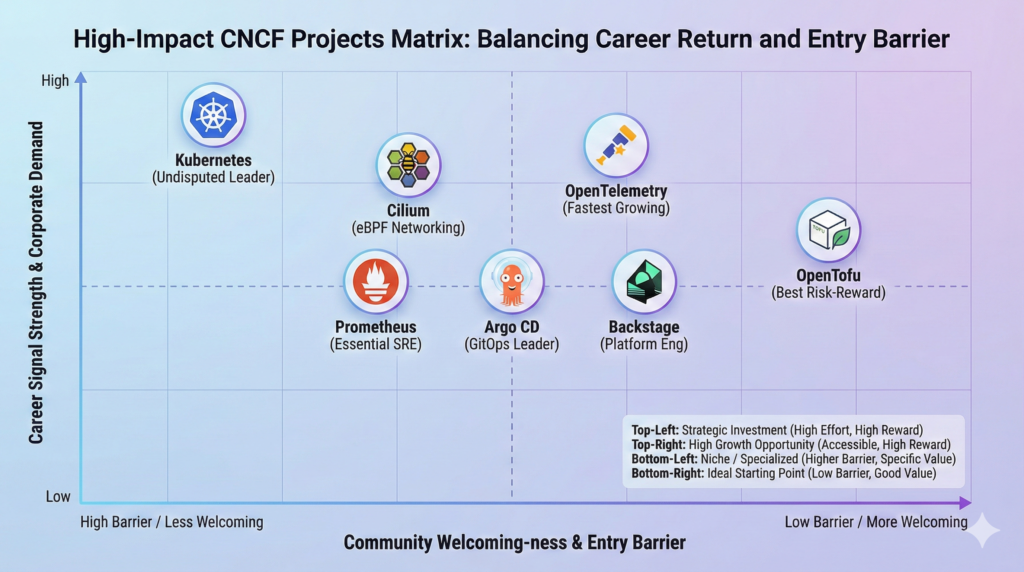
Strategic project selection determines ROI on your contribution time. These seven CNCF projects represent the highest-return targets for cloud engineers in 2025, ranked by job market demand, community welcoming-ness, corporate backing, and career signal strength.
Kubernetes (112,000+ stars, 3,500+ contributors) remains the undisputed leader. Every major cloud employer values Kubernetes expertise. The project maintains dedicated good first issue labels, a Contributor Playground repository, and approximately 30 Special Interest Groups offering focused entry points. The barrier is community size, standing out requires sustained commitment. The payoff: direct recruiting approaches from companies seeking cloud-native expertise.
OpenTelemetry represents the fastest-growing opportunity, now the second most active CNCF project with 9,160+ contributors from 1,100+ companies. The CNCF launched the OpenTelemetry Certified Associate certification in November 2024. The multi-language SIG structure lets you contribute in your strongest language whilst building observability expertise companies desperately need.
OpenTofu offers the best risk-reward ratio for newcomers. After HashiCorp’s licence change, community PRs to Terraform dropped from 21% to 9%, whilst OpenTofu’s contributor base nearly tripled. Contributing to OpenTofu builds core IaC expertise from our Infrastructure as Code career guide with the advantage of a growing project actively seeking contributors.
Prometheus (56,000+ stars) provides essential SRE knowledge, with Grafana Labs maintaining an explicit contributor-to-hire pipeline. Argo CD (18,000+ stars) leads GitOps with strong enterprise demand. Backstage (28,000+ stars) dominates platform engineering with 2,600+ companies adopting it. Cilium (20,000+ stars) represents eBPF networking, a growing specialisation with high demand and fewer qualified contributors.
Framework for selection: contribute to tools you use at work first (your user knowledge provides advantage and your employer may support contribution), then expand to adjacent projects building new capabilities.
Companies That Hire Directly From Open Source Communities
The employer landscape divides into three tiers based on how formally they use OSS contributions as a hiring signal. Understanding these tiers helps you target contribution efforts toward companies matching your career goals and compensation expectations.
Tier 1 companies treat OSS contribution as the job itself. Red Hat recruits developers who actively participate in open projects, making community involvement an explicit hiring criterion rather than a nice-to-have differentiator. Canonical, headquartered in the UK, treats passion for open source as a core evaluation criterion across all engineering roles. Their graduate positions specifically require engaging with users and the open source community through code reviews and issue trackers. Grafana Labs states directly on its GitHub page: “If you choose to contribute to any of our projects, we would love to work with you. If you like the experience and think you might want to do this full-time, we are always hiring.” Multiple Prometheus maintainers including Tom Wilkie (now CTO), Richard Hartmann (Senior Director), and Josue Abreu (Principal Engineering) were hired through this pipeline, demonstrating systematic conversion of contributors to employees.
Tier 2 companies maintain active contributor-to-hire pipelines without making OSS contribution mandatory. GitLab documented that nearly one-third of its first 40 engineers were contributors to its codebase first, providing one of the most concrete quantified examples of systematic OSS hiring. The company actively cultivated this pipeline, converting community members who demonstrated both technical capability and cultural fit. HashiCorp runs a Core Contributor recognition programme and has hired community members into full-time roles, including apprentice engineers specifically tasked with tackling open issues from the backlog. Confluent, founded by Apache Kafka’s creators, continues hiring from the Kafka community with engineers like Gwen Shapira proactively reaching out specifically to work on Kafka rather than responding to traditional job postings.
Tier 3 companies value OSS as a strong differentiator without maintaining formal pipelines. Microsoft Azure has become the largest public cloud contributor to the CNCF, with Brendan Burns (Kubernetes co-creator) serving as Corporate VP of cloud-native compute. Google originated Kubernetes and actively hires from its contributor community, though through traditional recruiting processes rather than direct community-to-employee conversion. Databricks, Elastic, and MongoDB all operate as open-core companies where contributor experience provides implicit advantage during hiring processes. In the UK market specifically, Arm contributes to open source hardware and software ecosystems, whilst UK financial services firms like Bloomberg and JPMorgan increasingly seek engineers with cloud-native OSS experience for their infrastructure teams.
An important caveat deserves attention: even GitLab, an open-core company built on OSS principles, published a thoughtful warning that requiring OSS contributions as a hiring filter can disadvantage caregivers, career-changers, and underrepresented groups who may lack free time for unpaid work. The industry consensus in 2025 treats OSS contributions as a strong positive signal but one of multiple evaluation criteria rather than an absolute requirement. This actually works to your advantage because choosing to invest in OSS contribution when not mandatory creates differentiation in applicant pools where most candidates rely solely on certifications and employment history.
What to Contribute: Code Isn’t the Only Thing That Counts
Hiring managers evaluate contributions differently, and the hierarchy isn’t what most engineers assume. Understanding which types deliver maximum career value helps focus limited time effectively.
Feature development and architecture contributions rank highest because building new capabilities demonstrates deep technical understanding and design thinking. A 2025 study found employers want 6-10 issues solved at varied difficulty levels, showing progression from simple fixes to complex features. Critical bug fixes and security vulnerability reports rank closely behind, demonstrating debugging ability and responsible disclosure skills.
Documentation contributions are systematically undervalued by contributors but highly valued by maintainers. Well-framed documentation demonstrates developer experience awareness, a trait extremely scarce in Senior Engineers. Frame it as “developer experience improvement” not “fixed typos.” Clear documentation reduces support burden and demonstrates communication skills that distinguish senior from mid-level engineers.
Code reviews and reviewer status in OWNERS files prove maintainers trust your technical judgment. Test coverage improvements signal engineering discipline. Issue triage shows project ownership that gets noticed because few contributors volunteer for these essential tasks.
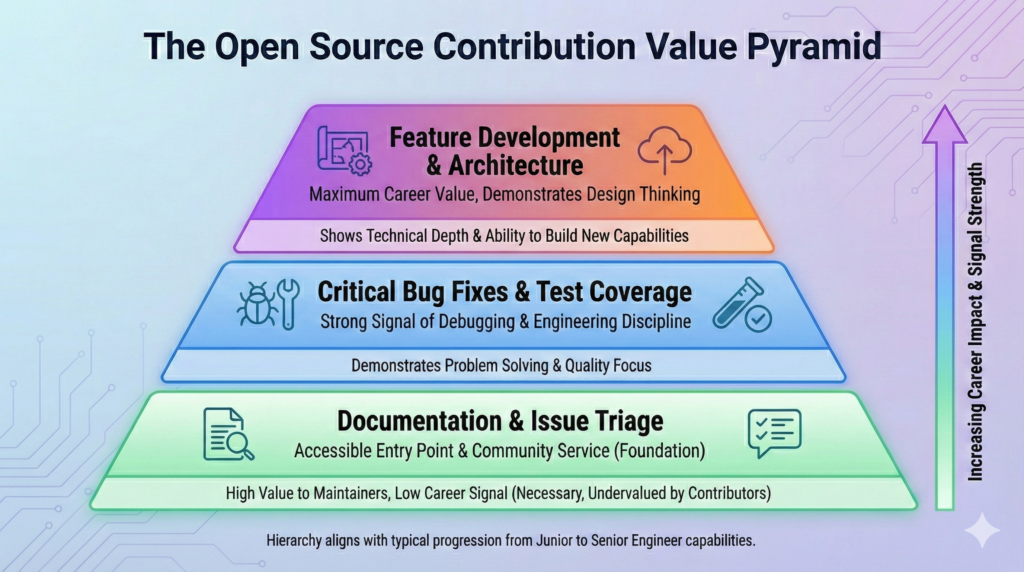
Practical progression: weeks 1-4 on documentation fixes to learn workflows; months 1-3 on bug reproductions and tests; months 2-4 on small bug fixes; months 3-6 on features; months 6-12 on code reviews and reviewer status. This systematic progression demonstrates career growth matching internal promotion trajectories from junior to mid to senior engineer.
Real Engineers Whose OSS Work Transformed Their Careers
Named examples provide concrete evidence of the contributor-to-career pipeline and help visualise realistic timelines from first contribution to career impact. These aren’t exceptional outliers but representative cases showing how consistent OSS contribution accelerates advancement.
Mariam Fahmy offers the clearest recent example of rapid progression through structured contribution. A software engineer with Google Summer of Code experience but no Docker or Kubernetes knowledge, she entered the CNCF LFX Mentorship programme in early 2023 for Kyverno with Jim Bugwadia, CEO of Nirmata, as her mentor. Within 10 months, she progressed from mentee to maintainer with 7,794 contributions, was hired as a Software Engineer at Nirmata, and spoke at KubeCon EU 2024 in Paris. She now mentors the next generation of contributors, completing the cycle from recipient to provider of community support. Her timeline demonstrates that 10 months of focused contribution, 5-10 hours weekly, can compress what traditionally requires years of employment progression into a single intensive learning period.
Liz Rice, based in the UK (Cambridge-educated, London area), built one of the most prominent cloud-native careers through open source over a longer timeframe. She progressed from network protocol software development to Chief Open Source Officer at Isovalent, creators of Cilium which Cisco acquired. She chaired the CNCF Technical Oversight Committee from 2019-2022, authored two O’Reilly books including “Container Security” and “Learning eBPF,” and was named OpenUK Individual of the Year 2020. Her trajectory demonstrates how deep OSS involvement in an emerging area like eBPF and Cilium can lead to C-level positions where compensation packages at acquired companies often include equity gains of millions of pounds. The key lesson from her career is sustained commitment to a specific technical area rather than scattered contributions across many projects.
Dr Dawn Foster, also UK-based, offers perhaps the most instructive long-term example of how OSS contribution shapes career mobility. Over a 25+ year career spanning Intel, Puppet, VMware, and CHAOSS, she testified: “Every job I’ve ever had, with the exception of one job, I’ve gotten based on the people that I knew, who knew the work that I did through open source. Frankly, those people were in the US, and I got jobs where I could work from the UK because those people knew who I was.” She now serves on the CNCF TAG Contributor Strategy and OpenUK Board. Her experience illustrates how OSS contribution creates geographic flexibility, allowing UK-based engineers to access US compensation levels whilst maintaining UK residence, a form of location arbitrage worth potentially £20,000-£50,000 annually in purchasing power.
At Grafana Labs, the pattern is institutional rather than individual. Tom Wilkie from the Prometheus team and original author of Cortex and Loki became CTO. Richard Hartmann, Prometheus maintainer and OpenMetrics founder, became Senior Director. Goutham Veeramachaneni went from infrastructure intern to Prometheus TSDB maintainer to Product Manager. The company’s entire leadership bench was substantially populated through the open source contributor pipeline, creating a systematic pathway from community to employment to leadership that repeats across hiring cycles.
The Kafka ecosystem follows the same pattern at company-founding scale. Jay Kreps, Neha Narkhede, and Jun Rao created Kafka at LinkedIn, open-sourced it to build community and adoption, then co-founded Confluent which IPO’d at an $11.4 billion valuation. Kafka contributor Matthias J. Sax moved from academic research (PhD, Humboldt University) to Apache Kafka PMC member to Confluent software engineer. Linux Foundation Fellow Greg Kroah-Hartman captured the dynamics most succinctly: “If you get five commits in the kernel you will get offered the job,” though this specific threshold varies by project and should be understood as illustrating rapid hiring pipeline rather than a universal standard.
Realistic Time Investment and Expected Timeline
Most working developers who contribute to open source spend 1-5 hours per week according to DigitalOcean’s developer survey. The ambitious but achievable range for career-focused contribution is 5-10 hours weekly, particularly if your employer provides dedicated time, which 79% of developers believe companies should grant. The most productive approach is structured consistency: 2-4 hours per week beats sporadic marathons because it maintains community relationships, keeps you current with project developments, and builds sustainable habits that persist over the 12-18 months needed for meaningful career impact.
The timeline from first contribution to career impact follows a predictable arc that helps set realistic expectations. Months 1-3 focus on building initial portfolio by learning project workflows, getting first pull requests merged, and establishing yourself in community channels. During months 3-6, you build a visible track record by aiming for reviewer attention, joining a Special Interest Group or working group, and submitting substantive contributions beyond trivial fixes. Months 6-12 represent the inflection point where you pursue reviewer status, write about your contributions on your blog or company engineering blog, and speak at community meetings. By months 12-18, consistent contributors typically see tangible career outcomes including recruiter attention, speaking invitations to conferences, and direct job offers from companies using the projects you contribute to.
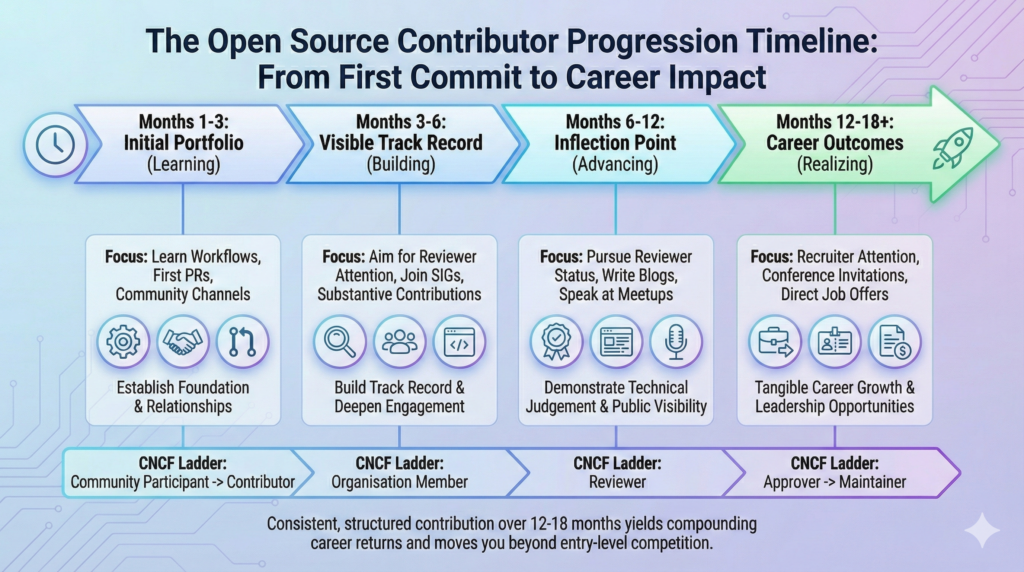
Small contributions absolutely matter because they demonstrate engagement and reduce maintainer burden, but for maximum career signal the goal is progressing from documentation to code contributions to reviewer status within 6-12 months. The CNCF contributor ladder formalises this progression: Community Participant (immediate upon joining Slack or mailing lists), Contributor (first merged pull request, typically within weeks), Organisation Member (sustained contributions and sponsorship from existing members, typically 3-6 months), Reviewer (demonstrated technical judgment and community trust, 6-12 months), Approver (authority to approve changes for merge, 12-24 months), and Maintainer (strategic project ownership, 1-3+ years). This ladder provides clear milestones for tracking progress and demonstrating advancement on your CV and during interviews.
The compound nature of OSS contribution means your first 50 hours deliver different returns than your second 50 hours. Initial contributions teach workflows and build relationships. Subsequent contributions leverage that foundation to tackle more complex issues that generate stronger career signals. By month 6, you’re not starting from zero on each contribution but drawing on accumulated codebase knowledge and maintainer relationships that dramatically accelerate your ability to ship meaningful work. This compounding effect is why consistent small contributions outperform sporadic large efforts, much like our practical skills building approach emphasises sustained hands-on work over cramming for certifications.
Showcasing Contributions So They Actually Get Noticed
Most recruiters won’t spontaneously browse your GitHub profile. One AWS contributor noted: “No one is going to take time to look at your GitHub profile. Mine only gained traction because I targeted a niche where companies were using the project and I was a major contributor.” The solution is active showcasing through multiple channels.
On GitHub, pin 3-6 repositories demonstrating breadth and depth. Write comprehensive READMEs with project descriptions and your specific contributions. Ensure your profile bio clearly states your specialisation: “Cloud Native Engineer specialising in Kubernetes networking and eBPF” performs better than vague descriptions. A GitHub profile with 50 merged PRs to Kubernetes SIG-Network signals far more than 500 commits to personal hobby projects.
On your CV, create a dedicated “Open Source Contributions” section with quantified achievements. Compare “Contributed to Kubernetes” with “Contributed 50+ pull requests to Kubernetes SIG-Network, reducing DNS resolution latency by 15% and implementing IPv6 dual-stack networking features used by 12,000+ production clusters.” Specify project scale: “Core contributor to OpenTelemetry (9,000+ contributors, 1,100+ companies).”
On LinkedIn, use the Projects section with direct links to key PRs and write posts about your contributions. A post explaining how you debugged a tricky issue demonstrates technical depth, communication skills, and community contribution.
The content flywheel multiplies impact: one contribution generates a blog post, which becomes a conference talk, which generates social proof attracting recruiters. Developer Advocate roles at AWS, GitLab, and Google require this combination of OSS contribution and communication.
Active OSS contributions replace side projects when showcasing capabilities. Contributing to recognised projects demonstrates working in large codebases, collaborating across distributed teams, passing rigorous code review, and following established processes – collaborative skills that predict professional performance better than solo projects.
Overcoming the Barriers That Stop 95% of Engineers
Researchers have identified 58 distinct barriers to open source contribution spanning five categories: finding a way to start, social interactions, code issues, documentation problems, and newcomers’ knowledge gaps. Approximately 70% of people experience imposter syndrome at some point, and in OSS this manifests as “I don’t have the experience,” “my code isn’t good enough,” and “what if I break something?” Understanding these barriers helps you recognise that hesitation is normal rather than a signal you’re not ready to contribute.
The practical antidotes are straightforward. Start with projects you already use because familiarity with the tool as a user dramatically reduces the overwhelming codebase barrier. You already understand the product’s purpose, typical use cases, and common pain points, giving you advantages that random contributors lack. Use CLOTributor (clotributor.dev) or goodfirstissue.dev to find beginner-friendly tasks across CNCF projects, specifically filtered to match your expertise level and interests. Begin with documentation rather than code because it’s lower risk, highly valued by maintainers, and teaches repository structure whilst you build confidence.
Read CONTRIBUTING.md files carefully before submitting anything, as they contain project-specific workflows, style guides, and expectations that vary significantly between projects. Submit small, focused pull requests with clear descriptions referencing issue numbers because median PR processing time has risen to approximately 22 hours across active projects, and smaller PRs get reviewed faster. Your first PR should change 5-20 lines, not 500, allowing maintainers to review quickly whilst you learn their feedback style and preferences.
Rejection is normal and instructive rather than a sign of inadequacy. About 7% of PRs are rejected for targeting outdated versions or duplicating existing work, and 15% are incomplete when submitted. Maintainers aren’t gatekeeping, they’re maintaining quality in projects used by millions of users in production environments where bugs have real costs. Code review feedback is the most efficient learning mechanism available because experienced engineers explain exactly what production-quality code requires in your specific context rather than generic advice. One maintainer’s typical response captures the welcoming spirit: “Thank you for reporting this issue! Would you like to help? Maybe write a failing test that reproduces this issue?” This invitation demonstrates that maintainers actively want new contributors and will guide you through the process.
Legal considerations deserve attention before significant contribution. Under most employment agreements, employers may claim ownership of work-related code. Review your IP clause, use personal devices for unrelated contributions, and consider pitching contribution to tools your company uses as part of your professional development. Many employers support OSS contribution because it builds expertise they benefit from, particularly if you’re contributing to tools in your company’s technology stack. GitHub’s open-source Balanced Employee IP Agreement template specifically allows personal OSS work and is worth sharing with your employer if IP ownership concerns arise. Most UK employment contracts are less restrictive than US equivalents, but explicit clarification prevents complications later when your contributions start attracting job offers.
The Compounding Returns of Visible Expertise
The return on investment of open source contribution defies simple calculation because benefits compound and multiply over time in ways that one-time certifications cannot match. Investing 260-780 hours over 12-18 months at 5-10 hours weekly won’t guarantee a specific salary increase, but it generates something more valuable: verifiable expertise that compounds with every contribution, review, and community interaction.
Each merged pull request builds technical skills that transfer to your day job, making you more effective in your current role whilst simultaneously building your external portfolio. Each code review builds relationships with maintainers and fellow contributors who become professional network nodes, potentially leading to job referrals, collaboration opportunities, and insider information about hiring at their companies. Each community interaction in Slack channels, GitHub issues, or community meetings expands your network exponentially, because you’re connecting with engineers at hundreds of companies rather than just colleagues at your current employer. Each blog post or conference talk amplifies your visibility beyond direct contribution, as your explanatory content gets shared, referenced, and associated with your expertise.
The engineers who benefit most from OSS contribution share three characteristics regardless of their starting point or background. They contribute to projects their target employers care about rather than random repositories that seem interesting but lack job market demand. This means Kubernetes for engineers targeting Google, Prometheus for those targeting Grafana Labs, Kafka for those targeting Confluent, or OpenTofu for those pursuing Infrastructure as Code specialisation. They progress beyond casual contribution to recognised community roles including reviewer status, Special Interest Group membership, and maintainer track rather than stopping at a handful of merged PRs. This progression demonstrates sustained commitment that employers value more than brief contribution bursts. They make their work visible through writing, speaking, and active professional networking rather than assuming quality code will spontaneously generate opportunities.
For UK cloud engineers specifically, the opportunity is particularly acute. The UK has more GitHub accounts per capita than any other country, yet only a few thousand are active contributors, creating immediate differentiation for engineers who choose to engage seriously with OSS communities. OSS contributors accounted for 27% of the UK tech sector’s gross value added in 2022, demonstrating enormous economic impact from a relatively small contributor base. With median cloud engineer salaries at £67,500 and top-tier roles exceeding £100,000, the gap between median and top represents the value of demonstrated, differentiated expertise that moves you from commodity engineer competing on credentials to specialist whom companies recruit directly.
Open source contribution is the most accessible path to that differentiation because it works from anywhere in the UK, connects you to a global hiring market, and builds the kind of reputation that makes employers come to you rather than requiring you to compete in applicant pools of hundreds. The investment is hours per week rather than tens of thousands in advanced degrees, the timeline is months rather than years, and the outcomes include not just higher compensation but work you find genuinely engaging because you’re contributing to tools that matter rather than maintaining legacy systems. Most importantly, the skills you build through OSS contribution are exactly the skills that command premium compensation in cloud engineering: deep technical expertise in production-grade systems, collaboration across distributed teams, and the ability to ship code that millions of users depend on.
Useful Links
CNCF Contributor Resources:
- CNCF Contributors Guide – Official onboarding for cloud-native projects
- CLOTributor – Find beginner-friendly CNCF issues matched to your skills
Project-Specific Contribution Guides:
- Kubernetes Contributors Guide – Comprehensive contributor documentation
- OpenTelemetry Contributor Guide – Multi-language observability contribution paths
- OpenTofu Contributing – IaC contribution getting started
UK Career and Salary Data:
- IT Jobs Watch UK – Cloud engineering salary trends and demand data
- OpenUK – UK open source community, careers, and skills initiatives
Learning and Mentorship:
- CNCF LFX Mentorship – Structured mentorship programmes in cloud-native projects
- Good First Issue – Curated beginner-friendly issues across projects
Community and Networking:
- CNCF Slack – Join project channels and connect with maintainers