

AWS certifications boost salaries by 25.9% on average. Azure credentials add 18.1%.
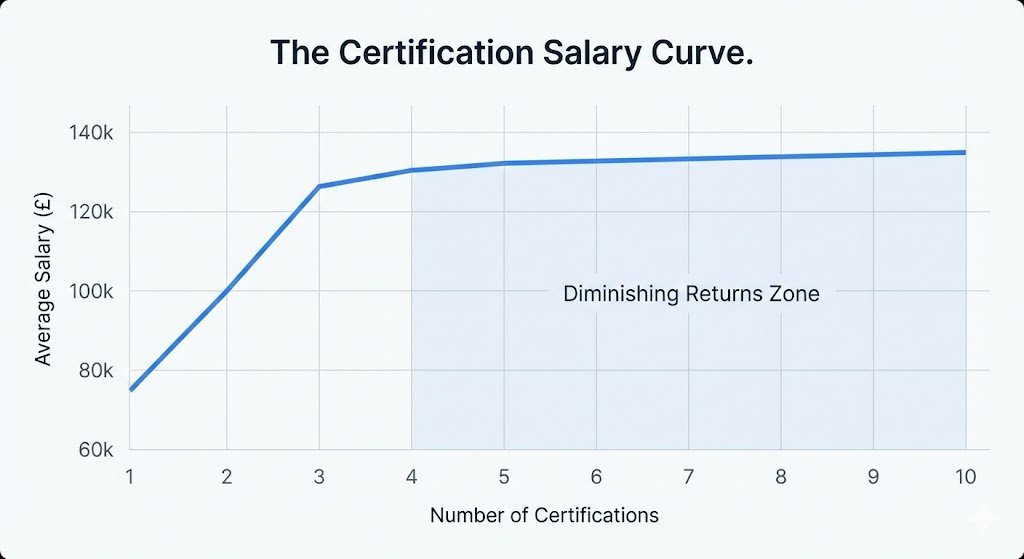
But here is the data no training provider wants you to see: that premium applies to your first 2-3 certifications. Beyond that, the curve flattens dramatically.
Engineers with 3-4 strategic certifications earn £110,000 to £140,000 in the UK market. Those with 8-12 certifications? The same £110,000 to £140,000. The 800+ hours they invested collecting additional credentials generated virtually zero salary return.
Global cloud spending hit £723.4 billion in 2025, driving unprecedented demand for cloud professionals. Training providers market comprehensive certification paths as career insurance.
Yet, hiring manager surveys reveal an uncomfortable truth: 91% cite hands-on experience as “the most important factor” in final hiring decisions, while certifications function primarily as screening filters. This creates a dangerous trap for ambitious engineers. They spend years accumulating credentials whilst competitors invest that same time building production systems, leadership portfolios, and measurable business impact.
Understanding where certification ROI ends and alternative investments begin becomes critical for engineers targeting £140,000 to £200,000+ roles.
The Strategic Certification Timeline: Research & ROI
Research from PassITExams, DataCamp, and Morgan McKinley (2025) reveals a consistent pattern. The most successful engineers do not collect certifications. They use a “Phase” approach.
Here is the combined market data and strategic path for optimal ROI.
Phase 1: The Foundation (Certification #1)
Verdict: Essential Career Investment
This is the gatekeeper. Without it, your CV rarely reaches the hiring manager.
- Market Reality: Job postings explicitly requiring cloud certifications jumped 23% between 2023 and 2025.
- UK Salary Impact: jumps from £45k-£60k (General IT) to £65k-£85k (Cloud-focused).
- Target Credentials:
- AWS Certified Solutions Architect – Associate
- Microsoft Certified: Azure Administrator Associate
- Google Cloud Certified: Associate Cloud Engineer
The ROI Calculation:
- Investment: £120-£150 exam fee, 60-100 study hours
- Salary Gain: £15,000-£20,000 annually
- Payback Period: 1-2 months
Phase 2: Professional-Level Leverage (Certification #2)
Verdict: High Value Proposition
This separates the “users” from the “architects.” DataCamp’s 2025 analysis found O’Reilly survey data showing professional-level credentials are “most strongly associated with salary increases.”
- UK Salary Impact: Moves to £85k-£115k.
- Target Credentials:
- AWS Certified Solutions Architect – Professional
- Microsoft Certified: Azure Solutions Architect Expert
- Google Cloud Professional Cloud Architect
The ROI Calculation:
- Investment: £240-£300 exam fee, 100-150 study hours
- Salary Gain: £10,000-£20,000 annually
- Payback Period: 3-6 months
Phase 3: The Specialist Differentiator (Certification #3)
Verdict: Strategic Differentiation
This is where you carve a niche. Security and Platform Engineering command the highest premiums in 2025.
- UK Salary Impact: Moves to £100k-£130k.
- Target Credentials:
- Security: AWS Certified Security – Specialty / Azure Security Engineer Associate (Essential for regulated industries).
- Platform: Certified Kubernetes Administrator (CKA) / CKS.
- Market Context: Fortray Global Services reports cloud security specialists command 40% salary premiums.
The ROI Calculation:
- Investment: £240-£300 exam fee, 80-120 study hours
- Salary Gain: £8,000-£15,000 annually
- Payback Period: 4-8 months
Phase 4: The Plateau (Certification #4 and Beyond)
Verdict: Diminishing Returns
Here is where the math stops working for employees.
- UK Salary Reality: Holders of 4-8 certifications earn £110,000-£145,000.
- The Plateau Pattern: This is the same salary range as those with 3 certifications but strong experience.
- Why it Happens:
- Screening Met: You have already passed the HR filters.
- Overlapping Knowledge: The 8th cert rarely introduces fundamentally new architectural concepts.
- The Experience Gap: The time spent studying prevents you from building the production portfolio that actually unlocks the £150k+ bracket.
The Hiring Manager Reality Check
Before you book your next exam, consider what the decision-makers are saying in 2025.
“If forced to choose between equal candidates, employers overwhelmingly prefer experience over additional certifications. With all things equal, they’d choose certified over non-certified – but experience rarely proves equal.” (Source: AVID Technical Resources)
A comprehensive hiring analysis published in Medium (October 2025) surveyed IT hiring managers. While 70% rated certifications “important” for screening, 91% cited hands-on experience as “the most important factor” in final hiring decisions.
Certifications open the door. Experience closes the deal.
What Actually Drives £140,000 to £200,000+ Growth
If certifications plateau at £140k, what unlocks the next level? The answer lies in shifting your focus from acquiring knowledge to demonstrating impact.
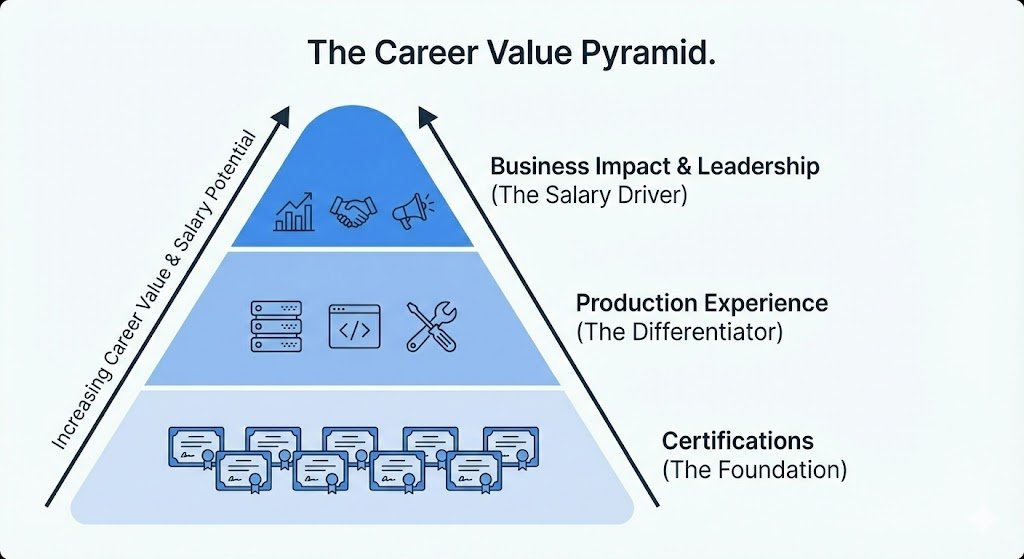
1. Quantifiable Production Impact Senior engineers commanding top-tier salaries consistently demonstrate measurable business outcomes.
- Cost Optimization: “Decreased cloud costs 35%, saving £420,000 annually through reserved instance strategy.”
- Automation: “Implemented auto-scaling reducing compute costs £180,000 whilst improving response times 40%.”
- Reliability: “Architected multi-region DR solution reducing RTO from 4 hours to 15 minutes.”
2. Leadership and Influence Salary progression beyond £120,000 correlates strongly with scope of influence, not exam scores.
- Team Development: Structured mentoring of 3-5 junior engineers.
- Strategic Planning: Leading 12-24 month technical roadmaps aligned with business objectives.
- Standards: Establishing engineering standards adopted across multiple departments.
3. Business Communication The engineer who can articulate how architectural decisions affect quarterly revenue advances faster than the colleague collecting specialty certifications. This includes translating technical trade-offs (cost, risk, opportunity) into financial terms for the C-suite.
The 800-Hour Pivot: Alternative Investments
The time required for certifications 5-8 (approx. 800-1,200 hours) could fund career investments with substantially higher returns.
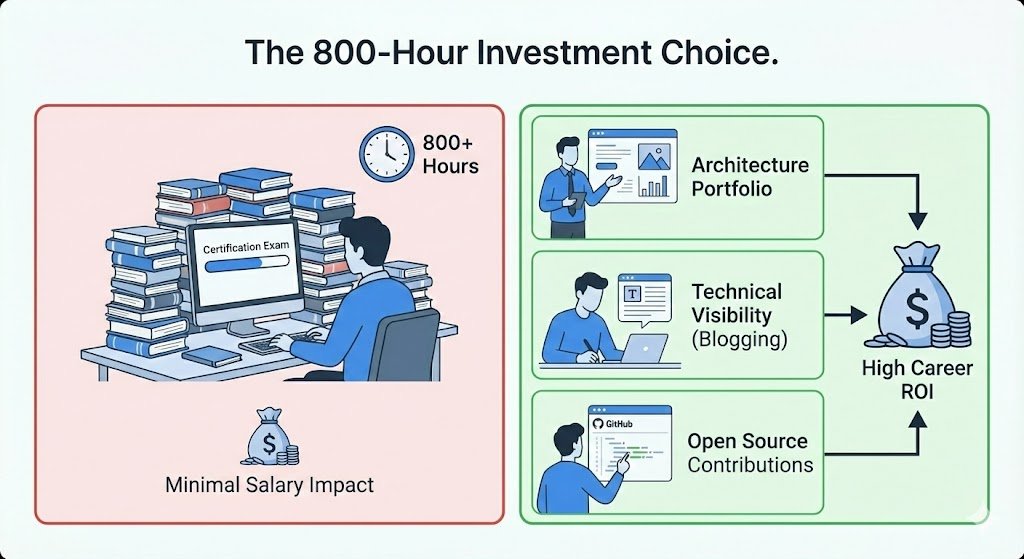
Investment Option 1: The Architecture Portfolio
Potential Salary Premium: £30,000-£50,000 Instead of another exam, build 4-6 comprehensive case studies. Document major architectural decisions, alternatives considered, and outcomes achieved. Engineers with polished architecture case studies significantly outperform certification-heavy candidates in Staff/Principal interviews.
Investment Option 2: Technical Visibility
Potential Salary Premium: £30,000-£50,000 Use your 800 hours to write 20-30 detailed technical blog posts or internal documentation whitepapers. Engineers with visible thought leadership receive 5-7x more recruiter approaches. This functions as an extended interview, proving your communication skills before you even speak.
Investment Option 3: Open Source & Public Code
Potential Salary Premium: £25,000-£40,000 Contribute to Terraform providers, Kubernetes operators, or publish useful automation tools. The 2025 skills-based hiring movement prioritizes GitHub repositories over credentials.
When More Certifications DO Make Sense
To be clear, there are specific scenarios where collecting 5+ certifications is the correct strategy:
- The Training Career: If you are an instructor, broad coverage is your product.
- The Consultant: Independent consultants use credential badges as a proxy for trust with new clients.
- The Partner Requirement: If your employer needs to maintain AWS/Azure Partner Tier status, they may require you to hold specific certs. Note: Do this on company time.
- The Career Pivot: If you are switching from non-tech to tech, volume can help signal commitment, though the plateau still hits eventually.
The Strategic Truth
The certification industry markets comprehensive coverage as career insurance. However, the data reveals a different reality: Strategic certification selection (3-4 credentials) combined with demonstrable production impact generates substantially superior career outcomes.
After the strategic 3-4 certification threshold, every additional study hour invested in certifications represents an hour not building the capabilities that actually command premium compensation in the £140,000 to £200,000+ market range.
Ask yourself: Will certification #6 change how the market values you? Or is it time to build something that proves you can lead?
Useful Links
- AWS Certification paths and requirements – Official AWS certification overview
- Kubernetes Certification overview (CKA, CKAD, CKS) – Cloud Native Computing Foundation credentials
- Microsoft Azure certification roadmap – Azure certification learning paths
- Google Cloud certification directory – GCP certification options
- Levels.fyi UK salary data – Comprehensive technology salary research
- Glassdoor UK Cloud Engineer salaries – Real salary reports from UK professionals
- Indeed UK Cloud careers – Job market and salary trends
- PassITExams certification salary guides – Research-backed certification ROI analysis
- ISC2 Cybersecurity hiring trends study – Hiring manager priority research
- Morgan McKinley Technology Salary Guide 2025 – UK market compensation benchmarking
- From Cloud Support to Solutions Architect: £240K Career Roadmap
- From Certification to Expertise: Building Practical Skills