
Reserved Instances promise 40-60% cost savings, yet many organisations either over-commit to workloads that don’t justify the lock-in or miss opportunities on stable infrastructure that’s haemorrhaging money on on-demand pricing. The decision shouldn’t be guesswork, and it’s time enterprises had a systematic approach to RI purchasing.
The £47,000 Question Nobody Asks
Platform teams face this scenario constantly: a production workload has been running consistently for six months, consuming £80,000 annually at on-demand rates. Finance wants cost reduction. Engineering worries about commitment. Someone suggests Reserved Instances, and the conversation stalls because nobody has a framework for making the decision confidently.
The result? Either hasty RI purchases that prove inflexible when requirements change, or continued on-demand spending that nobody can justify when the monthly bill arrives. Both outcomes are expensive, and both stem from the same problem: treating RI decisions as binary yes/no choices rather than nuanced evaluations of workload characteristics, payment options, and organisational constraints.
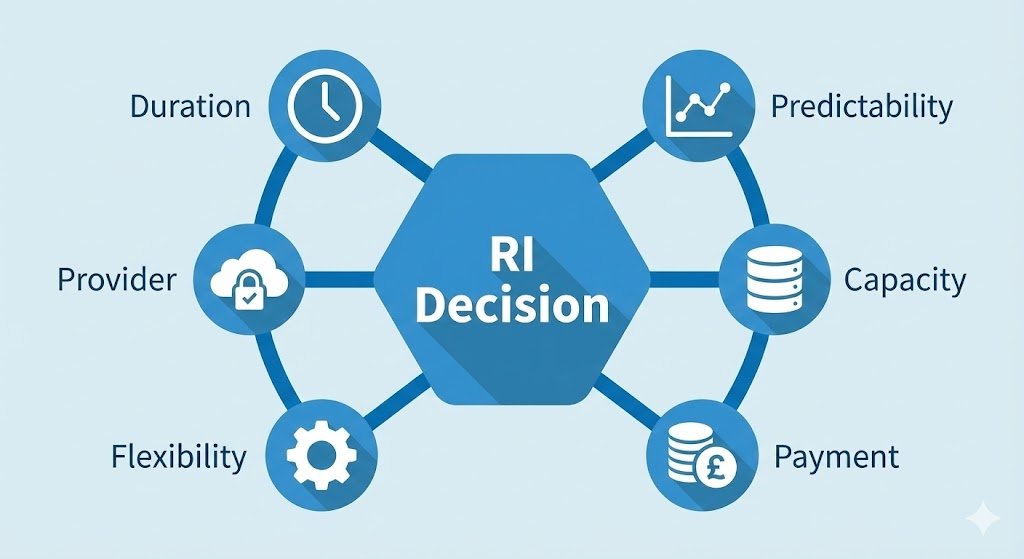
The Six-Factor RI Decision Framework
Reserved Instance suitability depends on six critical factors that most teams evaluate inconsistently or ignore entirely. Here’s the systematic approach that actually works in production environments.
1. Workload Duration: The Non-Negotiable Foundation
If your workload won’t run for at least 12 months, stop reading and stick with on-demand pricing. The break-even point for Reserved Instances typically hits between 7-9 months depending on the instance type and payment option, but that assumes perfect utilisation with zero configuration changes.
For workloads with 1-2 year lifespans, one-year RIs with no upfront payment provide the flexibility you need whilst delivering 15-25% savings. The partial upfront option pushes savings to 20-35%, but requires finance approval for the initial capital outlay.
Three-year commitments unlock the headline 40-60% savings figures, but only make sense for infrastructure you’d bet your professional reputation will remain stable. Mission-critical databases that have run unchanged for five years? Perfect RI candidates. That experimental microservices platform the team spun up last quarter? Absolutely not.
2. Usage Predictability: Beyond “It Runs 24/7”
Predictability isn’t just about uptime. It’s about consistency in configuration, instance type, and capacity requirements. An application that runs constantly but scales from 10 instances at 3am to 50 instances at 2pm doesn’t benefit from RIs the way a stable 30-instance deployment does.
Highly predictable workloads (consistent capacity, stable configuration, minimal architectural changes) are ideal RI candidates. Cover 70-80% of your baseline capacity with RIs, leave the remainder for on-demand scaling, and you’ve optimised for both cost and flexibility.
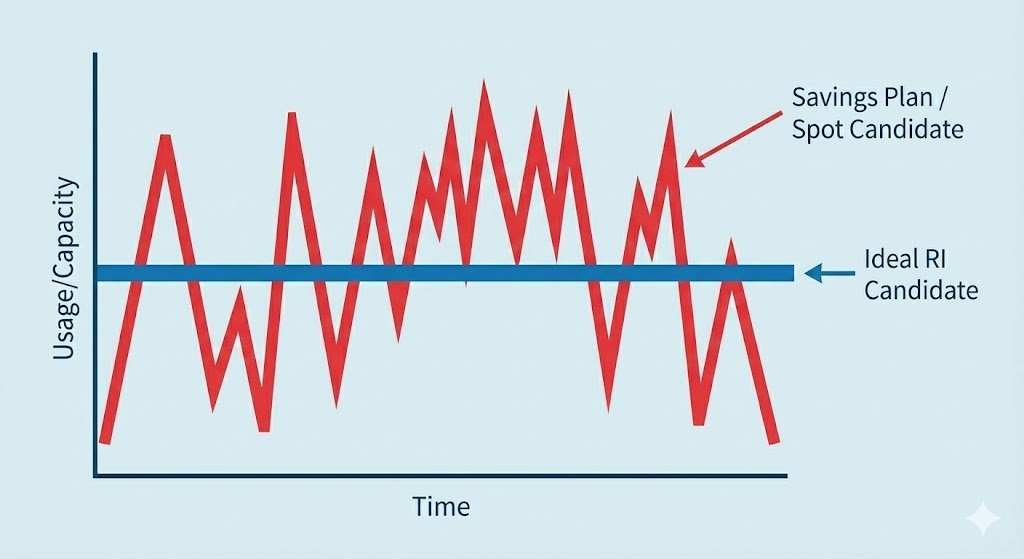
Variable workloads present a different calculation entirely. Seasonal peaks, unpredictable traffic patterns, or architectures under active development should trigger consideration of AWS Savings Plans rather than RIs. Savings Plans provide compute commitment flexibility whilst still delivering meaningful discounts, typically 10-15% less savings than equivalent RIs, but with significantly more architectural freedom.
Moderately predictable workloads require a cautious approach. If your usage shows some variation but generally stable patterns, start with covering only 20-40% of baseline capacity with one-year Convertible RIs. Monitor utilisation for three months before expanding coverage. This staged approach limits risk whilst building confidence in your RI strategy.
3. Capacity Coverage: The Often-Ignored Critical Factor
Here’s where most organisations make expensive mistakes: they identify a stable workload and immediately purchase RIs to cover 100% of that capacity. This leaves no headroom for growth, experimentation, or architectural changes.
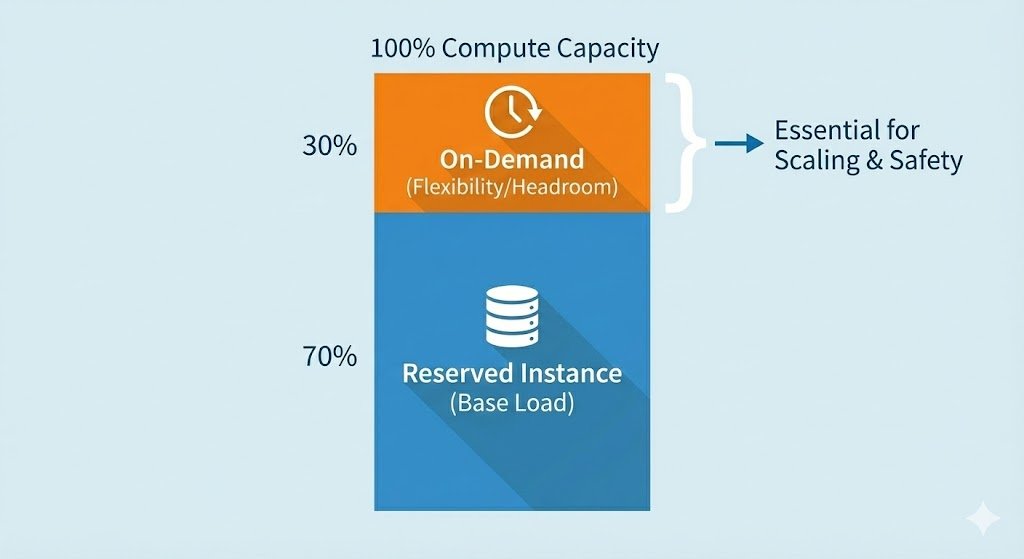
The capacity percentage question matters enormously. A single application consuming 20% of your total compute capacity has very different risk characteristics than a monolithic workload representing 80% of your infrastructure.
For small workloads (under 30% of total capacity), you can safely cover 70-80% with RIs. The risk of over-commitment is contained because the workload represents a small portion of your overall spend.
For major workloads (30-70% of capacity), cover 60-70% with RIs maximum. Leave 30-40% on-demand for flexibility. These workloads are significant enough that over-commitment becomes painful.
For workloads representing 70%+ of your infrastructure, never exceed 60% RI coverage even if the workload is highly predictable. The sheer scale means you need substantial headroom for business growth, new projects, and architectural evolution. Over-committing at this scale locks your entire organisation into specific instance configurations.
4. Payment Flexibility: Finance Constraints Matter
The all-upfront payment option delivers maximum savings but requires capital availability that many organisations lack, particularly in January when budgets reset and finance teams guard spending carefully. The difference between all-upfront and no-upfront on a three-year AWS RI can be 10-15 percentage points of savings, which sounds compelling until you realise the upfront payment might be £30,000 that finance won’t approve.
No-upfront RIs eliminate the capital hurdle whilst still providing substantial savings over on-demand pricing. You’re leaving money on the table compared to upfront payment, but you’re not leaving as much as you’d lose by staying on-demand because finance blocked the RI purchase entirely.
Partial upfront splits the difference, literally. Half the cost paid immediately, half amortised over the term, with savings that fall between the two extremes. This often represents the political sweet spot where finance approves the expenditure and engineering gets meaningful cost reduction.
5. Instance Flexibility Requirements
AWS distinguishes between Standard and Convertible Reserved Instances for exactly this reason. Standard RIs lock you into specific instance families but offer the deepest discounts. Convertible RIs allow instance family changes during the term but sacrifice 5-10 percentage points of savings.
If your architecture is stable and you’re confident in your instance sizing decisions, Standard RIs deliver better economics. If you’re running workloads that might migrate from compute-optimised to memory-optimised instances, or you’re hedging against future architectural changes, Convertible RIs provide insurance against obsolescence.
Even if you think your architecture is completely stable, consider your track record. If your team has changed instance types twice in the past year, Convertible RIs acknowledge reality rather than wishful thinking about stability.
Azure and GCP handle this differently. Azure Reserved VM Instances include instance size flexibility within the same family by default, whilst GCP’s Committed Use Discounts apply across resource usage with less granular commitment requirements. Understanding your cloud provider’s flexibility model matters as much as understanding your own workload requirements.
6. Provider-Specific Considerations
Each cloud platform implements reservation commitments differently, and those differences materially impact your decision framework.
AWS offers the most granular control with Regional versus Zonal RIs, Standard versus Convertible options, and the newer Savings Plans that apply broadly across compute services. The complexity creates opportunity for optimisation but also increases the risk of purchasing the wrong commitment type.
Azure combines Reserved VM Instances with Azure Hybrid Benefit for organisations holding SQL Server or Windows Server licences with Software Assurance. The combined savings can reach 80% compared to on-demand Windows pricing, transformative for enterprises with existing Microsoft licensing agreements. Our FinOps Evolution guide explores how licensing optimisation intersects with reservation strategies for maximum financial impact.
GCP’s Committed Use Discounts operate on spend commitments rather than specific instance reservations, providing the most flexibility but requiring more sophisticated usage analysis to purchase optimally. Resource-based CUDs lock in specific machine types, whilst spend-based CUDs apply across all compute usage.
Using the Decision Framework in Production
We’ve built a Reserved Instance Decision Helper that systematically evaluates these six factors and provides specific recommendations. The tool walks through workload duration, usage predictability, capacity coverage, payment preferences, cloud provider specifics, and flexibility requirements in under 60 seconds.
The framework filters out inappropriate RI candidates before you waste time on detailed analysis. Workloads under 12 months get redirected to on-demand or Spot instances, highly variable usage patterns get steered toward Savings Plans, and workloads representing most of your infrastructure get explicit warnings about maintaining adequate headroom.
For genuine RI candidates, the tool recommends specific commitment types, terms, payment options, and coverage percentages based on your inputs. A three-year workload with high predictability, upfront payment capability, and moderate infrastructure footprint gets directed toward Standard RIs with all-upfront payment covering 70-80% of capacity for maximum savings. A two-year workload with moderate predictability, no capital availability, and representing 80% of your infrastructure gets Convertible RIs with no-upfront payment covering only 50-60% of capacity. Less optimal savings, but appropriate for the constraints and risk profile.
Implementation Strategy for Enterprise Teams
Start with your most stable workloads: production databases, core application infrastructure, persistent development environments. These represent the lowest-risk RI purchases because they’ve demonstrated stability over time.
Analyse actual utilisation patterns before committing. Cloud providers offer RI recommendation tools built into their consoles (AWS Cost Explorer, Azure Advisor, GCP Recommender), but these tools sometimes over-recommend based on recent usage spikes. Validate recommendations against 6-12 months of historical data, not just the past 30 days.
Purchase RIs in tranches rather than attempting to cover all eligible workloads simultaneously. Start with 20-30% of your stable compute capacity, monitor for three months, and expand coverage based on actual results. This staged approach limits risk whilst building organisational confidence in RI management.
Never purchase RIs to cover 100% of any workload, regardless of how stable it appears. Always maintain 20-40% headroom for growth, architectural changes, and unexpected requirements. Over-commitment is significantly harder to fix than under-commitment.
Our hidden costs of cloud migration guide examines why RI commitments often fail, typically due to purchasing before workload patterns stabilise or committing to instance types before rightsizing efforts complete.
When Reserved Instances Are the Wrong Choice
Workloads under active development shouldn’t carry RI commitments regardless of how stable they appear today. Architectural changes during development can invalidate instance type selections, and early-stage workloads often reveal optimisation opportunities that require different configurations.
Highly elastic workloads that scale dramatically based on demand rarely benefit from RIs. If your application runs 10 instances overnight but 100 instances during business hours, RIs on those 10 baseline instances might save 5-10% overall, but the 90 instances scaling on-demand represent 90% of your cost. Focus optimisation efforts on Spot instances or architectural changes that reduce peak capacity requirements.
Organisations without mature FinOps practices struggle with RI management because they lack the visibility and processes to track utilisation, identify unused reservations, and optimise coverage over time. Build your cost management capabilities before committing significant capital to multi-year reservations.
Workloads that represent more than 70% of your total infrastructure require extremely careful RI planning. Even with perfect predictability, maintain at least 40% headroom to avoid locking your entire organisation into specific instance configurations that might not serve future business needs.
Key Takeaways
Reserved Instances deliver genuine 40-60% savings for stable, predictable workloads with appropriate commitment terms. The decision framework matters more than the savings percentage. Purchasing the wrong RI type or committing to unsuitable workloads costs more than staying on-demand.
Use systematic evaluation rather than intuition: workload duration, usage predictability, capacity coverage, payment flexibility, instance requirements, and provider specifics all influence whether RIs make sense for your infrastructure.
The RI Decision Helper tool provides that systematic evaluation in under 60 seconds, steering you toward appropriate commitment types or away from RIs entirely when better alternatives exist.
Start small, measure results, and expand coverage incrementally. Twenty percent RI coverage on truly stable workloads beats 80% coverage on workloads that change three months into a three-year commitment. Never cover 100% of any workload with RIs, regardless of stability.