

Part 1 of The Cloud Professional’s Industry Playbook series
Healthcare represents one of the most compelling yet complex sectors for cloud professionals. With patient data breaches exposing 275 million records and affecting 82% of the US population in 2024 alone, the demand for skilled cloud practitioners who understand both technology and healthcare compliance has never been higher. Healthcare data breaches now cost an average of $9.77 million, making it the highest-cost industry for the 14th consecutive year. This creates exceptional opportunities for professionals willing to navigate the unique challenges of this critical industry.
The sector offers remarkable career stability. Healthcare organisations require continuous technology expertise, recession-proof demand, and increasingly sophisticated cloud implementations. However, success requires understanding that healthcare cloud work differs significantly from standard enterprise environments, with stricter compliance requirements, enhanced security protocols, and patient safety considerations that directly impact human lives.
With 82 NHS trusts currently using cloud computing with an average annual investment of £2.2 million each, the transformation from traditional infrastructure to cloud-based systems creates exceptional opportunities for professionals willing to specialise in this critical sector.
The Healthcare Cloud Career Landscape
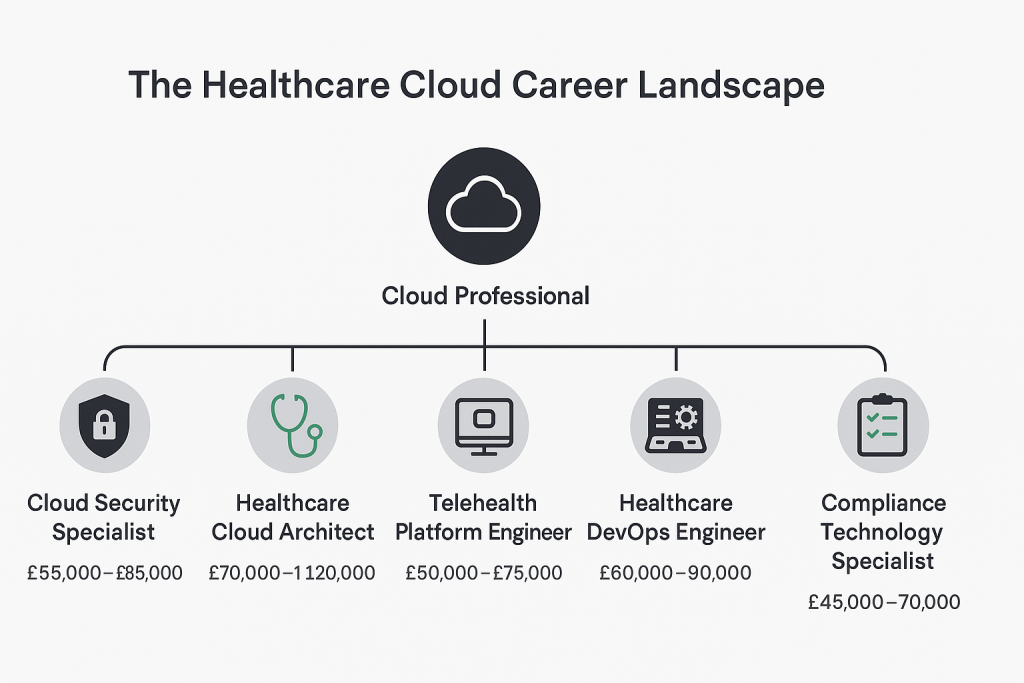
Healthcare cloud roles span a broader spectrum than many professionals realise. Beyond traditional cloud engineering positions, the sector demands specialists who can bridge technology and healthcare operations, creating unique career paths unavailable in other industries.
Cloud Security Specialists earn between £55,000-£85,000 annually, focusing exclusively on HIPAA compliance, data protection, and healthcare-specific threat management. These professionals often transition from cybersecurity or cloud security roles, adding healthcare compliance knowledge to existing technical skills.
Healthcare Cloud Architects command £70,000-£120,000, designing cloud infrastructures that support everything from electronic health records to telehealth platforms. The role requires understanding clinical workflows alongside technical architecture, making it ideal for professionals who enjoy complex, mission-critical system design.
Telehealth Platform Engineers represent an emerging specialisation, earning £50,000-£75,000 while building and maintaining video consultation systems, remote monitoring platforms, and mobile health applications. This role combines traditional development skills with healthcare-specific requirements like clinical device integration.
Healthcare DevOps Engineers focus on deploying and maintaining cloud applications within strict regulatory frameworks, earning £60,000-£90,000. The position requires understanding how to implement CI/CD pipelines whilst maintaining audit trails and change control processes that satisfy healthcare regulators.
Compliance Technology Specialists bridge IT and regulatory teams, earning £45,000-£70,000 while ensuring cloud implementations meet healthcare standards. This role suits professionals who enjoy detailed process work and regulatory interpretation.
Essential Skills and Knowledge Areas
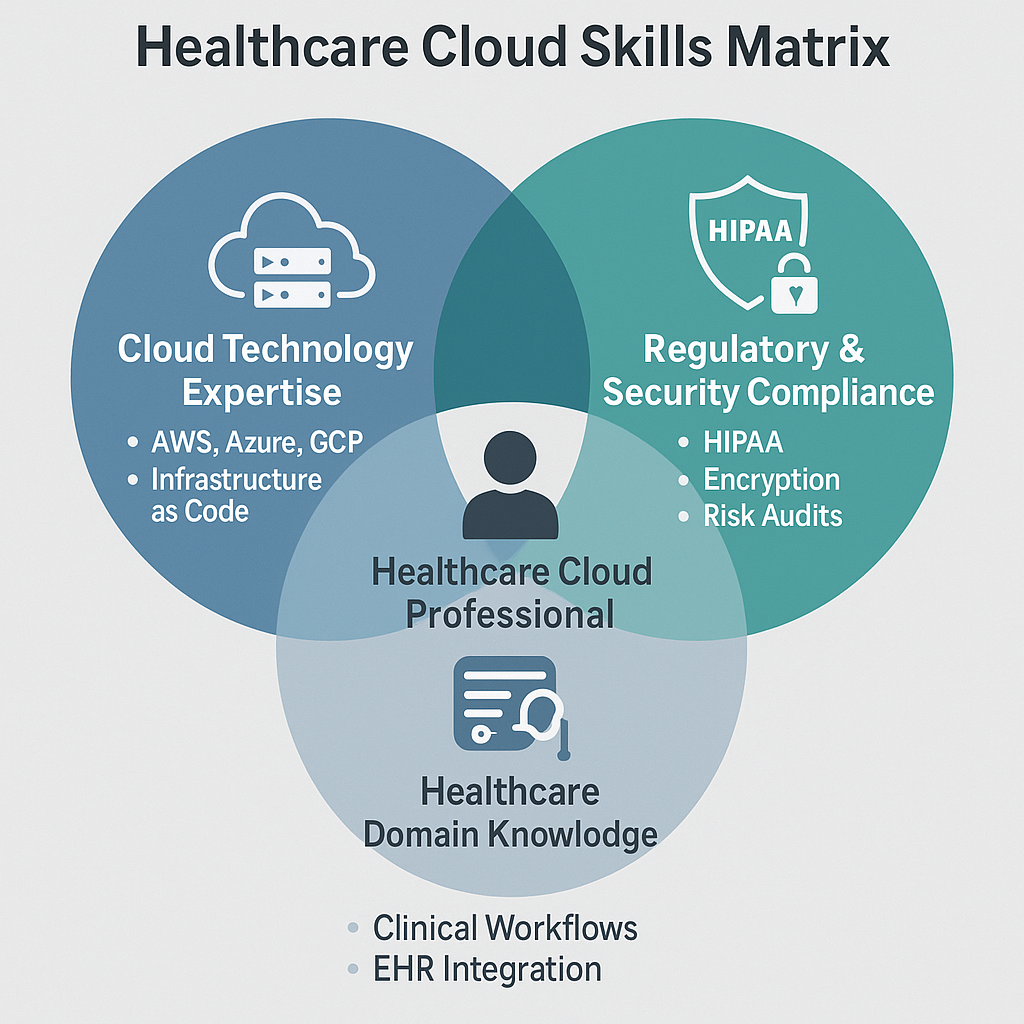
Healthcare cloud professionals require a broader skill set than their counterparts in other industries. Technical competency must be paired with healthcare domain knowledge and regulatory understanding.
Core Technical Skills
Cloud platform expertise remains fundamental, but healthcare environments often favour specific services and configurations. Azure’s healthcare-focused offerings, AWS’s HIPAA-eligible services, and Google Cloud’s healthcare APIs require deep understanding rather than surface-level familiarity.
Infrastructure as Code becomes particularly crucial in healthcare, where audit requirements demand precise documentation of all system changes. Terraform and ARM templates aren’t just efficiency tools, they’re compliance necessities.
Security skills must extend beyond standard cloud security to encompass healthcare-specific threats, breach notification requirements, and patient data protection protocols. Understanding encryption at rest and in transit isn’t optional, it’s legally mandated.
Healthcare Domain Knowledge
Electronic Health Records (EHR) systems represent the backbone of healthcare IT, and cloud professionals must understand how these complex systems integrate with cloud services whilst maintaining data integrity and availability.
Clinical workflows dictate technology requirements in ways that purely business applications don’t. Understanding how healthcare professionals actually work helps design systems that support rather than hinder patient care.
Regulatory frameworks extend beyond HIPAA to include GDPR (for European operations), state-specific privacy laws, and emerging regulations around AI in healthcare. Staying current with regulatory changes becomes part of the role.
Soft Skills for Healthcare Environments
Healthcare organisations operate differently from typical enterprises. Patient safety concerns create risk-averse cultures where change management requires exceptional communication and stakeholder engagement skills.
Cross-functional collaboration becomes critical when working with clinical staff, compliance teams, and administrative personnel who may have limited technical backgrounds but deep expertise in their domains.
Problem-solving in healthcare often involves life-and-death implications, requiring professionals who can work under pressure whilst maintaining meticulous attention to detail.
Certification Pathways and Professional Development
Healthcare cloud careers benefit from strategic certification combinations that demonstrate both technical competency and healthcare-specific knowledge.
Foundation Certifications
Start with core cloud platform certifications, AWS Solutions Architect, Azure Solutions Architect, or Google Cloud Professional Cloud Architect. These establish credibility and demonstrate fundamental cloud competency to healthcare employers.
Security certifications like CompTIA Security+ or (ISC)² CISSP provide essential cybersecurity foundations that healthcare environments demand.
Healthcare-Specific Certifications
The Certified Professional in Healthcare Information and Management Systems (CPHIMS) credential demonstrates healthcare IT knowledge and commands respect within healthcare organisations.
HIPAA compliance training, while not formally certified, provides essential knowledge that employers expect. The 2025 HIPAA Security Rule updates have introduced mandatory requirements for encryption, multi-factor authentication, and continuous risk monitoring that significantly impact cloud implementations.
Healthcare Information Security and Privacy Practitioner (HCISPP) combines healthcare knowledge with information security expertise, creating a powerful credential
combination.
Advanced Specialisations
Certified Ethical Hacker (CEH) or Offensive Security Certified Professional (OSCP) certifications appeal to healthcare organisations increasingly focused on proactive security measures.
Project Management Professional (PMP) certification proves valuable for senior roles, as healthcare technology implementations often involve complex, multi-stakeholder projects with strict timelines.
Continuous Learning Strategy
Healthcare technology evolves rapidly, with new regulations, emerging threats, and advancing clinical technologies requiring ongoing education. Successful professionals establish learning routines that include regulatory updates, security threat intelligence, and emerging healthcare technologies.
Professional associations like HIMSS (Healthcare Information and Management Systems Society) provide networking opportunities, continuing education, and industry insights essential for career advancement. The NHS England Digital Cloud Centre of Excellence offers free training programmes for NHS staff, including partnerships with major cloud providers.
Salary Expectations and Market Demand
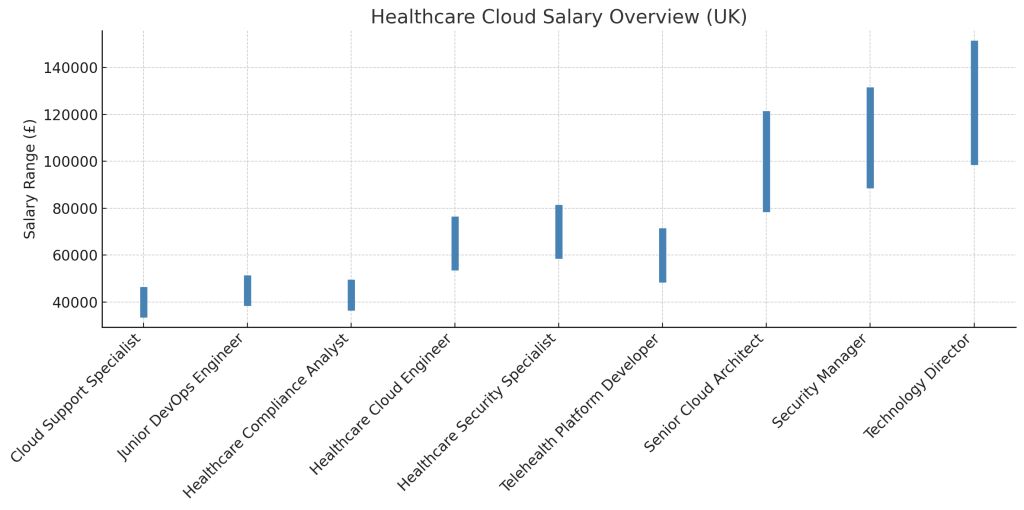
Healthcare cloud salaries typically exceed general cloud positions by 10-20%, reflecting the specialised knowledge requirements and sector-specific challenges. Location significantly impacts compensation, with London-based roles commanding premium rates.
Entry-Level Positions (0-2 years experience)
- Healthcare Cloud Support Specialist: £35,000-£45,000
- Junior Healthcare DevOps Engineer: £40,000-£50,000
- Healthcare Compliance Analyst: £38,000-£48,000
Mid-Level Positions (3-7 years experience)
- Healthcare Cloud Engineer: £55,000-£75,000
- Healthcare Security Specialist: £60,000-£80,000
- Telehealth Platform Developer: £50,000-£70,000
Senior-Level Positions (8+ years experience)
- Senior Healthcare Cloud Architect: £80,000-£120,000
- Healthcare Cloud Security Manager: £90,000-£130,000
- Healthcare Technology Director: £100,000-£150,000
Factors Affecting Compensation
Organisation type significantly impacts salary levels. Private healthcare organisations and health technology companies typically offer higher compensation than NHS trusts, though public sector roles provide superior benefits and pension schemes.
Geographic location remains crucial, with London roles offering 20-30% premiums over regional positions. However, remote work opportunities are expanding, particularly post-pandemic.
Certification combinations command salary premiums, with professionals holding both cloud and healthcare certifications earning 15-25% more than those with only cloud credentials.
Security specialisation consistently commands the highest premiums, reflecting the critical importance of patient data protection and the shortage of qualified healthcare security professionals. The healthcare cybersecurity market is projected to reach $35.3 billion, driven by increasing cyber threats and regulatory requirements.
Transition Strategies for Current Cloud Professionals
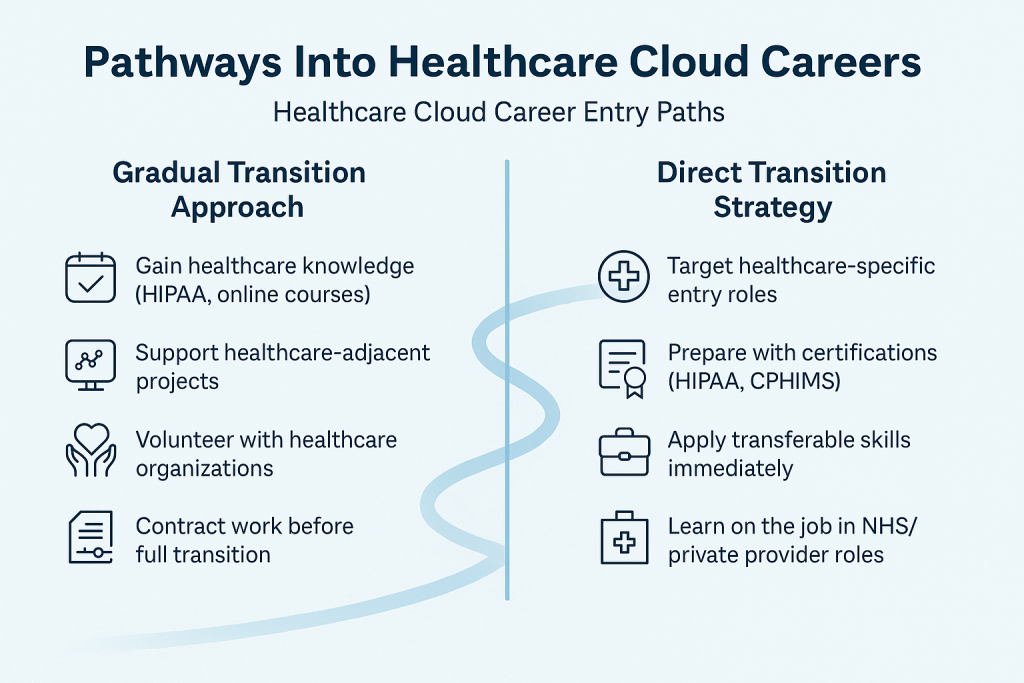
Moving into healthcare cloud work doesn’t require starting over. Existing cloud skills provide strong foundations for healthcare specialisation.
Gradual Transition Approach
Begin by gaining healthcare compliance knowledge through online courses, professional training, or volunteer work with healthcare organisations. Understanding HIPAA requirements, patient data protection, and healthcare operations provides context for technical decisions.
Seek opportunities to work on healthcare-adjacent projects within current roles. Perhaps supporting vendors who serve healthcare clients or working on projects with patient data components.
Consider contract or consulting work with healthcare organisations to gain direct experience whilst maintaining current employment stability.
Direct Transition Strategy
Some professionals prefer immediate immersion in healthcare environments. This approach requires thorough preparation but can accelerate career development.
Target entry-level healthcare cloud positions that value transferable skills whilst providing healthcare-specific training. Many healthcare organisations prefer hiring experienced cloud professionals and training them on healthcare requirements rather than attempting the reverse.
Building Healthcare Networks
Healthcare operates as a relationship-driven industry where professional networks significantly impact career opportunities. Attend HIMSS local chapter meetings, healthcare technology conferences, and professional development events.
LinkedIn engagement with healthcare technology content and professionals helps establish industry presence and demonstrate genuine interest in healthcare challenges.
Volunteer technical skills with healthcare charities or community health organisations to gain practical experience whilst building meaningful professional connections.
Key Employers and Career Paths
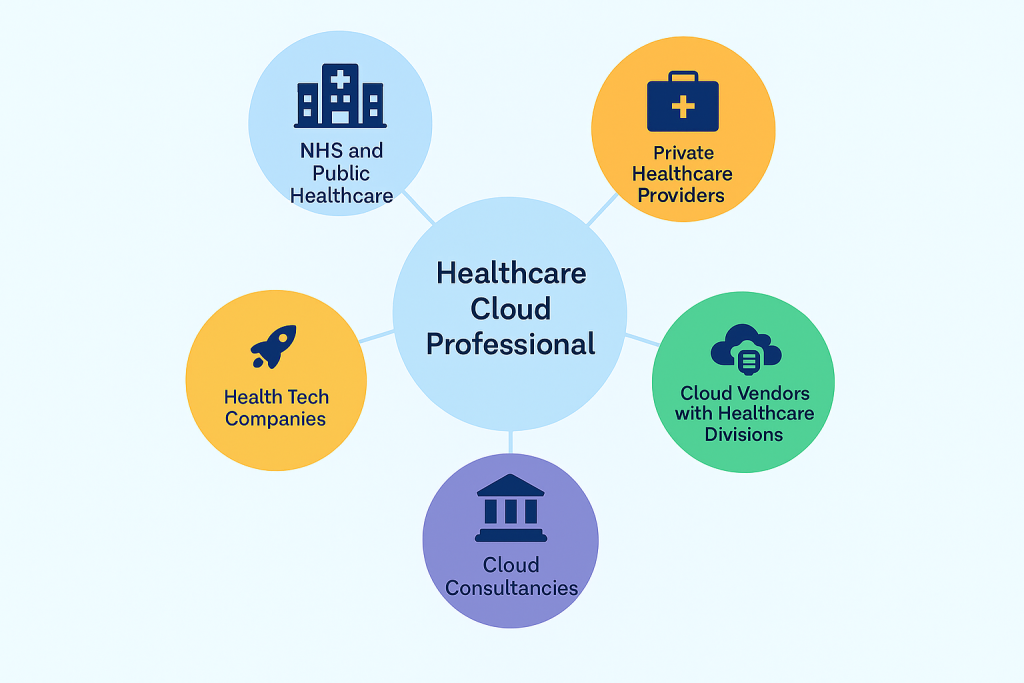
Healthcare cloud opportunities exist across diverse organisation types, each offering different career experiences and advancement paths.
NHS and Public Healthcare
NHS trusts provide stable employment, excellent benefits, and exposure to large-scale healthcare operations. Career progression follows established civil service structures, with clear advancement criteria and professional development support.
NHS Digital and NHS England offer technology-focused roles that influence healthcare policy and standards nationwide. These positions provide exceptional learning opportunities but may involve bureaucratic processes that frustrate professionals accustomed to agile commercial environments.
Private Healthcare Providers
Private hospital groups like HCA Healthcare, Spire Healthcare, and BMI Healthcare offer faster-paced environments with commercial pressures that drive efficiency and innovation.
These organisations often implement cutting-edge technologies more rapidly than public sector counterparts, providing exposure to emerging healthcare technologies and implementation approaches.
Health Technology Companies
Epic, Cerner, and other EHR vendors employ cloud professionals to support their increasingly cloud-based offerings. These roles combine product development with customer implementation support.
Emerging health technology startups offer equity participation opportunities alongside competitive salaries, though with associated start-up risks and uncertainty.
Healthcare Cloud Consultancies
Specialised consulting firms like Deloitte Digital Health, Accenture Health, and boutique healthcare technology consultancies provide diverse project exposure and rapid skill development.
Consulting roles typically command premium compensation whilst providing broad experience across different healthcare organisations and use cases.
Technology Vendors Serving Healthcare
Microsoft, Amazon, and Google all maintain dedicated healthcare divisions requiring professionals who understand both cloud platforms and healthcare requirements.
These roles involve supporting healthcare customers whilst influencing product development to better serve healthcare use cases.
Future Prospects and Emerging Opportunities
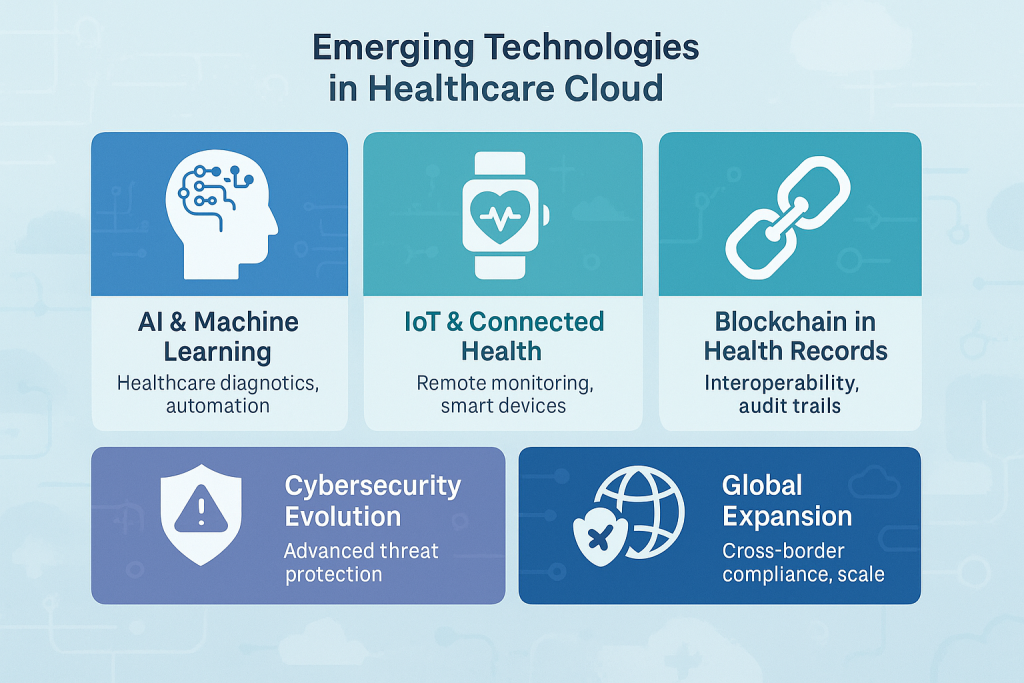
Healthcare cloud careers benefit from several positive trends that suggest strong long-term prospects and expanding opportunities.
Artificial Intelligence and Machine Learning
Healthcare AI applications are expanding rapidly, with about 15% of providers having an AI strategy today compared with around 5% in 2023. This creates demand for cloud professionals who understand AI/ML platforms within healthcare contexts. These roles combine traditional cloud skills with healthcare AI ethics, regulatory compliance, and clinical workflow integration.
The healthcare AI market is projected to grow from $29.01 billion in 2024 to $504.17 billion by 2032, representing a 44.0% compound annual growth rate that creates exceptional opportunities for skilled professionals.
Internet of Things and Connected Health
Remote patient monitoring, wearable devices, and smart medical equipment generate massive data streams requiring sophisticated cloud processing capabilities. This creates opportunities for IoT specialists with healthcare domain knowledge.
Blockchain and Distributed Health Records
Patient data interoperability remains a significant healthcare challenge, with blockchain technologies offering potential solutions. Early career investment in blockchain knowledge could provide significant advantages as these technologies mature.
Cybersecurity Evolution
Healthcare cyber threats continue evolving, requiring increasingly sophisticated defence strategies. Security specialists with healthcare experience will remain in high demand as organisations invest heavily in patient data protection.
International Expansion
UK healthcare technology companies are expanding globally, creating opportunities for professionals interested in international healthcare markets and cross-border regulatory compliance.
Getting Started: Your Next Steps
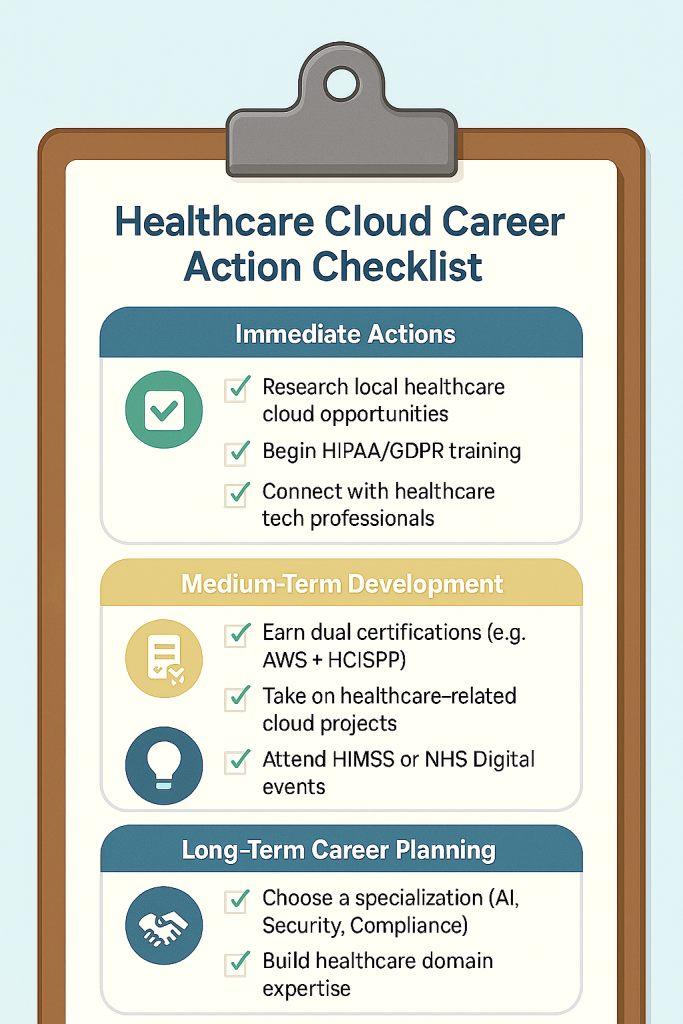
Healthcare cloud careers offer exceptional opportunities for professionals willing to invest in sector-specific knowledge and navigate unique industry requirements. The combination of technical challenges, meaningful work, and strong compensation makes healthcare cloud an attractive specialisation.
Immediate Actions
Research healthcare organisations in your area to understand local opportunities and requirements. Many healthcare systems publish technology strategies that reveal their cloud adoption plans and skill needs.
Begin healthcare compliance education through online courses or professional training programmes. Understanding HIPAA requirements provides immediate value and demonstrates genuine sector interest.
Connect with healthcare technology professionals through LinkedIn, professional associations, and local networking events to understand industry dynamics and career opportunities.
Medium-Term Development
Pursue relevant certifications that combine cloud expertise with healthcare knowledge. The investment in dual credentials pays dividends through expanded opportunities and higher compensation.
Seek opportunities to apply cloud skills in healthcare contexts, whether through volunteer work, side projects, or transitional roles that provide healthcare exposure.
Long-Term Career Planning
Consider specialisation areas that align with personal interests and emerging healthcare technology trends. Early investment in emerging technologies like healthcare AI or blockchain could provide significant career advantages.
Develop healthcare domain expertise through continuing education, professional development, and practical experience. The most successful healthcare cloud professionals understand both technology and healthcare operations.
Healthcare cloud careers represent more than job opportunities, they offer chances to apply technical skills in ways that directly improve patient outcomes and healthcare efficiency. For cloud professionals seeking meaningful work alongside strong compensation and career stability, healthcare provides an ideal environment to build expertise whilst making genuine differences in people’s lives.
The sector’s continued evolution ensures that healthcare cloud professionals will remain in high demand, with expanding opportunities for specialisation and advancement. The key lies in understanding that success requires commitment to both technical excellence and healthcare domain expertise, a combination that creates exceptional value for both professionals and the healthcare organisations they serve.