

When organisations embark on their cloud journey, they’re often overwhelmed by the sheer complexity of transformation ahead. The Google Cloud Adoption Framework (GCAF) promises to simplify this process, but does it deliver? More importantly, what questions should you be asking before diving in?
After analysing hundreds of community discussions, professional services documentation, and expert insights, we’ve identified the questions that matter most to organisations at every stage of their cloud adoption journey. The surprising finding? Most concerns aren’t about technical implementation, they’re about people, processes, and organisational change.
Let’s address the questions that keep cloud leaders awake at night.
Getting Started: The Foundation Questions
What exactly is the Google Cloud Adoption Framework?
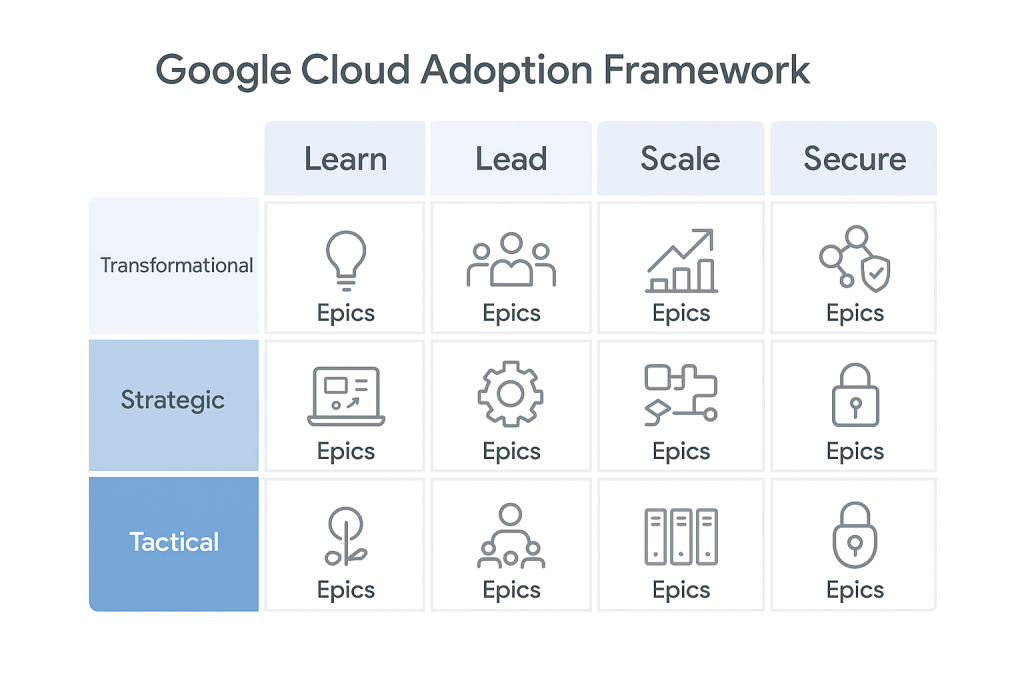
GCAF isn’t a rigid methodology or a marketing tool, it’s a strategic assessment and planning framework built around four core themes: Learn, Lead, Scale, and Secure. Think of it as a compass for your cloud journey rather than a detailed roadmap.
The framework helps organisations assess their current cloud maturity across three phases (Tactical, Strategic, Transformational) and provides actionable guidance through specific workstreams called “epics.” These epics span people, process, and technology considerations, ensuring no critical aspect of transformation is overlooked.
Should we use GCAF if we’re already in a multi-cloud environment?
Absolutely. GCAF principles apply regardless of your cloud provider mix. The framework focuses on organisational capabilities rather than specific technology implementations. Whether you’re using AWS for compute, Google Cloud for data analytics, or Azure for productivity tools, GCAF helps assess and improve your cloud adoption maturity across all platforms.
Is GCAF only for large enterprises?
This misconception persists, but GCAF scales effectively for mid-size organisations. The key is selective implementation, focus on the epics within the four core themes rather than attempting a comprehensive enterprise-grade approach. Start with the Cloud Maturity Scale assessment to identify your most critical gaps, then prioritise accordingly.
Where should we actually start?
Begin with the Cloud Maturity Scale assessment available at digitalmaturitybenchmark.withgoogle.com/cloud/. This 15-minute assessment provides a baseline across all four themes and generates specific recommendations. Don’t try to tackle everything simultaneously. Identify your top three priority epics and build momentum through early wins.
Understanding the Four Themes
What does “Learn” really mean in practice?
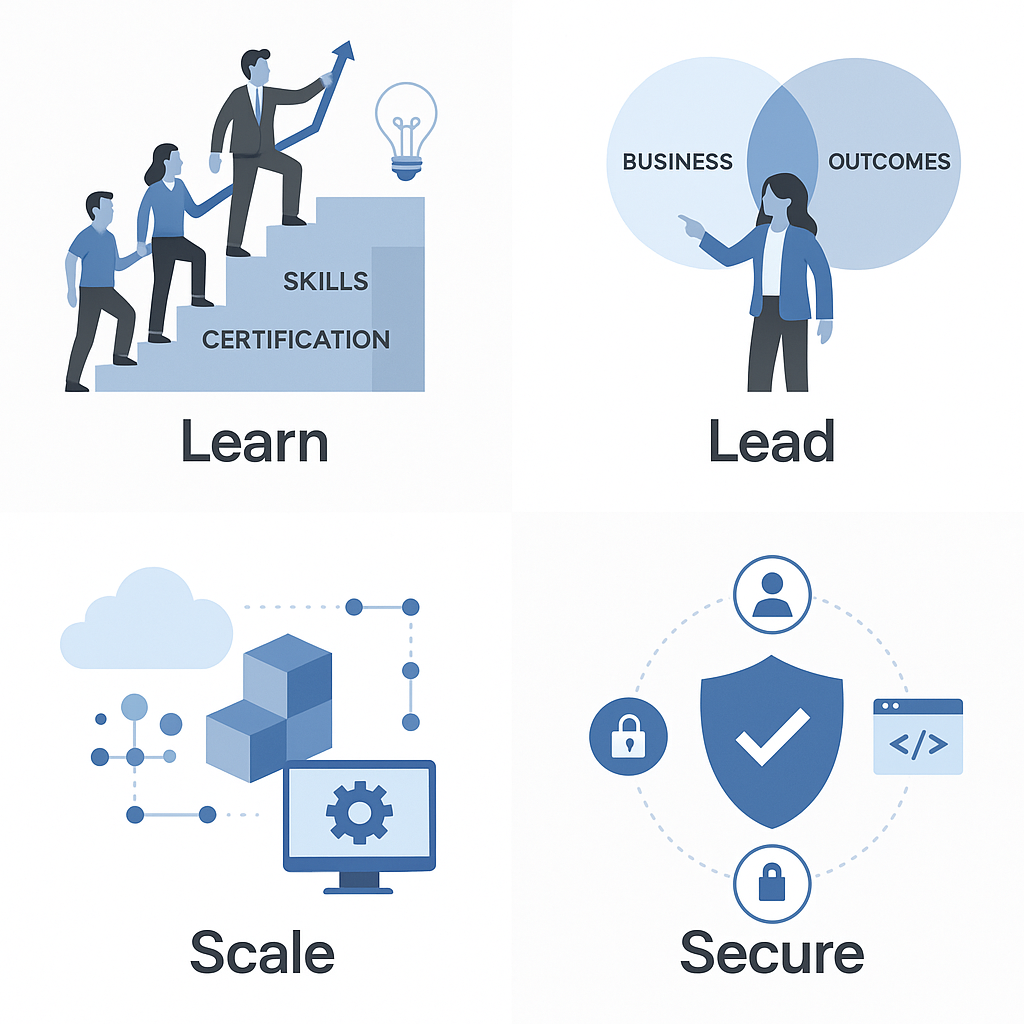
Learn encompasses your organisation’s ability to continuously upskill IT staff whilst leveraging external expertise. It’s not just about sending people to training courses. It’s about creating a culture of continuous learning and establishing pathways for knowledge transfer.
Practical indicators of learning maturity include formal certification programmes, regular knowledge-sharing sessions, and the strategic use of experienced partners to fill skill gaps rather than handle all cloud work indefinitely.
How is “Lead” different from traditional IT leadership?
This is where most organisations struggle. Traditional IT leadership often operates in functional silos with clear boundaries between business and technology teams. The Lead theme requires cross-functional collaboration, shared accountability for business outcomes, and a shift from project-based thinking to product-based ownership.
The fundamental question isn’t “How do we deliver this IT project?” but rather “How do we enable business capability through technology?” This requires different skills, different team structures, and often different people in leadership roles.
What’s the relationship between “Scale” and cost optimisation?
Scale isn’t primarily about reducing costs, it’s about achieving operational efficiency that enables innovation. Organisations focused solely on cost savings often miss the transformational benefits of cloud adoption.
True scaling involves leveraging cloud-native services to reduce operational overhead, implementing automated processes that minimise manual intervention, and creating infrastructure that adapts to business needs rather than constraining them.
Why is “Secure” at the centre of the framework?
Security isn’t an add-on consideration, it’s foundational to every other theme. The Secure theme emphasises identity-centric, multi-layered security models that assume no implicit trust. This represents a fundamental shift from perimeter-based security models that most organisations still rely upon.
Mature cloud security means service-to-service authentication, continuous monitoring of IAM policies, and security governance that scales with your cloud adoption rather than constraining it.
Implementation Challenges
How do we overcome the “old way” of thinking where business and IT are separate?
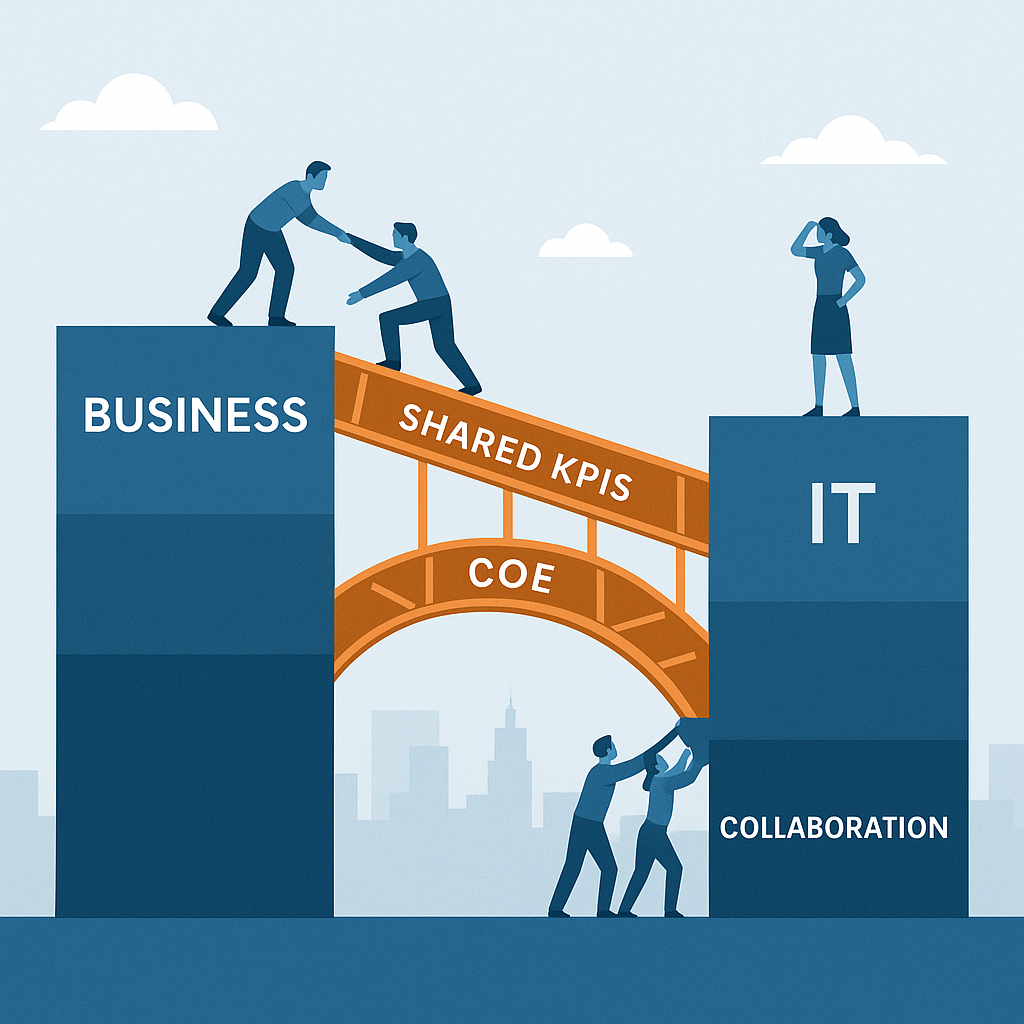
This cultural transformation is the biggest challenge most organisations face. Start by creating cross-functional teams for specific business capabilities rather than maintaining traditional functional silos. Establish shared KPIs that connect IT metrics to business outcomes, and celebrate collaborative wins rather than individual departmental achievements.
Consider implementing a “Center of Excellence” model where representatives from different business units work together on cloud initiatives. This creates natural bridges between business and IT whilst developing internal cloud expertise.
Do we need a dedicated Cloud Center of Excellence?
A CCOE can be valuable, but structure matters more than formality. You need dedicated resources for cloud governance, standards development, and knowledge sharing, whether that’s a formal team or distributed responsibilities across existing roles.
The key characteristics of effective cloud governance include clear standards for cloud resource provisioning, established cost monitoring and allocation processes, and defined escalation paths for both technical and business decisions.
How do we balance moving fast versus implementing proper governance?
This is the most common implementation challenge. The solution isn’t choosing between speed and governance, it’s implementing governance that enables speed rather than hindering it.
Start with minimum viable governance: automated resource provisioning templates, clear spending limits with automatic alerts, and standardised security configurations. Build governance that automates decisions rather than requiring manual approval processes.
Business Value and ROI
What’s a realistic timeline for seeing ROI from GCAF implementation?
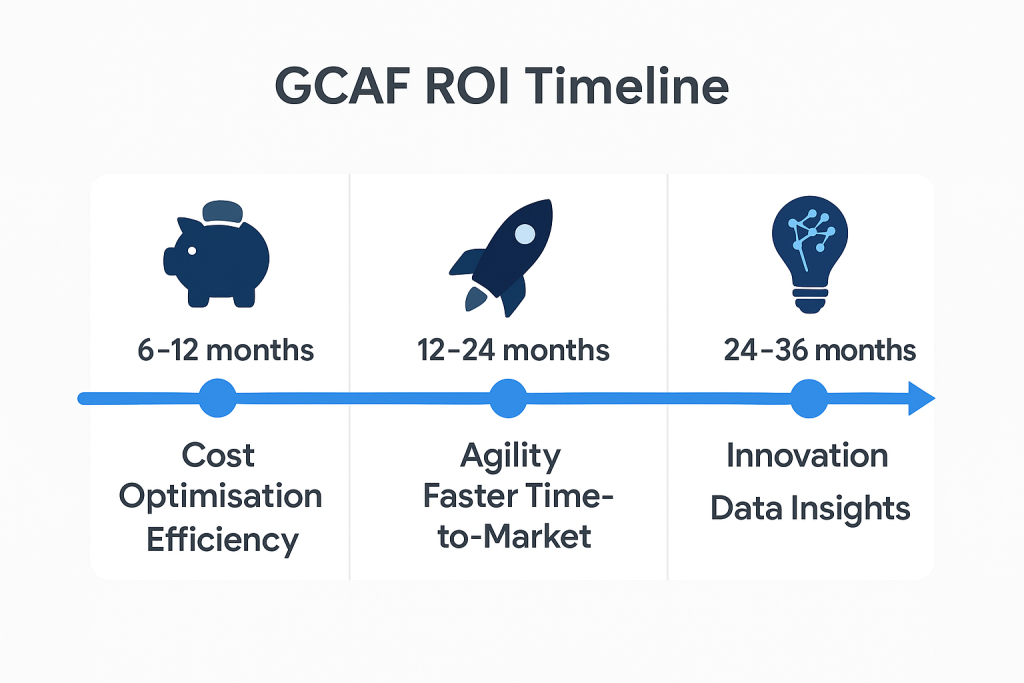
Tactical benefits (cost optimisation, operational efficiency) typically appear within 6-12 months. Strategic value (improved agility, faster time-to-market) emerges in 12-24 months. Transformational benefits (innovation capability, data-driven insights) require 24-36 months of sustained effort.
The key is setting appropriate expectations and measuring different types of value at different stages. Don’t expect transformational ROI from tactical implementations, but do capture and communicate early wins to maintain momentum.
How do we quantify the business value of improved cloud maturity?
Move beyond traditional IT cost metrics to business capability measurements. Track deployment frequency, lead time for changes, mean time to recovery, and change failure rates. These metrics directly correlate with business agility and innovation capacity.
Additionally, measure business-specific indicators like time-to-market for new products, ability to scale during peak demand, and responsiveness to market changes. These demonstrate cloud value in business terms that executives understand.
What if we can’t afford a comprehensive GCAF implementation?
Focus on the lean approach: prioritise epics within the four core themes rather than attempting comprehensive coverage. Often, addressing critical gaps in one or two themes delivers more value than superficial progress across all areas.
Consider phased implementation tied to business cycles or specific business initiatives. This approach spreads costs over time whilst ensuring cloud investments directly support business priorities.
Technical Implementation
Which epics should we focus on first?
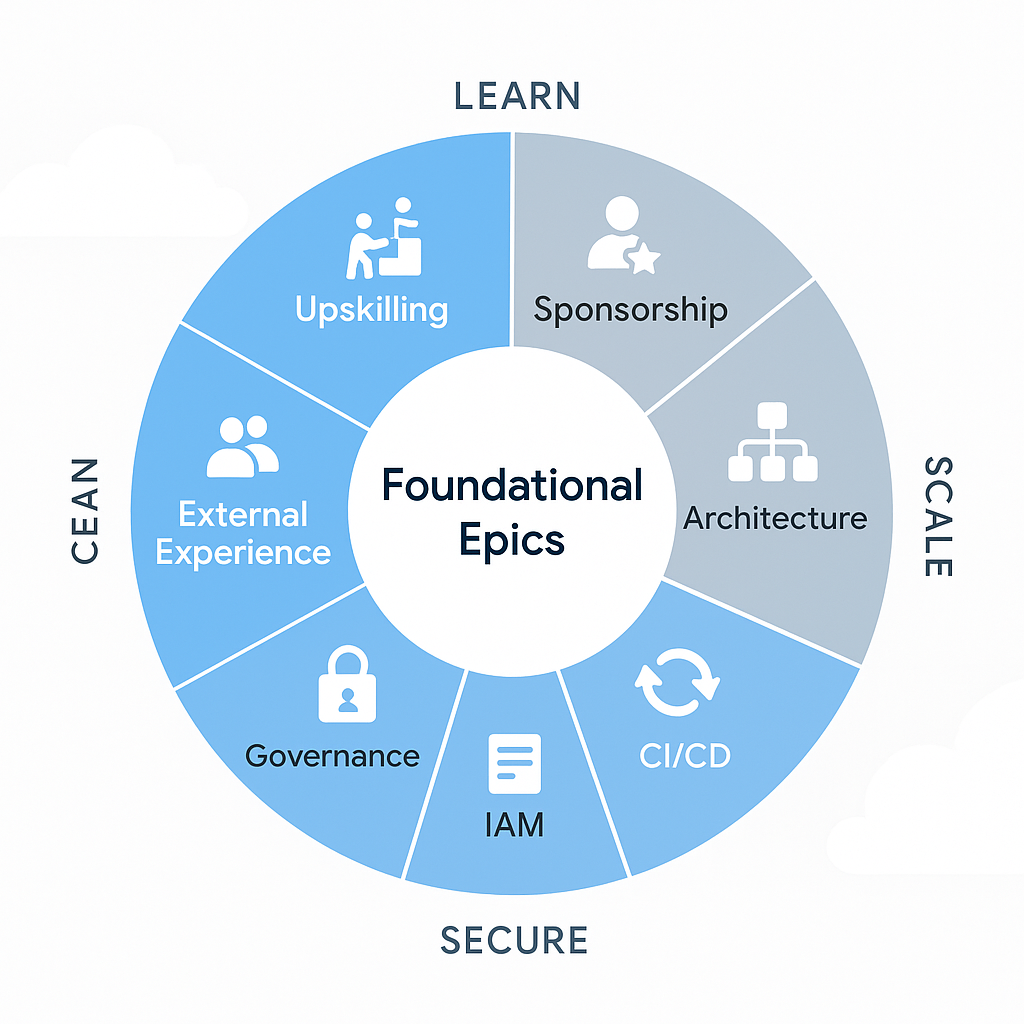
If you can only tackle a subset of epics, concentrate on those within the coloured segments of GCAF’s visual framework. These align directly with the four themes and provide the greatest impact.
Specifically, prioritise Upskilling and External Experience (Learn), Sponsorship and Teamwork (Lead), Architecture and CI/CD (Scale), and Identity & Access Management (Secure). These foundational epics enable progress across multiple areas simultaneously.
How do we handle legacy systems during GCAF implementation?
Use the 6Rs framework as a decision-making tool: Repurchase, Rehost, Replatform, Refactor, Retire, or Retain. The choice depends on business criticality, technical debt, and strategic value rather than just migration complexity.
Don’t assume all systems need to move to the cloud immediately. Some legacy systems may be better served by API integration or data replication rather than full migration, especially if they’re stable and business-critical.
What’s the relationship between GCAF and security compliance?
GCAF’s Secure theme addresses compliance requirements including HIPAA, PCI-DSS, and GDPR, but compliance should be integrated from the beginning rather than treated as a final checkpoint.
The framework’s identity-centric approach naturally supports most compliance requirements whilst providing the audit trails and access controls that regulatory frameworks demand.
Common Misconceptions
Is GCAF just Google marketing for cloud services?
GCAF principles apply across cloud providers, though implementation details may vary. The framework addresses fundamental cloud adoption challenges that exist regardless of your chosen platform. Many organisations successfully use GCAF principles whilst implementing multi-cloud or hybrid strategies.
Will cloud adoption automatically reduce our costs?
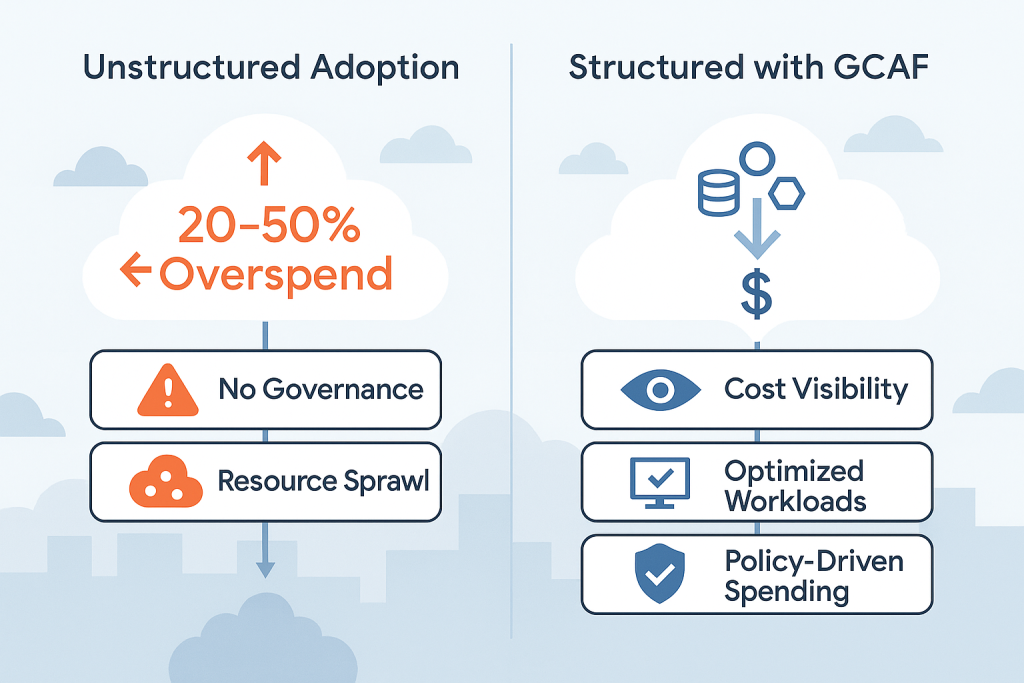
Not necessarily. Cloud adoption often increases costs initially whilst organisations learn new operational models. The value comes from improved agility, innovation capability, and operational efficiency rather than simple cost reduction.
Research indicates that organisations without structured adoption frameworks often experience 20-50% cloud overspend due to poor resource management and lack of governance.
Moving Forward: Your Next Steps
Start with assessment, not action. Complete the Cloud Maturity Scale evaluation to understand your current position across all four themes. Use these results to identify the top three epics that would most impact your organisation’s cloud capabilities.
Remember that cloud adoption is fundamentally an organisational transformation initiative, not just a technology migration. Success depends on addressing people and process changes alongside technical implementation.
The organisations that struggle with cloud adoption are those that treat it as an IT project rather than a business transformation. Those that succeed view cloud capability as a competitive advantage that requires investment in people, processes, and culture alongside technology.
Your cloud journey is unique, but you don’t need to navigate it alone. Whether you choose to work with Google Cloud’s Professional Services, certified partners, or internal teams, the GCAF provides a proven structure for moving forward with confidence.
What questions did we miss? The cloud adoption conversation continues, and your specific challenges help refine these frameworks for everyone’s benefit.
Ready to assess your organisation’s cloud maturity? Visit the Google Cloud Digital Maturity Benchmark to begin your structured cloud adoption journey.