

The FinOps practitioner role didn’t exist five years ago. Today, organizations with substantial cloud spending increasingly recognize that dedicated focus on cloud financial management delivers returns that dwarf the investment. A practitioner earning £110,000 who saves 15% on £10 million annual cloud spend has delivered £1.5 million in value, a 13:1 return that makes the business case self-evident.
This represents a fundamental shift in how organizations view cloud costs. Finance teams once treated cloud spending as an uncontrollable variable, engineers considered costs someone else’s problem, and executives accepted 30% waste as inevitable. The emergence of dedicated FinOps practitioner roles signals organizational maturity – cloud spending now receives the same financial rigour as any other major expense category.
Dedicated FinOps roles offer salaries ranging from £90,000 for practitioners at mid-sized organizations to £150,000+ for senior practitioners and leads at enterprises. More importantly, these roles position you at the intersection of engineering, finance, and strategy. You’re not just saving money; you’re enabling business agility, informing architectural decisions, and influencing how organizations think about cloud investment.
Building on adding FinOps skills to your engineering toolkit, this guide explores the full-time FinOps practitioner career path. You’ll understand different role types, salary expectations, the IC versus management decision, and multiple exit opportunities that emerge after 3-5 years of dedicated FinOps work.
The career trajectory from practitioner to leadership typically spans 3-5 years: FinOps Practitioner (£90K-£110K) progresses to Senior FinOps Practitioner (£110K-£130K), then branches toward Lead/Principal FinOps (£130K-£160K) or FinOps Manager/Director (£120K-£180K+). Understanding these paths helps you make strategic decisions about specialization, skill development, and career positioning.
The FinOps Stakeholder Model: Operating at Scale
Full-time FinOps practitioners orchestrate three distinct constituencies, each with competing priorities and different success metrics. Mastering this orchestration separates effective practitioners from exceptional ones.
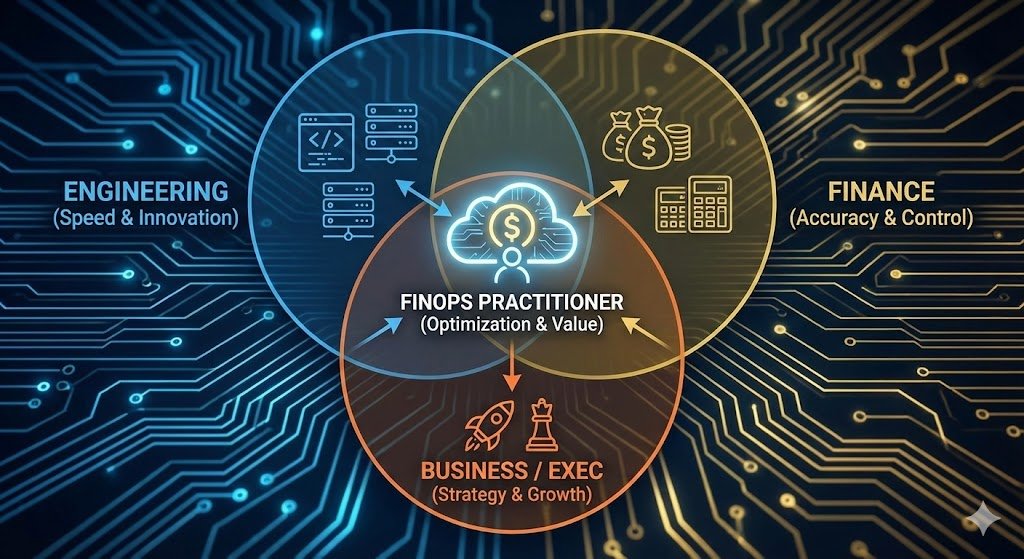
Engineering Teams: Enablement Over Restriction
Engineers control cloud resource deployment, making their buy-in essential. The practitioner viewed as “the person who says no” faces constant resistance. The practitioner who enables teams to build faster whilst spending intelligently becomes indispensable.
Frame cost optimization as capacity creation. When you save £400,000 annually through rightsizing and commitment optimization, that’s budget freed for new product development, additional engineers, or expanded infrastructure. Engineers respond positively when optimization funds innovation rather than just improving margins.
Build automated guardrails rather than manual approval processes. Policy-as-code preventing obviously wasteful deployments (untagged resources, publicly accessible S3 buckets, oversized instances in non-production) educates whilst protecting budgets. Engineers prefer automated feedback in their deployment pipelines over retrospective cost conversations.
Celebrate engineering team wins publicly. When a team reduces their infrastructure costs by 25% whilst maintaining performance, ensure leadership recognizes this achievement. Recognition creates positive reinforcement, encouraging other teams to engage with FinOps practices.
Finance Teams: Reliability and Partnership
Finance teams need accurate forecasts, clear variance explanations, and confidence that cloud spending aligns with budgets. Building trust with finance transforms them from potential adversaries to powerful career sponsors.
Deliver monthly forecasts within 5% accuracy. Finance operates on precise budgets – a 15% forecast error creates planning chaos. Invest heavily in forecasting sophistication, using historical trends, growth projections, and seasonality factors. When your predictions prove reliable over 6-12 months, finance learns to trust your judgment.
Proactively communicate unexpected changes. If spending will exceed forecast by 10% due to an unplanned migration, alert finance immediately with mitigation options. Surprises damage trust; early warnings with action plans build it.
Present variance analysis with business context, not technical excuses. “Compute spending increased 20% due to planned Black Friday capacity, delivering £2M in additional revenue” connects technical changes to business outcomes. Finance understands this framing immediately.
Participate in annual planning cycles. Offer to build multi-year cloud spending models incorporating growth projections, architectural changes, and optimization opportunities. This partnership positions you as strategic advisor rather than cost reporter.
Executive Leadership: Strategic Influence
Executives make decisions about cloud strategy, vendor relationships, and technology investments worth millions. Earning their trust opens doors to senior roles and strategic influence.
Present options with clear recommendations. Executives hire you for expertise, not to rubber-stamp preconceptions. When evaluating multi-cloud strategies, present pros and cons of each approach, then state your recommendation with supporting reasoning. This demonstrates strategic thinking executives value.
Translate technical decisions into business impact. “Migrating to Graviton instances” means little to executives. “Graviton migration delivers £180,000 annual savings with zero application changes, freeing budget for data science team expansion” connects technical work to business outcomes.
Quarterly business reviews should emphasize trends, not data dumps. Executives want to understand: Are we on budget? What risks exist? What opportunities should we pursue? Answer these questions clearly using visualizations that communicate at a glance.
Technical Skills: From Practitioner to Strategic Authority
Full-time FinOps roles demand sophisticated technical capabilities beyond foundational cost optimization. The progression from practitioner to senior practitioner to lead reflects deepening expertise and strategic sophistication.
Practitioner Level (£90K-£110K)
Multi-Cloud Cost Management
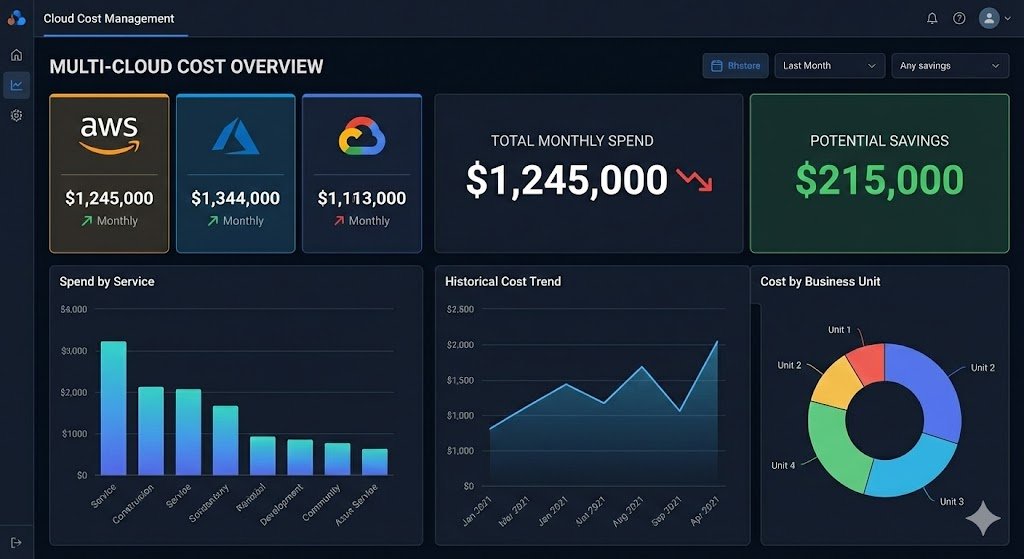
Organizations with substantial cloud spending increasingly adopt multi-cloud strategies, requiring practitioners who understand cost management across AWS, Azure, and GCP. Master the nuances of each platform’s billing model, reserved capacity mechanisms, and native cost tools.
Build unified reporting that aggregates costs across providers. Finance teams need consolidated views showing total cloud spending, not separate reports for each platform. Use tools like CloudHealth, Apptio Cloudability, or build custom aggregation using each provider’s billing APIs.
Understand cross-cloud service equivalencies and pricing. When comparing AWS Lambda versus Azure Functions versus Google Cloud Functions, analyze not just compute costs but also data transfer, API charges, and operational complexity. Your recommendations guide architectural decisions affecting multi-year spending.
FinOps Platform Implementation
Organizations investing in dedicated FinOps platforms need practitioners who can deploy, configure, and extract value from sophisticated tools. CloudHealth, Apptio Cloudability, and Kubecost each offer powerful capabilities but require expertise to leverage effectively.
Learn platform-specific features deeply. CloudHealth’s perspective API enables custom cost views matching organizational structure. Apptio’s business mapping connects cloud spending to products and customers. Kubecost’s container cost allocation solves Kubernetes attribution challenges. Mastering these features makes you valuable for implementation projects.
Build custom dashboards and reports meeting stakeholder needs. Engineering teams want resource-level visibility. Finance needs business unit allocation. Executives require trend analysis and forecast accuracy. Your ability to serve all three audiences distinguishes you from practitioners who only understand technical metrics.
Advanced Optimization Techniques
Commitment optimization – Reserved Instances, Savings Plans, and Committed Use Discounts – requires analytical sophistication. Analyze 6-12 months of usage data identifying stable workloads suitable for commitments. Model different commitment terms (1-year versus 3-year) showing ROI and risk assessment. Present recommendations quantifying £200,000-£500,000 in annual savings.
Kubernetes cost optimization has become critical as container adoption grows. Master cost allocation at pod, namespace, and cluster levels. Implement resource requests and limits preventing waste. Configure cluster autoscaling balancing performance and cost. Practitioners with container expertise command premiums because these skills remain scarce.
Automated governance prevents costly mistakes. Build policy frameworks detecting untagged resources, publicly accessible storage, or oversized non-production environments. Policy-driven automation scales your impact far beyond manual optimization efforts.
Senior Practitioner Level (£110K-£130K)
Strategic Cost Analysis
Total Cost of Ownership (TCO) modeling informs major architectural decisions. Build models comparing cloud versus on-premise costs for specific workloads over 3-5 years. Include not just infrastructure costs but also staffing, facilities, and opportunity costs. These analyses influence £10+ million decisions, justifying senior-level compensation.
Multi-year cost projections require understanding business growth, architectural evolution, and optimization opportunities. Finance needs these projections for annual planning, and your accuracy determines how much they trust your judgment. Senior practitioners achieve <5% forecast error rates through sophisticated modeling.
What-if scenario analysis helps organizations evaluate strategic options. Model the cost impact of: doubling customer base, expanding to new regions, adopting serverless architecture, or migrating databases. Each scenario requires understanding cost structures, growth patterns, and architectural implications.
Vendor Management and EAs
Enterprise Agreements with hyperscale cloud providers involve millions in commitments with complex discount structures. Understanding EA terms, discount tiers, and commitment mechanisms provides enormous value.
Support finance teams in EA negotiations by analyzing spending patterns, projecting growth, and modeling commitment scenarios. The senior practitioner who helps structure an EA delivering an additional 5% discount on £8 million annual spend has saved the organization £400,000 – a substantial career highlight.
Understand rate card optimization across different purchasing mechanisms: pay-as-you-go, Reserved Instances, Savings Plans, Enterprise Discount Programs. Organizations with sophisticated purchasing strategies achieve 30-50% discounts on compute, and your expertise enables these savings.
FinOps Culture Development
Senior practitioners build organizational capabilities that persist beyond individual optimization efforts. Develop training programs teaching engineers cloud economics, create playbooks documenting optimization patterns, and establish metrics tracking cultural adoption.
Your internal FinOps training might include: understanding cloud pricing models, cost-efficient architectural patterns, tagging and allocation best practices, and optimization techniques. As hundreds of engineers complete this training, cost awareness becomes embedded in engineering culture.
Document repeatable patterns solving common cost challenges. Playbooks covering Reserved Instance management, container cost optimization, and data transfer reduction enable teams to optimize independently. This scales your impact far beyond personal efforts.
Lead/Principal Level (£130K-£160K)
Organizational Strategy
Lead practitioners develop multi-year FinOps roadmaps moving organizations from Crawl to Walk to Run maturity. This strategic work influences how organizations think about cloud investment, not just specific optimizations.
Build FinOps governance frameworks defining roles, responsibilities, and decision-making authority. Who approves Reserved Instance purchases? How do teams request budget increases? What triggers cost reviews? Clear governance prevents costly mistakes whilst maintaining engineering velocity.
Executive FinOps reporting synthesizes cost data into strategic insights. Board presentations should communicate: cloud spending as percentage of revenue, cost efficiency trends, optimization ROI, and strategic recommendations. This visibility positions you as strategic advisor to C-level executives.
Industry-Specific Expertise
Specializing in specific industries commands salary premiums because regulatory requirements and business models create unique cost challenges. Financial services compliance adds 20-40% infrastructure costs. Healthcare data residency requires specific architectural patterns. Retail seasonal scaling demands sophisticated capacity planning.
Develop deep expertise in your industry’s specific challenges. This specialization makes you the practitioner who understands both FinOps principles and industry context – a combination that justifies £140,000-£160,000 salaries.
Thought Leadership
Lead practitioners contribute to industry knowledge through conference speaking, published articles, and community leadership. This external visibility creates opportunities impossible to plan directly whilst establishing you as industry authority.
Develop proprietary frameworks or tools solving common FinOps challenges. Open-sourcing these contributions builds professional reputation whilst giving back to the community. Organizations hire thought leaders for their expertise and external credibility.
Career Decision Points: Navigating Your Path
Full-time FinOps careers branch at several decision points. Understanding these choices helps you make strategic decisions about specialization and advancement.
Individual Contributor Versus Management Track

IC Track: Lead/Principal FinOps Engineer (£130K-£160K)
Choose the IC track if you love hands-on technical work, want to stay deep in multi-cloud optimization, prefer building tools and automation, and don’t want direct people management responsibilities.
Your day-to-day involves: solving complex optimization problems, developing strategic technical initiatives, advising executives as subject matter expert, building frameworks and tools, and contributing to industry knowledge through speaking and writing.
Career progression continues to Distinguished Engineer or Principal Architect levels at £140,000-£180,000+, with compensation reflecting technical expertise rather than team size.
The IC track offers technical depth, direct impact through your work, flexibility in how you spend time, and influence through expertise rather than authority. However, organizational impact may be limited compared to leading teams, compensation ceiling is typically lower than executive roles, and advancement requires continuous technical skill development.
Management Track: FinOps Manager/Director (£120K-£180K+)
Choose management if you enjoy building teams and culture, want organizational influence, prefer strategic over tactical work, and are excited about budget and headcount ownership.
Your day-to-day involves: team development and hiring, strategic planning and OKRs, executive partnership, budget and vendor management, and cross-functional collaboration at scale.
Career progression leads to VP FinOps or Head of Cloud Financial Management at £150,000-£250,000+, with compensation reflecting organizational scope and budget responsibility.
Management offers broader organizational impact, typically higher compensation ceiling, influence through team leverage, and clear advancement path to executive roles. However, it requires less hands-on technical work, people management complexity, political navigation, and accountability for team performance.
Can You Switch Tracks?
Yes, though IC to management is easier than management to IC. Most successful practitioners stay IC through Senior/Lead level, then decide based on clear preference and opportunity. You don’t need to commit to management early in your FinOps career.
Full-Time Employee Versus Consulting
Full-Time FinOps Practitioner
Full-time roles offer: stability and benefits, deep organizational impact, clear career progression path, equity or stock options at startups, and consistent salary (£90,000-£150,000).
The downside: single organization focus limits skill diversity, slower exposure to different industries and problems, and capped upside compared to consulting rates.
Best for: building deep expertise, long-term organizational transformation, stable income, and developing leadership skills in one environment.
FinOps Consultant (£600-£1,000/day)
Independent consulting offers: higher earning potential (£120,000-£250,000+ annually), diverse client exposure, rapid skill growth, flexibility and autonomy, and personal brand building.
The challenges: income variability, sales and business development required, less deep organizational impact per client, and self-managed benefits and pension.
Best for: experienced practitioners with 5+ years experience, entrepreneurial mindset, comfort with business development, and desire for diverse industry exposure.
Most successful consultants work full-time for 3-5 years building deep expertise and professional network before transitioning to independent work. Explore our complete guide to cloud consulting rates for detailed consulting path analysis.
Specialization Options
Multi-Cloud FinOps Specialist (£100K-£150K + £10K-£20K premium)
Deep expertise across AWS, Azure, and GCP combined with complex hybrid environment experience commands premiums. Organizations with sophisticated multi-cloud deployments need practitioners who understand cost optimization across platforms without vendor bias.
Kubernetes/Container Cost Specialist (£100K-£145K + £10K-£15K premium)
Platform teams at scale need practitioners who master Kubernetes cost attribution, implement sophisticated resource management, and optimize container infrastructure. This specialization remains scarce, creating premium opportunities.
FinOps Platform Expert (£95K-£140K + £5K-£10K premium)
Deep CloudHealth, Apptio, or similar platform expertise creates demand for implementation projects, migrations, and optimization work. Organizations investing £100,000+ annually in FinOps platforms need experts maximizing their investment.
Industry Vertical Specialist (£105K-£160K + £15K-£25K premium)
Financial services, healthcare, or retail specialization combining FinOps expertise with deep industry knowledge commands the highest premiums. Understanding regulatory requirements, compliance frameworks, and industry-specific optimization patterns creates rare, valuable expertise.
Job Search and Career Advancement
Transitioning to full-time FinOps roles or advancing to senior positions requires strategic job search and interview preparation.
Finding FinOps Roles
LinkedIn searches for “FinOps Practitioner” and “Cloud Financial Management” reveal available positions. The FinOps Foundation job board lists dedicated roles. Networking through FinOps Foundation Slack channels and local meetups often surfaces opportunities before public posting.
Direct outreach works effectively. Identify companies with cloud spending exceeding £1 million monthly, research their FinOps maturity through LinkedIn and job postings, then reach out to Engineering or Finance leaders proposing FinOps value. Many roles are created through this outreach rather than traditional job postings.
Resume Optimization
Quantify everything: “Delivered £2.4M annual cloud cost savings (28% reduction) while supporting 40% infrastructure growth” beats “Responsible for cloud cost optimization.”
Highlight cross-functional work: “Partnered with CFO on quarterly cloud spend planning” and “Trained 50+ engineers on cost-efficient architecture” demonstrate stakeholder management.
Feature certifications prominently: FinOps Certified Practitioner badge, cloud provider certifications, and platform credentials signal commitment and expertise.
Link to portfolio: GitHub repositories with cost optimization scripts, dashboard screenshots, and anonymized case studies provide tangible evidence of capability.
Interview Preparation
Technical assessment often involves analyzing actual cost data. Practice with sample billing exports, focusing on quick wins plus strategic initiatives. Understand optimization methodology, multi-cloud challenges, and commitment strategies deeply.
Behavioral questions probe stakeholder management: “Tell me about a time you saved significant costs,” “How do you handle engineering team pushback?” and “Describe your approach to executive communication.”
Case study exercises are common. Companies provide real cost data expecting analysis and recommendations. Practice identifying optimization opportunities, quantifying impact, and presenting business-focused recommendations.
Questions to ask reveal organizational maturity: “What’s your current FinOps maturity level?” “What tools are in place?” “How does FinOps report – Engineering or Finance?” “What’s your monthly cloud spend?” Understanding these factors helps you evaluate role fit.
Salary Negotiation
Know your worth: Practitioner (£90K-£110K baseline), Senior (£110K-£130K), Lead (£130K-£160K). Add premiums for multi-cloud expertise, industry specialization, London location, and large company scale.
Negotiation leverage comes from: quantified savings from previous roles, multiple offers, specialized expertise (Kubernetes, multi-cloud), certifications, and strong portfolio.
Consider total compensation: base salary, bonus or performance pay, equity at startups, training budget, conference attendance, and flexible working arrangements.
Red flags include: no budget for FinOps tooling, reporting to low-level manager without strategic visibility, unclear scope, and “FinOps” being only 20% of a hybrid role.
Success in Your First 90 Days
New FinOps practitioners succeed by demonstrating quick value whilst building strategic foundations.
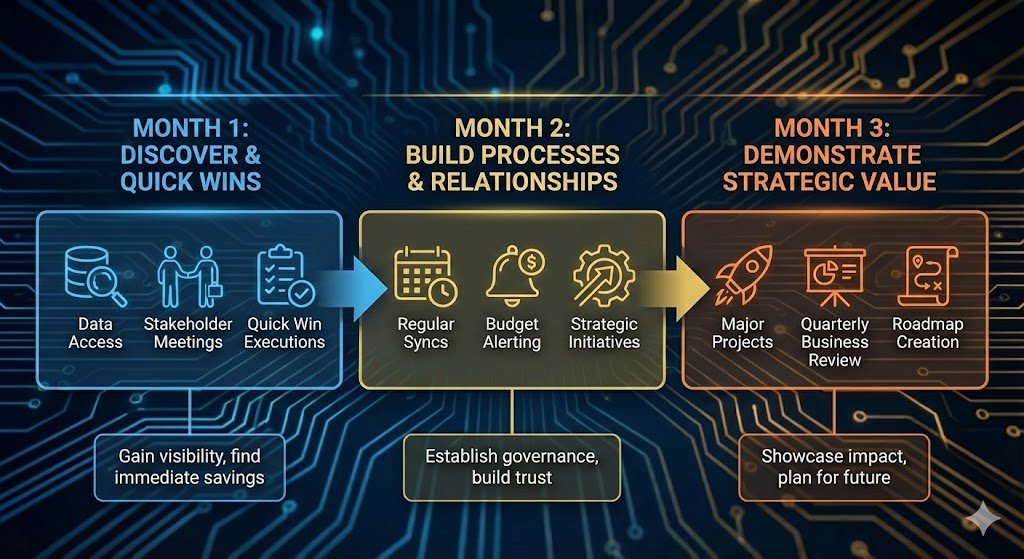
Month 1: Discover and Deliver Quick Wins
Gain access to billing data and tools, meet key stakeholders across engineering, finance, and leadership, review existing documentation and processes, understand cost history and trends, and identify immediate optimization opportunities.
Execute 2-3 quick wins targeting £50,000-£100,000 in annual savings. Obvious waste – orphaned resources, oversized non-production environments, unattached storage – provides easy victories building credibility.
Document current state comprehensively. What’s the monthly spend? How accurate are forecasts? What’s tagging compliance? What optimization opportunities exist? This baseline measures your impact over time.
Month 2: Build Processes and Relationships
Establish regular touchpoints: weekly engineering syncs, monthly finance reviews, and quarterly executive updates. Consistent communication builds trust and visibility.
Implement foundational processes: budget alerting preventing surprises, cost anomaly detection catching problems early, tagging compliance enforcement improving attribution, and showback or chargeback mechanisms creating accountability.
Launch strategic initiatives: Reserved Instance and Savings Plans analysis, multi-cloud optimization roadmap, and FinOps platform evaluation if needed.
Month 3: Demonstrate Strategic Value
Execute major optimization projects showing sophisticated capability beyond quick wins. Platform migrations, disaster recovery optimization, or commitment strategy implementation demonstrate strategic thinking.
Present quarterly business review to leadership showing: cost trends with business context, savings delivered with specific figures, forecast accuracy improvements, and 6-month roadmap with projected impact.
By day 90, successful practitioners have: identified £250,000-£500,000 in annual savings, established executive awareness of FinOps value, gained engineering team engagement, and created clear roadmap for continued impact.
Long-Term Career Strategy
Years 1-2: Establish Expertise
Master your organization’s unique challenges, build trust across engineering and finance, deliver consistent 10-20% annual savings, and expand FinOps across departments and business units.
Salary progression from £90,000-£110,000 toward £100,000-£120,000 rewards demonstrated performance. Promotion to Senior Practitioner becomes possible.
Begin external positioning: speak at local meetups, write articles or LinkedIn posts, participate in FinOps Foundation working groups, and build professional network beyond your organization.
Years 3-5: Leadership Positioning
Two paths emerge: IC track toward Lead/Principal (£130,000-£160,000) requires deep multi-cloud expertise, strategic advisory to executives, tool and framework development, and industry thought leadership. Management track toward Manager/Director (£120,000-£180,000+) requires building FinOps teams, owning organizational strategy, executive partnership with CFO/CTO, and budget ownership.
Actions for IC track: publish whitepapers or tools, speak at conferences (FinOps X, cloud summits), mentor junior practitioners, and contribute to open source FinOps projects.
Actions for management track: develop hiring and training programs, present strategic initiatives to Board, own cloud financial planning process, and build FinOps Center of Excellence.
Years 5+: Strategic Options
Multiple high-value paths emerge: VP or Head of FinOps at large enterprises (£150,000-£250,000+), independent consulting or firm partnership (£150,000-£300,000+), vendor or tool company roles in product management or solutions architecture (£120,000-£180,000+ plus equity), or thought leadership through analyst roles at Gartner/Forrester or FinOps Foundation leadership (£130,000-£200,000+).
Each path offers distinct advantages. Evaluate based on personal interests, risk tolerance, compensation goals, and desired lifestyle.
The Strategic Value of FinOps Careers
Full-time FinOps practitioner roles offer unique career positioning at the intersection of technology, finance, and strategy. You’re not just optimizing costs – you’re enabling business agility, informing architectural decisions, and influencing how organizations invest in technology.
The career trajectory from £90,000 practitioner to £150,000+ senior roles or leadership positions reflects growing organizational recognition that cloud financial management deserves dedicated expertise. Organizations that once viewed cloud costs as uncontrollable now understand that strategic FinOps practice delivers measurable returns.
Whether pursuing IC depth or management breadth, specializing in multi-cloud or industry verticals, or eventually transitioning to consulting or vendor roles, FinOps careers offer diverse opportunities with strong compensation and career resilience. Economic downturns increase demand for cost optimization expertise, making these roles recession-resistant.
The practitioners who move quickly – building expertise, delivering measurable savings, and positioning themselves strategically – will capture the best opportunities. Organizations increasingly recognize FinOps value, but qualified practitioners remain scarce. This supply-demand imbalance creates exceptional career opportunities for engineers willing to develop this expertise.
Understand the strategic context through our FinOps Evolution guide, showing how FinOps transforms from tactical cost-cutting to strategic value creation.
Useful Links
- State of FinOps Salary Data – Annual compensation survey
- CloudHealth by VMware – Leading FinOps platform
- Apptio Cloudability – Enterprise FinOps platform
- Kubecost – Kubernetes cost management
- FinOps Evolution: From Penny-Pinching to Profit Engine – Strategic context
- Cloud Consulting Rates UK – Alternative career path
- Add FinOps Skills to Your Engineering Toolkit – Part 1 of this series
- FinOps X Conference – Annual industry conference
- Levels.fyi – Salary benchmarking for FinOps roles