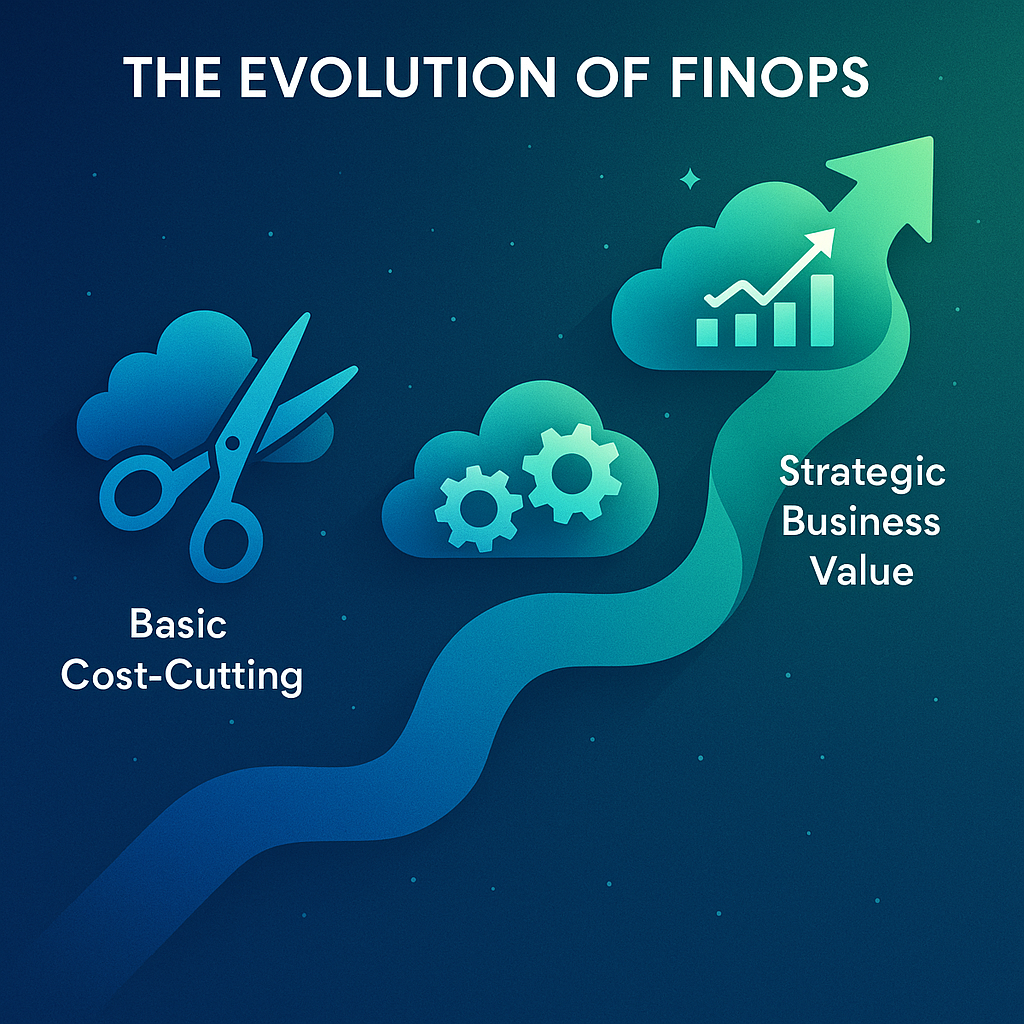
Cloud computing has revolutionised how organisations build and scale their digital infrastructure, but this transformation has brought significant financial challenges. As cloud spending continues to accelerate—with Gartner projecting global cloud spending to exceed £900 billion in 2025—organisations are increasingly focused on optimising their cloud investments. Enter FinOps: a discipline that has rapidly evolved from basic cost management to a strategic business function that drives value creation across the enterprise.
The FinOps Origin Story: Cost Control as the Primary Driver
The concept of FinOps emerged around 2019 as organisations grappled with unexpected cloud bills and the challenges of managing variable spending models. In these early days, FinOps primarily served as a reactionary discipline focused on cost reduction.
Early FinOps practices typically involved:
- Identifying and eliminating waste: Locating unused or over-provisioned resources
- Implementing basic governance: Creating tagging policies and basic accountability structures
- Reacting to billing surprises: Addressing unexpected costs after they occurred
During this phase, FinOps was often perceived as an extension of IT procurement or a specialised form of cloud management. Finance and technology teams operated in silos, with limited collaboration and different objectives.
Image prompt: A split-screen digital illustration showing finance professionals on one side looking at spreadsheets with concerned expressions, and IT professionals on the other side working with cloud interfaces. Show a visual barrier between them to represent silos, with cloud cost reports and invoices scattered between them. Use a corporate office aesthetic with subtle blue tones.
The FinOps Transformation: From Cost Centre to Value Driver
As cloud adoption matured and organisations developed more sophisticated approaches to cloud management, FinOps began to evolve dramatically. The publication of the FinOps Framework by the FinOps Foundation in 2020 marked a significant turning point, providing structure and best practices that elevated the discipline.
This evolution was characterised by three significant shifts:
1. From Reactive to Proactive
Modern FinOps teams don’t merely react to costs – they anticipate and shape them. According to research by McKinsey, organisations with mature FinOps practices achieve 30-40% cost savings compared to those with reactive approaches.
Proactive FinOps practices now include:
- Architectural cost optimisation: Designing systems with cost efficiency as a core principle
- Predictive modelling: Forecasting cloud spending based on business initiatives
- Automated governance: Implementing guardrails that prevent cost overruns before they occur
2. From Technical Function to Business Discipline
FinOps has transcended its origins as a purely technical discipline to become a crucial business function that bridges technical and financial domains. This transformation is reflected in organisational structures—51% of enterprise organisations now have dedicated FinOps teams, according to the 2024 State of FinOps Report.
The business-oriented FinOps function now encompasses:
- Unit economics: Mapping cloud costs to business metrics like cost per customer or transaction
- Investment prioritisation: Guiding technology investments based on value/cost analysis
- Cross-functional collaboration: Uniting finance, engineering, product, and executive leadership
3. From Cost Management to Value Creation
Perhaps the most profound evolution has been the shift from cost reduction to value maximisation. Progressive organisations now view FinOps not as a constraint but as an enabler of innovation and business growth.
Image prompt: A professional infographic showing a pyramid or hierarchy of FinOps evolution. At the bottom level show “Cost Reduction” (with downward arrows and cost symbols), middle level “Cost Optimization” (with efficiency symbols), and top level “Value Creation” (with growth charts and innovation symbols). Use a clean, modern design with professional blue/green gradient styling suitable for a corporate blog.
The Modern FinOps Practice: Core Components
Today’s advanced FinOps functions comprise several essential components that work together to create business value:
Data-Driven Decision Making
Modern FinOps relies on comprehensive data integration and analytics capabilities. By combining cloud spending data with business metrics, organisations gain insights that inform strategic decisions.
Key elements include:
- Unified data platforms: Consolidating financial and operational data from multiple cloud providers
- Business intelligence integration: Connecting cloud spending to business outcomes
- Anomaly detection and alerting: Identifying spending patterns that require investigation
Cultural Transformation
Effective FinOps requires a cultural shift that emphasises financial accountability across all teams involved in cloud usage. According to Deloitte’s Cloud Cost Management Survey, organisations with strong cost accountability cultures achieve 25% higher cloud ROI.
Cultural elements of mature FinOps include:
- Engineering ownership: Developers taking responsibility for the financial impact of their technical decisions
- Financial transparency: Making cost data visible and actionable for all stakeholders
- Continuous education: Building financial awareness into technical training programmes
Strategic Alignment
The most evolved FinOps functions align directly with business strategy, ensuring that cloud investments support organisational objectives.
This alignment manifests as:
- Executive engagement: C-level involvement in setting cloud financial strategy
- Value-based prioritisation: Allocating resources based on business impact rather than technical preference
- Long-term planning: Developing multi-year cloud investment roadmaps tied to business growth
Image prompt: A professional digital illustration showing circular alignment between Business Strategy (represented by documents and growth charts), Technology Implementation (represented by cloud symbols and code), and Financial Governance (represented by financial graphs and budget symbols). Show connecting arrows creating a continuous cycle. Use a clean corporate style with blue and green professional color scheme.
Real-World Value Creation: FinOps Success Stories
The evolution of FinOps is perhaps best illustrated through examples of organisations that have transformed their approach to cloud financial management:
Case Study: Financial Services
A leading British financial services company implemented a mature FinOps practice that went beyond cost management to enable faster time-to-market for new products. By optimising their development environments and implementing just-in-time resource provisioning, they reduced their infrastructure costs by 42% while simultaneously accelerating their release cycles by 30%.
Case Study: Healthcare Technology
A healthcare technology provider used FinOps principles to optimise their machine learning operations, reducing the cost of each model training run by 60%. This cost efficiency enabled them to run more complex models and achieve higher diagnostic accuracy—directly improving patient outcomes while maintaining cost discipline.
Case Study: E-commerce Platform
An e-commerce platform leveraged advanced FinOps practices to optimise their infrastructure spending during peak shopping periods. Rather than simply reducing costs, they reallocated savings to enhance customer experience features, resulting in a 15% increase in conversion rates during their busiest season.
The Future of FinOps: Emerging Trends
As FinOps continues to evolve, several trends are shaping its future development:
AI-Driven Optimisation
Artificial intelligence is transforming FinOps by enabling more sophisticated optimisation strategies. Machine learning algorithms can now analyse usage patterns, predict future requirements, and automatically adjust resource allocation for optimal price-performance.
The FinOps Foundation’s AI Working Group is developing frameworks specifically for managing AI/ML workloads, which present unique cost management challenges due to their resource-intensive nature.
Sustainability Integration
The convergence of financial and environmental considerations is creating a new dimension for FinOps. According to Gartner, by 2025, 60% of organisations will include carbon footprint measurement in their cloud optimisation strategies.
This integration enables:
- Carbon-aware workload placement: Scheduling compute tasks to minimise environmental impact
- Green ROI calculations: Incorporating sustainability metrics into investment decisions
- Regulatory compliance: Preparing for emerging carbon reporting requirements
Image prompt: A digital illustration showing the integration of FinOps and sustainability. Create a Venn diagram with one circle representing financial metrics (dollar symbols, cost charts) and another representing sustainability metrics (leaf symbols, carbon footprint indicators), with the overlapping section showing “Green Value Creation” with both symbols together. Use a professional style with natural green and business blue color scheme.
Multi-Cloud Financial Orchestration
As organisations increasingly adopt multi-cloud strategies, FinOps is evolving to provide unified financial governance across diverse environments. Advanced FinOps platforms now offer centralised visibility and control across AWS, Azure, Google Cloud, and private cloud environments, enabling truly strategic resource allocation.
Building Your Strategic FinOps Practice
For organisations looking to evolve their FinOps function from cost management to strategic value creation, several key steps can accelerate the journey:
1. Establish Clear Business Alignment
Begin by mapping cloud spending to specific business outcomes and establishing KPIs that reflect value rather than just cost. For instance, measure “cost per transaction” rather than total spending, or “infrastructure cost as a percentage of revenue” rather than absolute numbers.
2. Invest in FinOps Capabilities
Develop specialised skills within your organisation by investing in FinOps training and certification. The FinOps Certified Practitioner programme provides a structured path to building expertise.
3. Implement Value-Based Showback
Move beyond simple chargeback mechanisms to implement value-based showback that demonstrates both the cost and the business value of cloud resources. This approach helps stakeholders make informed decisions about resource utilisation.
4. Foster Cross-Functional Collaboration
Create formal structures that bring together finance, technology, and business teams. Regular FinOps councils or steering committees can ensure alignment across these traditionally separate domains.
Conclusion: FinOps as a Competitive Advantage
The evolution of FinOps from cost-cutting to strategic value creation represents a significant opportunity for organisations to transform their approach to cloud financial management. By embracing this evolution, companies can not only optimise their cloud spending but also accelerate innovation, improve business outcomes, and create sustainable competitive advantages.
As we look to the future, the organisations that will thrive in the cloud era will be those that view FinOps not as a constraining function but as a strategic enabler—one that balances financial discipline with the agility and innovation that cloud technologies make possible.
About the Author: This article was written by a technology communicator specialising in cloud financial management and organisational transformation.
Further Reading
- The FinOps Foundation – The definitive resource for FinOps frameworks, research, and certification
- AWS Cost Management Guide – Specific tools and techniques for optimising AWS spending
- Azure Cost Management Best Practices – Microsoft’s guidance on optimising Azure expenditure
- The State of FinOps Report – Annual research on FinOps adoption and maturity