

In today’s cloud-centric world, organisations of all sizes face a common challenge: managing cloud costs effectively whilst maximising business value. Enter FinOps – a groundbreaking approach that’s transforming how businesses think about cloud financial management. If your organisation is struggling with unpredictable cloud bills or lacks visibility into cloud spending, implementing FinOps principles could be your path to financial clarity and optimised cloud investments.

Understanding FinOps: The Fundamentals
FinOps, short for Financial Operations, represents a cultural practice that brings financial accountability to the variable spending model of cloud. At its core, FinOps is about creating a collaborative framework where technology, finance, and business teams work together to make data-driven decisions that deliver value through cloud investments. Unlike traditional IT financial management, FinOps addresses the unique challenges of the pay-as-you-go cloud model where resources can be provisioned instantly and costs can fluctuate dramatically.
Rather than being merely a set of tools or a one-time project, FinOps embodies a continuous cycle of optimisation and improvement. It’s about fostering a culture where everyone takes ownership of their cloud usage and its associated costs.
The Heart of FinOps: Collaboration, Ownership and Guidance
The beauty of FinOps lies in its fundamental principles. At its heart, FinOps recognises that no single department can effectively manage cloud costs alone. When technology teams work in isolation from finance, or when business units aren’t involved in resource decisions, inefficiencies naturally emerge.
Successful FinOps practices break down these traditional silos. Engineers gain understanding of the financial implications of their architecture choices. Finance teams develop appreciation for the technical constraints and opportunities of cloud platforms. And business stakeholders can clearly articulate the value they expect from cloud investments.
Beyond collaboration, FinOps cultivates a sense of ownership. When developers understand that their code deployment decisions directly impact the monthly cloud bill, they naturally become more cost-conscious. This ownership mindset transforms conversations from “Who’s responsible for the cloud bill?” to “How can we collectively optimise our cloud usage?”
While distributed responsibility is essential, most organisations benefit from a central FinOps function—a team or individual who champions best practices, provides tools and frameworks, and keeps the organisation aligned on financial objectives. This centralised guidance ensures consistency without stifling innovation.

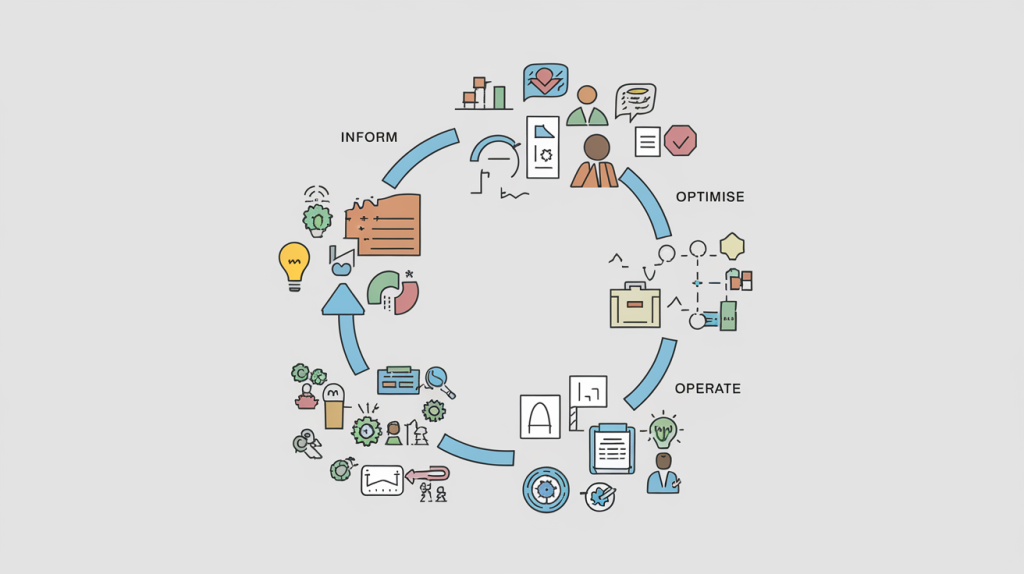
The FinOps Journey: Inform, Optimise, Operate
Think of FinOps as a continuous journey rather than a destination. This journey typically unfolds across three interconnected phases that organisations cycle through repeatedly as they mature.
The journey begins with transparency. Before you can optimise costs, you need visibility into where your money is going. This “Inform” phase focuses on gathering and sharing meaningful data about cloud spend. It’s about moving beyond the shock of unexpectedly high cloud bills to understanding exactly which teams, projects, and resources are driving costs.
During this phase, organisations implement tagging strategies to allocate costs to teams and projects. They establish dashboards that give stakeholders real-time visibility into spending patterns. Most importantly, they begin connecting cloud costs to business metrics, answering questions like “What’s the cloud cost per customer?” or “How much does each transaction cost us?”
Once you have visibility, you can identify opportunities for optimisation. In the “Optimise” phase, teams use data to make informed decisions about resource allocation. They might discover instances running at 5% utilisation that could be downsized. They might identify development environments running 24/7 that could be scheduled to shut down outside working hours. Or they might uncover storage volumes that haven’t been accessed in months.
The optimisation phase isn’t simply about cutting costs, though. It’s about making intentional trade-offs between cost, performance, and business requirements. Sometimes spending more in one area allows significant savings elsewhere. The key is making these decisions with complete information rather than in the dark.
As organisations mature, they move into the “Operate” phase, where cost-efficiency becomes embedded in everyday workflows. Teams establish guardrails that prevent costly mistakes, like automatically tagging resources upon creation or requiring approval for unusually large instances. They implement anomaly detection that flags unusual spending patterns before they become problematic. And they create feedback loops that continuously reinforce cost-conscious behaviour.
Bringing FinOps to Life in Your Organisation
Implementing FinOps doesn’t require a massive organisational restructuring or expensive consultants. Many organisations begin with small, focused initiatives that demonstrate value and build momentum.
Start by assessing your current state. What visibility do you have into cloud costs today? How are decisions about cloud resources made? Where are the most significant inefficiencies? This assessment gives you a baseline and helps identify high-impact opportunities.
Form a cross-functional working group with representatives from engineering, finance, and business units. This group becomes the seed of your FinOps practice, championing cost-awareness throughout the organisation. Choose members who are influential within their teams and passionate about improving organisational efficiency.
Define metrics that matter to your business. While technical metrics like instance utilisation are important, business-oriented metrics like cost per customer or cost per transaction often drive more meaningful decisions. These unit economics help teams understand how cloud spending translates to business outcomes.
Begin with high-impact projects that deliver quick wins. Perhaps you focus first on rightsizing oversized instances, which often yields immediate savings with minimal effort. Or maybe you implement scheduled shutdowns for non-production environments. These early successes build credibility and create resources for more complex initiatives.
Invest in education throughout the organisation. Many engineers lack understanding of cloud pricing models and how their technical decisions impact costs. Finance teams may not grasp the technical constraints and opportunities of cloud platforms. Bridging these knowledge gaps enables more effective collaboration.
Navigating Common FinOps Challenges

As with any cultural and operational change, implementing FinOps comes with challenges. Understanding these challenges in advance helps you navigate them more effectively.
Engineering teams sometimes resist FinOps initiatives, fearing cost constraints will limit their ability to innovate. This resistance often stems from misunderstanding—FinOps isn’t about restricting spending, but about spending intentionally. Frame the conversation around enabling sustainable innovation rather than cutting costs. Show how optimisation creates headroom for new initiatives within existing budgets.
Allocating shared costs presents another common challenge. When multiple applications share underlying infrastructure, determining who should bear the costs becomes complex. There’s no one-size-fits-all solution to this challenge. Some organisations allocate based on compute usage, others on business metrics like revenue. Begin with simple allocation models and refine them over time as your understanding deepens.
Multi-cloud environments add another layer of complexity. Different cloud providers use different pricing models and terminology, making it difficult to gain a unified view of spending. While cloud-specific tools offer deeper insights, many organisations benefit from normalised views across providers. Consistent tagging strategies across clouds can simplify this challenge considerably.
The Business Impact: Beyond Cost Savings
When implemented thoughtfully, FinOps delivers benefits far beyond simple cost reduction. Organisations typically see cost reductions of 20-30% through systematic optimisation, but the value extends well beyond savings.
FinOps dramatically improves forecasting accuracy. Instead of treating cloud as an unpredictable expense, organisations can forecast needs based on business drivers and historical patterns. This improved forecasting enables better budgeting and planning across the organisation.
The collaborative nature of FinOps breaks down traditional silos between technology and finance teams. These improved relationships yield benefits beyond cloud cost management, fostering more effective partnerships on other initiatives.
Perhaps most importantly, FinOps enables faster innovation by removing financial uncertainty from cloud adoption. When teams understand the financial implications of their technical decisions, they can move more confidently and avoid costly mistakes that might otherwise slow progress.

Looking Forward: The Evolution of FinOps
As cloud adoption continues to mature, FinOps practices are evolving to address emerging challenges. Containerised environments and serverless architectures require new approaches to cost allocation and optimisation. The environmental impact of cloud usage is drawing increasing attention, leading some organisations to incorporate sustainability metrics alongside financial considerations.
Artificial intelligence is beginning to transform FinOps practices, enabling predictive optimisation that anticipates and prevents cost anomalies before they occur. And forward-thinking organisations are moving beyond cost management to value measurement, focusing on maximising the return on cloud investments rather than simply minimising their cost.
Conclusion
FinOps represents a fundamental shift in how organisations approach cloud financial management. By bringing together technology, finance, and business perspectives, FinOps enables companies to maximise the value of their cloud investments whilst maintaining financial control. Whether you’re managing AWS, Azure, Google Cloud, or a multi-cloud environment, these principles apply universally.
The most successful organisations view FinOps not as a cost-cutting exercise but as a value-creation strategy that supports innovation and growth. As cloud environments become increasingly complex, adopting FinOps principles has moved from being a competitive advantage to an operational necessity.
Remember that FinOps is a journey, not a destination. Start where you are, establish a baseline, and continuously improve through the inform-optimise-operate cycle.