

The cloud engineer sitting across from you at the pub mentions she just completed her FinOps Foundation certification. Three months later, she’s landed a role with a £15,000 salary increase. Her responsibilities haven’t drastically changed, but her focus has sharpened – she’s still building infrastructure, but now she’s quantifying every architectural decision in pounds saved and ROI delivered.
FinOps practitioner roles are growing 40% year-over-year, with average salary premiums of £10,000-£30,000 for engineers who add cost optimization expertise to their technical skillset. Organizations waste an average of 30% on cloud spending, and 85% now have dedicated FinOps teams working to reclaim those losses. When your organization spends £5 million annually on cloud, a 20% optimization delivers £1 million back to the bottom line. CFOs are paying attention, and they’re willing to reward engineers who can deliver measurable financial outcomes.
The career trajectory is straightforward: Cloud Engineer (£60K-£90K) transitions to engineer with FinOps focus (£80K-£110K), then moves into dedicated FinOps Practitioner roles (£90K-£150K). More importantly, FinOps skills position you as a strategic advisor rather than a tactical implementer. You’re no longer just provisioning infrastructure; you’re quantifying its business value and optimizing for organizational outcomes.
This guide maps the journey from cloud engineer to FinOps-focused professional. You’ll learn which certifications matter, how to build a portfolio of cost optimization wins, and the specific timeline for achieving salary increases.
The FinOps Foundation Maturity Model: Your Career Framework
The FinOps Foundation’s Crawl-Walk-Run maturity model maps directly to career progression, helping you identify which skills to develop and which opportunities to pursue.
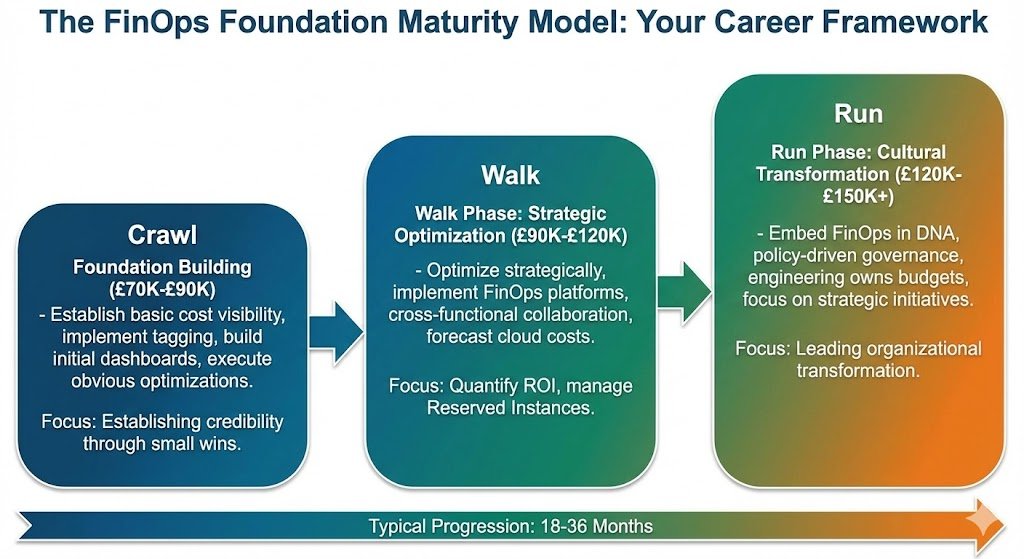
Crawl Phase: Foundation Building (£70K-£90K)
Organizations establishing basic cost visibility need engineers who can implement tagging strategies, build initial dashboards, and execute obvious optimizations. You’re supporting broader engineering efforts whilst gradually taking ownership of cost-related concerns. Success means establishing credibility through small wins – rightsizing obvious waste, implementing budget alerts, and establishing cost allocation frameworks.
Crawl phase organizations reward engineers who establish foundational practices without sophisticated tooling. You’re building dashboards with native cloud tools, writing scripts for resource cleanup, and evangelizing cost awareness. The engineer who masters these skills within six months positions themselves for Walk phase opportunities.
Walk Phase: Strategic Optimization (£90K-£120K)
Walk phase organizations have visibility and are now optimizing strategically. They’ve implemented FinOps platforms, established cross-functional collaboration between engineering and finance, and forecast cloud costs with reasonable accuracy. Engineers at this stage lead optimization initiatives, manage Reserved Instance strategies, and quantify ROI of architectural decisions.
Organizations reward Walk phase practitioners significantly because financial impact scales. A single well-executed Reserved Instance strategy might save £200,000 annually. Your salary premium reflects this organizational value – you’re enabling strategic investment in product development and market expansion.
Run Phase: Cultural Transformation (£120K-£150K+)
Run phase organizations embed FinOps into their DNA. Cost optimization happens automatically through policy-driven governance, engineering teams own their budgets, and FinOps practitioners focus on strategic initiatives. Engineers at this level typically become dedicated FinOps professionals leading organizational transformation.
Progressing through these maturity phases typically takes 18-36 months, with salary increases tracking your ability to operate at increasingly sophisticated levels.
Technical Skills: From Cost Awareness to Strategic Optimization
FinOps career progression layers financial accountability onto existing engineering expertise, creating a skillset that commands premium compensation through measurable business outcomes.
Foundation Skills: Engineer Adding FinOps (£70K-£100K)
Cost Visibility and Reporting
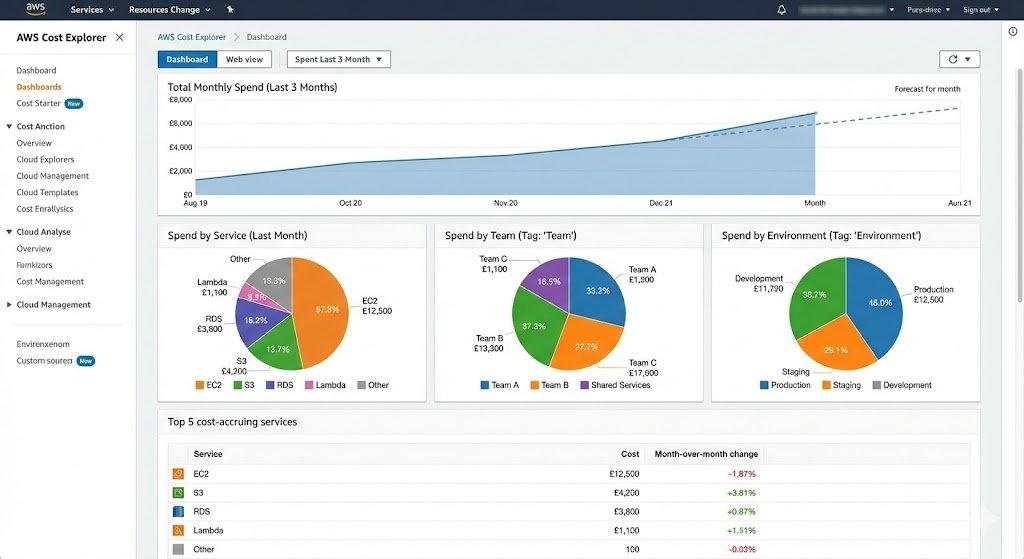
Master native cloud cost management tools before investing in sophisticated platforms. AWS Cost Explorer, Azure Cost Management, and GCP Billing provide everything needed for initial visibility. Build your first cost dashboard tracking total monthly spend, spend by service, and spend by team or project within the first month.
Tag strategy forms the foundation of sophisticated cost management. Implement a basic scheme covering environment (production, staging, development), owner (team or product), and cost centre. Drive adoption by making tags mandatory in Infrastructure as Code templates. Target 70-80% tagging compliance within three months.
Document every insight: “Discovered £8,000 monthly spend on orphaned EBS volumes” tells a more compelling story than “improved cost visibility.”
Resource Optimization Techniques
Right-sizing represents the lowest-hanging fruit. Build a Python script using boto3, Azure SDK, or Google Cloud Client Libraries that analyzes instance utilization over 30 days and outputs recommendations with cost calculations. When this tool saves your organization £5,000 monthly, you’ve built undeniable evidence of FinOps value.
Storage lifecycle policies deliver sustained savings with minimal ongoing effort. A well-configured lifecycle policy on a 500TB S3 bucket might save £20,000-£40,000 annually. Master spot instances and preemptible VMs for non-critical workloads, the 70-90% cost savings on compute makes them irresistible when implemented correctly.
These foundation skills typically generate £50,000-£200,000 in annual savings depending on organizational cloud spend. Your CV should quantify exact savings: “Implemented automated rightsizing recommendations saving £84,000 annually across 300+ EC2 instances.”
The salary impact manifests within 6-12 months. Engineers demonstrating consistent FinOps value command £10,000-£20,000 premiums over peers with identical technical skills but no cost optimization focus.
Intermediate Skills: FinOps Practitioner (£90K-£130K)
Advanced Cost Management
Multi-account or multi-subscription cost allocation separates intermediate practitioners from beginners. Master AWS Cost Categories and Azure Cost Allocation rules to build accurate chargeback models across dozens or hundreds of accounts.
Commitment management: Reserved Instances, Savings Plans, and Committed Use Discounts, requires analytical rigour. Analyze 3-6 months of usage patterns to identify stable workloads suitable for commitments. Build models showing ROI for different commitment terms, presenting recommendations that quantify £100,000+ in annual savings with clear risk assessment.
Build a forecasting model that predicts next quarter’s cloud spending within 5% accuracy using historical trends, growth projections, and seasonality factors. Accurate forecasting establishes credibility that opens doors to dedicated FinOps roles.
FinOps Platform Expertise
Organizations spending £500,000+ monthly typically invest in dedicated platforms like CloudHealth, Apptio Cloudability, or Kubecost. Learning these platforms significantly enhances market value because implementation expertise is scarce.
Container cost allocation requires specialized understanding. Kubernetes cost attribution challenges stem from shared infrastructure, making accurate per-pod or per-namespace calculation complex. Engineers who master container cost allocation position themselves for platform engineering teams where salaries exceed £120,000.
Platform-specific certifications combined with hands-on implementation experience create powerful differentiation in the job market.
Advanced Skills: Senior FinOps Practitioner (£130K-£150K)
Advanced practitioners develop strategic capabilities beyond tactical optimization. You’re building 3-5 year cloud financial models, analyzing cloud vs on-premise TCO for major workloads, and supporting executive decisions about multi-cloud strategies. These strategic analyses influence £10+ million in spending, justifying senior-level compensation.
Enterprise Agreement analysis, commitment term optimization, and rate card negotiation support provides enormous value. The senior practitioner who helps negotiate an additional 5% discount on £5 million annual spend has saved the organization £250,000.
FinOps Culture Development
Building FinOps culture transforms organizations from cost-unconscious to cost-aware. Develop training programs, create playbooks documenting optimization patterns, and establish incentive structures rewarding cost-conscious architecture. When engineers complete your internal certification program, they internalize cost awareness, reducing need for centralized optimization.
Business and Leadership Skills: Beyond Technical Excellence
FinOps careers diverge from traditional engineering because financial and business skills matter as much as technical expertise. The practitioner earning £130,000 vs £90,000 typically excels at stakeholder management and executive communication.
Finance Fundamentals for Engineers
Learn how cloud costs appear on P&L statements, the difference between CAPEX and OPEX models, and why CFOs care intensely about forecast accuracy. When you can explain that migrating a workload from on-premise to cloud shifts £500,000 from capital expenditure to operating expense, you’re speaking the CFO’s language.
Unit economics, cost per transaction, cost per user, cost per API call – frame cloud spending in business terms. A SaaS company with 50,000 customers spending £500,000 monthly has a £10 per-customer infrastructure cost. Product leadership understands this immediately.
Executive Communication
Compare these statements:
Technical: “We implemented automated EBS snapshot lifecycle policies reducing snapshot storage from 200TB to 75TB.”
Business: “Automated data retention policies deliver £36,000 annual savings whilst improving compliance with our 30-day backup retention policy.”
The second connects technical action to financial outcome and business benefit. This is how executives think, and speaking their language accelerates your career.
Dashboard design differs dramatically between audiences. Engineers want detailed resource-level metrics. Executives want trend lines showing spending vs budget, forecast accuracy, and savings delivered. Build both, switching context based on audience.
Stakeholder Management Across Functions
Your success depends on relationships with engineering teams who control resource deployment, finance teams who own budgets, and executives who make strategic decisions. Frame FinOps as enablement rather than restriction: “Optimizing our current spend by 20% frees £400,000 for new product development.”
Build trust with finance by delivering accurate monthly predictions, immediately alerting them to unexpected changes, and presenting variance analysis with mitigation plans. Present options to executives with pros, cons, and your recommendation. They’re hiring you for expertise, not to rubber-stamp preconceptions.
Influence Without Authority
Most FinOps practitioners lack direct reports yet must drive organizational change. Celebrate optimization wins publicly. When your script saves £10,000 monthly, ensure engineering leadership knows about it. Build a coalition of cost-conscious engineers across teams. As this network grows, FinOps practices spread organically without requiring top-down mandates.
Certification and Training Strategy
FinOps Foundation Certified Practitioner
The £300 exam requires 40-60 hours of study, with a 65% pass rate. Study using free FinOps Foundation materials and supplement with hands-on practice analyzing your organization’s actual costs. Real-world experience reinforces theoretical concepts better than any study guide.
Schedule your exam after 6-12 months of hands-on cost management work. Engineers attempting certification without practical experience struggle because the exam tests judgment, not just knowledge.
The ROI is substantial: £300 investment frequently returns £10,000-£20,000 in salary increases. “FinOps Certified Practitioner” on your CV signals commitment, making you discoverable to recruiters. Many job descriptions now list FinOps certification as required or strongly preferred.
Cloud Provider Certifications
Cloud provider certifications demonstrate technical depth that enhances FinOps recommendations. AWS Certified Solutions Architect or Azure Administrator Associate lend credibility to your technical judgment when suggesting architectural changes for cost optimization.
Focus strategically on platforms your organization uses or where market opportunity exists. Don’t pursue every certification, prioritize depth over breadth.
Complementary Skills
Data analysis skills dramatically enhance FinOps effectiveness. Learn SQL for querying cost data, Python for automation, and visualization tools like Tableau or Grafana. Finance fundamentals courses bridge the knowledge gap between engineering and business. Executive communication training develops soft skills that differentiate senior practitioners.
Total investment typically ranges from £500-£2,000 over 12-18 months – less than 5% of the salary increase you can expect, making it one of the highest-ROI career investments available.
Career Progression Roadmap: Your 12-Month Plan
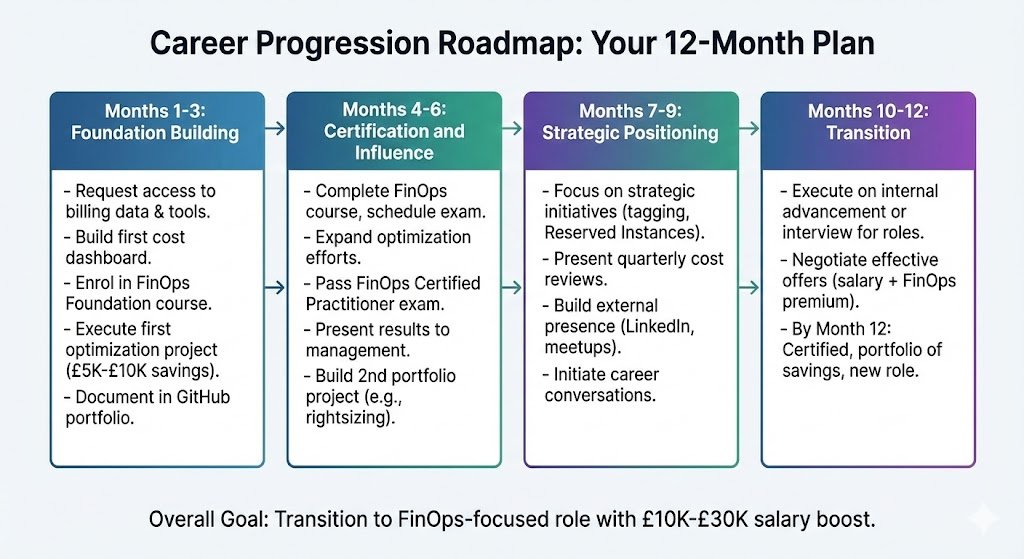
Months 1-3: Foundation Building
Request access to billing data and cost management tools. Build your first cost dashboard tracking total spend, spend by service, and spend by environment. Enrol in the FinOps Foundation free course, dedicating 2-3 hours weekly.
Identify and execute your first optimization project targeting £5,000-£10,000 in annual savings. Document everything in a GitHub repository with cost dashboard code, optimization scripts, and documented savings.
Join the FinOps Foundation Slack community and participate in discussions.
By Month 3: basic cost visibility established, 1-2 optimization projects completed, documentation of £10,000-£30,000 in annual savings, and portfolio showcasing your work.
Months 4-6: Certification and Influence
Complete the FinOps Foundation course and schedule your certification exam for 6-8 weeks out. Expand optimization efforts beyond your immediate team, offering to analyze costs for neighbouring business units.
Pass the FinOps Certified Practitioner exam and immediately update LinkedIn, CV, and internal HR systems. Present cost optimization results to your manager and skip-level manager, showing spending trends, savings achieved, and upcoming opportunities.
Build your second significant portfolio project – automated right-sizing recommendations, Reserved Instance analyzer, or cost anomaly detection. Document 3-5 projects totaling £50,000-£100,000+ in annual savings.
Months 7-9: Strategic Positioning
Focus on strategic initiatives requiring cross-functional collaboration: comprehensive tagging, showback/chargeback processes, or Reserved Instance strategies. These force you to work with finance teams, product managers, and engineering leadership – the stakeholder management experience that distinguishes senior practitioners.
Present quarterly cost reviews to broader engineering leadership. Begin building external presence through LinkedIn articles or local meetup talks.
Initiate career conversations with your manager about focusing more heavily on cost optimization, or begin job searching for dedicated FinOps practitioner roles if pursuing external opportunities.
Months 10-12: Transition
Execute on internal advancement or actively interview for FinOps practitioner roles. Your portfolio, certification, and documented savings create compelling interview material.
Negotiate effectively when offers arrive. Your baseline is current salary plus £10,000-£30,000 premium for FinOps skills. Don’t accept lateral moves unless other factors justify it.
By Month 12: FinOps Foundation certified, portfolio demonstrating £100,000-£300,000 in annual savings, established relationships with finance and engineering leadership, and either internal promotion or external role transition completed.
Measuring Success: Metrics That Matter
Technical Delivery Metrics
Annual cost savings remains the primary metric. Track this rigorously, documenting baseline and sustained savings. Verify savings persist for 3-6 months before considering them fully realized.
Forecast accuracy separates competent analysts from exceptional ones. Achieving <5% variance consistently demonstrates analytical rigor organizations value highly.
Tagging compliance percentage demonstrates operational excellence. Moving from 40% to 85% tagged resources over six months shows persistent attention to foundational practices.
Business Impact Metrics
Finance team partnership satisfaction manifests in career advancement. If finance actively seeks your input on budget planning and trusts your forecasts, you’ve built organizational credibility.
Engineering team adoption of FinOps practices creates lasting impact. Track: percentage of pull requests including cost impact assessment, engineers attending FinOps training, and team engagement with cost dashboards.
Executive visibility indicates strategic positioning. Presenting to VPs or C-level executives quarterly means you’ve transcended tactical roles.
Career Advancement Metrics
Salary progression toward £100,000-£130,000 represents tangible success. Track market rate comparison – if your compensation lags market by £15,000+, you’re under-earning and should address this.
Job market interest provides external validation. Track recruiter inquiries and interview requests. Increasing interest indicates your skills resonate with market demand.
Common Pitfalls and How to Avoid Them
Over-Indexing on Certification Without Experience
FinOps Certified Practitioner opens doors, but certification alone won’t land you a £110,000 role. Employers hire for demonstrated capability, with certification serving as validation. Prioritize hands-on projects and documented savings over collecting certifications.
Focusing Exclusively on Technical Optimization
FinOps requires equal parts technical skill and business acumen. The engineer who saves £200,000 annually but can’t explain this to executives plateaus around £100,000-£110,000. The engineer who saves £150,000 but presents compelling business cases progresses to £130,000-£150,000+ through demonstrated strategic thinking.
Waiting for Perfect FinOps Roles
Don’t wait for organizations to post dedicated FinOps positions. Start optimizing costs within your current role, build evidence of value, and either formalize your FinOps focus internally or leverage your portfolio for external opportunities. Build first, formalize second.
Poor Documentation of Achievements
Create a living document tracking every optimization project with specific savings figures. Update your CV immediately when completing significant work. Take screenshots, save before/after reports, and collect stakeholder testimonials. This evidence makes salary negotiations dramatically more effective.
ROI Analysis: Investing in Your FinOps Career
Investment Required
Time: 5-10 hours weekly for 6-12 months (130-520 hours total) Financial: £300 exam + £500-£1,000 optional training = £1,000 total Opportunity cost: Minimal – you’re adding to existing skills, not replacing them
Returns
Short-term (6-12 months): £10,000-£20,000 salary increase = 5,000% ROI on £300 certification
Medium-term (2-3 years): Transition to FinOps practitioner at £90,000-£130,000 = £120,000+ cumulative increase over three years
Long-term (5+ years): Senior IC roles (£130,000-£160,000), management (£120,000-£180,000+), or consulting (£600-£1,000/day) = £500,000-£1,000,000+ lifetime earnings premium
Explore our FinOps Evolution guide to understand the strategic value FinOps delivers to organizations and how that creates career opportunities.
Your Next Steps: Taking Action This Week
This Week
Enrol in the FinOps Foundation free course today. The first module takes 45 minutes.
Request access to your organization’s cloud billing data. Email your manager: “I’m interested in learning about our cloud costs and identifying optimization opportunities. Could you grant me read access to Cost Explorer / Cost Management / Billing?”
Identify one obvious cost optimization opportunity in your current projects – an orphaned resource, oversized staging environment, or unattached storage volume.
Join the FinOps Foundation Slack community at finopsfoundation.slack.com.
This Month
Complete the first three modules of the FinOps Foundation course (2-3 hours weekly).
Build your first cost dashboard tracking total spend, spend by service, and spend by environment.
Execute your first optimization project documenting baseline cost, changes made, and projected annual savings.
Schedule a coffee chat with someone from finance to learn about budget processes and their perspective on cloud costs.
Next Three Months
Complete the FinOps Foundation course and schedule your certification exam for 6-8 weeks out.
Lead 2-3 optimization projects documenting £20,000-£50,000 in annual savings.
Present your results to your manager, requesting 15 minutes to share what you’ve learned and value delivered.
Start building your portfolio GitHub repository with optimization scripts, dashboard code, and case studies.
Next Six Months
Pass the FinOps Foundation Certified Practitioner exam and update all professional profiles.
Build strategic relationships with finance and product teams through cross-functional projects.
Document £75,000-£150,000 in annual savings across 5-8 optimization initiatives.
Make a career decision: pursue internal advancement or begin job searching for dedicated FinOps practitioner roles.
The FinOps Career Opportunity
Cloud costs represent one of the fastest-growing expenses in modern organizations, yet most engineers view this as finance’s problem rather than their opportunity. The engineers who recognize that cost optimization delivers measurable business value whilst expanding their technical expertise create unique career positioning.
Adding FinOps skills to your cloud engineering toolkit delivers £10,000-£30,000 salary premiums within 12-18 months. More importantly, it positions you as strategic advisor rather than tactical implementer. You’re solving business problems through technical expertise, which organizations reward generously.
The path forward is clear: complete FinOps Foundation certification (£300 and 60 hours), build a portfolio of optimization projects demonstrating £100,000-£300,000 in annual savings, develop cross-functional relationships with finance and leadership, and either formalize your FinOps focus internally or leverage your portfolio for dedicated practitioner roles at £90,000-£130,000.
This transition doesn’t require abandoning technical depth. FinOps practitioners remain engineers who write code, build automation, and solve technical problems. The difference is that your technical work now connects directly to business outcomes, making your value explicit rather than implicit.
The engineers who add FinOps skills in 2025 will command premium salaries and strategic roles that influence organizational direction. Those who wait will find themselves at career disadvantage as FinOps fluency becomes expected rather than exceptional.
Begin today with the FinOps Foundation course. Join the community. Build your first dashboard. Career transformation starts with immediate action, not perfect planning.
Useful Links
- FinOps Foundation – Official certification and training
- FinOps Foundation Free Course – Begin learning immediately
- State of FinOps Report 2025 – Industry trends and salary benchmarks
- AWS Cost Management Documentation – Essential AWS cost tools
- Azure Cost Management – Microsoft cost optimization resources
- GCP Cloud Billing – Google Cloud cost management
- FinOps Foundation Slack Community – 15,000+ practitioners
- Cloud FinOps Book (O’Reilly) – Comprehensive framework
- FinOps Evolution: From Penny-Pinching to Profit Engine – Our pillar guide
- Cloud Consulting Rates UK – Alternative career path exploration