

Research shows that 80% of CVs fail to survive initial screening, yet the UK cloud market grew 49% year-on-year in Q1 2025 with 98% of employers facing skills shortages. The disconnect is jarring. Thousands of qualified cloud professionals are invisible to the organisations desperately seeking them, not because they lack capability, but because they cannot communicate it effectively. The average UK cloud engineering vacancy now attracts 118 applications, yet specialist recruiters report fewer than 20,000 certified cloud professionals nationally. Opportunity exists, but only for those who can translate technical expertise into clear professional communication.
Most cloud professionals present their CVs like system logs, chronological task lists without context or outcome. “Managed AWS infrastructure.” “Deployed Kubernetes clusters.” “Configured CI/CD pipelines.” These statements communicate activity without impact, responsibility without achievement, involvement without value. Hiring managers scanning 200 CVs daily form their critical impression in 7-10 seconds, spending just 30-60 seconds total on initial screening. Dense paragraphs are ignored entirely. First bullets receive the most scrutiny. The top third of page one determines whether your CV advances or joins the rejected 80%.
The shift required is architectural thinking. Your CV should read like technical documentation: clear problem statements, design decisions with rationale, measurable outcomes, and demonstrated strategic thinking. This guide provides the frameworks, templates, and research-backed strategies to help cloud professionals at every career stage communicate their value authentically and effectively to both automated systems and human decision-makers.
The UK CV Standard: What Employers Actually Expect
The two-page A4 CV remains the definitive UK standard in 2026, confirmed by Reed, Hays, National Careers Service, and every major recruitment authority. Former recruiter Andrew Fennell describes two pages as “the sweet spot for most professional job seekers in the UK.” One page works for graduates and junior professionals with limited experience. Academic CVs may run longer. The format must be reverse chronological, the universally recognised structure for technical roles.
UK CVs differ fundamentally from US resumes. The document is called a “CV,” never a “resume” outside academic contexts. Use A4 paper, not US Letter sizing. Employ British English throughout: “optimise,” “organisation,” “programme,” “analyse.” Include a professional profile or personal statement at the top, typically 3-5 lines establishing your engineering focus and core competencies. US resumes favour shorter objective statements or omit them entirely.
UK conventions firmly exclude photographs, date of birth, marital status, nationality, and full postal addresses. These inclusions can trigger bias concerns and data protection issues. Your contact section should contain only your name, phone number, email address, city or region, LinkedIn URL, and GitHub or portfolio links. Technical roles increasingly expect GitHub profiles alongside LinkedIn.
The recommended structure follows this sequence: contact details, professional profile (3-5 lines), technical skills matrix, certifications, work experience in reverse chronological order with quantified achievements, education, and links to GitHub, portfolio, or technical blog. Formatting should use a single-column layout to ensure ATS compatibility, professional fonts (Arial, Calibri, or Verdana at 10-12pt), 2.5cm margins all around, and consistent bullet point styles. Save as PDF unless an employer specifically requests Word format. Modern ATS platforms parse PDFs perfectly, and the format preserves your carefully crafted layout across all devices and operating systems.
How Hiring Managers Actually Review Your CV
The widely quoted “6-second rule” is outdated oversimplification. Jan Tegze’s 2023 study tracked 114 experienced recruiters using Microsoft Clarity software whilst participants remained unaware of being timed. Average review times measured 17-46 seconds depending on CV length. A 2024 ResumeGo survey of 418 hiring professionals found 47% spend 30 seconds to 1 minute on initial screening, whilst only 1% spend fewer than 10 seconds examining each CV.
The consensus from multiple rigorous studies: recruiters form their critical first impression in 7-10 seconds, then spend an additional 20-50 seconds deciding whether to shortlist the candidate. Those first 10 seconds determine whether your CV receives genuine consideration or joins the rejection pile.
Eye-tracking research reveals that recruiters scan CVs in an F-pattern or E-pattern, reading across the top of the document, then moving down the left margin with progressively shorter horizontal scans. A University of Minnesota study of 150 hiring managers found that 62% of gaze time concentrated on the first 30% of the page, with 48% of recruiters stopping their scan after just the first two sections. The six consistent fixation points are: candidate name, current job title, current company, employment dates, previous role, and education.
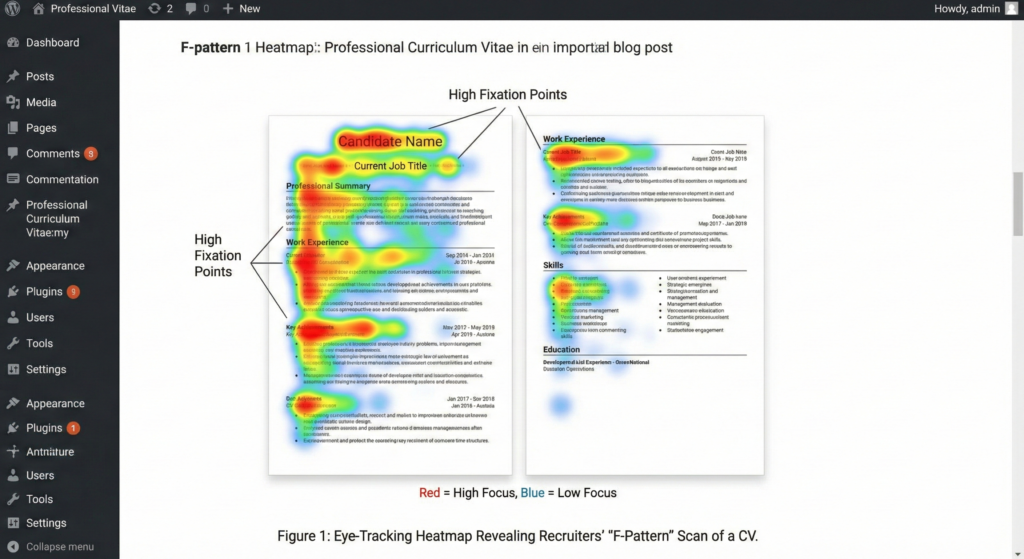
Dense paragraphs receive minimal attention. Short bullet points attract significantly more visual focus. The first bullet point under each role receives the most scrutiny. This research has direct implications for how you structure your CV. Your most impressive, most relevant achievement must be the first bullet under your current role. Your professional summary and technical skills section must sit in the top third of page one. One UK recruiter captured the reality bluntly: “I view around 200 CVs per day. As soon as I open a CV, it only takes me around 10 seconds to know if the candidate is a potential fit. The biggest thing I notice first is the formatting and structure.”
Consider what this means practically. If your most compelling achievement sits buried as the fourth bullet point on page two, 80% of recruiters will never see it. If your technical skills appear below the fold, automated systems may not parse them correctly. If your professional summary uses generic language like “hardworking team player seeking challenging opportunities,” you’ve wasted the 7 seconds that determine your fate.
Understanding ATS Without Gaming the System
Applicant Tracking Systems are now ubiquitous: 71% of UK and Irish hiring managers use an ATS to screen CVs before personally reviewing them, according to CV Genius survey data of 625 hiring managers. Among Fortune 500 companies, usage exceeds 97%. Understanding how these systems work isn’t about tricking them, it’s about ensuring your genuine qualifications communicate clearly to every reader, whether human or automated.
ATS platforms follow a four-stage process. First, extraction: the system converts your uploaded file into raw text, stripping away all visual formatting. Second, segmentation: it identifies text blocks as “Contact,” “Work Experience,” “Education,” and “Skills” based on header keywords. Third, parsing: it breaks these blocks into structured fields such as job title, company name, start date, end date, and description. Fourth, ranking: it calculates relevance by matching parsed fields against keywords and requirements from the job description.
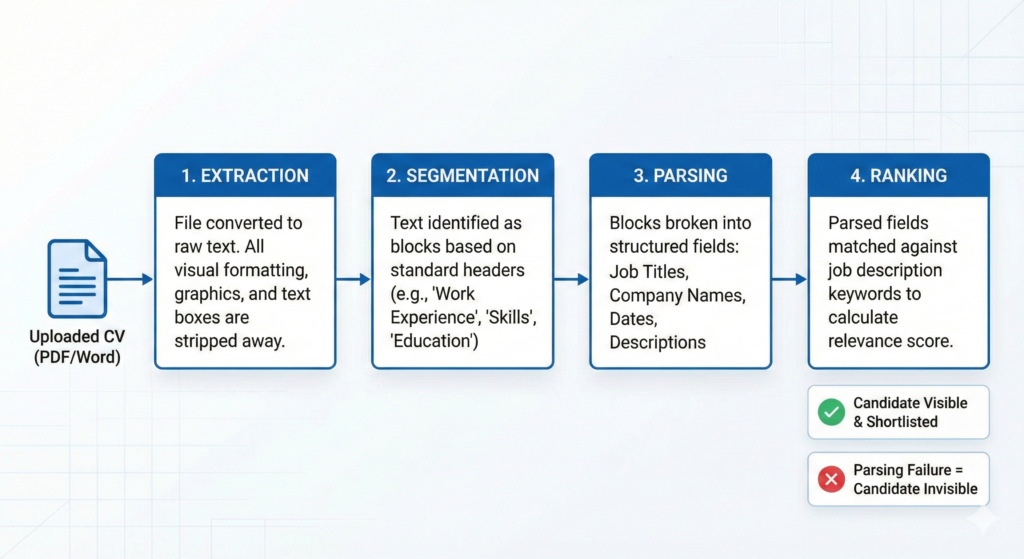
The critical insight is that if parsing fails at stage three, ranking produces a zero, rendering the candidate invisible regardless of qualifications. A highly qualified cloud architect whose CV uses creative section headings like “My Professional Journey” instead of “Work Experience” may be scored as having no employment history at all.
The most common parsing failures have straightforward solutions. Tables, text boxes, and multi-column layouts scramble content order because ATS reads text in linear flow. Text boxes are treated as floating objects outside the main text flow and may be completely invisible to the parser. A single-column layout eliminates all ambiguity. Headers and footers typically aren’t read by ATS engines. TopResume testing confirmed that contact information placed in headers was unidentifiable 25% of the time. Keep your name and contact details in the main document body at the top of page one.
Non-standard date formats are described by ATS vendors as “the single most common cause of parsing errors.” Use consistent MM/YYYY format throughout your CV, for example “03/2023 – Present.” Avoid seasons like “Summer 2023,” abbreviations like “’23,” or year-only dates. Creative section headings confuse parsers. Use standard headings: “Professional Summary,” “Work Experience,” “Education,” “Skills,” “Certifications.” Images, graphics, decorative icons, and skill bars are invisible to ATS. Those attractive phone and email icons often render as garbage characters that break the parser.
Include both full terms and acronyms when first mentioned: “Amazon Web Services (AWS)” and “Infrastructure as Code (IaC).” Some platforms don’t recognise abbreviations in isolation. Modern ATS systems increasingly use semantic matching and natural language processing, meaning keyword stuffing is counterproductive and detectable. The goal is natural, clear writing that communicates your capabilities to any reader, whether silicon or carbon-based.
The CAR Framework: Writing Achievement Statements That Demonstrate Value
The single biggest mistake on cloud engineering CVs is listing technologies without demonstrating practical impact. Wade Russ, Director of Data Engineering, captures the problem: “The most common mistake I see is prioritising a list of tools over demonstrating real impact. It’s not about how many technologies you’ve touched, it’s about how you used them to solve problems.” Our analysis of the essential cloud skills valued in 2025 confirms that employers prioritise business outcomes over technology name-dropping.
The CAR framework (Challenge-Action-Result) provides the most effective structure for CV bullet points. CV specialist JM Auron explains why the Challenge component matters: “Most tech CVs focus too much on either actions or results. Very few give a strong sense of the initial challenges. It’s the challenges that define what you’ve done and give the reader a clear sense of the potential you bring.”
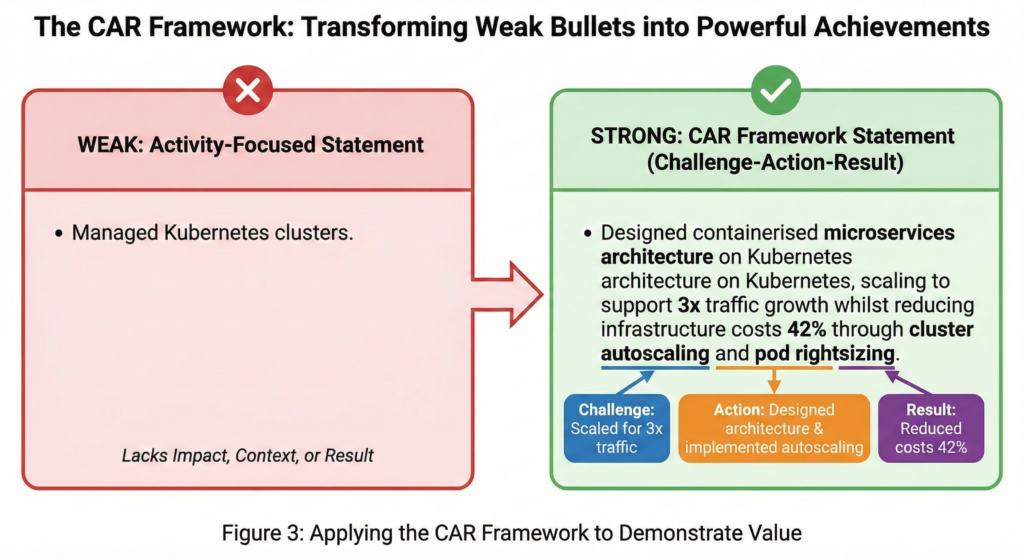
The practical formula is: [Power verb] + [What you did / scope] + [Quantified business result] + [How / using what].
The difference between weak and strong statements is dramatic:
Weak: “Managed cloud services” Strong: “Led cross-functional FinOps initiative implementing automated rightsizing that saved £1.2M annually whilst maintaining performance SLAs across 200+ production workloads”
Weak: “Set up CI/CD pipelines”
Strong: “Migrated from traditional CI/CD to GitOps-driven Infrastructure as Code, implementing Terraform modules that decreased deployment times from 2 days to under 15 minutes and reduced configuration errors 87%”
Weak: “Managed Kubernetes clusters” Strong: “Designed containerised microservices architecture on Kubernetes, scaling to support 3x traffic growth whilst reducing infrastructure costs 42% through cluster autoscaling and pod rightsizing”
Weak: “Handled deployments” Strong: “Transformed manual deployment process by implementing blue-green deployment strategies with automated rollback, eliminating 6 hours of weekly downtime and improving developer productivity 22%”
The metrics that matter most in cloud engineering fall into five categories. Cost and efficiency: cloud spend reduction percentages, annual savings in pounds sterling, resource optimisation gains. Reliability and performance: uptime percentages (99.9% vs 99.99% matters), mean time to recovery reduction, incident reduction rates. Delivery velocity: deployment time reduction from hours to minutes, release frequency improvements from monthly to daily. Scale and scope: services managed, team size led, migrations completed, users supported. Security and compliance: incident reduction percentages, vulnerability remediation speed, compliance achievements like SOC 2 or ISO 27001 certification.
Power verbs signal seniority. Junior engineers use “developed,” “built,” “implemented,” and “assisted.” Senior engineers use “architected,” “spearheaded,” “orchestrated,” “championed,” and “pioneered.” For cloud-specific work, the most effective verbs include: architected, deployed, migrated, automated, provisioned, containerised, optimised, and orchestrated. The phrase “responsible for” should never appear on your CV as it signals passive involvement rather than active ownership.
Career-Level CV Strategies: From Graduate to Architect
The difference between a junior and senior cloud engineer’s CV goes far beyond years of experience. It’s a fundamental shift in what you communicate and how you present it.
Junior cloud engineers (0-3 years) should lead with certifications and education near the top of the CV, allocate significant space to personal and lab projects demonstrating practical capability, and use an objective statement describing what they aim to contribute. Achievement statements should focus on specific task-level contributions: “Deployed a three-tier application on AWS using CloudFormation, reducing manual provisioning time 60% and documenting the process for team knowledge sharing.” The Cloud Resume Challenge project specifically provides portfolio-worthy material at this level.
Mid-level engineers (3-7 years) should lead with experience over certifications, show increasing scope and responsibility across roles, and demonstrate expertise across platforms or deep specialisation in one. The professional summary should be achievement-focused rather than aspirational. Statements should bridge technical work and business outcomes: “Automated infrastructure deployment across multi-cloud environments using Terraform, reducing provisioning time 40% through reusable modules and enabling self-service for 15 development teams.”
Senior engineers and architects (7+ years) must emphasise strategic contributions, team leadership, and architectural decisions that shaped organisational outcomes. The summary should immediately establish thought leadership and scope of influence. Include mentoring activities, publications, conference speaking, and cross-functional influence. Statements should demonstrate organisational impact: “Established enterprise cloud governance framework spanning 200+ microservices across three business units, reducing security incidents 76% whilst enabling developer self-service through automated compliance checks and policy-as-code implementation.”
For professionals transitioning from legacy IT infrastructure to cloud roles, the CV should explicitly frame traditional skills in cloud context. “Managed on-premises VMware infrastructure” becomes “Managed virtualised infrastructure supporting 500+ VMs, providing foundation for subsequent AWS migration and containerisation strategy.”
UK professional communication standards favour understated confidence backed by evidence, a distinctly different tone from American self-promotion. Let results speak rather than superlatives. Avoid generic clichés like “team player,” “hardworking,” or “dynamic individual.” Provide the evidence that proves these qualities instead: “Mentored 4 junior engineers, with 3 progressing to mid-level roles within 18 months through structured learning paths and pair programming sessions.”
Technical Skills: Organised by What You Can Do
The “technology soup” approach to skills sections fails completely. Alphabetically listing 40 tools and platforms tells hiring managers nothing about your actual capabilities. “AWS, Azure, Ansible, Bash, CloudFormation, Docker, EKS, Grafana, Jenkins, Kubernetes, Lambda, Prometheus, Python, Terraform, VPC…” communicates noise, not signal.
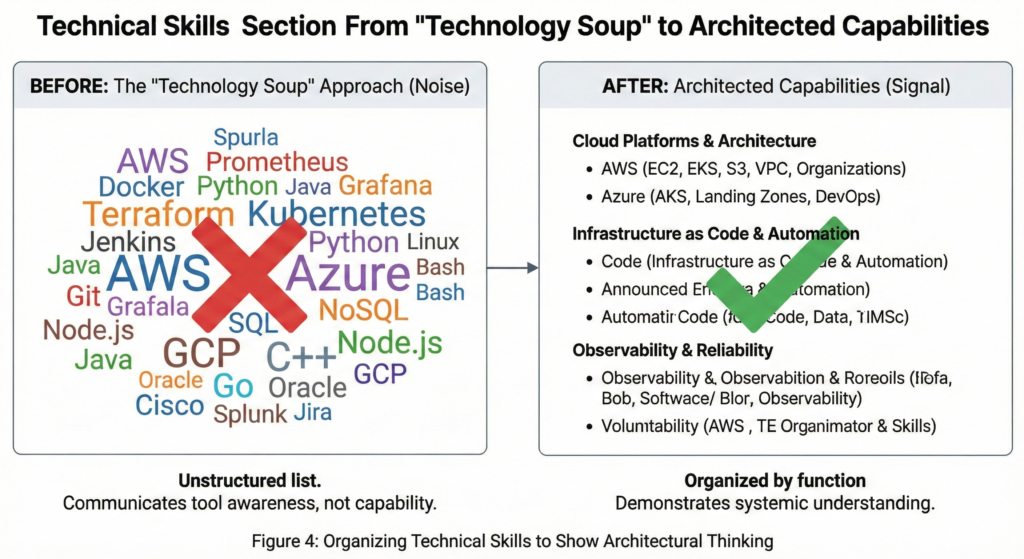
Instead, organise your technical capabilities by logical category, demonstrating architectural thinking. This structure shows you understand how these technologies relate to each other, not just that you’ve encountered them individually.
Cloud Platforms & Architecture
- AWS: Designed production architectures across compute (EC2, EKS, Lambda), storage (S3, EBS, EFS), networking (VPC, Transit Gateway, PrivateLink), and managed services (RDS, ElastiCache). Implemented multi-account strategies using Organizations and Control Tower
- Azure: Architected enterprise landing zones, hybrid connectivity (ExpressRoute), and AKS-based platform solutions with Azure DevOps integration
- GCP: Working knowledge of GKE, Cloud Storage, and BigQuery for specific project requirements
Infrastructure as Code & Automation
- Terraform: Authored reusable modules for multi-cloud deployments, implemented remote state management with locking, automated testing with Terratest
- Kubernetes: Designed cluster architectures, implemented GitOps workflows (ArgoCD), managed 1000+ pod deployments with autoscaling and resource quotas
- CI/CD: Built deployment pipelines across GitHub Actions, GitLab CI, and Azure DevOps with automated testing, security scanning, and approval gates
Observability & Reliability
- Monitoring: Designed observability solutions using Prometheus/Grafana stack, CloudWatch, and Azure Monitor with custom metrics and alerting
- Incident Response: On-call experience managing P1 incidents, post-mortem facilitation, implemented reliability improvements reducing MTTR 45%
This organisation immediately communicates several things to hiring managers: you think systemically, you understand the cloud ecosystem comprehensively, you can articulate depth versus breadth, and you’ve moved beyond individual tool usage to capability demonstration.
Certification Presentation: Evidence Without Padding
Cloud certifications open doors but are insufficient alone. Experis UK states explicitly: “While skills and certifications are a must, we also value experience. We advise those applying for cloud engineering jobs to gain hands-on experience through internships and real-world projects.” The practical consensus is that certifications validate knowledge, but hands-on evidence differentiates candidates.
Present certifications in a dedicated section immediately after your technical skills matrix. For roles where a specific certification is essential (many AWS architect roles explicitly require Solutions Architect certification), reference it in your professional summary to ensure it appears above the fold.
Show only the most advanced certification per platform track to avoid padding. Listing both AWS Solutions Architect Associate and Professional suggests resume inflation rather than genuine progression. The Professional supersedes the Associate. Similarly, don’t list expired certifications unless you’re currently recertifying. Include the certification name exactly as issued, the issuing organisation, and the date obtained.
The certifications most valued in the UK cloud market in 2025/2026 include AWS Certified Solutions Architect (Associate and Professional), Azure Solutions Architect Expert, Google Professional Cloud Architect, HashiCorp Certified Terraform Associate (essential for infrastructure automation roles), and Certified Kubernetes Administrator (CKA). The entry-level certifications (AWS Cloud Practitioner, AZ-900) are appropriate for career changers and graduates but generally insufficient for engineering positions. Our detailed analysis of certification career value explores strategic approaches for different career stages.
Building an Integrated Professional Presence
The modern cloud professional’s career presence extends well beyond a two-page document. Research shows that 84% of recruiters consider LinkedIn the most effective sourcing platform, and job seekers active on LinkedIn are 4.2x more likely to be contacted by recruiters. Meanwhile, 38% of engineering leaders cite side projects and portfolios as the most important hiring signal outside interviews, with 34% specifically valuing public code portfolios on GitHub.
LinkedIn optimisation starts with a keyword-rich headline that includes your role, key platforms (AWS/Azure/GCP), and modern tooling (Terraform, Kubernetes, GitOps). Profiles showing five or more relevant skills attract 17x more profile views according to LinkedIn’s own research. Only 1% of LinkedIn users share content weekly, yet those posts generate 9 billion impressions, creating massive visibility opportunity for cloud engineers who publish case studies, architecture opinions, or certification experiences.
LinkedIn recommendations remain dramatically underutilised. Profiles with recommendations receive 14x more profile views, and 70% of hiring managers trust them more than traditional references. Request recommendations from managers, colleagues, and stakeholders who can speak to specific achievements, not generic character endorsements.
GitHub profile optimisation centres on quality over quantity. Pin 3-6 best repositories showcasing infrastructure-as-code modules, CI/CD pipeline configurations, and Kubernetes deployments. Each pinned repository needs a clear README containing the project’s purpose, technologies used, architecture diagrams where relevant, setup instructions, and live deployment links where possible. Hiring managers spend only a few minutes reviewing profiles. They evaluate code quality, commit message clarity, project structure, and documentation thoroughness rather than commit frequency alone.
Technical blogging functions as career compounding. Well-optimised posts generate traffic for months or years, and hiring managers routinely Google candidates before interviews. High-impact content for cloud engineers includes migration case studies with specific metrics, cost optimisation strategies with measurable outcomes, Kubernetes troubleshooting guides solving common production issues, post-incident analyses demonstrating reliability thinking, and certification study experiences helping others prepare.
Consistency across platforms is non-negotiable. Recruiters cross-reference CVs with LinkedIn and GitHub using automated tools that index multiple networks simultaneously. Job titles, employment dates, employer names, and skills must match exactly. Discrepancies raise immediate red flags suggesting dishonesty or carelessness. The integration loop should work as follows: your CV links to LinkedIn and GitHub in the contact section; LinkedIn’s Featured section showcases your best blog posts and key repositories; GitHub’s profile README links to LinkedIn and portfolio; and blog posts reference GitHub projects with live demonstrations.
Common Mistakes That Immediately Disqualify CVs
Certain errors trigger instant rejection regardless of your qualifications. Generic objective statements waste the most valuable real estate on your CV. “Seeking challenging role to advance career in cloud computing” communicates nothing. Replace it with a value proposition: “Platform engineer specialising in Kubernetes orchestration and FinOps optimisation. Reduced infrastructure costs 30% across three business units whilst improving deployment velocity 5x through GitOps automation.”
Technology soup skills sections mentioned earlier demonstrate surface-level thinking rather than capability. Dense paragraph formatting ensures your achievements remain invisible. Recruiters skip paragraph blocks entirely in favour of scannable bullet points. Outdated information damages credibility: certifications from 2018 without renewal, Windows Server 2012 expertise, references to deprecated services like AWS CodeCommit after its retirement.
Spelling and grammatical errors suggest carelessness that translates to production code quality concerns. British English consistency matters in UK applications: “optimise” not “optimize,” “organisation” not “organization,” “programme” not “program.” Inconsistent date formats create parsing chaos for ATS. Use MM/YYYY consistently: “03/2023 – Present” throughout, never mixing with “March 2023” or “2023-03.”
Missing contact information seems obvious but occurs surprisingly often. Ensure your email address is professional (firstname.lastname@domain, not coolclouddude123@hotmail). Include city/region but not full postal address. Verify your LinkedIn URL is customised (linkedin.com/in/yourname) rather than the default random number string.
The Complete Cloud Professional CV Template
YOUR NAME
Phone: +44 7XXX XXXXXX | Email: your.email@domain.com | Location: London, UK
LinkedIn: linkedin.com/in/yourname | GitHub: github.com/yourname

PROFESSIONAL PROFILE
Cloud platform engineer specialising in infrastructure automation and cost optimisation across AWS and Azure environments. Led migration projects reducing operational overhead 40% whilst improving system reliability to 99.97%. Experienced architecting solutions for organisations scaling from startup to enterprise, with focus on Kubernetes orchestration, GitOps workflows, and FinOps implementation.

TECHNICAL CAPABILITIES

Cloud Platforms & Architecture
• AWS: Production architecture design across compute (EC2, EKS, Lambda), storage (S3, EFS), networking (VPC, Transit Gateway). Multi-account strategies using Organizations and Control Tower
• Azure: Enterprise landing zones, hybrid connectivity (ExpressRoute), AKS platform solutions, Azure DevOps integration
• Multi-cloud: Cross-platform networking, unified identity management, cost optimisation strategies

Infrastructure as Code & Automation
• Terraform: Reusable module development, remote state management, automated testing with Terratest
• Kubernetes: Cluster architecture, GitOps (ArgoCD), production workload management (1000+ pods)
• CI/CD: GitHub Actions, GitLab CI, Azure DevOps pipelines with security scanning and compliance gates

Observability & Site Reliability
• Monitoring: Prometheus/Grafana, CloudWatch, Azure Monitor, custom metrics, alert management
• Incident Response: On-call rotation, P1 incident management, post-mortem facilitation
• Performance: Load testing, capacity planning, autoscaling strategies

CERTIFICATIONS
• AWS Certified Solutions Architect - Professional | Amazon Web Services | 2024
• Certified Kubernetes Administrator (CKA) | Cloud Native Computing Foundation | 2024
• HashiCorp Certified: Terraform Associate | HashiCorp | 2023

PROFESSIONAL EXPERIENCE

Senior Platform Engineer | Technology Company Ltd | 04/2022 - Present
Joined during rapid growth phase (50 → 200 engineers) to build platform engineering capability and establish cloud infrastructure standards across AWS and Azure environments.

• Architected Infrastructure-as-Code framework using Terraform enabling engineering teams to provision environments independently, reducing infrastructure request cycle from 5 days to 2 hours and eliminating manual configuration errors
• Designed Kubernetes-based deployment platform supporting 150+ microservices, improving deployment reliability from 78% to 99.2% success rate whilst decreasing rollback frequency 65%
• Established FinOps practices identifying £47K monthly cloud waste through automated cost visibility dashboards, rightsizing recommendations, and Reserved Instance strategies
• Implemented GitOps workflows with ArgoCD enabling declarative infrastructure management, reducing deployment time from 4 hours to 12 minutes whilst improving audit compliance
• Mentored 4 junior engineers in platform engineering practices and cloud-native technologies, with 3 progressing to mid-level roles within 18 months

Technologies: AWS (EKS, RDS, S3, CloudFormation), Azure (AKS, DevOps), Terraform, Kubernetes, ArgoCD, Prometheus/Grafana, Python

Cloud Engineer | Financial Services Firm | 06/2020 - 03/2022
Supported hybrid cloud infrastructure across on-premises data centres and AWS, focusing on migration planning, security hardening, and operational efficiency.

• Led migration of 23 applications from on-premises VMware to AWS, reducing infrastructure costs 28% whilst improving availability from 99.5% to 99.95%
• Implemented automated backup and disaster recovery solution using AWS Backup and cross-region replication, achieving 4-hour RTO and 1-hour RPO for critical systems
• Designed network architecture connecting on-premises data centres to AWS via Direct Connect, reducing latency 60% and improving application performance
• Automated security compliance scanning using AWS Config and custom Lambda functions, reducing configuration drift incidents 84%

Technologies: AWS (EC2, RDS, Direct Connect, Lambda), VMware, Python, CloudFormation, Ansible

Junior Cloud Engineer | Managed Services Provider | 09/2018 - 05/2020
Supported multi-tenant cloud infrastructure across AWS and Azure for SMB clients, focusing on automation, monitoring, and incident response.

• Automated provisioning of client environments using CloudFormation templates, reducing setup time from 2 days to 4 hours
• Implemented centralised logging and monitoring using CloudWatch and Grafana, improving incident detection and resolution
• Participated in 24/7 on-call rotation managing P1/P2 incidents across 50+ client environments

Technologies: AWS (EC2, S3, RDS), Azure, CloudFormation, CloudWatch, Grafana, Bash

EDUCATION
BSc Computer Science (2:1) | University Name | 2015 - 2018
Relevant modules: Distributed Systems, Cloud Computing, Network Security

ADDITIONAL INFORMATION
• Technical Blog: yourblog.dev (cloud architecture case studies, averaging 5K monthly visitors)
• Conference Speaking: AWS Community Day London 2024 - "Kubernetes Cost Optimisation at Scale"
• Open Source: Contributor to Terraform AWS modules (github.com/yourname/terraform-aws-modules)
Implementation: Your Four-Week Action Plan
Week One: Foundation and Assessment. Review your current CV against this template structure. Run it through a free ATS checker to identify parsing failures. Conduct a keyword gap analysis by comparing your CV against five job descriptions for roles you want. Gather quantitative evidence for your achievements by reviewing project documentation, performance reviews, and team retrospectives to find specific metrics.
Week Two: Rebuild Core Content. Restructure to the recommended format with professional profile first, then skills matrix. Rewrite your top three achievements per role using the CAR framework (Challenge-Action-Result). Add platform-specific keywords naturally within achievement statements. Remove formatting that breaks ATS parsing: tables, text boxes, headers/footers for contact info, graphics and icons.
Week Three: Extended Professional Presence. Update LinkedIn with keyword-optimised headline and comprehensive experience matching your CV exactly. Pin your three best GitHub repositories with clear READMEs explaining purpose, architecture, and implementation. Start or refresh your technical blog with one high-value post (migration case study, certification guide, or architecture deep-dive).
Week Four: Launch and Optimisation. Create three versions of your CV tailored for different role types: platform engineer, DevOps specialist, cloud architect. Track your application-to-interview conversion ratio to measure effectiveness. Adjust based on results: if interviews remain low after 15-20 applications, revisit achievement quantification and keyword optimisation. Request LinkedIn recommendations from recent managers and colleagues.
Success Metrics: How to Know It’s Working
Track application-to-interview ratio. Industry baseline sits at 3-8% for competitive technical roles. Target 10-15% or higher with an optimised CV. If you’re applying to 20 positions and receiving fewer than 2 interviews, your CV needs significant revision. Monitor recruiter inbound messages. Quality specialist recruiters contacting you directly about relevant roles indicates strong LinkedIn optimisation and market visibility.
Compare salary ranges in initial offers against your target. A well-optimised CV presenting senior capabilities should yield offers reflecting that seniority. Interview process length matters: stronger CVs typically result in faster processes as hiring managers recognise fit immediately. Extended multi-round processes sometimes indicate uncertainty about your level.
The before/after benchmark is stark. Generic CVs typically require 15-20 applications per interview. Optimised CVs using the frameworks in this guide achieve 3-5 applications per interview. This isn’t magic or deception. It’s clear communication of genuine value to the people who need to understand it.
Conclusion: Professional Communication as Career Infrastructure
The research points to three fundamental shifts in how cloud professionals should approach their CVs. First, the CV exists as one node in an integrated professional ecosystem. LinkedIn, GitHub, technical blogs, and the CV itself must work together coherently, each serving its unique purpose whilst reinforcing the others. Inconsistency across platforms raises immediate red flags; integration creates compound visibility.
Second, achievement quantification has moved from “nice to have” to essential differentiator. Metrics like cost reduction percentages (30% infrastructure savings), uptime improvements (99.5% to 99.97%), deployment velocity gains (2 days to 15 minutes), and team scale (led 4 engineers) separate shortlisted candidates from the 80% filtered out. Generic statements about “managing cloud infrastructure” communicate nothing in a market where every applicant claims cloud expertise.
Third, authenticity is becoming competitive advantage as AI-generated applications flood the market. In early 2025, 74% of UK hiring managers report they can identify AI-written applications, often perceiving them as “repetitive and lacking authenticity.” A CV demonstrating genuine expertise through specific, contextualised achievements stands out precisely because mass-produced applications have made authentic communication rare.
The UK cloud talent shortage creates genuine opportunity. With 98% of engineering employers facing skills gaps and cloud roles growing 49% year-on-year, demand dramatically exceeds supply. But opportunity converts to outcomes only when professionals can communicate their value clearly. The most effective cloud engineers treat their CV not as a document to be endured, but as a piece of technical documentation to be engineered: structured for its audience, optimised for clarity, and built to convey maximum information with minimum noise.
Your CV is your architecture document. Build it accordingly.
Useful Links
- UK CV Standards – National Careers Service
- LinkedIn Professional Profile Optimisation
- GitHub Profile README Best Practices
- CAR Framework for Achievement Statements – Columbia Career Education
- ATS Compatibility Guidelines – Jobscan
- UK Cloud Recruitment Agencies – Cloud Computing Jobs
- Technical Blogging ROI for Cloud Professionals
- Reed Technology – UK Recruitment Statistics
- Eye-Tracking Research on CV Review – ResumeGo
- Cloud Certifications Presentation Guide – Pluralsight