The cloud computing landscape has fundamentally transformed over the past year, creating both unprecedented opportunities and new challenges for practitioners at every level. With global cloud spending projected to reach £580 billion in 2025 and over 356,700 annual job openings expected across the sector, the question isn’t whether cloud skills remain valuable, it’s which specific competencies will drive career advancement in an increasingly competitive market.
Recent industry analysis reveals a striking trend: whilst basic cloud adoption has plateaued, the demand for specialised expertise has intensified dramatically. Organisations now seek professionals who can navigate complex multi-cloud environments, integrate artificial intelligence capabilities, and maintain security posture across hybrid architectures. This evolution has created distinct skill premiums, with specialised practitioners earning 15-30% more than their generalist counterparts.
The convergence of artificial intelligence, platform engineering maturity, and enterprise security imperatives is reshaping career trajectories across the cloud computing sector. Professionals who master these emerging competencies will find themselves positioned at the forefront of digital transformation initiatives, commanding salaries ranging from £76,000 to £240,000+ whilst contributing to strategic business outcomes.
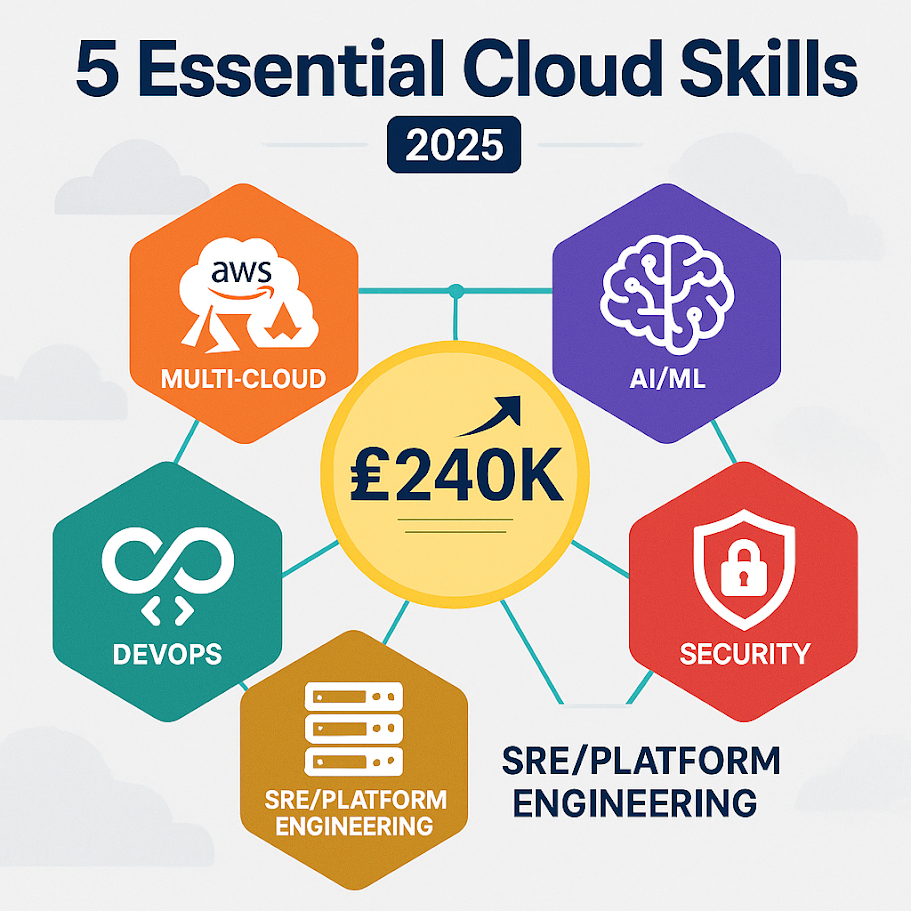
This comprehensive guide examines the five critical skills that distinguish high-performing cloud practitioners in 2025, providing actionable insights for career development and strategic skill acquisition.
1. Multi-Cloud Architecture: The Foundation of Modern Enterprise Strategy
Multi-cloud proficiency has emerged as the most lucrative differentiator in today’s market, with practitioners demonstrating cross-platform expertise commanding salary premiums of 15-25% above single-provider specialists. This trend reflects a fundamental shift in enterprise strategy: 78% of organisations now employ hybrid or multi-cloud approaches, with the average enterprise managing 2.02 cloud providers simultaneously.
Understanding Platform Dynamics
Each major cloud platform offers distinct strategic advantages that practitioners must comprehend to design optimal solutions. Amazon Web Services maintains market dominance through its comprehensive service portfolio and enterprise-grade offerings, making AWS expertise essential for maximum employability. The platform’s maturity in areas such as compute, storage, and networking provides the broadest foundation for cloud architecture skills.
Microsoft Azure has demonstrated remarkable growth, achieving 35% expansion in Q3 2025 compared to AWS’s 17%, driven primarily by deep enterprise penetration and exclusive OpenAI integration through Copilot services. Azure’s strength lies in its seamless integration with existing Microsoft ecosystems, making it particularly valuable for organisations with established Windows infrastructure.
Google Cloud Platform leads innovation in artificial intelligence and machine learning capabilities through services like Vertex AI and BigQuery, positioning it as critical for data science and analytics applications. GCP’s approach to container orchestration and DevOps tooling often appeals to organisations prioritising modern development practices.
Developing Cross-Platform Competency
The most successful practitioners adopt a T-shaped expertise model: developing deep knowledge in one primary platform whilst maintaining working competency across others. This approach maximises career flexibility whilst providing organisations with architectural options that prevent vendor lock-in.
Technical mastery requires understanding each platform’s core services, pricing models, and integration patterns. For instance, whilst AWS Lambda, Azure Functions, and Google Cloud Functions all provide serverless computing, their respective triggers, scaling behaviours, and cost structures differ significantly. Practitioners who understand these nuances can design solutions that leverage the optimal service for each specific requirement.
Infrastructure as Code (IaC) skills using Terraform have become particularly valuable due to their platform-agnostic nature. Unlike provider-specific tools such as CloudFormation or ARM templates, Terraform enables consistent infrastructure management across multiple clouds. This capability proves essential for organisations implementing multi-cloud strategies or planning for provider portability.
Certification Strategy and ROI
Strategic certification planning can significantly impact career progression and earning potential. AWS Solutions Architect Professional certification typically adds £16,000-£20,000 to base salaries, whilst Azure certifications average £108,000 annually for certified professionals. However, the highest returns come from combining certifications across platforms rather than pursuing deep specialisation in a single provider.
The optimal certification pathway begins with foundational credentials in the practitioner’s primary platform, followed by associate-level certifications in secondary platforms. Google Cloud certifications complement AWS and Azure credentials effectively, demonstrating multi-cloud competency to employers whilst building the technical foundation necessary for advanced architectural roles.
2. AI and Machine Learning Integration: The New Universal Language
Artificial intelligence integration has transitioned from a specialised skill to a fundamental requirement across all cloud roles in 2025. AI workloads are projected to consume over 50% of cloud resources by 2028, making AI competency essential for cloud architects, engineers, and administrators regardless of their primary specialisation.
The Economics of AI Implementation
The explosive growth of generative AI services from AWS Bedrock to Azure OpenAI to Google’s Vertex AI requires practitioners to understand both technical implementation and cost optimisation strategies. Enterprise AI implementations frequently cost £32,000-£80,000+ monthly, making efficient resource management critical for project success.
MLOps expertise commands 20-30% salary premiums as organisations struggle to operationalise machine learning at scale. This discipline encompasses end-to-end ML pipeline management, from data ingestion through model training, deployment, monitoring, and retraining cycles. The complexity of these workflows creates demand for professionals who can bridge the gap between data science and operational excellence.
Platform-Specific AI Capabilities
Each cloud provider has developed distinct AI service portfolios that practitioners must understand to design effective solutions. Amazon’s Nova family of generative AI models provides cost-effective alternatives to third-party services, whilst AWS SageMaker offers comprehensive ML lifecycle management. Microsoft’s Copilot integration across enterprise applications creates opportunities for AI-powered productivity enhancement, particularly in organisations using Office 365 and Teams.
Google’s PaLM and Imagen services excel in multimodal AI applications, combining text, image, and code generation capabilities. GCP’s BigQuery ML enables SQL-based machine learning, making AI accessible to analysts without extensive programming backgrounds.
Emerging AI Specialisations
Career differentiation increasingly comes through specialisation in specific AI domains. Cloud AI architects design AI-powered solutions and command £120,000-£160,000+ salaries by combining traditional architecture skills with AI expertise. ML platform engineers build and maintain AI infrastructure, focusing on scalability, reliability, and cost optimisation of ML workloads.
AI security specialists represent a rapidly growing field, addressing vulnerabilities that traditional security frameworks don’t cover. These include data poisoning attacks, model inversion threats, and prompt injection vulnerabilities. The intersection of AI and cybersecurity creates unique challenges that require specialised knowledge and command premium compensation.
Prompt engineering has emerged as a critical skill for optimising interactions with large language models whilst reducing inference costs. Effective prompt design can improve model accuracy by 20-40% whilst significantly reducing token consumption and associated costs.
3. DevOps Automation and Infrastructure Mastery: The Operational Backbone
Infrastructure automation and DevOps practices form the foundation of modern cloud operations, with platform engineering representing the evolution of traditional DevOps toward product-oriented internal infrastructure. Current market data shows platform engineers earning 26.6% more than traditional DevOps roles, with average salaries of £154,329 compared to £121,768 for conventional positions.
Infrastructure as Code Evolution
Infrastructure as Code has transitioned from best practice to non-negotiable requirement, with the global IaC market projected to grow from £681 million in 2024 to £4.7 billion by 2032. This growth reflects organisations’ recognition that manual infrastructure management cannot scale with modern development velocity and complexity.
Terraform dominance spans multiple cloud providers, making it more valuable than platform-specific alternatives. Advanced practitioners understand declarative infrastructure patterns, policy-as-code integration, and GitOps workflows that treat infrastructure changes like application deployments. This approach enables version control, peer review, and automated testing of infrastructure modifications.
Modern IaC implementation extends beyond basic resource provisioning to include configuration management, security policy enforcement, and compliance validation. Tools like Terraform Sentinel and Open Policy Agent enable policy-as-code approaches that automatically prevent misconfigurations and security vulnerabilities.
Container Orchestration Mastery
Kubernetes expertise remains universally demanded, appearing in 100% of container-related job postings. However, organisations increasingly require advanced capabilities beyond basic deployment and scaling. Service mesh architectures using Istio or Linkerd provide sophisticated traffic management, security, and observability for microservices environments.
Certified Kubernetes Administrator (CKA) certification typically adds £12,000-£16,000 to base salaries, whilst advanced certifications like Certified Kubernetes Security Specialist (CKS) command even higher premiums. The progression from basic Kubernetes skills to advanced orchestration capabilities often enables transition into Site Reliability Engineering roles that command £132,000-£240,000+ annually.
Platform Engineering and Developer Experience
Platform engineering represents the newest frontier in DevOps evolution, focusing on building Internal Developer Platforms (IDPs) that provide self-service capabilities whilst maintaining operational excellence. This approach reduces cognitive load on development teams whilst ensuring security, compliance, and cost efficiency.
Successful platform engineers think like product managers, treating internal infrastructure as customer-facing services with clear service level agreements and user experience considerations. This mindset shift from purely technical implementation to product-oriented thinking distinguishes senior practitioners and enables career advancement into leadership roles.
Progressive delivery techniques including canary deployments, feature flags, and blue-green deployments have become standard practices. Advanced practitioners implement these patterns using cloud-native tools and understand how to balance deployment velocity with risk management.
4. Cloud Security and Compliance: The Premium Specialisation
Cloud security specialisation offers the highest salary premiums in the industry, with cloud security engineers averaging £130,151 and specialists earning up to £204,000 annually—representing 20-30% increases over generalist roles. This premium reflects the critical importance of security in cloud-first organisations and the scarcity of professionals with comprehensive security expertise.
Zero Trust Architecture Implementation
The shift from perimeter-based security to Zero Trust architecture requires practitioners to understand identity-centric security models. This approach assumes no implicit trust based on network location, requiring verification for every access request regardless of source. Implementation involves integrating identity providers, implementing conditional access policies, and deploying continuous monitoring solutions.
Cloud-Native Application Protection Platforms (CNAPP) represent the convergence of multiple security tools into unified platforms that provide comprehensive protection for cloud workloads. Practitioners who understand CNAPP implementation and optimisation can significantly improve organisations’ security posture whilst reducing tool sprawl and operational complexity.
Identity and Access Management Excellence
Identity and Access Management (IAM) mastery is universally required across all cloud platforms and roles. Advanced practitioners understand principle of least privilege implementation, role-based access control patterns, and integration with enterprise identity providers. Multi-cloud IAM coordination becomes particularly complex, requiring expertise in federation protocols and cross-platform policy management.
The complexity of modern IAM extends beyond basic user management to include service accounts, machine identities, and automated access provisioning. Understanding tools like HashiCorp Vault for secrets management and implementing just-in-time access patterns distinguishes advanced practitioners from those with basic IAM knowledge.
Compliance and Regulatory Expertise
Compliance frameworks drive significant specialisation opportunities and salary premiums. Financial services organisations typically pay 20-30% premiums for professionals with regulatory expertise in frameworks such as SOC 2, PCI-DSS, and FCA requirements. Healthcare organisations add 15-25% for compliance specialisation in GDPR, HIPAA, and medical device regulations.
Government contracts require security clearances and specialised frameworks, creating additional career paths for security-focused practitioners. The convergence of AI and security creates new challenges around data governance, model security, and algorithmic bias that traditional compliance frameworks don’t adequately address.
Automated Security and DevSecOps
Cloud Security Posture Management (CSPM) and continuous compliance monitoring have become essential as organisations manage increasingly complex multi-cloud environments. Practitioners who understand automated security scanning, vulnerability management, and incident response protocols provide immediate value to employers.
The integration of security into DevOps workflows (DevSecOps) requires professionals who can implement security controls without impeding development velocity. This involves shift-left security practices, automated security testing, and security policy enforcement in CI/CD pipelines.
5. Platform Engineering and Site Reliability Excellence: The Senior Differentiation
Platform Engineering has emerged as the highest-growth specialisation in cloud computing, representing the evolution of DevOps toward product-oriented internal infrastructure management. This discipline focuses on building Internal Developer Platforms that abstract infrastructure complexity whilst providing self-service capabilities for development teams.
Site Reliability Engineering Practices
Site Reliability Engineering (SRE) practices consistently command higher compensation than comparable DevOps roles, with salaries ranging from £132,000 to £240,000+ for senior positions. SRE combines software engineering approaches with operational responsibilities, focusing on service level objectives (SLOs), error budgets, and blameless postmortem culture.
The most successful SREs understand distributed systems theory, performance optimisation, and incident management at scale. This includes implementing chaos engineering practices, designing fault-tolerant architectures, and establishing monitoring and alerting systems that provide actionable insights without creating alert fatigue.
Error budget management enables teams to balance feature development velocity with system reliability. SREs work with product teams to establish acceptable risk levels and make data-driven decisions about when to prioritise reliability improvements over new feature development.
Advanced Observability and Monitoring
Modern observability extends beyond traditional monitoring to provide comprehensive visibility into complex distributed systems. The three pillars of observability—metrics, logs, and traces—must be integrated through platforms like Datadog, New Relic, or open-source solutions to provide holistic system understanding.
OpenTelemetry standards enable vendor-neutral instrumentation and observability data collection. Practitioners who understand OpenTelemetry implementation can avoid vendor lock-in whilst providing comprehensive visibility into application and infrastructure performance. This approach becomes particularly valuable in multi-cloud environments where consistent observability across platforms is essential.
AI-powered observability tools now provide intelligent anomaly detection and root cause analysis, requiring practitioners to understand machine learning applications in operational contexts. These tools can identify performance degradation patterns and potential failures before they impact users, enabling proactive rather than reactive operations.
Developer Experience Optimisation
Developer Experience (DevEx) optimisation represents the newest frontier in platform engineering, focusing on reducing friction in development workflows whilst maintaining security and compliance requirements. This involves designing self-service portals, automated provisioning systems, and developer productivity metrics that balance speed with quality.
Organisations increasingly recognise that developer productivity directly impacts business outcomes, creating demand for professionals who can quantify and improve engineering effectiveness. This includes implementing developer self-service platforms, optimising build and deployment pipelines, and establishing metrics that correlate engineering practices with business results.
Successful DevEx initiatives require understanding both technical implementation and organisational change management. Platform engineers must work with development teams to understand pain points, gather requirements, and iteratively improve developer workflows whilst maintaining operational excellence.
Strategic Skill Development and Career Progression
The cloud skills landscape in 2025 rewards professionals who combine deep technical expertise with business acumen and strategic thinking. The convergence of AI, multi-cloud complexity, and security imperatives creates unprecedented opportunities for career advancement and financial growth.
T-Shaped Skill Development
The most effective skill development approach follows a T-shaped progression: establishing foundational competency across all five critical areas before specialising deeply in 1-2 domains aligned with career goals. This approach provides career flexibility whilst developing the broad knowledge base necessary for senior architectural and leadership roles.
Entry-level practitioners should focus on multi-cloud fundamentals and DevOps automation as these skills provide the foundation for all other specialisations. Understanding Infrastructure as Code, basic container orchestration, and fundamental security practices creates a solid base for advanced skill development.
Experienced professionals should emphasise AI integration and platform engineering to differentiate themselves for senior roles. These emerging specialisations command the highest salary premiums and position practitioners for leadership opportunities in digital transformation initiatives.
Certification Strategy and Investment
Strategic certification planning can significantly accelerate career progression and earning potential. The optimal approach combines foundational certifications in the practitioner’s primary cloud platform with specialised credentials in high-demand areas such as security or AI.
Cloud platform certifications provide immediate credibility and often result in salary increases within 6-12 months. However, vendor-neutral certifications in areas like Kubernetes (CKA, CKS) or security frameworks (CISSP, CCSP) demonstrate broader expertise and may provide longer-term career value.
The investment in cloud skills education typically generates returns within 6-12 months through salary increases and career advancement opportunities. With organisations facing acute skills shortages that cost an estimated £4.4 trillion globally, skilled practitioners have exceptional leverage in salary negotiations and career advancement.
Market Positioning and Value Demonstration
Success in the cloud job market requires demonstrating measurable business value through technical expertise. Practitioners should focus on developing portfolios that showcase cost optimisation achievements, security improvements, and operational efficiency gains rather than purely technical implementations.
Understanding business impact metrics enables practitioners to communicate their value in terms that resonate with hiring managers and business leaders. This might include infrastructure cost reductions, deployment frequency improvements, or security incident prevention that directly correlates with business outcomes.
Looking Ahead: Preparing for Continued Evolution
The cloud computing landscape will continue evolving rapidly, with emerging technologies such as quantum computing, edge computing, and advanced AI capabilities creating new specialisation opportunities. Successful practitioners maintain learning agility and curiosity whilst building strong foundational skills in the five critical areas identified.
Emerging Trend Awareness
Edge computing represents a significant growth area as organisations seek to reduce latency and improve user experience through distributed computing architectures. This trend creates demand for practitioners who understand edge deployment patterns, content delivery networks, and hybrid cloud-edge architectures.
Quantum computing, whilst still emerging, will eventually require cloud practitioners who understand quantum algorithms, quantum-safe cryptography, and hybrid classical-quantum computing architectures. Early investment in quantum computing education may provide significant career advantages as these technologies mature.
Continuous Learning Framework
The rapid pace of cloud technology evolution requires establishing sustainable learning practices rather than reactive skill acquisition. This includes following industry thought leaders, participating in cloud communities, and maintaining hands-on experience with emerging services and tools.
Regular assessment of skill gaps and market demands enables proactive rather than reactive career development. Cloud practitioners should establish quarterly skill reviews to identify emerging trends and adjust learning priorities accordingly.
Building a professional network within the cloud community provides access to opportunities, insights, and collaborative learning experiences. This might include participating in local cloud meetups, contributing to open-source projects, or engaging with cloud vendors’ community programmes through platforms like AWS Community Builders, Microsoft MVP, or Google Developer Experts.
Recommended Learning Resources:
- Hands-on Labs: A Cloud Guru, Pluralsight, Cloud Academy
- Free Training: AWS Skill Builder, Microsoft Learn, Google Cloud Skills Boost
- Community Forums: Reddit CloudCareers, Stack Overflow, Cloud Native Computing Foundation Slack
- Industry News: The New Stack, InfoQ, AWS News Blog
The investment in cloud skills mastery represents one of the most reliable paths to career advancement and financial growth in the technology sector. With demand significantly exceeding supply across all specialisations, 2025 presents an optimal opportunity for comprehensive skill development in this transformative field.
This analysis is based on current market research and industry trends. Cloud technology evolves rapidly, and practitioners should continue monitoring developments in their areas of specialisation to maintain competitive advantage.