
Most cloud engineers are leaving £15,000-£30,000 a year on the table by applying to the wrong companies. Not because they are underqualified or underselling themselves, but because they are evaluating employers using a framework that only looks at base salary and job title while ignoring the components of total compensation that make the biggest difference over a 10 to 20 year career. According to IT Jobs Watch, the median salary for a cloud architect in the UK sits at £85,000. What that figure does not tell you is that two cloud architects at that exact salary can have a total compensation gap approaching £20,000 per year, depending solely on who employs them and what pension scheme comes with the role.
The default assumption among cloud professionals is a clear hierarchy: hyperscalers and hot fintechs at the top, consultancies in the middle, and then everyone else. Large retailers, government departments, NHS trusts, and media organisations are treated as fallback options, places where careers go to slow down. This assumption is wrong in ways that are worth examining carefully. Engineers who hold it are typically comparing starting salaries on job boards without accounting for defined benefit pensions, employer contribution rates, working pattern flexibility, technical ownership scope, and career ceiling differences that only become visible several years in. The cost of this error is not just financial; it also shapes the kind of engineer you become and the ceiling you eventually hit.
This guide maps the four major employer categories in UK cloud careers, shows you how to calculate total compensation properly across each, and identifies the specific career profiles where non-tech employers consistently outperform. The aim is not to argue that every engineer should work at a supermarket. It is to give you a framework for making the decision with accurate data rather than received wisdom about where cloud careers belong.
The Four Employer Categories and What They Actually Offer
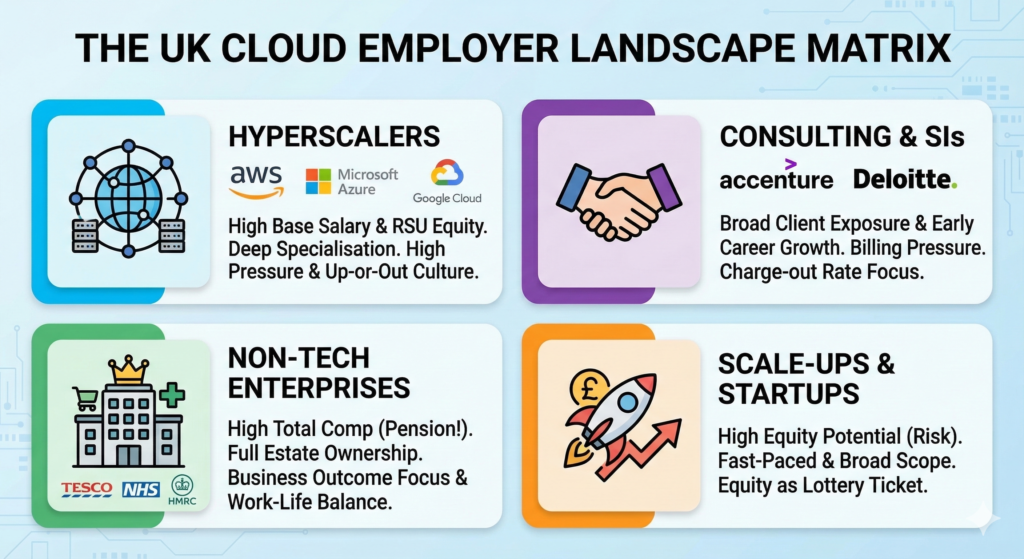
Understanding the UK cloud market requires separating it into four distinct employer types, each with genuinely different characteristics across compensation, pace, technical scope, and career trajectory.
Hyperscalers (Amazon Web Services UK, Microsoft UK, Google UK) offer base salaries that are competitive, typically £70,000-£120,000 for senior individual contributors, with meaningful equity through RSU schemes. The trade-off is real. Up-or-out performance culture means that engineers who do not consistently hit high performance ratings face stalled progression or managed exits. Technical scope is often narrow and deep rather than broad: you may become the foremost expert on a specific AWS service or Azure feature, which has genuine market value, but you will not own a full cloud estate in the way that builds the breadth required for Principal-level roles elsewhere. Pensions are typically defined contribution with employer contributions of 5-8%, placing them at the lower end of UK employer pension generosity.
Consulting and systems integration firms (Accenture, Deloitte, Capgemini, KPMG, IBM) offer strong development opportunities early in a cloud career, primarily because of client exposure breadth. You will see more architectures in two years at a consultancy than most in-house engineers see in five. Salary ranges for senior cloud consultants sit between £75,000 and £115,000 depending on specialisation and level. The structural reality is that consultancies are billing businesses: your value to the firm is directly tied to your charge-out rate, and this creates ongoing pressure that shapes everything from hours worked to which clients you are staffed on. Pension arrangements are defined contribution, typically matching the hyperscaler range.
Non-tech enterprises is the category that most engineers underestimate. This covers large retailers (Tesco, Sainsbury’s, Marks and Spencer, Ocado Technology), government departments and agencies (HMRC Digital, DVLA, Home Office Digital, Ministry of Justice), central government bodies (the Government Digital Service, Central Digital and Data Office), media organisations (BBC, ITV, Sky), financial services (Lloyds Banking Group, NatWest, Barclays technology divisions), utilities, and NHS Trusts and NHS England’s technology arm. The salary ranges here are frequently comparable to consulting and sometimes exceed them at senior levels. Glassdoor data from February 2026 shows Sainsbury’s cloud engineers in London averaging £68,570, which is competitive with mid-market consulting rates. Senior cloud architects at large UK retailers and financial institutions regularly command £100,000-£140,000. The difference is not the base salary. The difference is everything else.
Scale-ups and funded startups offer the highest potential upside through equity, and occasionally match or exceed market base salaries to attract experienced engineers. The realistic assessment is that pre-IPO equity in UK startups converts to meaningful cash value for a minority of cases. If you are joining a Series B company with a credible path to exit and genuinely market-rate equity, the calculus changes. For most early or mid-stage roles, equity packages represent a lottery ticket rather than a compensation component you can plan around.
The Pension Calculation That Changes Everything
This is the part of the conversation that is almost never had on engineering Slack communities or LinkedIn career threads, yet it represents the single largest variable in total compensation across employer types.
The NHS Pension Scheme carries an employer contribution rate of 23.7%. At a senior cloud architect salary of £85,000, that means the NHS contributes approximately £20,100 per year into your pension on top of your base salary. At £100,000, the figure exceeds £23,700. These are defined benefit arrangements: your eventual pension income is calculated based on career average revalued earnings, providing retirement security that no defined contribution scheme with uncertain investment returns can match reliably.
The civil service pension, available to engineers at HMRC, DVLA, the GDS, and most other government departments, operates on similar principles. The alpha scheme employer contribution rate is set at 28.97% from 2024-25 through 2026-27. At a salary of £90,000, employer contributions amount to approximately £26,100 per year.
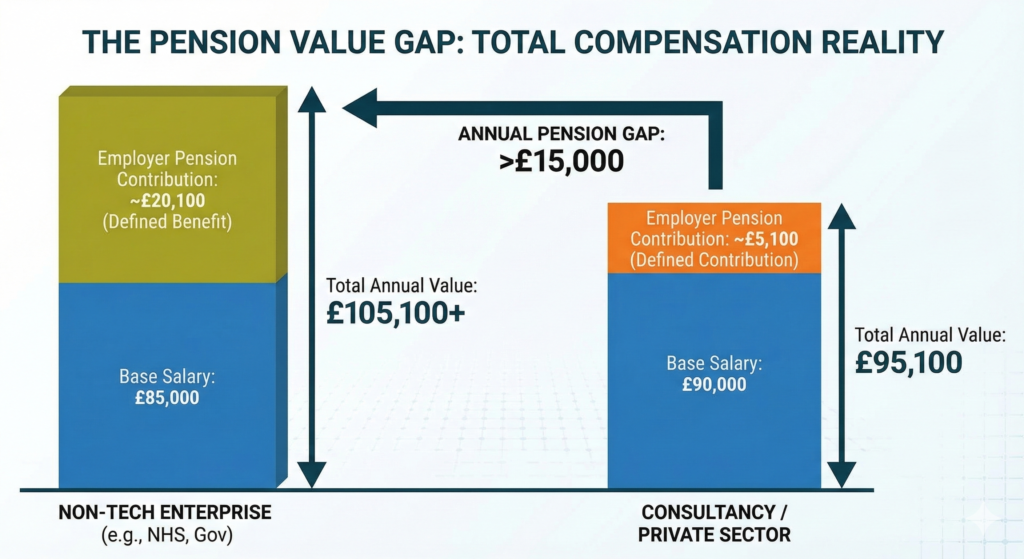
Compare this to the 5-6% employer contributions typical at a consultancy or hyperscaler. At the same £90,000 salary, employer pension contributions amount to roughly £4,500-£5,400 per year. The gap between the two is not marginal. It is the difference between £22,000 and £5,000 in annual compensation that does not appear in any base salary comparison on a job board.
Over a 20-year career at the point of difference, this pension differential, conservatively modelled, represents a total benefit gap well into six figures. Engineers who spend their careers chasing base salary without accounting for this are, to use an appropriately blunt framing, making expensive assumptions.
Technical Scope and What It Does to Your Career
Beyond pension, the technical ownership question materially shapes the kind of engineer you become and the roles you qualify for later.
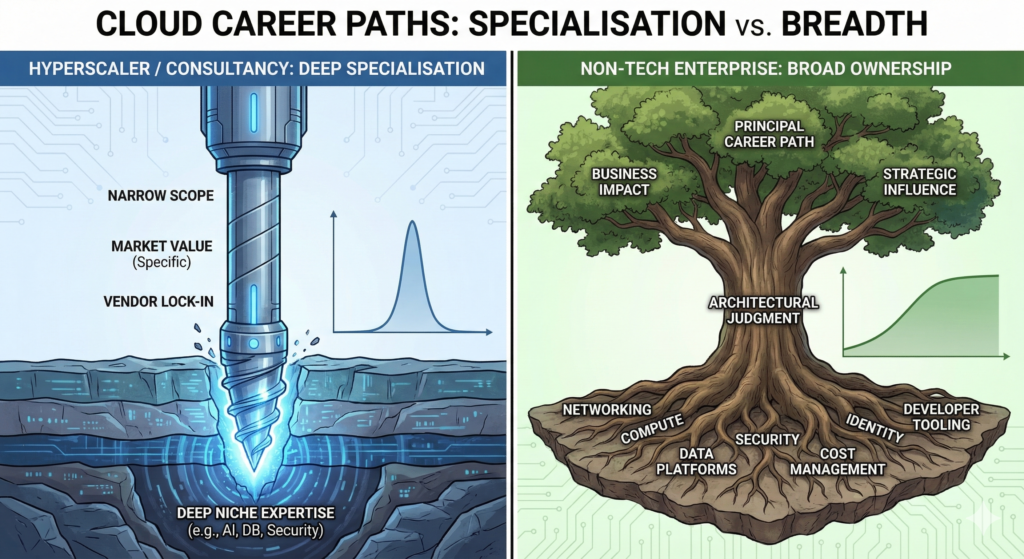
At a consultancy or hyperscaler, the nature of the work pushes toward specialisation. You become very good at a specific practice area, a particular cloud provider, or a defined set of services. This has genuine value and is the right path for engineers who want to develop deep expertise in a specific domain. As we explored in our guide to multi-cloud versus single-cloud career paths, the market rewards both approaches, but the paths diverge meaningfully.
At a large non-tech enterprise, the opposite is typically true. When Tesco needs a cloud architect, that person is responsible for the full estate: networking, compute, data platforms, security, cost management, identity, developer tooling, and platform engineering. There is no colleague three desks away who owns the networking layer or the IAM strategy. The breadth is yours to manage, and this breadth is precisely what develops the architectural judgment required to progress to Staff and Principal levels. Engineers who have owned a full cloud estate for a complex enterprise are demonstrably better equipped to make the kind of broad architectural decisions that define senior individual contributor careers.
This is also where the FinOps dimension becomes relevant. Engineers at non-tech companies typically have direct visibility into the business impact of their cloud decisions in a way that engineers working as part of a delivery team within a consulting engagement rarely achieve. The ability to demonstrate cost reduction outcomes in business terms, rather than technical metrics, is exactly the gap between engineers who plateau at Senior and those who progress further. Understanding this link between technical decision-making and financial outcomes is central to the FinOps Evolution framework that distinguishes architects from engineers.
Career Progression by Employer Type
The progression ceiling differs significantly across the four categories, and this difference compounds over time.
At a hyperscaler, the progression path is steep early and narrows sharply above Principal Engineer level. Reaching Senior Principal or Distinguished Engineer requires an unusually high level of technical contribution, often approaching research-grade output. The engineers who reach these levels are exceptional; the rest plateau or move on. Senior engineers at UK hyperscaler offices typically sit in the £90,000-£130,000 range, with total compensation meaningfully higher due to RSUs. That equity is real, but its value fluctuates.
At consulting firms, progression follows a leverage model. Reaching Partner or Director level requires building a client relationship book and demonstrating commercial contribution, not solely technical excellence. Engineers who are excellent practitioners and have no interest in business development often find that Partner-level progression is structurally unavailable to them. The salary ceiling for a senior non-Partner technical role at a UK consultancy sits around £100,000-£120,000 before bonus. Cloud leadership careers that extend beyond this level require either the business development path or a move out of consulting, as we covered in our cloud leadership career guide.
Non-tech enterprises offer a different and, for the right profile, a more accessible trajectory. Large retailers, financial institutions, and government departments have senior technical roles (Head of Cloud, Cloud Platform Director, Chief Architect) that sit at £120,000-£170,000 and are genuinely achievable for excellent engineers with strong business communication. The promotion criteria are typically tied to business outcomes rather than billing contribution or academic-standard technical research. Engineers who can demonstrate the ability to translate cloud technical strategy into business language have a clearer path to these levels than they often do in consulting or at hyperscalers.
What Non-Tech Employers Actually Look For
Understanding that these roles exist is only useful if you know how to position yourself for them. Non-tech employers evaluate cloud engineers differently from how consulting firms or hyperscalers do, and this requires a different interview and CV approach.
Business outcome framing is the most important shift. Where a consulting firm might assess you on your depth of knowledge about a specific service, a retailer or government department cares primarily about what you delivered, what it cost, and what it enabled for the business. “Designed and deployed an Azure Private Link architecture” is a technical statement. “Replaced a legacy VPN architecture affecting 3,000 warehouse users, reducing connectivity incidents by 70% and removing £180,000 in annual circuit costs” is the language that resonates in non-tech enterprises.
Domain awareness matters more than most engineers expect. You do not need to have worked in retail to apply to Tesco, but demonstrating that you understand something about how a large omnichannel retailer uses technology, what their data challenges look like, and why their cloud estate is structured around both physical store operations and digital platforms shows the kind of genuine interest that distinguishes candidates. The same principle applies to government roles: understanding the Government Digital Service design principles and the policy context of the department you are applying to will differentiate you from engineers who fire and forget applications.
Certifications play well in non-tech enterprises, and they carry different weight than in consultancies. In consulting, certifications are table stakes, expected of nearly everyone at mid-level and above. In many non-tech enterprises, particularly in government and healthcare, certifications are still differentiating, in part because the supply of certified engineers who are actively interested in these sectors is lower than in commercial tech. This asymmetry is worth exploiting. Our analysis of strategic cloud certification maintenance covers how to manage a multi-vendor portfolio without spending the year on renewal exams, which becomes increasingly relevant as you move into roles where business output matters more than certification count.
Finding Non-Tech Cloud Roles
The job board question is practical and worth addressing directly. Many of the best non-tech enterprise cloud roles are posted in places that engineers do not habitually check.
The Government Digital and Data job site (civilservicejobs.service.gov.uk) lists cloud roles across HMRC, DVLA, the Home Office, and dozens of other departments. These roles typically include explicit salary banding, transparent pension information, and clear hybrid working arrangements. HMRC’s Digital Technology Services division alone employs hundreds of cloud engineers and regularly recruits senior architects at £75,000-£115,000 with the civil service pension on top.
NHS Jobs (jobs.nhs.uk) lists roles across NHS Trusts and NHS England. The NHS England technology directorate in particular has invested heavily in cloud capability. Band 8a-8d roles, where the majority of senior cloud engineering positions sit, offer salaries in the £53,000-£106,000 range before the pension contribution advantage is factored in.
Large retailers post directly on their own careers portals. Tesco Technology, Sainsbury’s Technology, Ocado Technology (which operates as a genuine engineering organisation and pays accordingly), and Marks and Spencer Digital all have dedicated technology career pages. These roles are also listed on LinkedIn and Reed, but direct applications to the careers portal often see faster handling.
When Hyperscaler or Consultancy Genuinely Is the Right Choice
The argument so far is not that non-tech employers are universally better. There are specific career situations where a hyperscaler or consultancy role is the right decision.
If you are within the first five years of your cloud career, a consultancy role offers breadth of exposure that is genuinely difficult to replicate in an in-house environment. Seeing five different architectures across five different sectors in two years builds pattern recognition that pays dividends for the rest of a career. The cost, in hours and billing pressure, is real but the development value at this career stage is high.
If you have a specific technical niche you want to develop and a hyperscaler runs that niche’s centre of excellence, the access to internal expertise, tooling, and technical community is valuable in ways that are hard to replicate externally. Engineers who want to develop deep expertise in a specific AI platform, database engine, or security domain sometimes find that the concentration of knowledge inside a hyperscaler accelerates development that would take years longer elsewhere.
If you are considering equity and a specific organisation has genuinely credible economics behind it, the risk-adjusted calculus can favour a scale-up or funded startup. The key word is credible. The question to ask is whether someone has built a clear-eyed model of what the equity is worth across three or four exit scenarios, not whether the hiring manager is enthusiastic about the company’s trajectory.
The Total Compensation Decision Framework
The practical version of this analysis comes down to running actual numbers before you make a decision. For any role you are seriously evaluating, calculate the following:
Base salary is the starting point, not the conclusion. To it, add employer pension contribution as a percentage of salary, converted to an annual cash equivalent. For an NHS role at £85,000 with a 23.68% employer rate, add £20,100. For a consultancy role at £90,000 with a 6% employer rate, add £5,400. The effective salary difference after pension is £4,700 in this example, even though the consultancy role pays £5,000 more in base.
Add the value of any guaranteed bonus, RSU vesting, or other cash-equivalent benefit. Subtract the realistic value of working pattern differences: if one role requires an average of 50 hours per week and another requires 40, the effective hourly rate difference is significant over a year.
Finally, assess career optionality value. A role that broadens your portfolio, gives you ownership of a complex estate, or positions you for a Principal track that is genuinely accessible within your profile adds value that is not visible in the current salary figure but compounds substantially.
Engineers who run this analysis properly often find that a non-tech role at £80,000 with a defined benefit pension and genuine technical ownership compares very favourably with a consulting role at £90,000 that offers a standard defined contribution pension and narrower scope.
Next Steps
The most useful immediate action is to run the total compensation calculation for one role you are currently considering against one non-tech employer in your sector of interest. Pull the employer pension contribution rate from the company’s careers page or employee benefits documentation. Add it to the base salary and compare. The gap will likely be larger than you expect.
If you have not explored government digital roles before, spend thirty minutes on civilservicejobs.service.gov.uk filtered to cloud, architecture, or platform engineering. The roles are more interesting, better scoped, and better compensated on a total package basis than their profile suggests.
Update your CV to lead with business outcomes rather than technical actions. The organisations where the best non-tech cloud opportunities sit are evaluating you on what you delivered, not on which services you configured.
Finally, if you are at a point in your career where breadth of ownership and career ceiling matter more than speed to a narrow specialisation, the non-tech enterprise sector deserves serious consideration. The engineers who figure this out early tend to find that the supposedly less glamorous employer ends up looking rather good on a 15-year time horizon.
Useful Links
- Civil Service Jobs – Digital, Data and Technology roles – Government cloud and architecture roles with transparent salary banding
- NHS Jobs – NHS technology roles across trusts and NHS England digital teams
- NHS Pension Scheme employer contribution rates – NHS Employers – Official employer contribution data for pension calculations
- IT Jobs Watch – Cloud Architect salary trends – Live UK market salary data including median, percentile ranges and demand trends
- Hays UK Technology Salary Guide 2026 – Benchmark salary data across technology roles and sectors
- Morgan McKinley Cloud Architect Salary Data – London and UK cloud architect salary benchmarks
- Government Digital Service – Design Principles – Useful context for engineers considering government digital roles
- Reed.co.uk – Cloud Architect average salary – UK-wide salary data updated regularly
- Civil Service Pension Scheme – Employer contributions (alpha scheme) – Official contribution rate documentation for government roles