

You’ve invested £2,000 and 500 hours earning six cloud certifications over four years. Congratulations on the commitment. Now comes the part nobody warned you about: maintaining those credentials requires 150-200 hours annually with costs approaching £1,500, equivalent to one month’s salary purely on keeping digital badges current rather than developing new skills.
The UK cloud market reached £46.3 billion in 2025, rewarding certified professionals with 15-25% salary premiums. However, the mathematics of maintenance create a hidden career tax that escalates dramatically beyond three certifications. Mid-to-senior professionals holding six to nine credentials report spending nearly 5% of annual working hours on renewal activity alone, creating an unsustainable treadmill that delivers diminishing returns.
The strategic opportunity lies in portfolio rationalisation. Research across UK cloud professionals demonstrates that maintaining three to five carefully selected certifications outperforms comprehensive coverage. The “alphabet soup” approach signals test-taking capability rather than production expertise to hiring managers evaluating senior candidates. The optimal strategy combines high-value credentials with efficient renewal systems, leveraging cascade renewals, free assessment options, and strategic expiry decisions based on career trajectory rather than completionism.
The vendor renewal landscape creates radically unequal maintenance burdens
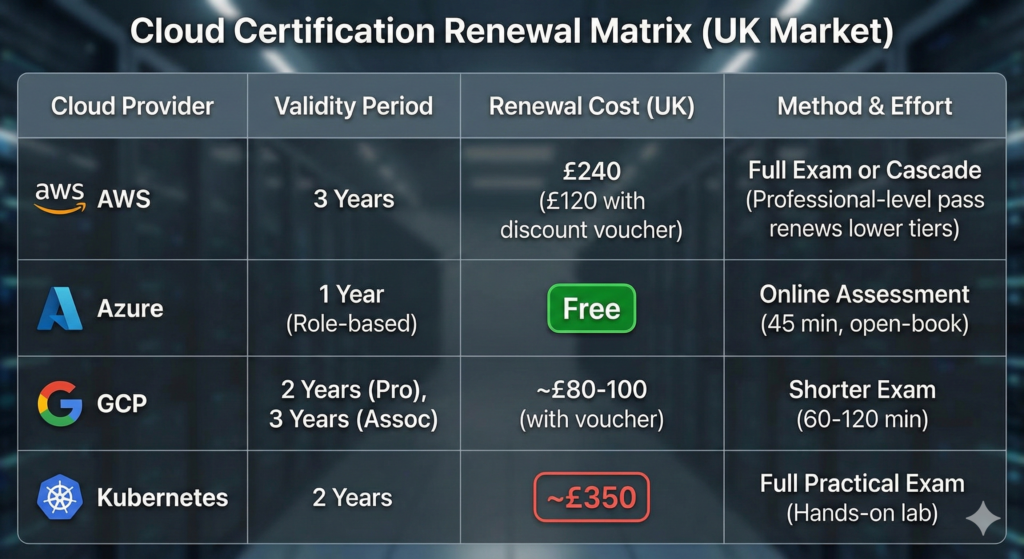
The three major cloud providers operate fundamentally different certification renewal philosophies, creating vastly unequal time and cost commitments for multi-cloud professionals.
Microsoft Azure offers the most generous renewal model for UK professionals managing certification portfolios. Role-based certifications including Azure Administrator, Solutions Architect Expert, and Security Engineer require annual renewal through free, unproctored online assessments taking approximately 45 minutes. These open-book evaluations permit access to Microsoft Learn, browser tabs, and even the Azure Portal during testing. Unlimited retakes are available until expiration, with only a 24-hour waiting period required after three consecutive failures. Fundamentals certifications like AZ-900 never expire, providing permanent entry-level credentials. This learner-friendly approach means maintaining Azure credentials costs nothing beyond study time, typically two to four hours per certification annually.
AWS takes a considerably harder line, requiring full examination retakes every three years with no shortened recertification pathway. The benefit emerges through cascade renewal: passing a Professional-level exam automatically renews lower certifications in that track, so Solutions Architect Professional simultaneously renews the Associate and Cloud Practitioner credentials. A 50% discount voucher granted upon passing any examination reduces Professional and Specialty renewal costs from £240 to £120. The sole free option, AWS Cloud Quest for Cloud Practitioner, launched in June 2025 as a game-based recertification pathway. Study time for AWS renewals typically runs 20-40 hours for Associate level credentials, expanding to 40-80 hours for Professional level certifications.
Google Cloud occupies middle ground with two-year validity for Professional certifications and three-year validity for Associate and Foundational levels. GCP recently introduced shorter one-hour renewal examinations versus standard two-hour tests for select certifications including Professional Cloud Architect and Professional Data Engineer. A 50% discount code provided upon certification makes renewals approximately £80-100 for Professional credentials. The 60-day eligibility window before expiration proves notably shorter than competitors, requiring more precise renewal timing.
Kubernetes certifications through the Linux Foundation operate on two-year validity with full exam retakes required at approximately £350 per renewal. The Certified Kubernetes Administrator (CKA) and Certified Kubernetes Application Developer (CKAD) maintain strong market value as platform-agnostic credentials transferable across all cloud environments, though the premium pricing and hands-on practical exam format demand significant preparation investment.
The portfolio problem: when certification collecting becomes counterproductive
Certification inflation has created a peculiar professional burden that compounds geometrically rather than linearly. The engineer who earned AWS Solutions Architect Associate in 2018, added Azure Administrator in 2019, collected Cloud Practitioner and GCP Cloud Digital Leader in 2020, then acquired Security Specialties and Kubernetes certifications through 2023 now faces perpetual renewal obligations consuming substantial career bandwidth.
The mathematics of maintenance become punishing at scale. Managing three certifications requires approximately 60-80 hours annually, equivalent to one full working fortnight devoted purely to credential upkeep. Expanding to six certifications doubles this burden to 120-160 hours. Beyond nine certifications, professionals consistently report exceeding 200 hours per year on maintenance alone, representing nearly 5% of annual working hours invested in renewal rather than skill development or project delivery.
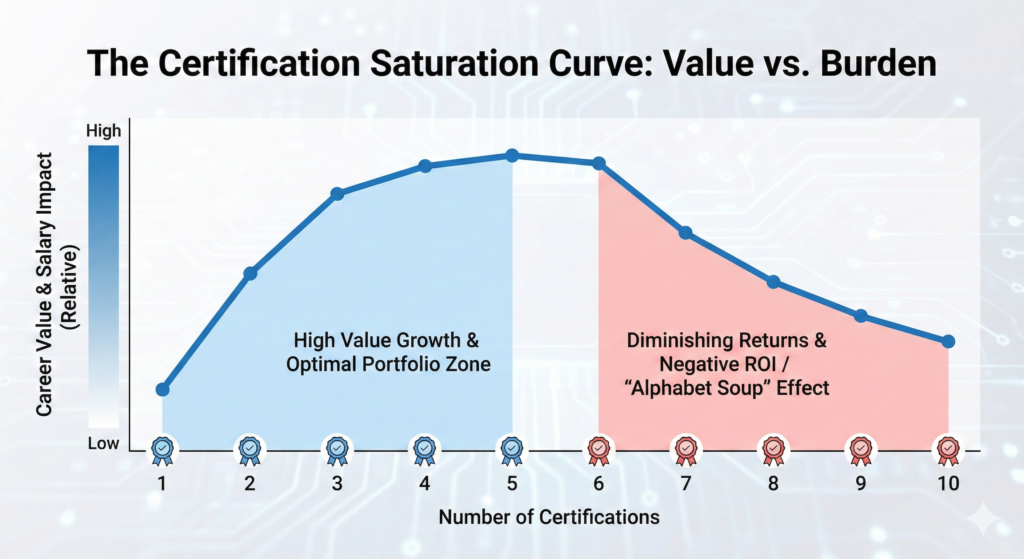
Financial costs compound similarly. A modest three-certification portfolio combining AWS Solutions Architect Professional, Azure Solutions Architect Expert, and Kubernetes CKA costs roughly £275-450 annually including study materials and examination fees. Expanding to six certifications pushes annual expenditure toward £800-1,200. The professional maintaining nine or more credentials faces potential annual outlays exceeding £1,500, often without comprehensive employer support covering the full burden.
Community consensus emerging from professional forums suggests a saturation point exists around six to seven certifications. Beyond this threshold, the credential accumulation can actually signal “test-taker rather than practitioner” to hiring managers evaluating senior candidates. One security professional holding CISSP, CISA, CRISC, CCSP, and multiple GIAC certifications received blunt community feedback: “If you are not complementing those certifications with practical knowledge, there is probably a saturation point you’ve long since passed.”
This represents a fundamental shift in certification strategy as careers mature. Early-career professionals benefit from breadth, demonstrating foundational competency across multiple platforms and domains. Mid-to-senior professionals with established track records gain more value from strategic depth and portfolio evidence than comprehensive credential coverage. The transition typically occurs around five to seven years of experience, when demonstrated delivery capability outweighs certification count in hiring decisions.
Understanding which certifications retain value versus decay over time
Not all certifications warrant equal maintenance investment. Strategic portfolio management requires distinguishing credentials that retain strong market value from those representing sunk costs better allowed to expire.
High-value credentials consistently worth maintaining include security specialisations across all platforms. AWS Security Specialty holders earn average UK salaries exceeding £130,000, with security skills remaining persistently scarce despite recent market corrections. Solutions Architect Professional certifications from AWS (SAA-P), Azure (AZ-305), and GCP (PCA) serve as flagship credentials commanding £90,000-120,000 salaries in UK markets while opening doors to senior architecture and technical leadership positions. Machine Learning and AI certifications represent the fastest-growing premium, with AI-skilled professionals earning 30-50% more than standard cloud roles according to recent UK salary surveys. Kubernetes certifications (CKA and CKAD) transfer across all platforms and remain essential for container-orchestrated environments, particularly valuable for DevOps engineers and platform architects.
Moderate-value certifications include Associate-level credentials that primarily serve as stepping stones toward professional recognition. Once you hold Solutions Architect Professional, the Associate credential can safely expire through cascade renewal rather than requiring separate maintenance. Developer Associate certifications add diminishing value once architectural credentials establish senior-level capability. The AWS Cloud Practitioner and Azure Fundamentals serve entry-level credentialing purposes, though the former now offers free renewal via Cloud Quest while the latter never expires, making both low-burden options for maintaining baseline credentials.
Lower-value certifications safe to strategically expire include retired credentials no longer recognised by vendors. AWS retired Data Analytics Specialty, Database Specialty, and SAP on AWS Specialty in April 2024, replacing them with consolidated alternatives. Specialty certifications in areas no longer actively practiced deliver minimal value, particularly when career focus has shifted to different domains. Platform-specific credentials following career transitions represent another category suitable for expiry; maintaining AWS certifications when transitioning to primarily Azure-focused roles delivers questionable return on renewal investment. Google’s Workspace Administrator certification faces retirement in December 2024, exemplifying the importance of tracking vendor roadmaps.
The emerging pattern suggests that security, architecture, and AI/ML credentials maintain strongest value retention, while platform-specific and specialty credentials in inactive practice areas represent prime candidates for strategic portfolio pruning.
The optimal portfolio: a “core four” strategy balancing demand and efficiency
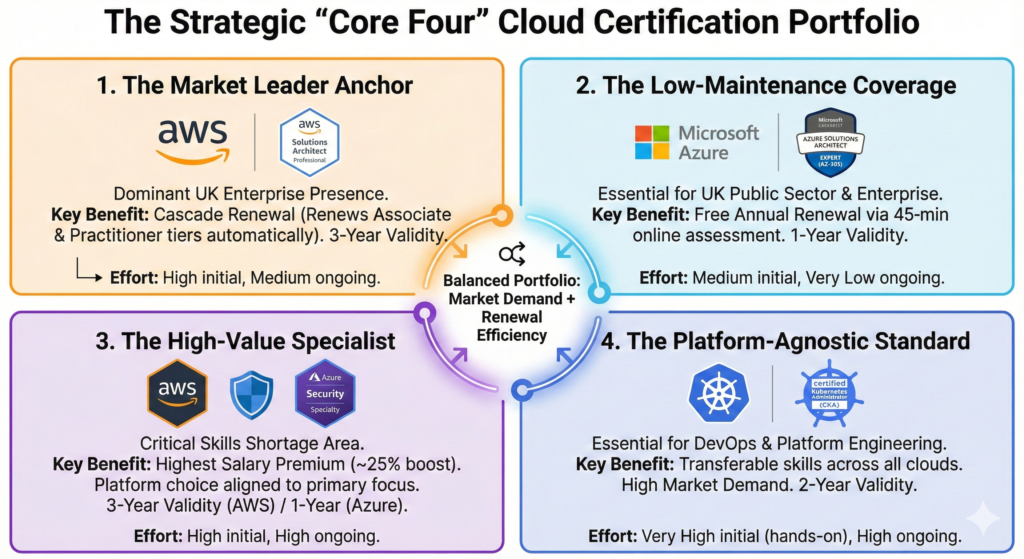
For mid-to-senior UK cloud professionals with five to ten years experience, research supports maintaining three to five strategically selected certifications rather than comprehensive multi-platform coverage. This approach balances market demand recognition, renewal efficiency, and career positioning effectiveness.
The recommended “core four” portfolio provides flagship coverage across key domains. First, AWS Solutions Architect Professional serves as market leader credentialing given AWS’s dominant UK enterprise presence. This certification automatically renews Associate and Cloud Practitioner credentials through cascade renewal, requiring examination retake only every three years at approximately £120 with discount vouchers. The comprehensive scope covers architecture patterns, security, cost optimisation, and operational excellence across the full AWS service portfolio.
Second, Azure Solutions Architect Expert (AZ-305) addresses Microsoft’s enterprise and UK public sector dominance, where Azure skills remain essential for government contracts, financial services, and healthcare organisations. The annual renewal via free 45-minute online assessment makes this the lowest-maintenance flagship credential available, requiring only modest study time to remain current with platform evolution. The combination of Azure and AWS coverage positions professionals for approximately 85% of UK cloud architecture opportunities.
Third, one Security Specialty certification from either AWS or Azure delivers the highest salary premium at approximately 25% according to Hays UK Technology Salary Guide. Security certifications face persistent skills shortages as organisations grapple with zero-trust architecture, compliance requirements, and sophisticated threat landscapes. Platform choice should align with primary professional focus, though AWS Security Specialty typically commands slightly higher recognition given the vendor’s market position.
Fourth, Kubernetes CKA provides platform-agnostic credentialing transferable across all cloud environments. Essential for DevOps engineers, platform architects, and any professional working with container-orchestrated architectures, this certification demonstrates hands-on capability with the industry-standard orchestration platform. Renewal every two years at approximately £350 represents the highest individual cost in the portfolio but delivers strong differentiation value, particularly for platform engineering roles commanding £120,000-180,000 salaries.
The optional fifth credential, GCP Professional Cloud Architect, suits multi-cloud consultants and professionals in organisations with significant GCP adoption. GCP-certified professionals can earn 25% more than AWS or Azure counterparts due to smaller talent pools, though the shorter two-year validity increases maintenance burden relative to AWS’s three-year cycle. This certification makes particular sense for professionals targeting consultancies, managed service providers, or enterprises with deliberate multi-cloud strategies.
This portfolio requires approximately 80-100 hours annually in aggregate maintenance time and £400-600 in direct costs, both manageable within typical employer support frameworks while delivering comprehensive market coverage.
UK employer funding realities and negotiation leverage for certification support
Over 55% of UK technology employers now fund employee certifications according to recent recruitment market analysis, representing a 22% increase since 2016. The typical professional development budget ranges from 1-5% of salary, translating to £500-2,500 annually for most cloud roles. Companies offering ten days paid study leave are considered “highly attractive” according to Henderson Scott’s technology recruitment research, though many organisations provide substantially less time allocation.
However, employer support for renewal specifically rather than initial certification remains inconsistently documented across UK organisations. Most certification funding programmes focus on credential attainment to meet partner requirements or project staffing needs, treating ongoing maintenance as employee responsibility. This creates an important negotiation opportunity for mid-to-senior professionals with established market value.
Recommended contract language for comprehensive certification support includes annual training budgets of £2,000-3,000 for technical roles, paid study time allocation of five to ten days annually for certification preparation and examination, explicit renewal coverage clauses for role-relevant credentials, and separate allowances for study materials and practice examinations beyond basic exam fees.
The tax treatment strongly favours such employer-funded arrangements. Training expenditure qualifies as tax-deductible business expense whilst generally avoiding classification as taxable benefit for employees when meeting HMRC’s “work-related training” definitions. Training to maintain skills current with technological changes explicitly qualifies under these provisions, making certification renewal an efficient compensation element from tax perspective.
Clawback clauses commonly appear in certification funding agreements but must follow fair principles under UK employment law. Typical structures provide 100% cost recovery if departing within three months post-certification, 50% recovery after six months, declining to zero recovery after one year of continued employment. Mandatory compliance training cannot be subject to clawback provisions, though voluntary professional development certifications generally can be.
UK government initiatives provide additional support avenues beyond employer funding. Skills Bootcamps offer free 16-week intensive courses with guaranteed job interviews upon completion, covering cloud fundamentals through advanced topics. The Lifelong Learning Entitlement launching January 2027 provides £37,000 in loan funding for upskilling and reskilling throughout careers. UK Public Sector Cloud Certification Month offers free or heavily discounted examination vouchers from AWS, Azure, GCP, and Oracle specifically for government employees, representing significant value for public sector professionals.
Financial services and consulting firms typically offer the most comprehensive certification support given partner programme requirements driving revenue qualification. Technology vendors and cloud-native organisations often provide strong support aligned to platform specialisation needs. Small to medium enterprises demonstrate more variable support, frequently covering initial certifications but expecting professionals to self-fund renewals.
The cascade renewal system provides powerful efficiency leverage
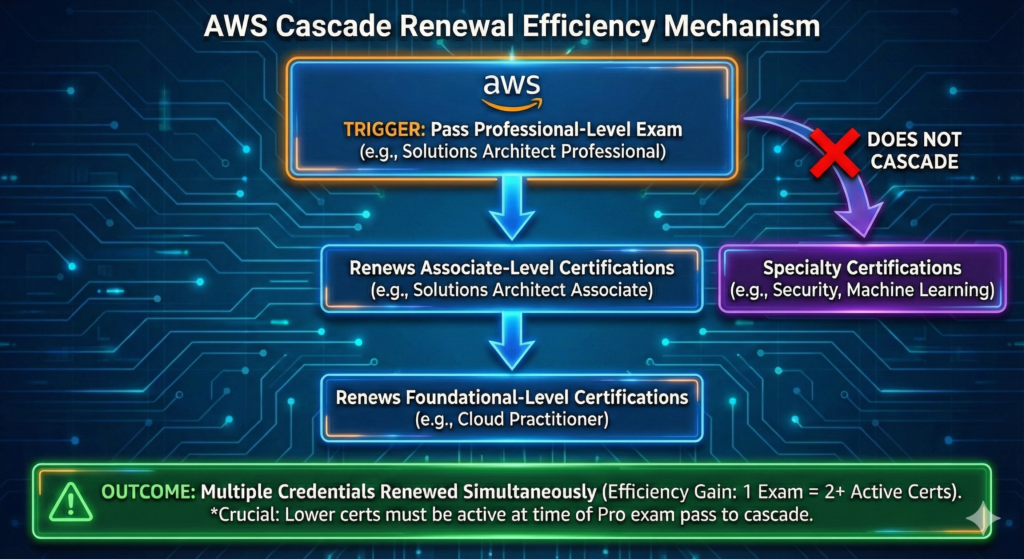
AWS’s cascade renewal mechanism offers significant efficiency gains for multi-certification holders through strategic examination timing. Passing one Professional-level examination automatically renews all lower certifications in that learning path, creating substantial time and cost savings versus separate renewal activities.
Solutions Architect Professional renewal simultaneously refreshes Solutions Architect Associate and Cloud Practitioner credentials. DevOps Engineer Professional renews Developer Associate, SysOps Administrator Associate, and Cloud Practitioner. Any Associate-level examination renews Cloud Practitioner. The recently introduced ML Engineer Associate renews AI Practitioner certification. This cascading structure means a single £120 Professional examination (with 50% discount voucher) can renew three certifications simultaneously, versus £240 in separate examination fees plus additional study time.
The optimal timing strategy involves scheduling Professional examination renewal approximately six months before Associate credential expiration to maximise cascade benefit whilst maintaining sufficient preparation runway. This approach provides insurance against examination failure requiring retake whilst capturing full validity extension across all cascade-eligible credentials.
Critical implementation warning: cascade renewal functions only when both certifications maintain current validity status. One professional documented the failure mode: “I let my associate credential lapse for a couple weeks before taking the Professional examination. That did NOT recertify my associate certification.” Planning renewal timing carefully around expiration dates proves essential for capturing cascade benefits rather than requiring separate renewal activity.
Content overlap between related certifications enables efficient study batching that further reduces aggregate preparation time. AWS Security Specialty shares approximately 40% conceptual content with Solutions Architect Professional, allowing combined preparation covering both examinations. Azure Administrator and Solutions Architect Expert demonstrate significant overlap in networking, identity management, and governance domains. Kubernetes knowledge transfers directly across all cloud platforms, with CKA preparation simultaneously strengthening AWS EKS, Azure AKS, and GCP GKE competency. Strategic grouping of renewal study for related certifications can reduce total preparation time by 20-30% versus isolated renewal approaches.
The cascade system particularly benefits professionals maintaining comprehensive AWS coverage whilst wanting to minimise renewal burden. Rather than tracking separate renewal dates and preparing for multiple examinations across different timeframes, consolidating renewal through Professional-level examinations every three years dramatically simplifies portfolio management.
The renewal decision framework: strategic expiry versus maintenance
Strategic portfolio management requires explicit decision criteria for which certifications warrant renewal investment versus which can safely expire based on career trajectory and opportunity cost.
Renew certifications when they satisfy employer or partner programme compliance requirements driving revenue qualification or project eligibility. Actively interviewing or consulting makes current credentials valuable credibility signals, particularly for contract roles where technical screening may involve credential verification before interview progression. When the specialty area represents your primary income driver and competitive differentiation, maintaining current status preserves market positioning. Government and regulated industry requirements may mandate specific current certifications for contract award or compliance demonstration. Finally, preserving the 50% discount voucher for future AWS examinations provides financial incentive for timely renewal even when current role requirements prove ambiguous.
Allow certifications to expire when you’ve achieved Professional-level equivalent credentials that cascade renew lower certifications automatically. When specialty areas no longer relate to current role responsibilities, renewal investment delivers questionable return versus developing skills aligned to active practice. Career transitions to different cloud platforms make maintaining credentials in abandoned platforms inefficient. Retired certifications obviously warrant no renewal investment. Professionals with ten or more years experience and strong portfolio evidence may find certification status matters less than demonstrated delivery capability, particularly when not actively seeking new employment. Employer indifference to credential status removes compliance-driven renewal motivation.
Pursue new certification instead of renewal when career pivoting to new specialty areas where fresh credentials signal commitment to domain expertise development. Moving to different cloud platforms suggests maintaining one flagship credential in the old platform whilst building comprehensive coverage in the new environment. Current certifications facing retirement often have replacement credentials better positioned for future market demand. Emerging technology areas showing strong market demand, particularly AI and ML certifications through 2025-2026, may warrant investment over maintaining legacy credentials in mature domains.
The framework emphasises aligning certification portfolio to forward-looking career strategy rather than backward-looking sunk cost preservation. The professional targeting platform engineering leadership benefits more from Kubernetes and infrastructure-as-code certifications than maintaining comprehensive multi-cloud coverage. The security specialist gains more value from CISSP or advanced security specialties than broad foundational credentials across multiple platforms.
Practical mathematics: time and cost budgets for strategic portfolios
For mid-to-senior UK professionals maintaining the recommended “core four” portfolio, the aggregate annual commitment becomes precisely quantifiable and budgetable.
Annual time investment totals 80-100 hours across the portfolio. AWS Solutions Architect Professional requires 40-60 hours of preparation every three years, amortising to 13-20 hours annually when spread across the validity period. Azure Solutions Architect Expert demands approximately four hours annual investment for the free online assessment, representing minimal ongoing burden. Security Specialty certifications require 30-50 hours preparation every three years, amortising to 10-17 hours yearly. Kubernetes CKA demands 20-40 hours every two years, representing 10-20 hours annual commitment when amortised across validity period.
This time commitment fits within reasonable professional development allocation, representing approximately 2-2.5% of annual working hours for focused renewal activity. Distributing preparation across multiple months rather than cramming immediately before examinations reduces disruption to primary work responsibilities whilst maintaining knowledge currency throughout validity periods.
Annual cost budget ranges £400-600 including examination fees and study materials. AWS Solutions Architect Professional renewal with 50% discount voucher costs £120 every three years, amortising to £40 annually. Azure Solutions Architect Expert renewal remains free, contributing zero direct cost. Security Specialty renewal with voucher costs £120 every three years, amortising to £40 yearly. Kubernetes CKA renewal at £350 every two years represents £175 annual amortised cost. Study materials including practice examinations, video courses, and reference materials add £100-200 annually depending on preparation approach and platform familiarity.
ROI calculation strongly favours maintenance investment. The salary premium for maintained certifications ranges 15-25% according to UK market data, with some specialties commanding higher differentials. A £70,000 cloud engineer earning 20% certification premium receives £14,000 additional annual compensation against £500 maintenance investment, delivering 28:1 return on certification renewal expenditure. Even accounting for opportunity cost of 100 hours annual time investment, the financial return remains compelling through mid-career stages.
The economics shift at senior levels where compensation increasingly reflects leadership capability, strategic thinking, and delivery track record rather than credential accumulation. The £150,000+ principal engineer or architect may find certification maintenance delivers diminishing marginal return compared to investing equivalent time in thought leadership, conference speaking, or technical community contribution that builds reputation capital.
When established professionals stop renewing: a senior career perspective
An instructive counterpoint emerges from recognised AWS experts Andreas and Michael Wittig of cloudonaut.io, who publicly documented their decision discontinuing AWS certification renewals despite operating as established AWS authorities. Their reasoning provides valuable perspective for senior professionals evaluating portfolio strategy.
They articulate certification commoditisation: “It is a race to the bottom. An AWS certification will not distinguish you from peers anymore.” With millions of certified professionals globally, credentials alone no longer provide meaningful differentiation at senior career stages. Their professional focus shifted toward demonstrable work including blogging, open-source contributions, conference speaking, and published expertise that signals capability more effectively than credential maintenance. They advocate “finding independents to learn from and avoiding AWS marketing materials,” emphasising practical expertise over vendor-curated certification paths.
This perspective applies most strongly to professionals with ten or more years experience, established industry reputations, and portfolios of demonstrable public work. At these career stages, maintained certifications shift from “proof of competence” to “compliance requirement,” retaining value when employer or partner status demands active credentials whilst becoming unnecessary when reputation speaks independently.
The transition point typically occurs when speaking invitations arrive based on reputation and published work rather than credential listings on conference biography forms. Consulting clients reference your delivery portfolio, case studies, and recommendations rather than certification counts during engagement discussions. Hiring decisions for senior positions favour demonstrated architectural decision-making, team leadership capability, and strategic business impact over credential accumulation.
For professionals not yet at this threshold, certifications remain valuable credibility signals that open doors, satisfy employer requirements, and demonstrate commitment to professional currency. The strategic guidance suggests maintaining optimal portfolio through mid-career whilst preparing the transition toward portfolio-based credibility for senior career phases. Building the blog, conference talks, open-source contributions, and published expertise during years when certifications remain actively maintained creates foundation for eventual credential independence.
The path forward involves recognising certifications as time-bounded career tools rather than permanent professional identity. They serve specific purposes during specific career stages, with diminishing marginal utility as reputation, portfolio, and demonstrable expertise accumulate. The £150,000+ professional with strong delivery track record faces fundamentally different calculation than the £70,000 engineer establishing market credibility.
Next steps: implementing strategic portfolio management this quarter
Effective portfolio management requires deliberate action rather than passive credential accumulation. Professionals should complete these specific steps within the next 90 days to establish sustainable certification strategy.
First, audit current certification holdings with complete expiration date mapping. Document every active credential, expiration timeline, renewal requirements, and estimated preparation time. Calculate aggregate annual maintenance burden in hours and cost. This inventory reveals whether current portfolio remains sustainable or requires strategic pruning. Many professionals discover they’re tracking toward 200-hour annual renewal commitments without conscious decision-making, simply allowing inertia to drive ever-expanding portfolios.
Second, evaluate each credential against career trajectory and market positioning. Which certifications align with target roles over the next three to five years? Which represent legacy investments no longer supporting career direction? Apply the renewal decision framework rigorously, identifying credentials warranting active maintenance versus those suitable for strategic expiry. This analysis often reveals that three to five carefully chosen credentials provide equivalent market positioning to comprehensive coverage whilst dramatically reducing maintenance burden.
Third, optimise renewal timing to leverage cascade systems and content overlap. Map AWS certification families to capture cascade renewal benefits through Professional-level examinations. Schedule related certification renewals consecutively to exploit study overlap, such as pairing Azure Administrator renewal with Solutions Architect preparation, or combining Kubernetes study with cloud platform container service deepening.
Fourth, negotiate comprehensive employer support explicitly into professional development plans or employment contracts. Present business case for certification maintenance aligned to partner requirements, project eligibility, or client-facing credibility. Request specific annual training budget, paid study time allocation, and renewal coverage for role-relevant credentials. Frame certification maintenance as strategic investment in organisational capability rather than individual employee benefit.
Fifth, establish realistic annual time and budget allocations for sustainable portfolio maintenance. Block calendar time quarterly for renewal preparation rather than cramming immediately before examinations. Budget £400-800 annually for examination fees and study materials. Consider opportunity cost explicitly, weighing renewal time investment against alternative professional development activities including conference attendance, project delivery, or thought leadership development.
For professionals currently maintaining six or more certifications, immediate portfolio rationalisation likely delivers substantial time and cost savings whilst improving rather than harming market positioning. The “alphabet soup” effect often undermines rather than enhances credibility with hiring managers evaluating senior candidates, who increasingly value focused expertise over broad certification coverage.
The most successful professionals treat certification portfolios as dynamic career tools requiring active management rather than static achievements to be preserved indefinitely. Strategic renewal, selective expiry, and deliberate portfolio composition aligned to evolving career goals delivers optimal return on certification investment throughout professional development.
Useful Links
- AWS Certification Renewal Official Guide – Complete AWS recertification requirements, cascade renewal policies, and discount voucher details
- Microsoft Learn Certification Renewal – Azure free renewal assessments, eligibility windows, and renewal process documentation
- Google Cloud Certification Renewal FAQ – GCP renewal exam requirements, validity periods, and recertification pathways
- Linux Foundation CKA/CKAD Certification FAQ – Kubernetes certification validity, renewal requirements, and examination details
- IT Jobs Watch UK Cloud Salaries – Real-time UK salary data for cloud certifications and skills, updated quarterly
- Hays Technology Salary Guide UK – Annual UK technology salary benchmarks including certification premiums by role
- UK Government Skills Bootcamps – Free cloud training programmes with guaranteed job interviews for eligible professionals
- A Cloud Guru Certification Paths – Comprehensive training for AWS, Azure, GCP certification preparation and renewal
- Reddit r/AWSCertifications Community – Active community discussing certification strategies, renewal experiences, and study resources
- cloudonaut.io Blog – Independent AWS expertise and perspectives on certification value from established practitioners