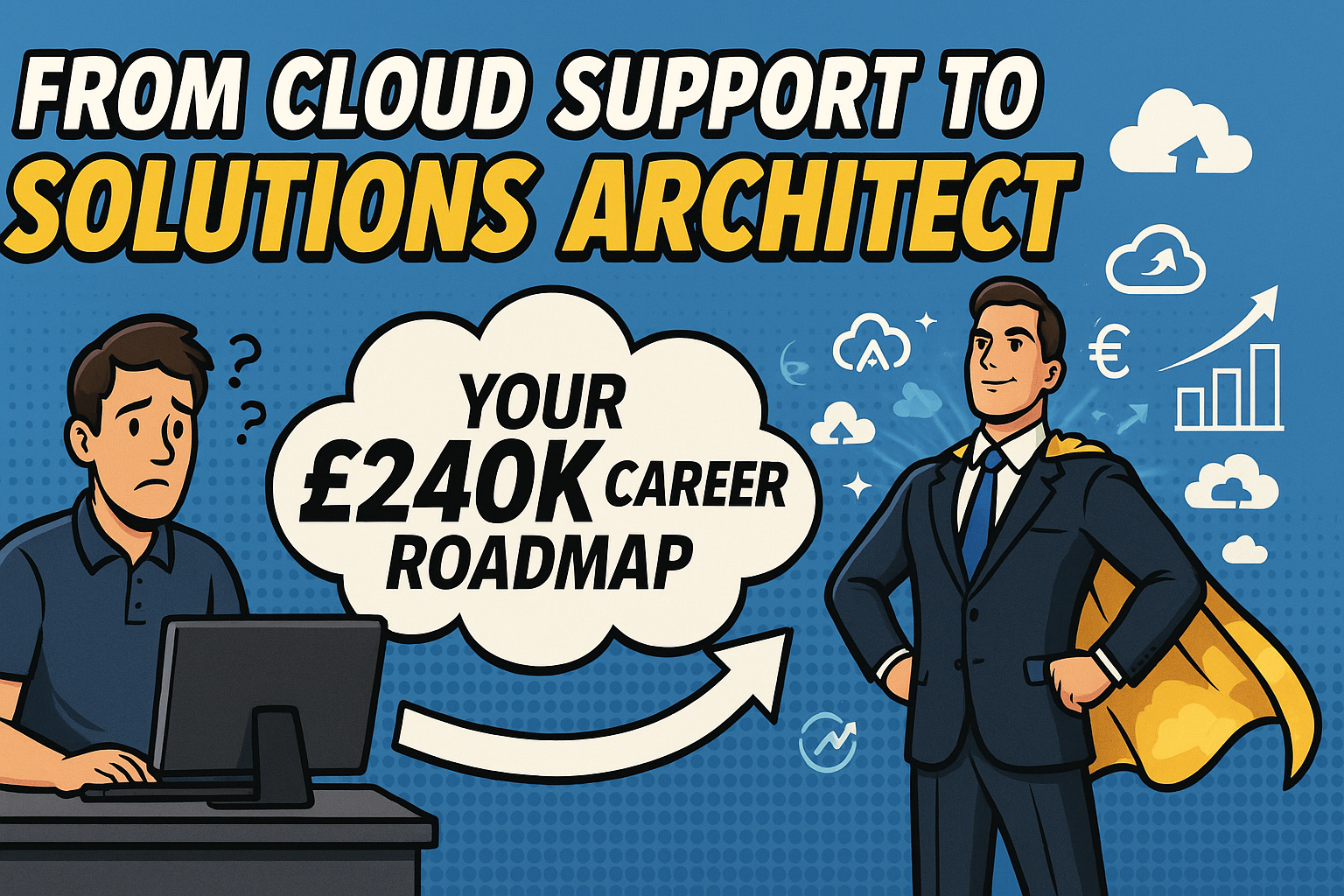
Picture this: You’re starting as a cloud support engineer earning £45,000, answering tickets and troubleshooting basic issues. Fast-forward seven years, and you’re designing enterprise cloud architectures earning £200,000+ annually whilst shaping digital transformation strategies for major organisations. This isn’t just a career progression—it’s a strategic journey that thousands of cloud professionals navigate successfully each year.
The cloud computing career landscape offers one of tech’s most predictable yet rewarding advancement paths. With global cloud spending reaching £580 billion in 2025 and a persistent skills shortage driving up salaries, understanding your progression options has never been more crucial. Unlike traditional IT careers that often plateau, cloud roles provide clear advancement trajectories with substantial financial rewards at each milestone.
Recent market analysis reveals that professionals who strategically plan their cloud career progression see 150-200% salary increases within five to seven years. The journey from entry-level support to senior architecture roles follows well-established patterns, with specific skills, certifications, and experience requirements at each stage. This comprehensive guide maps out exactly how to navigate this lucrative career path.
Whether you’re considering your first cloud role or planning your next career move, understanding the progression pathway, timeline expectations, and skill requirements will help you make informed decisions about your professional development. The cloud skills shortage means employers are actively seeking professionals at every level, but knowing which skills to develop and when can dramatically accelerate your advancement.

The Cloud Career Hierarchy: Understanding Your Options
The cloud computing sector operates with a relatively predictable career structure, offering multiple entry points and clear advancement opportunities. Understanding this hierarchy helps you identify your current position, set realistic goals, and plan your skill development strategy effectively.
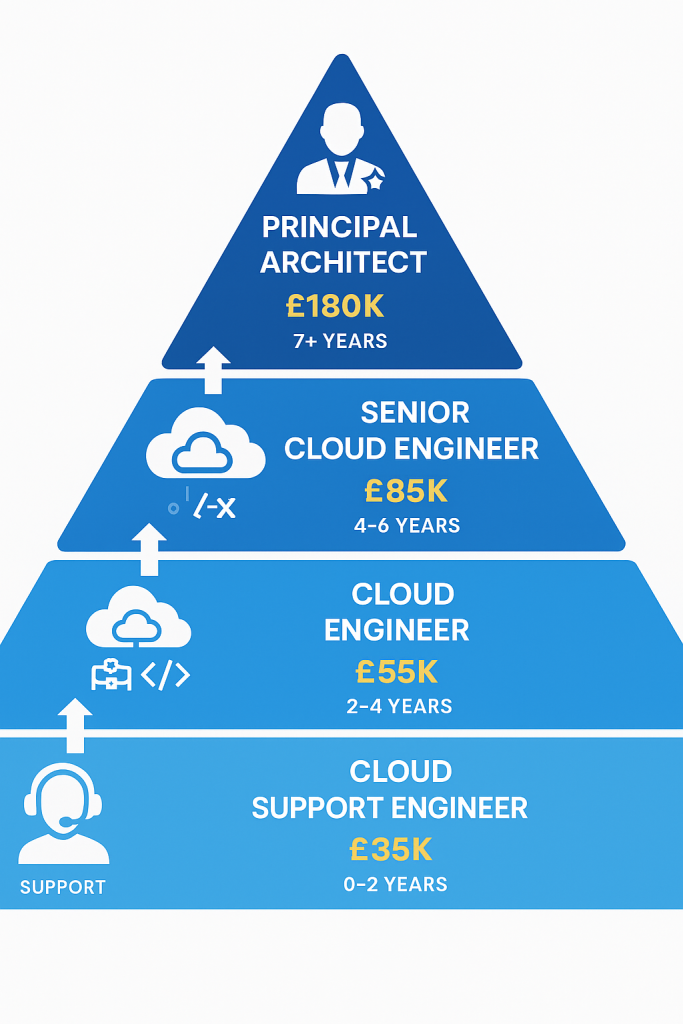
Entry-Level Positions (£35,000-£55,000)
Cloud careers typically begin with support-focused roles that provide foundational experience whilst requiring minimal prior expertise. These positions serve as crucial stepping stones, offering hands-on experience with cloud platforms and customer-facing problem-solving skills.
Cloud Support Engineers form the frontline of cloud operations, responding to customer tickets, troubleshooting basic technical issues, and escalating complex problems to senior team members. This role requires strong communication skills, basic understanding of networking concepts, and familiarity with at least one major cloud platform. The work involves monitoring cloud environments, documenting customer interactions, and participating in knowledge-sharing sessions.
IT Support Technicians transitioning to cloud-focused roles represent another common entry point. These professionals leverage existing helpdesk experience whilst learning cloud-specific technologies. The transition typically involves obtaining foundational cloud certifications and developing understanding of cloud service models (IaaS, PaaS, SaaS).
Mid-Level Engineering Roles (£55,000-£85,000)
After 1-3 years in entry-level positions, professionals typically advance to hands-on engineering roles with greater technical responsibility and autonomy. These positions focus on implementation, maintenance, and optimisation of cloud infrastructure.
Cloud Engineers design, deploy, and manage cloud infrastructure for organisations. They work with Infrastructure as Code tools like Terraform, implement automation solutions, and ensure system reliability and performance. Required skills include programming languages (Python, Java), containerisation technologies (Kubernetes), and deep knowledge of cloud platforms.
DevOps Engineers specialising in cloud technologies bridge development and operations teams, implementing CI/CD pipelines, automating deployment processes, and managing cloud-based development environments. This role commands average salaries of £70,000-£95,000 and provides excellent preparation for senior architectural positions.
Cloud Security Engineers focus on protecting cloud infrastructure, implementing security policies, and ensuring compliance with regulatory requirements. This specialisation commands premium salaries due to high demand and the critical nature of security in cloud environments.
Senior Technical Roles (£85,000-£140,000)
Senior-level positions require 3-7 years of experience and involve strategic planning, complex problem-solving, and often team leadership responsibilities. These roles combine deep technical expertise with business acumen.
Senior Cloud Engineers lead technical initiatives, mentor junior team members, and design complex cloud solutions. They typically specialise in specific areas such as multi-cloud environments, AI/ML workloads, or high-availability systems. Progression to this level requires demonstrated expertise in multiple cloud platforms and proven ability to deliver large-scale projects.
Platform Engineers design and maintain Internal Developer Platforms (IDPs) that enable self-service infrastructure for development teams. This emerging role commands high salaries (£90,000-£120,000) due to its strategic importance and the specialised skills required.
Architectural and Leadership Roles (£120,000-£250,000+)
The pinnacle of cloud careers involves designing enterprise-scale solutions, setting technical direction, and often managing teams or entire technology strategies.
Cloud Solutions Architects design comprehensive cloud strategies for organisations, working with stakeholders to translate business requirements into technical solutions. They require extensive experience across multiple cloud platforms, understanding of enterprise architecture principles, and strong communication skills for executive-level presentations.
Principal Cloud Architects represent the most senior technical individual contributor role, focusing on the most complex architectural challenges and providing technical leadership across entire organisations. These positions require 7+ years of experience and command salaries of £180,000-£300,000+.
Cloud Practice Leads or Cloud Directors combine technical expertise with people management, overseeing cloud transformation initiatives and building cloud centres of excellence within organisations.
Timeline Expectations: Realistic Progression Pathways
Understanding realistic timelines for career progression helps set appropriate expectations and plan skill development activities effectively. Whilst individual circumstances vary, industry data reveals consistent patterns in advancement timeframes.
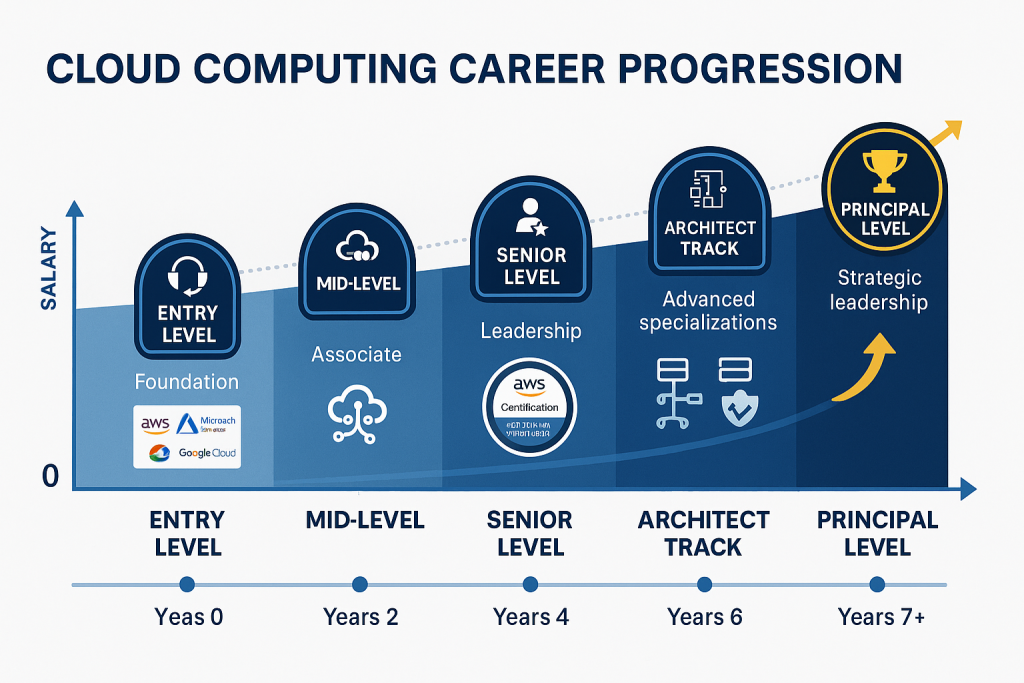
Years 0-2: Foundation Building
The initial phase focuses on gaining practical experience and building foundational skills. Entry-level professionals typically spend 12-24 months in support roles before advancing to engineering positions. This period involves obtaining foundational certifications like AWS Certified Cloud Practitioner or Azure Fundamentals, developing troubleshooting skills, and understanding cloud service models.
Accelerated progression is possible for professionals with relevant IT experience. System administrators, network engineers, and software developers can often transition directly to cloud engineering roles with appropriate certification and demonstrated cloud knowledge. The key success factor is hands-on experience with cloud platforms rather than just theoretical knowledge.
Years 2-4: Specialisation Development
Mid-career progression involves choosing specialisation areas and developing expertise in specific technologies or domains. Cloud engineers typically advance to senior roles within 2-3 years by demonstrating proficiency in automation, infrastructure design, and project leadership.
DevOps practitioners often see rapid advancement due to high demand for automation and CI/CD expertise. Specialising in containers, orchestration, and infrastructure automation can lead to senior positions within 18-24 months of focused development.
Security specialists may require additional time to develop comprehensive expertise, but the investment pays off through premium salaries and strong job security. Cloud security roles often require 3-4 years to reach senior levels due to the breadth of knowledge required.
Years 4-7: Architectural Transition
The transition to architectural roles represents the most significant career milestone, typically occurring after 4-7 years of progressive cloud experience. This transition requires developing business acumen, communication skills, and broad technical knowledge across multiple domains.
Solutions architect roles require demonstrating ability to design end-to-end solutions, work with business stakeholders, and provide technical leadership. The transition often involves taking on increased responsibility within current roles, leading technical projects, and obtaining advanced certifications like AWS Solutions Architect Professional.
Principal architect positions require additional 2-3 years beyond solutions architect level, focusing on enterprise-scale challenges and technical strategy development.
Acceleration Factors
Several factors can significantly accelerate career progression:
Strategic Certification Planning: Obtaining relevant certifications 6-12 months before targeting role transitions demonstrates commitment and validates skills. High-value certifications include cloud platform-specific credentials, security certifications (CISSP), and Kubernetes expertise (CKA).
Cross-Platform Expertise: Professionals with multi-cloud experience advance faster due to increased versatility and market demand. Understanding AWS, Azure, and GCP provides competitive advantages in most markets.
Specialisation in High-Demand Areas: AI/ML integration, security, and automation skills command premium salaries and faster advancement. Professionals who develop expertise in emerging areas like edge computing or quantum cloud services position themselves for rapid career growth.
Skills Evolution: What You Need at Each Level
Career progression in cloud computing requires continuous skill development, with different competencies becoming crucial at various stages. Understanding these requirements helps professionals focus their learning efforts and prepare for advancement opportunities.
Entry-Level Skill Requirements
New cloud professionals need foundational technical skills combined with strong problem-solving abilities and customer service orientation. Technical requirements include basic networking concepts (TCP/IP, DNS, routing), understanding of operating systems (Linux and Windows), and familiarity with at least one cloud platform’s core services.
Communication skills prove equally important, as entry-level roles involve significant customer interaction and knowledge transfer activities. The ability to explain technical concepts to non-technical users and document solutions clearly distinguishes successful candidates.
Foundational cloud knowledge should include understanding of core service categories: compute (virtual machines, containers), storage (object, block, file), networking (VPCs, load balancers), and basic security concepts (IAM, encryption). Hands-on experience through personal projects or labs demonstrates practical application of theoretical knowledge.
Mid-Level Technical Competencies
Engineering roles require deeper technical skills and increasing autonomy in problem-solving. Programming competency becomes essential, with Python being the most valuable language for cloud automation and scripting. Understanding of Infrastructure as Code concepts and tools like Terraform enables consistent, repeatable infrastructure deployment.
Containerisation knowledge, particularly Docker and Kubernetes, becomes crucial as organisations adopt microservices architectures. DevOps practices including version control (Git), CI/CD pipelines, and monitoring solutions form core competencies for cloud engineers.
Security awareness expands beyond basic concepts to include practical implementation of security policies, compliance frameworks, and incident response procedures. Understanding of cloud-native security tools and practices becomes essential for senior engineering roles.
Advanced Technical and Business Skills
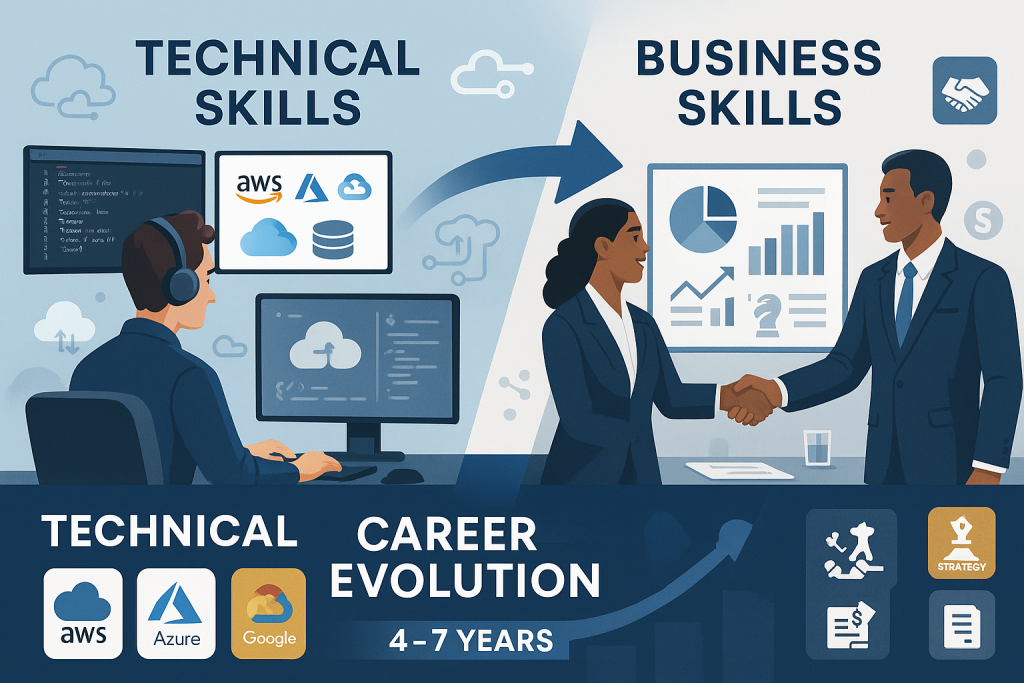
Senior roles require combination of deep technical expertise and business acumen. Architectural thinking involves understanding of distributed systems design, performance optimisation, and cost management strategies. The ability to evaluate trade-offs between different technical approaches and communicate implications to stakeholders becomes crucial.
Project management skills become important as senior professionals often lead technical initiatives. Understanding of Agile methodologies, stakeholder management, and budget considerations helps bridge the gap between technical implementation and business objectives.
Cross-functional collaboration skills enable effective work with product managers, business analysts, and executive teams. The ability to translate technical concepts into business value and risk assessment helps establish credibility with non-technical stakeholders.
Leadership and Strategic Competencies
Architectural roles require strategic thinking and leadership capabilities beyond pure technical skills. Business strategy understanding helps align technical decisions with organisational goals and competitive positioning. The ability to assess market trends and emerging technologies informs strategic technology decisions.
Team leadership skills become essential for senior positions, including mentoring junior professionals, conducting technical reviews, and building consensus around architectural decisions. Communication skills must extend to executive-level presentations and cross-functional team coordination.
Industry knowledge including regulatory requirements, compliance frameworks, and sector-specific challenges enables effective solution design for complex enterprise environments. Understanding of vendor management, contract negotiation, and technology evaluation processes supports strategic decision-making.
Salary Progression: Understanding Your Earning Potential
Cloud computing offers one of tech’s most lucrative career paths, with clear salary progression tied to experience and specialisation. Understanding compensation benchmarks helps professionals negotiate effectively and plan career transitions strategically.
Entry-Level Compensation Trends
Cloud support roles in the UK typically start at £35,000-£45,000, with rapid progression to £50,000+ within 18-24 months for high performers. Location significantly impacts starting salaries, with London positions commanding 15-25% premiums over regional roles.
Entry-level cloud engineers can expect £45,000-£60,000 starting salaries, reflecting the higher technical requirements and immediate value contribution. Professionals with relevant certifications or prior IT experience often secure offers at the higher end of this range.
Performance-based progression in entry-level roles can result in 20-30% salary increases within the first two years, particularly for professionals who demonstrate initiative in automation, problem-solving, and customer service excellence.
Mid-Career Earning Acceleration
Cloud engineers with 2-4 years of experience typically earn £60,000-£85,000, with specialisation driving significant premiums. DevOps engineers with cloud expertise often command £70,000-£95,000 due to high demand for automation skills.
Security specialists see accelerated earning progression, with cloud security engineers earning £75,000-£110,000 after 3-4 years of experience. The critical nature of security work and skills shortage drive these premium salaries.
Platform engineers and Site Reliability Engineers represent emerging high-value roles, with salaries of £80,000-£120,000 reflecting the strategic importance of developer experience and system reliability.
Senior Professional Compensation
Senior cloud engineers and lead developers earn £85,000-£140,000, with total compensation packages often including equity, bonuses, and comprehensive benefits. Specialisation in AI/ML, multi-cloud, or security can add £15,000-£25,000 to base salaries.
Contracting opportunities at senior levels offer higher daily rates (£450-£650 per day) but require managing business responsibilities and intermittent income. Many professionals use contracting to accelerate experience gain and increase total annual earnings.
Architectural Role Compensation
Cloud Solutions Architects earn £120,000-£180,000 on average, with senior positions reaching £200,000+. Total compensation including bonuses and equity can exceed £250,000 for principal architects at major technology companies.
Geographic arbitrage opportunities exist for remote architectural roles, with US companies often offering £150,000-£300,000+ for senior cloud architects willing to work across time zones.
Enterprise architects and cloud practice leads combine technical expertise with management responsibilities, earning £180,000-£350,000+ including management premiums and business outcome bonuses.
Factors Influencing Compensation
Certification impact varies by role and employer, but relevant credentials typically add £5,000-£15,000 to base salaries. High-value certifications include cloud platform professional-level credentials, security certifications, and emerging technology specialisations.
Company size and industry significantly affect compensation. Technology companies and financial services organisations typically offer highest salaries, whilst government and non-profit sectors may offer lower base compensation but better work-life balance and job security.
Negotiation skills become increasingly important at senior levels, where compensation packages involve multiple components beyond base salary. Understanding market rates, demonstrating value contribution, and timing negotiations with performance reviews or job transitions maximises earning potential.
Strategic Career Planning: Maximising Your Advancement
Successful cloud career progression requires strategic planning, continuous learning, and proactive skill development. Understanding how to position yourself for advancement opportunities significantly accelerates timeline and earning potential.
Building Your Technical Foundation
Strategic skill development begins with understanding which competencies provide maximum career leverage. Core cloud platform knowledge (AWS, Azure, GCP) forms the foundation, but specialisation in high-demand areas creates competitive advantages.
Automation skills using tools like Terraform, Ansible, and CI/CD platforms provide immediate value and transfer across roles. Programming competency in Python enables automation, data analysis, and infrastructure management, making it the most valuable language for cloud professionals.
Container orchestration with Kubernetes has become universal requirement for mid-level and senior roles. Obtaining CKA certification and hands-on experience with container platforms positions professionals for DevOps and platform engineering opportunities.
Certification Strategy and ROI
Strategic certification planning involves aligning credentials with career goals and market demand. Entry-level professionals should prioritise foundational certifications that demonstrate platform knowledge and commitment to the field.
Associate-level certifications (AWS Solutions Architect Associate, Azure Associate) provide optimal ROI for mid-career progression, typically resulting in £8,000-£15,000 salary increases within 12 months. Professional-level certifications become valuable for senior role transitions but require substantial preparation time.
Vendor-neutral certifications like CISSP or CompTIA Security+ demonstrate broader expertise and provide career flexibility. These credentials prove particularly valuable for professionals targeting security specialisations or leadership roles.
Experience Acceleration Tactics
Gaining relevant experience quickly requires proactive approach to project selection and skill demonstration. Volunteering for cloud migration projects, automation initiatives, and new technology evaluations provides visibility and learning opportunities.
Side projects and open-source contributions demonstrate initiative and practical skills to potential employers. Building cloud-based applications, contributing to infrastructure tools, or writing technical content establishes professional reputation and technical credibility.
Cross-functional collaboration opportunities help develop business acumen and communication skills essential for senior roles. Working with product teams, participating in business requirements gathering, and presenting technical solutions to stakeholders builds crucial non-technical competencies.
Network Building and Professional Development
Professional networking accelerates career advancement through access to opportunities, mentorship, and industry insights. Participating in cloud meetups, conferences, and online communities builds relationships with peers and potential mentors.
AWS User Groups, Microsoft Azure communities, and Google Cloud community events provide local networking opportunities and access to technical knowledge sharing.
Online presence through technical blogging, speaking at conferences, or contributing to technical discussions establishes professional reputation and attracts career opportunities. Many senior professionals receive job offers through their professional network rather than traditional recruitment channels.

Transition Planning and Timing
Strategic career transitions require timing market demand with skill development and personal readiness. Understanding industry hiring cycles, budget allocation patterns, and organisational transformation timelines helps optimise job search timing.
Internal promotion opportunities often provide fastest advancement with reduced interview stress and established relationships. Demonstrating readiness for increased responsibility through project leadership and skill development positions professionals for internal advancement.
External opportunities enable salary acceleration and experience diversification but require market awareness and negotiation skills. Understanding compensation benchmarks, company culture fit, and growth opportunities helps evaluate offers effectively.

Conclusion: Your Cloud Career Action Plan
The journey from cloud support engineer to solutions architect represents one of technology’s most rewarding career progressions, combining intellectual challenge, financial growth, and strategic business impact. With clear pathways, predictable timelines, and abundant opportunities, success depends primarily on strategic planning and consistent skill development.
The cloud skills shortage creates exceptional opportunities for professionals at every level, from entry-level support roles to senior architectural positions. Organisations struggle to fill cloud roles across all experience levels, creating seller’s market conditions that favour candidates with relevant skills and demonstrated experience.
Strategic career planning involves understanding progression timelines (4-7 years to senior architecture roles), skill requirements at each level, and market demand for specific competencies. Professionals who align their skill development with market demand and position themselves for advancement opportunities see accelerated progression and substantial salary growth.
The investment in cloud skills development provides exceptional return on investment, with professionals typically seeing 150-200% salary increases over 5-7 years. The combination of high demand, skills shortage, and strategic importance of cloud computing to business operations ensures continued growth opportunities and competitive compensation.
Success in cloud career progression requires combining technical excellence with business acumen, communication skills, and strategic thinking. The most successful professionals understand that advancement depends not just on technical capabilities but on ability to contribute to business objectives and lead technical initiatives.
Recommended Next Steps:
Assess Your Current Position: Evaluate your skills against the requirements for your target role and identify specific gaps to address through training or certification.
Develop a 24-Month Plan: Set specific goals for certification, skill development, and experience acquisition that align with your advancement timeline.
Build Your Professional Network: Engage with cloud communities, attend industry events, and establish relationships with professionals in your target roles.
Start Your Learning Journey: Explore AWS Training, Microsoft Learn, or Google Cloud Skills Boost to begin developing cloud competencies.
The cloud computing career landscape offers unprecedented opportunities for professional growth and financial advancement. With strategic planning, consistent effort, and focus on high-value skills, your journey from support engineer to solutions architect can provide both personal satisfaction and substantial financial rewards.
Where do you see yourself in 2 years? Let’s plan your path! Share your current role and target position in the comments below, and let’s discuss the specific steps you need to take to accelerate your cloud career progression.
Ready to accelerate your cloud career? Subscribe to our Friday Focus series for weekly professional development insights, and join our community of cloud professionals planning their advancement strategies.