The enterprise integration landscape faces a strategic inflection point in 2026. BizTalk Server’s mainstream support ends in April 2028, the Integration Service Environment retired in August 2024, and organizations face mounting pressure to modernize middleware architectures built on decade-old patterns. Meanwhile, the iPaaS market grows at 25-42% annually, reaching a projected £60-100 billion by 2030. For platform architects managing enterprise integration portfolios in the £100,000-£500,000 annual spend range, the question isn’t whether to modernize but which platform will anchor your integration strategy for the next decade.
Azure Logic Apps has emerged as Microsoft’s answer, achieving Gartner Magic Quadrant Leader status for seven consecutive years. With 1,400+ pre-built connectors, native AI integration through Azure OpenAI, and a Forrester-validated 295% ROI over three years, Logic Apps positions itself as a compelling iPaaS alternative to market leaders MuleSoft and Dell Boomi. The platform now processes over 450 million daily requests for BMW’s connected vehicle infrastructure and handles Microsoft’s own supply chain integration managing 250+ million messages monthly across 750+ suppliers.
This comprehensive master class examines Azure Logic Apps from architectural foundations through enterprise patterns to production deployment considerations. Whether you’re evaluating Logic Apps for adoption, planning infrastructure architecture, or optimizing existing deployments, this guide provides the technical depth and strategic context required for enterprise-scale integration success.
The evolution of enterprise integration: from BizTalk to cloud-native iPaaS
Enterprise integration has evolved through three distinct architectural eras. The first generation centred on enterprise service buses like BizTalk Server, WebSphere, and TIBCO, with on-premises middleware requiring substantial infrastructure investment and specialized development teams. These platforms excelled at B2B integration and complex orchestration but struggled with cloud service proliferation and agile development velocities.
The second generation introduced cloud-based integration through early iPaaS offerings, primarily focused on migrating ESB patterns to hosted infrastructure. These platforms reduced operational overhead but maintained traditional integration development approaches, requiring significant technical expertise and lengthy development cycles.
The third generation (where Logic Apps now competes) delivers low-code integration with serverless economics, AI-powered workflow automation, and hybrid connectivity spanning cloud and on-premises resources. Modern iPaaS platforms prioritize developer productivity through visual designers, pre-built connectors, and infrastructure automation whilst supporting both IT-led integration projects and citizen developer scenarios.
The market shift accelerates driven by three forces. First, SaaS application proliferation creates integration complexity. The average enterprise now manages 130+ SaaS applications requiring interconnection. Second, API economy maturity enables event-driven architectures replacing batch-oriented integration patterns. Third, AI integration requirements demand platforms capable of orchestrating machine learning models, vector databases, and large language models alongside traditional enterprise systems.
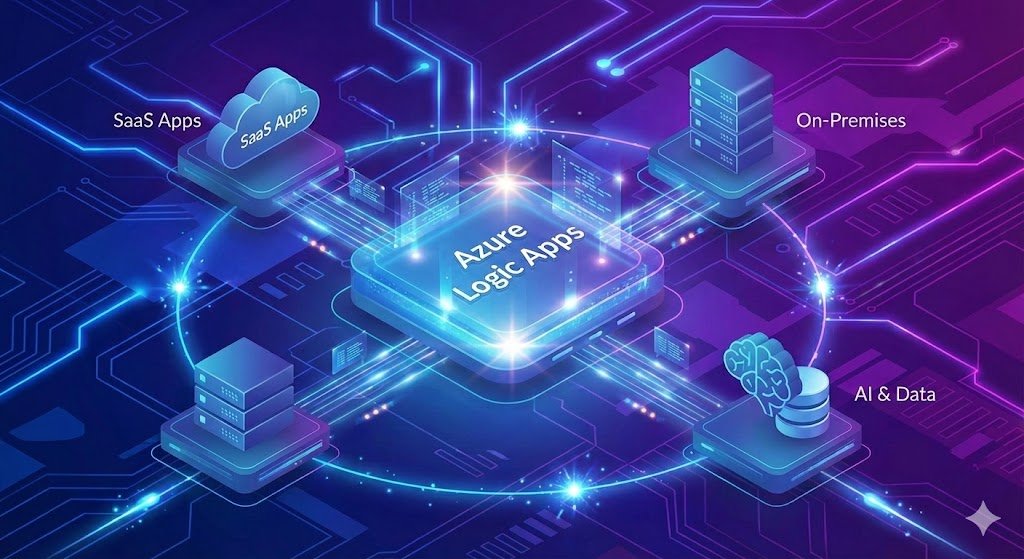
Microsoft’s strategic positioning leverages Azure ecosystem depth. Logic Apps integrates natively with Azure OpenAI for generative AI workflows, Azure AI Search for retrieval augmented generation patterns, Event Grid for event-driven architectures, and API Management for comprehensive API governance. This ecosystem integration delivers competitive advantage for organizations already invested in Azure (approximately 95% of Fortune 500 companies according to Microsoft).
The BizTalk Server end-of-life timeline creates urgency. Mainstream support concludes April 11, 2028, with extended support ending April 9, 2030. Critically, Azure Service Bus SBMP protocol (BizTalk’s default Service Bus adapter) retires September 30, 2026, forcing migration planning for hybrid architectures. With no BizTalk Server 2024 planned, Microsoft clearly signals Logic Apps as the strategic integration platform for the next decade.
Understanding broader cloud strategy decisions helps contextualize this integration platform evaluation within enterprise digital transformation initiatives.
Architectural foundations: Consumption versus Standard plans
Azure Logic Apps offers two fundamentally different deployment models, each optimized for distinct workload characteristics. Choosing incorrectly can result in 2-3x cost overruns or capability constraints that limit architectural options.
Consumption Plan: serverless multi-tenant infrastructure
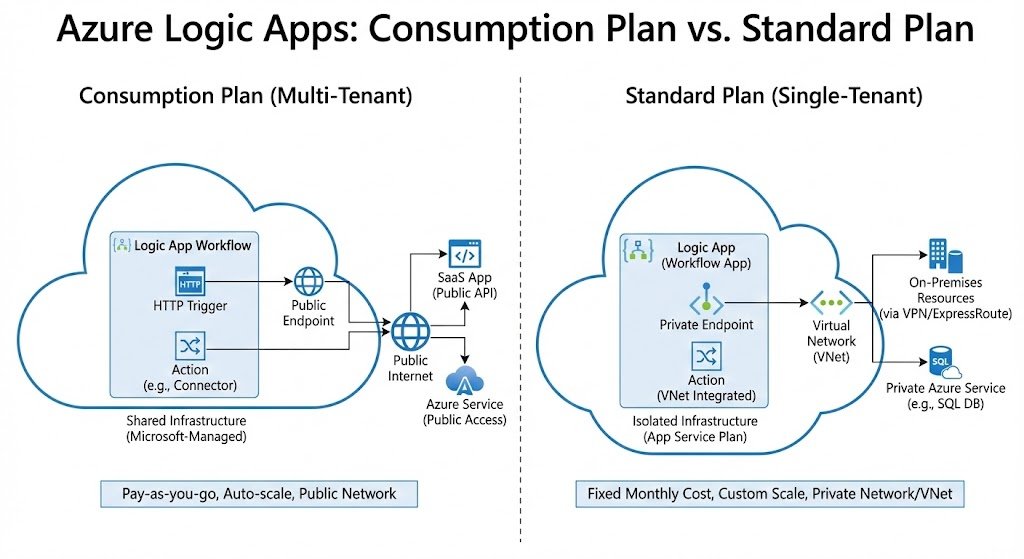
Consumption Plan operates as multi-tenant serverless infrastructure with pure pay-per-execution pricing. The platform charges approximately £0.00002 per action for built-in operations and £0.0001 per standard connector call, with enterprise connectors at £0.0008 per call. The first 4,000 actions per Azure subscription monthly incur no charge. This model suits organizations with unpredictable integration volumes, development and testing environments, and scenarios where minimizing fixed costs outweighs infrastructure control requirements.
Consumption workflows execute in shared Microsoft-managed infrastructure with automatic scaling but limited customization. You cannot control VM sizing, configure custom autoscaling rules, or implement VNet integration for network isolation. Workflows trigger via HTTP requests, Service Bus messages, Event Grid events, or polling-based connectors checking external systems at configurable intervals. The platform provides built-in retry logic with exponential backoff, dead-letter queue support, and comprehensive run history retention for 90 days.
Standard Plan: single-tenant isolated infrastructure
Standard Plan delivers single-tenant isolation running on the Azure Functions runtime with fundamentally different economics. Base compute starts at approximately £140 monthly for the WS1 tier (1 vCPU, 3.5GB RAM) scaling to £560 monthly for WS3 (4 vCPU, 14GB RAM). The critical economic distinction: built-in connector operations execute at no additional charge beyond the compute tier. Only managed connector calls to external services incur per-operation fees.
Standard Plan capabilities expand dramatically beyond Consumption:
VNet integration and private endpoints enable complete network isolation without the Integration Service Environment (ISE), which Microsoft retired August 31, 2024. Organizations running ISE workloads face a February 28, 2025 export deadline, migrating to Standard with VNet integration at approximately £5,000 monthly less than ISE Premium SKU whilst maintaining equivalent network security posture.
Multiple workflows per Logic App resource reduce management overhead significantly. A single Standard Logic App can host 20-50 workflows sharing compute resources, connection configurations, and deployment pipelines (analogous to Azure Functions’ function app model). This consolidation simplifies governance, reduces connection sprawl, and improves cost visibility.
Local development via Visual Studio Code transforms the development experience. Developers run and debug Logic Apps locally with full breakpoint support, test against local resources, and commit workflow definitions to Git repositories as JSON files. This enables proper CI/CD practices with pull request reviews, automated testing, and infrastructure-as-code deployment via ARM templates or Bicep.
Stateless workflow support represents a performance breakthrough for high-throughput scenarios. Stateless workflows execute entirely in memory, eliminating Azure Storage I/O overhead inherent in stateful workflows that persist state after each action. Real-world benchmarks demonstrate 5-10x faster response times for stateless implementations, with sub-100ms latency achievable for simple HTTP-triggered workflows.
The trade-offs for stateless workflows include maximum 5-minute runtime limits, 64KB optimal message size for best performance, and no run history retention beyond immediate execution context. Use stateless workflows for webhook handlers, synchronous API backends, high-frequency event processing, and scenarios where sub-second latency matters more than audit trail retention. Deploy stateful workflows for long-running processes, compliance-driven audit requirements, and complex orchestrations requiring debugging visibility.
Container deployment extends Standard workflows beyond Azure. Export Logic Apps as Docker containers, deploying to Azure Kubernetes Service, Azure Arc-enabled Kubernetes, or any container orchestration platform. This capability enables consistent integration runtime across cloud, edge, and on-premises environments (critical for highly regulated industries requiring data sovereignty or disconnected operation scenarios).
For organizations evaluating plan selection, the break-even analysis typically favours Standard at approximately 500,000-1,000,000+ monthly actions when built-in connectors dominate workflow composition. Consumption remains optimal for sporadic workloads, rapid prototyping, and scenarios requiring multi-region deployment without infrastructure management complexity.
Enterprise integration patterns: orchestration at scale
Azure Logic Apps implements enterprise integration patterns through declarative, event-driven workflows fundamentally different from traditional procedural middleware orchestration. The platform’s strength lies in composition: combining pre-built connectors, control flow primitives, and data transformation operations into sophisticated integration scenarios without extensive custom code.
Message routing and transformation
Content-based routing leverages Condition actions evaluating message properties, payload content, or external system state to determine execution paths. Switch actions provide cleaner syntax for multi-path routing scenarios. Parallel branches enable fork-join patterns where multiple integration paths execute concurrently, converging at a subsequent synchronization point. Dynamic routing using variables and workflow expressions enables runtime determination of endpoints, connection strings, and transformation rules (essential for multi-tenant integration scenarios).
The platform supports comprehensive transformation capabilities. XSLT 1.0 and 2.0 processors handle XML transformations with full XPath support. Liquid templates enable JSON-to-JSON and JSON-to-XML transformations with control flow, filtering, and complex restructuring logic. Native data operations (Parse JSON, Select, Filter Array, Compose) manipulate JSON payloads without external processors. Integration with Azure Functions enables custom transformation logic in C#, Python, JavaScript, or PowerShell for scenarios exceeding built-in capability.
Error handling and resilience patterns
Configurable retry policies per action follow either exponential backoff (default: 4 retries with 7.5-second interval scaling, capping delay between 5-45 seconds) or fixed interval strategies (supporting 1-90 retries with consistent delay, useful for rate-limited APIs with predictable recovery windows). Disabling retries propagates failures immediately for scenarios requiring human intervention or custom error handling logic.
Run-After conditions enable conditional error handling paths based on predecessor action status: Succeeded, Failed, Skipped, or TimedOut. This mechanism implements compensating transactions, notification workflows, and dead-letter processing patterns. For poison message scenarios, integrate with Azure Service Bus dead-letter queues, implementing retry limits before message quarantine. Scope actions group related operations, enabling grouped error handling and transaction-like semantics despite Logic Apps’ fundamentally stateless action model.
Parallel processing and scale
For Each loops support 1-50 concurrent iterations (default 20), processing array elements in parallel with configurable degree of parallelism. Trigger concurrency settings enable up to 100 concurrent workflow runs for the same Logic App, handling burst traffic scenarios. Split-On debatching extracts individual items from batch messages, triggering separate workflow runs for up to 100,000 items (enabling massive parallelization for scenarios like CSV processing or API result pagination).
Performance benchmarking from Microsoft demonstrates Standard Plan workflows achieving 500,000 operations per minute under sustained load with target-based scaling halving scale-out time compared to incremental scaling approaches. Real-world production workloads regularly sustain 50,000-100,000 executions daily per Logic App without throttling.
Hybrid connectivity patterns
The On-premises Data Gateway installs on Windows Server infrastructure, creating encrypted tunnels between Azure and private networks. Supported connectors include SQL Server, Oracle Database, SAP, SharePoint Server, and File System operations. The gateway itself incurs no charge; only connector action executions follow standard pricing.
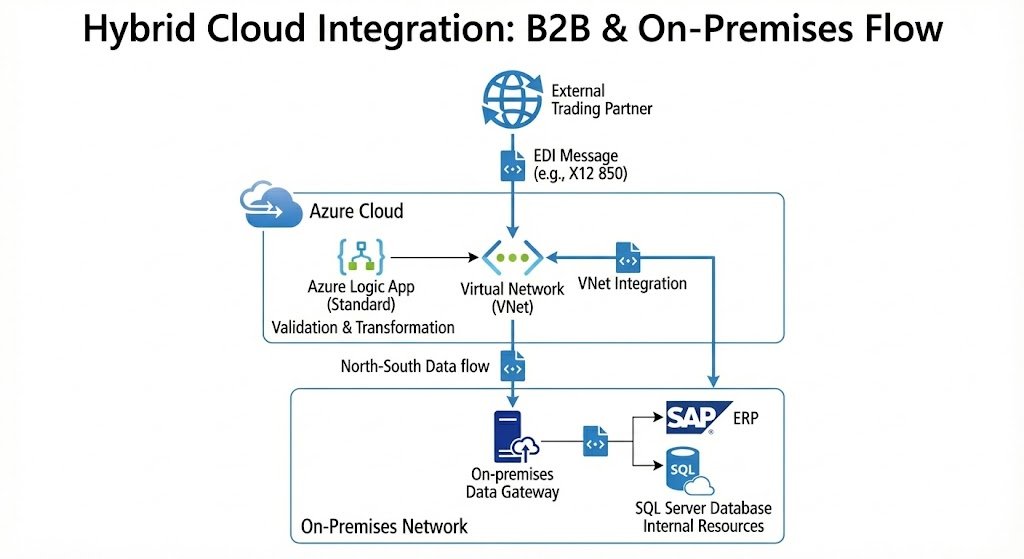
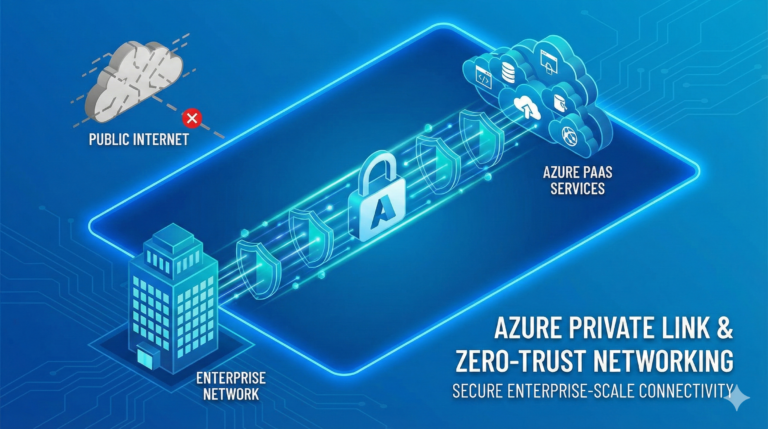
VNet Integration (Standard only) provides native outbound traffic routing through your virtual network without gateway infrastructure. Configure private endpoints for inbound traffic, creating fully network-isolated integration layers where workflows never traverse public internet paths. Required configuration includes app settings WEBSITE_VNET_ROUTE_ALL=1 and WEBSITE_CONTENTOVERVNET=1 for private storage account access. This architecture suits financial services, healthcare, and government deployments requiring zero internet exposure for sensitive data flows.
For organizations building hybrid cloud architectures, Logic Apps’ connectivity patterns complement Azure Arc’s management plane extension, enabling consistent integration runtime governance across distributed environments.
B2B integration and EDI capabilities
The Enterprise Integration Pack extends Logic Apps with comprehensive B2B capabilities essential for supply chain integration, healthcare data exchange, and financial services messaging. These features target organizations processing thousands to millions of EDI transactions annually, managing multiple trading partners with unique protocol requirements.
EDI message processing
Full X12 (North American standard) and EDIFACT (international standard) support includes encode and decode actions. X12 transaction sets include 850 (Purchase Order), 855 (PO Acknowledgment), 856 (Advance Ship Notice), 810 (Invoice), and all common variants. EDIFACT message types span ORDERS, ORDRSP, DESADV, INVOIC, and industry-specific implementations. The platform validates inbound messages against schemas, performing segment validation, element validation, control number verification, and functional acknowledgment generation (TA1, 997, 999 for X12; CONTRL for EDIFACT).
Schema repositories include all BizTalk-compatible EDI schemas, publicly available in Microsoft’s Integration GitHub repository. Organizations migrating from BizTalk can typically reuse existing schemas with minimal modification. Custom EDI variants and industry-specific implementations like HIPAA 837 (Healthcare Claims) or UCS (Uniform Communication Standard) require schema customization but leverage the same processing engine.
Protocol and trading partner management
AS2 (Applicability Statement 2) support includes digital signing via X.509 certificates, encryption using 3DES or AES, and synchronous or asynchronous MDN (Message Disposition Notification) acknowledgments. AS2 v2 compliance ensures interoperability with major EDI VAN (Value-Added Network) providers and trading partner AS2 servers. RosettaNet connectors enable PIP (Partner Interface Process) exchange for supply chain integration, particularly common in technology and electronics manufacturing.
The newly announced HL7 Connector (Public Preview) delivers critical healthcare interoperability, supporting HL7 v2.X flat-file and XML schemas with MLLP (Minimal Lower Layer Protocol) adapter now in private preview. This addition positions Logic Apps for healthcare system integration, enabling workflows bridging HL7-based electronic health records with modern FHIR APIs and cloud analytics platforms.
Trading partner management occurs through Integration Accounts providing centralized governance for B2B artifacts. Basic tier (~£240 monthly) supports 500 schemas/maps and 2 trading partners (suitable for pilot implementations). Standard tier (~£790 monthly) scales to 1,000 schemas/maps and 1,000 trading partners for enterprise B2B programs. Integration Accounts store partner profiles, trading partner agreements (defining protocol requirements, message formats, and acknowledgment rules), schemas, XSLT maps, and certificates.
A critical cost optimization: Standard Logic Apps can store schemas and maps locally without Integration Account charges when B2B protocol features (AS2, X12, EDIFACT) aren’t required. This approach suits organizations needing transformation capabilities for non-B2B integrations, reducing monthly costs by £240-£790.
Cost analysis: from pilot to enterprise scale
Understanding Logic Apps’ true cost requires modelling across transaction volumes, connector type distribution, and infrastructure requirements. The pricing model’s flexibility enables both compelling economics and potential cost overruns when misunderstood.
Consumption Plan TCO scenarios
For a pilot implementation processing 100,000 transactions monthly with average 10 actions per workflow, 70% standard connectors, and 30% enterprise connectors:
- Actions: 1,000,000 minus 4,000 free tier = 996,000 × £0.00002 = £20
- Standard connectors: 700,000 × £0.0001 = £70
- Enterprise connectors: 300,000 × £0.0008 = £240
- Monthly total: ~£330 | Annual: ~£3,960
Scaling to 500,000 transactions monthly (5,000,000 actions):
- Actions: 4,996,000 × £0.00002 = £100
- Standard connectors: 3,500,000 × £0.0001 = £350
- Enterprise connectors: 1,500,000 × £0.0008 = £1,200
- Monthly total: ~£1,650 | Annual: ~£19,800
At 1,000,000+ transactions monthly (10,000,000 actions):
- Actions: 9,996,000 × £0.00002 = £200
- Standard connectors: 7,000,000 × £0.0001 = £700
- Enterprise connectors: 3,000,000 × £0.0008 = £2,400
- Monthly total: ~£3,300 | Annual: ~£39,600
Standard Plan economics
Standard Plan’s fixed compute plus free built-in operations often delivers superior TCO for consistent high volumes. A WS2 tier (~£296 monthly) processing 1,000,000+ monthly transactions with predominantly built-in connectors (Azure services, HTTP operations, data operations) achieves 30-40% savings versus equivalent Consumption workloads.
Standard Plan tiers and approximate UK pricing:
- WS1 (1 vCPU, 3.5GB): ~£140/month
- WS2 (2 vCPU, 7GB): ~£296/month
- WS3 (4 vCPU, 14GB): ~£560/month
Workflows containing many HTTP calls to REST APIs, Azure service operations (Cosmos DB, Storage, Service Bus), or data transformation actions see dramatic cost reduction on Standard since these built-in operations incur no per-execution charges. The economic crossover typically occurs around 500,000-1,000,000 monthly actions depending on built-in versus managed connector ratio.
Hidden costs requiring modelling
Comprehensive TCO analysis includes ancillary services and operational overhead that can equal or exceed base Logic Apps costs:
Premium and enterprise connectors carry significantly higher per-operation charges. SAP, IBM MQ, ServiceNow, Oracle Database connectors bill at £0.0008 per call (8x standard connector costs). A workflow executing 100,000 SAP BAPI calls monthly costs £80 in connector charges alone, often exceeding base workflow execution costs.
Data egress charges apply when transferring data from Azure to on-premises systems or other cloud providers. First 10TB monthly costs £0.07 per GB. Organizations processing high-volume data synchronization (EDI documents, large batch files, media streaming) should model egress carefully. 10TB monthly represents £700 in data transfer charges.
API Management integration enhances Logic Apps with rate limiting, authentication, caching, and API analytics but adds £140-£2,240 monthly depending on tier. Developer tier (£140/month) suits non-production; Standard tier (~£600/month) provides SLA-backed production capabilities; Premium tier (~£2,240/month) delivers VNet integration and multi-region deployment.
Log Analytics ingestion enables comprehensive monitoring and diagnostics. Sending Logic Apps diagnostic logs and workflow tracking data to Log Analytics costs approximately £1.84 per GB ingested. High-volume production environments generating 50-100GB monthly diagnostic data add £92-£184 monthly monitoring costs.
Training and professional services represent significant initial investment. Logic Apps developer training runs £1,000-£5,000 per developer for comprehensive courses covering Standard workflows, B2B integration, and advanced patterns. Implementation partner services for complex BizTalk migrations typically range £50,000-£200,000 depending on interface complexity and customization requirements.
Forrester Total Economic Impact validation
The Forrester Total Economic Impact study (July 2023) quantified Azure Integration Services benefits for a composite organization: 10,000 employees, £2.8 billion revenue, 500 Logic Apps in production:
- 295% ROI over 3 years
- Net Present Value,: £6.86 million (approximately, converted from $8.57M)
- Payback period: under 6 months
Benefit categories with three-year present values:
Integration developer productivity improvement (35-45% efficiency gain): £1.92 million. Reduced development time from 4 weeks to 10 days for typical integration scenarios, enabled by visual designer, pre-built connectors, and reusable templates.
DevOps team efficiencies (40-50% operational improvement): £694,000. Automated deployment pipelines, infrastructure-as-code, and monitoring integration reduced manual release processes and incident response time.
Incremental revenue from data insights: £2.56 million. Real-time integration enabling analytics previously impossible with batch-oriented legacy middleware, driving business decisions leveraging current data.
Business efficiencies from automated processes: £2.8 million. Elimination of manual data entry, automated invoice processing, and self-service integration capabilities freeing business users from IT dependency.
Risk-adjusted costs totalled £2.58 million including subscription fees, professional services, training, and internal labour. The study validated Logic Apps’ business case for enterprises processing significant integration volumes, particularly those migrating from infrastructure-intensive legacy middleware.
Understanding cloud cost optimization strategies proves essential for maximizing Logic Apps ROI. Organizations implementing FinOps practices achieve 10-30% cost savings through right-sizing compute tiers, optimizing connector usage, and implementing data retention policies aligned with compliance requirements rather than default settings.
Vendor comparison: Logic Apps versus the market
MuleSoft Anypoint Platform: API-led connectivity leader
MuleSoft maintains market leadership position, achieving Gartner Magic Quadrant Leader status for nine consecutive years with highest marks for API lifecycle management capabilities (rated 9.4 versus Logic Apps’ 7.8) and exception handling sophistication (9.3 versus 7.8). The platform’s three-layer connectivity architecture (system APIs, process APIs, and experience APIs) enforces separation of concerns and promotes reusability across large development organizations.
MuleSoft’s DataWeave transformation language provides more powerful capabilities than Logic Apps’ expression language, particularly for complex data manipulation, recursive transformations, and streaming large datasets. The platform’s design-first API approach with RAML/OAS specifications and Anypoint Studio IDE delivers superior developer experience for teams building API-centric integration architectures.
However, enterprise licensing typically costs £80,000-£400,000+ annually for production deployments (2-3x Logic Apps’ TCO for equivalent transaction volumes). MuleSoft’s value proposition strengthens for organizations prioritizing API-led connectivity as strategic architecture, possessing Salesforce ecosystem investment, or employing large development teams with Java and integration expertise.
Choose MuleSoft when: API-led connectivity drives enterprise architecture strategy; Salesforce integration represents significant business value; complex data transformation requirements exceed Logic Apps capabilities; multi-cloud strategy spans AWS, GCP, and Azure with minimal Azure footprint; budget supports premium pricing for market-leading API management maturity.
Choose Logic Apps when: Microsoft and Azure ecosystem investment exists; budget constraints require cost-effective solution; rapid deployment with low-code development approach prioritizes speed over sophistication; simpler workflow automation requirements without complex API governance; citizen developer enablement alongside IT-led integration development.
Dell Boomi AtomSphere: data quality integration leader
Boomi achieved highest Gartner score for Ability to Execute in both 2024 and 2025 Magic Quadrants, with 11 consecutive years as Leader. The platform’s key differentiator: Master Data Hub providing embedded master data management capabilities ensuring integrated data maintains quality, consistency, and governance throughout integration flows.
Boomi Suggest and Boomi Assure deliver AI-assisted integration development, automatically recommending integration patterns, suggesting data mappings, and identifying potential data quality issues during design. This capability accelerates development whilst reducing errors, particularly valuable for organizations with limited integration expertise.
The platform’s unified interface provides consistent user experience across integration development, API management, master data management, and B2B management (reducing tool sprawl compared to assembling equivalent capabilities from multiple products). Boomi’s cloud-native architecture with containerized Atom runtimes enables flexible deployment patterns including cloud, on-premises, and edge.
Pricing typically ranges £40,000-£160,000+ annually for enterprise deployments. Boomi excels for organizations prioritizing data quality governance alongside integration, those requiring sophisticated MDM capabilities without separate product, and midmarket enterprises seeking comprehensive iPaaS platform without MuleSoft’s pricing premium.
AWS integration services: fragmented ecosystem approach
AWS requires combining Step Functions (state machine orchestration), EventBridge (event routing), and AppFlow (SaaS data transfer) to approximate Logic Apps’ unified capabilities. This fragmented approach creates architectural complexity with multiple pricing models, more integration points to maintain, and learning curve across three distinct services.
Step Functions pricing charges per state transition starting at $0.025 per 1,000 transitions (Standard workflows) or $1.00 per 1 million requests (Express workflows). AppFlow bills $0.001 per flow run plus $0.02 per GB of data processed. EventBridge charges $1.00 per million events published. Organizations must aggregate costs across services and architect carefully to avoid unexpected charges from high-volume scenarios.
AWS integration services suit organizations deeply invested in AWS ecosystem, building event-driven microservices architectures on AWS Lambda, or requiring tight coupling with AWS-native services like DynamoDB, S3, and Lambda. However, third-party SaaS connectivity requires custom Lambda development or AppFlow’s more limited connector library (80+ connectors versus Logic Apps’ 1,400+).
Choose AWS when: AWS represents primary cloud platform with minimal Azure footprint; event-driven microservices architecture on Lambda forms integration foundation; team possesses strong AWS development expertise with CloudFormation/CDK proficiency; integration requirements center on AWS service orchestration rather than third-party SaaS connectivity.
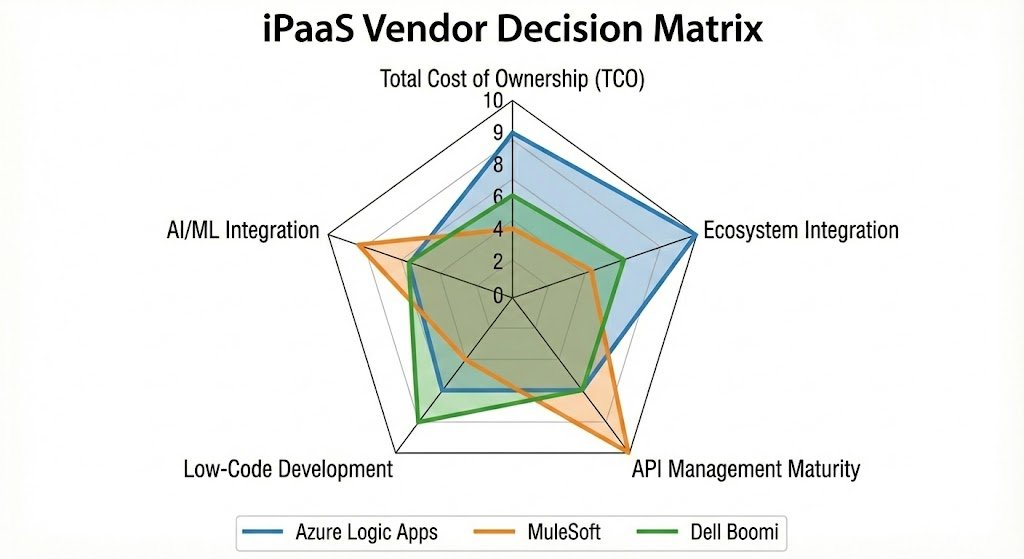
Competitive decision matrix
| Evaluation Criteria | Logic Apps | MuleSoft | Boomi | AWS Services |
|---|---|---|---|---|
| Total Cost of Ownership | ★★★★★ | ★★☆☆☆ | ★★★☆☆ | ★★★★☆ |
| Microsoft Ecosystem Integration | ★★★★★ | ★★☆☆☆ | ★★★☆☆ | ★☆☆☆☆ |
| API Management Maturity | ★★★☆☆ | ★★★★★ | ★★★☆☆ | ★★★☆☆ |
| Pre-built Connector Breadth | ★★★★★ | ★★★★☆ | ★★★☆☆ | ★★☆☆☆ |
| Enterprise B2B/EDI | ★★★★☆ | ★★★★★ | ★★★★☆ | ★★☆☆☆ |
| Low-Code Development | ★★★★☆ | ★★☆☆☆ | ★★★★☆ | ★★☆☆☆ |
| AI/ML Integration | ★★★★★ | ★★★☆☆ | ★★★☆☆ | ★★★★☆ |
| Hybrid/On-premises Connectivity | ★★★★☆ | ★★★★☆ | ★★★★★ | ★★☆☆☆ |
Cost sensitivity analysis: Organizations with £100,000 annual integration budget find Logic Apps supports 2-3x transaction volume versus MuleSoft, 1.5-2x versus Boomi. AWS costs vary dramatically based on architecture. EventBridge-heavy patterns can become expensive at high volumes whilst Step Functions with Express workflows remains cost-effective.
Ecosystem lock-in considerations: Logic Apps tightly couples to Azure ecosystem (migration to alternative platforms requires substantial reengineering). However, for organizations already standardized on Microsoft 365, Azure AD, Dynamics 365, or Power Platform, this coupling provides competitive advantage through seamless authentication, unified governance, and cross-product integration.
Market positioning and analyst recognition
Microsoft achieved Gartner Magic Quadrant Leader status in the 2025 iPaaS evaluation (the seventh consecutive year). This sustained Leader positioning demonstrates platform maturity, customer satisfaction, and Microsoft’s continued investment in integration capabilities.
Gartner evaluation highlights
Strengths recognized:
Comprehensive Azure ecosystem integration delivers competitive differentiation. Logic Apps connects natively with Azure OpenAI for generative AI workflows, Azure AI Search for RAG (Retrieval Augmented Generation) patterns, Azure Machine Learning for model scoring, Event Grid for event-driven architectures, and API Management for comprehensive API governance. This depth of integration enables sophisticated scenarios difficult or impossible with platform-agnostic iPaaS vendors.
Hybrid and multi-cloud capabilities spanning 60+ Azure regions globally with consistent management plane. Organizations deploy Logic Apps across cloud, on-premises via Azure Arc, and edge environments via containerized deployments. Geographic distribution supports data sovereignty requirements and latency optimization for global enterprises.
Dual go-to-market serving IT developers through Azure portal and Visual Studio Code whilst enabling business users through Power Automate (Logic Apps’ low-code variant). This broad addressability expands use cases from enterprise integration to departmental automation, maximizing platform utilization and ROI.
AI-infused workflow capabilities including Azure OpenAI connector, Form Recognizer for document processing, and Cognitive Services for language understanding. Microsoft positions Logic Apps as integration foundation for AI-powered business processes, crucial as enterprises implement generative AI at scale.
Cautions noted:
Dual go-to-market complexity between Azure (Logic Apps) and Power Platform (Power Automate) occasionally results in uncoordinated sales approaches confusing customers about product selection and licensing. Microsoft addresses this through improved field training and unified messaging positioning Power Automate for business users, Logic Apps for IT professionals.
Platform complexity navigating Standard versus Consumption plans, Integration Service Environment retirement, and choosing between Logic Apps and Azure Functions for workflow orchestration. Whilst this complexity reflects platform flexibility and evolution, it creates decision paralysis for some organizations requiring clearer guidance on plan selection.
iPaaS market trajectory
The global iPaaS market represents enterprise software’s fastest-growing segment with multiple analyst firms projecting exceptional growth:
Market size estimates:
- 2024: £6.4-10.4 billion (sources vary significantly)
- 2030-2033 projection: £62.4-107.2 billion
- CAGR: 25-42% depending on methodology
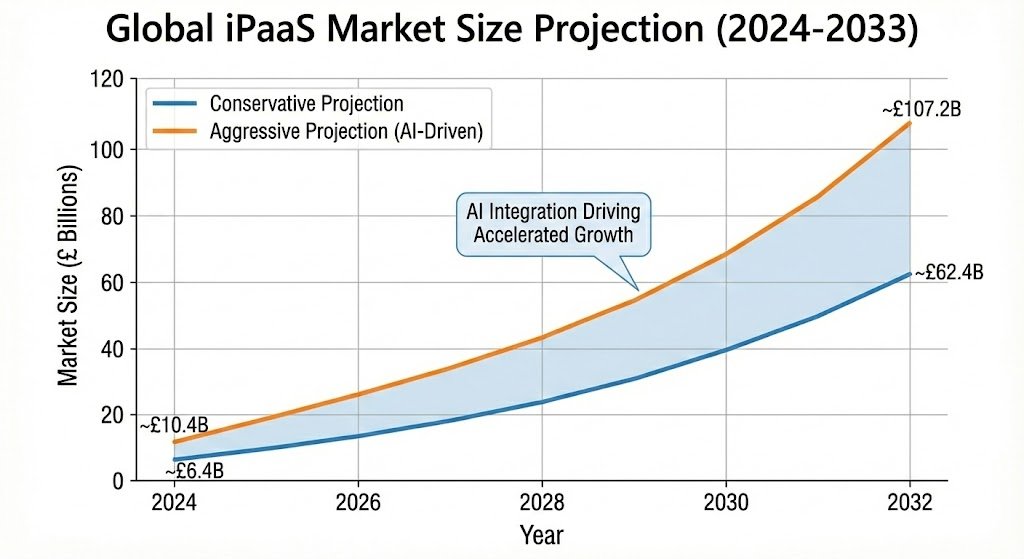
Growth drivers include cloud application proliferation (average enterprise manages 130+ SaaS applications requiring integration), digital transformation initiatives accelerating post-pandemic, and data analytics requirements demanding real-time integration replacing batch ETL patterns.
Geographic distribution sees North America maintaining 39-46% market share driven by early cloud adoption and SaaS vendor concentration. EMEA represents 30-35% share with strong growth in UK, Germany, and France. Asia-Pacific grows fastest (35-40% CAGR) led by China, India, and Southeast Asia digital transformation programs.
Industry vertical analysis shows BFSI (Banking, Financial Services, Insurance) commanding 22% share driven by Open Banking APIs, real-time payments, and fraud detection requirements. Healthcare shows fastest growth (31% CAGR) propelled by interoperability mandates, telehealth integration, and clinical trial optimization. Retail and manufacturing each represent 12-15% share with supply chain integration, omnichannel commerce, and Industry 4.0 initiatives driving adoption.
Competitive landscape evolution
The iPaaS market concentrates among established leaders (MuleSoft, Boomi, Software AG, IBM) whilst cloud hyperscalers (Microsoft, AWS, Google) gain share leveraging ecosystem advantage. Niche players (Workato, Tray.io, Zapier) target specific use cases or buyer personas with simplified offerings.
MuleSoft’s Salesforce acquisition strengthened API-led connectivity positioning but raised concerns about independence and multi-cloud commitment. Boomi’s positioning as pure-play iPaaS vendor without broader platform agenda appeals to organizations avoiding vendor lock-in with major cloud providers.
Cloud hyperscalers’ advantage stems from ecosystem integration depth, unified authentication, and simplified procurement. Organizations standardized on Azure gain marginal cost advantage through Azure Hybrid Benefit applying Windows Server and SQL Server licenses to Logic Apps Standard Plan compute, reducing effective costs 20-30% versus published pricing.
The market increasingly bifurcates between comprehensive iPaaS platforms (MuleSoft, Boomi, Logic Apps) supporting enterprise-grade B2B, API management, and governance versus lightweight automation platforms (Zapier, n8n, Make) targeting departmental use cases with consumer-friendly pricing and experience.
Strategic recommendations and decision criteria
Platform architects evaluating Logic Apps must align technical capabilities with organizational context, existing investments, and strategic direction:
Choose Azure Logic Apps when
Microsoft and Azure ecosystem forms foundation for cloud strategy. Organizations standardized on Microsoft 365, Azure AD, Dynamics 365, or Power Platform gain substantial integration advantage through unified authentication, consistent management experience, and pre-built connectors optimized for Microsoft services.
Budget constraints require cost-effective iPaaS solution. Logic Apps typically delivers 2-3x lower TCO than MuleSoft for equivalent transaction volumes whilst providing comparable connector breadth. Consumption Plan’s pay-per-execution model suits variable workloads whilst Standard Plan offers predictable costs for high-volume scenarios.
Rapid deployment and low-code development accelerate time-to-value. Visual workflow designer enables integration development by developers without extensive middleware expertise, reducing specialized skill requirements compared to MuleSoft’s Mule 4 or traditional ESB platforms requiring Java developers.
AI integration represents strategic priority. Native Azure OpenAI connectors, RAG pattern support, and agent orchestration capabilities position Logic Apps as foundation for AI-powered business processes. Organizations implementing generative AI at scale benefit from tight integration with Azure AI services.
Consider alternatives when
API-led connectivity represents core architectural philosophy. MuleSoft’s three-layer architecture (system/process/experience APIs) and comprehensive API lifecycle management provide superior capabilities for organizations prioritizing API governance, versioning, and reusability across large development teams.
Multi-cloud strategy spans AWS, GCP, and Azure without clear primary platform. Platform-agnostic iPaaS like Boomi or MuleSoft avoids coupling to single cloud provider’s ecosystem, though at 2-3x cost premium versus cloud-native alternatives.
Complex data transformation requirements exceed Logic Apps expression language capabilities. MuleSoft’s DataWeave or enterprise ETL platforms provide more sophisticated transformation features for scenarios involving recursive data structures, streaming large datasets, or complex data quality rules.
Existing integration team possesses deep Java or .NET middleware expertise. Organizations with skilled BizTalk, MuleSoft, or WebSphere developers may achieve faster time-to-value leveraging existing skills versus retraining on Logic Apps’ low-code paradigm.
Critical success factors
Executive sponsorship ensuring adequate budget, resources, and organizational change management support. Integration modernization affects multiple business units requiring coordination and stakeholder alignment.
Phased evaluation approach testing capabilities against real requirements. Conduct proof-of-concept implementations for critical integration patterns (B2B, high-volume messaging, hybrid connectivity) before commitment.
Skills development through formal training, certification pursuit, and hands-on experimentation. Microsoft Learn provides comprehensive learning paths for Logic Apps developers, administrators, and architects.
Governance framework planning preventing proliferation of unmanaged workflows. Design naming standards, deployment automation, monitoring instrumentation, and cost allocation patterns before scaled deployment.
Conclusion: mastering Azure Logic Apps for enterprise integration
Azure Logic Apps has matured from basic workflow automation into a strategic enterprise integration platform validated by seven consecutive years of Gartner Leader recognition, Forrester-documented 295% ROI, and production deployments processing hundreds of millions of daily transactions for global enterprises. For organizations within the Microsoft ecosystem, it offers unmatched connector breadth (1,400+), compelling economics compared to MuleSoft or Boomi alternatives, and native AI integration capabilities positioning it as orchestration foundation for autonomous enterprise automation.
The architectural choice between Consumption and Standard plans requires careful analysis. Standard Plan’s single-tenant isolation, VNet integration, local development capabilities, and stateless workflow performance advantages position it as the strategic choice for enterprises processing high volumes, requiring network isolation, or building containerized deployment patterns. Consumption Plan remains optimal for variable workloads, development environments, and organizations prioritizing operational simplicity over infrastructure control.
The competitive landscape offers clear differentiation points. MuleSoft delivers superior API management maturity and transformation capabilities at 2-3x cost premium. Boomi provides embedded data quality governance with comprehensive iPaaS capabilities at moderate pricing. AWS services offer deep ecosystem integration for AWS-committed organizations but require assembling fragmented services. Logic Apps uniquely combines Azure ecosystem depth, cost-effectiveness, and low-code developer productivity for Microsoft-centric enterprises.
The iPaaS market’s projected 25-42% CAGR through 2033 ensures continued Microsoft investment, regular feature releases, and expanding connector ecosystem. Platform architects making 2025-2026 integration platform decisions establish foundations lasting through the next technology cycle. For organizations committed to Microsoft cloud infrastructure and seeking cost-effective enterprise integration, Azure Logic Apps represents the strategic choice.
In our next article, we’ll examine implementation strategy: BizTalk migration roadmaps, real-world production case studies, security architecture patterns, AI integration implementations, and the 18-month journey from pilot to operational maturity. Understanding the strategic evaluation provides foundation; successful implementation determines ROI realization.
Useful links
- Azure Logic Apps Official Documentation – Comprehensive technical reference and tutorials
- Azure Logic Apps Pricing Calculator – Detailed pricing information for cost modelling
- Gartner Magic Quadrant for iPaaS – Market analysis and vendor comparison
- Azure Architecture Center – Integration patterns and reference architectures
- Logic Apps Standard Developer Guide – VS Code development and local debugging
- Azure Hybrid Benefit Calculator – Cost optimization for existing licenses
- Azure iPaaS Comparison Guide – Microsoft’s platform positioning