
Modern applications face an unforgiving reality: users expect sub-second response times regardless of their location on the globe. Whether streaming live sports content to millions of viewers, powering real-time gaming experiences, or enabling autonomous vehicle communications, the difference between success and failure often comes down to milliseconds.
AWS has constructed the world’s most comprehensive edge computing platform to address these demands, spanning over 700 CloudFront Points of Presence, 13 Lambda@Edge regional caches, and 31 Wavelength zones embedded directly within 5G networks. This infrastructure enables latencies as low as 1-10 milliseconds for critical applications, fundamentally changing what’s possible for real-time experiences.
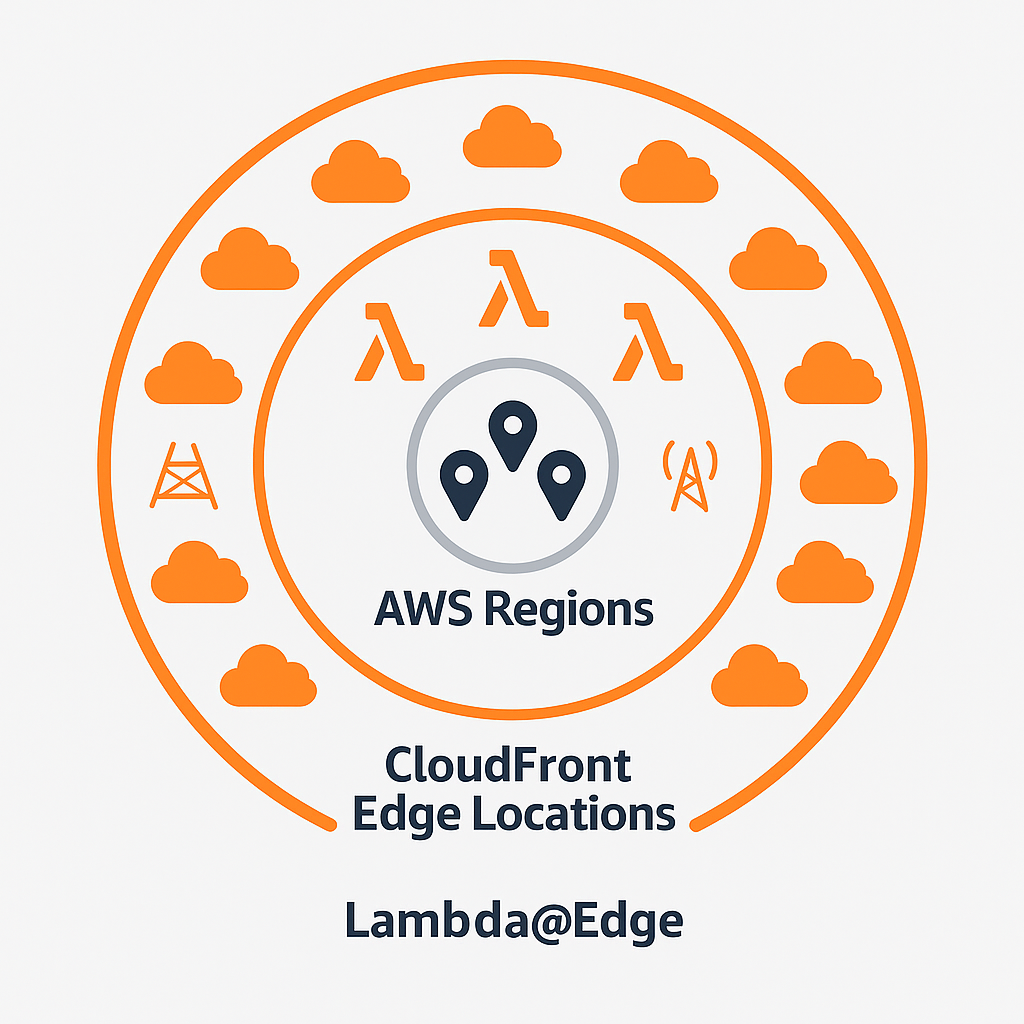
Recent innovations in 2024-2025 have transformed AWS edge capabilities with embedded Points of Presence, VPC Origins for private resources, and expanded 5G partnerships. These advances position AWS to capture significant portions of the £205 billion edge computing opportunity whilst enabling new categories of applications previously impossible due to network constraints.
Understanding AWS’s Three-Tier Edge Architecture
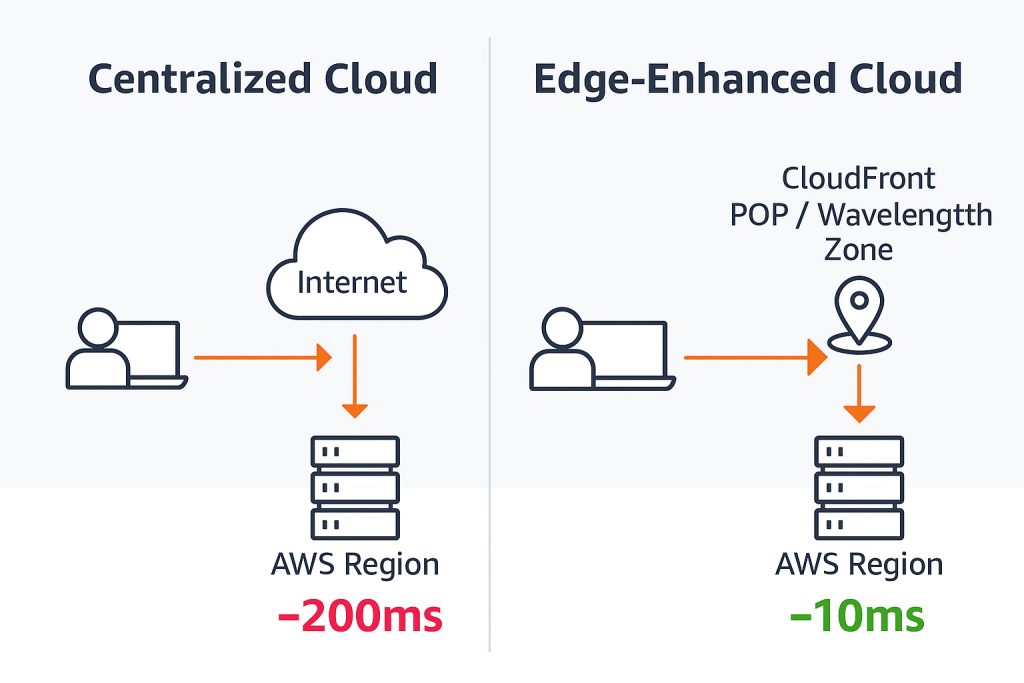
AWS’s edge computing strategy operates through a sophisticated three-tier hierarchy, each optimised for different latency and complexity requirements:
Tier 1 – Global Edge (CloudFront): 700+ locations providing 50-200ms latency for static content delivery, DDoS protection, and basic request modification through CloudFront Functions.
Tier 2 – Regional Edge (Lambda@Edge): 13 locations delivering 10-50ms latency for dynamic content generation, A/B testing, authentication workflows, and complex business logic requiring external integrations.
Tier 3 – Far Edge (Wavelength): 31 zones providing 1-10ms latency for real-time gaming, AR/VR applications, autonomous vehicle communication, and industrial automation requiring immediate response.
This tiered approach allows architects to place compute resources precisely where they deliver the most value, balancing performance requirements against cost and complexity considerations.
CloudFront: The Foundation of Global Content Delivery
Advanced Caching for Performance Optimisation
CloudFront’s modern policy-based caching framework provides granular control over content delivery optimisation. The managed cache policy system includes CachingOptimised for maximum performance, CachingDisabled for dynamic content, and specialised policies for media workloads.
The service operates through a sophisticated three-tier caching hierarchy: browser cache for user-specific content, CloudFront edge cache for static assets with one-year TTL for optimal hit ratios, and Regional Edge Caches serving as intermediate storage between edge locations and origins.
The embedded POPs, launched in March 2024, represent a significant architectural advancement. These 600+ edge locations are deployed directly within ISP networks, bringing content even closer to users. Real-world testing demonstrates up to 46% improvement in time to first frame and 49% reduction in rebuffering rates for video applications.
Security Integration and Modern Features
CloudFront’s security model has evolved significantly with the introduction of Origin Access Control (OAC), which replaces the legacy Origin Access Identity system. OAC uses AWS Signature Version 4 signing, supports SSE-KMS encryption, and provides enhanced protection against confused deputy attacks whilst enabling comprehensive HTTP method support.
The VPC Origins feature, introduced in December 2024, allows secure access to Application Load Balancers in private subnets without requiring internet gateways, significantly reducing attack surfaces for private resources. This capability enables organisations to expose internal applications through CloudFront whilst maintaining strict network isolation.
Lambda@Edge: Serverless Computing at the Network Edge
Execution Model and Performance Characteristics
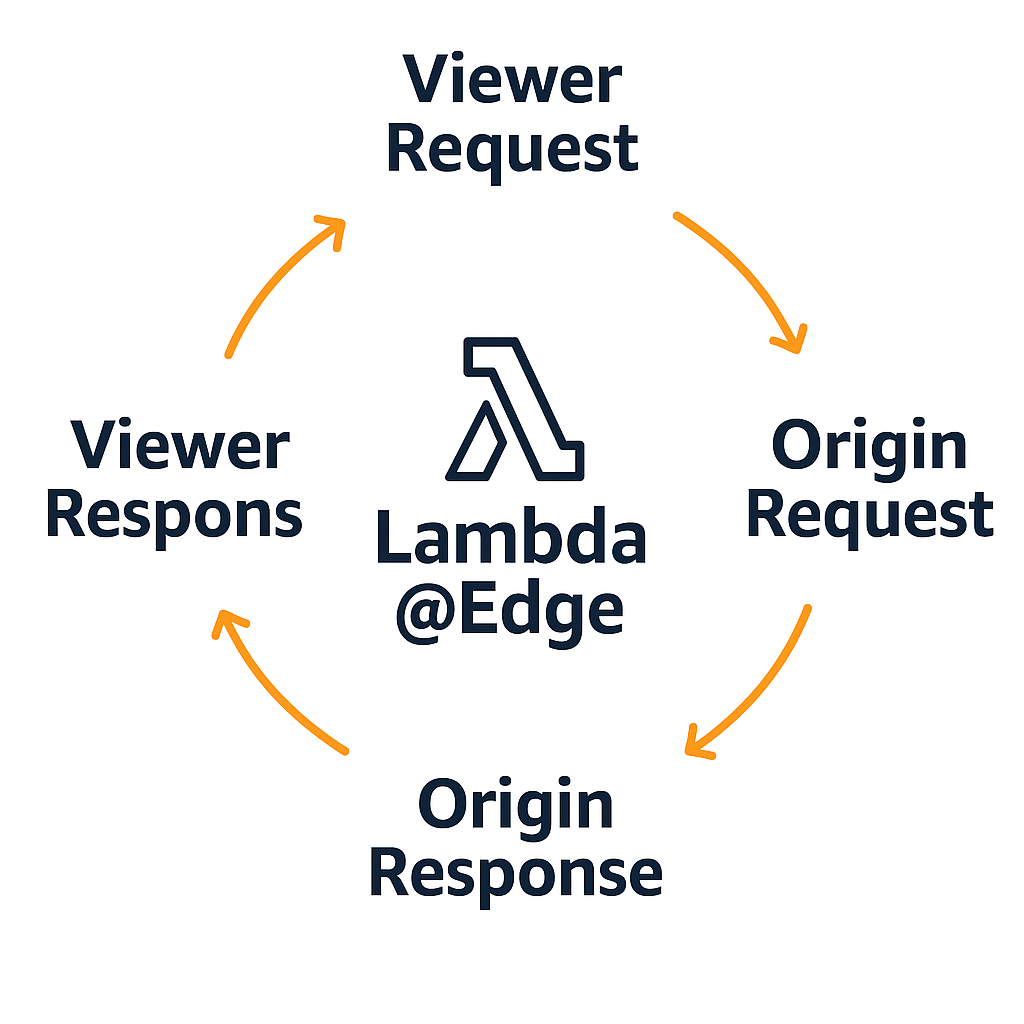
Lambda@Edge transforms CloudFront from a simple CDN into a programmable edge computing platform by enabling serverless code execution at 13 Regional Edge Caches globally. Functions execute in response to four CloudFront events: viewer request, viewer response, origin request, and origin response, each with distinct performance characteristics.
Performance analysis from production deployments reveals impressive metrics:
- Average execution duration: 23ms globally with regional variation
- Cold start frequency: Less than 1% of invocations under normal conditions
- P99 latency: 67ms for warm functions, up to 600ms during cold starts
- Warm function performance: Sub-10ms execution for simple operations
Practical Implementation Patterns
Dynamic content personalisation represents one of the most powerful Lambda@Edge use cases. Geographic routing enables content customisation based on CloudFront viewer country headers:
'use strict';
exports.handler = (event, context, callback) => {
    const request = event.Records[0].cf.request;
    const headers = request.headers;

    const countryToOrigin = {
        'DE': 'eu-central-1.example.com',
        'JP': 'ap-northeast-1.example.com',
        'US': 'us-east-1.example.com'
    };

    if (headers['cloudfront-viewer-country']) {
        const country = headers['cloudfront-viewer-country'][0].value;
        if (countryToOrigin[country]) {
            request.origin.custom.domainName = countryToOrigin[country];
        }
    }

    callback(null, request);
};
Authentication and authorisation at the edge provides significant security and performance benefits. JWT validation, session management, and access control can be implemented without round trips to central authentication services, reducing latency whilst maintaining security posture.
CloudFront Functions vs Lambda@Edge: Making the Right Choice
The choice between CloudFront Functions and Lambda@Edge depends on specific performance, complexity, and cost requirements. CloudFront Functions execute at all 700+ edge locations with sub-millisecond latency and cost £0.08 per million invocations, whilst Lambda@Edge provides more capable runtime environments at 13 locations for £0.47 per million invocations plus compute time.
CloudFront Functions excel at cache key normalisation, URL rewrites, simple header manipulation, and basic JWT validation. Lambda@Edge advantages include complex business logic requiring multiple programming languages, external API integrations, request body processing, and advanced authentication workflows.
AWS Wavelength: Ultra-Low Latency 5G Edge Computing
5G Network Architecture and Telecom Integration
AWS Wavelength represents a fundamental shift in edge computing by embedding AWS compute and storage services directly within telecommunications providers’ 5G networks. The platform currently operates 31 Wavelength Zones across 19 US cities (Verizon), 5 European cities (Vodafone), 2 UK cities (BT), 2 Japanese cities (KDDI), 2 Korean cities (SK Telecom), and expanding coverage through Orange in Africa.
Real-world testing demonstrates impressive latency reductions: 12ms improvement in Manchester UK compared to London Region, and 50% latency reduction in Dallas compared to US East Region. These improvements make previously impossible applications viable for production deployment.
Transformative Use Cases
Gaming and Interactive Entertainment: Real-time game streaming, competitive multiplayer gaming, and interactive sports experiences become viable without expensive local hardware. Production deployments show significant improvements in player experience quality and reduced churn rates.
Augmented and Virtual Reality Applications: Motion-to-Photon (MTP) latencies required for realistic experiences become achievable. Remote rendering for 3D content manipulation, cloud-powered AR without local processing requirements, and collaborative virtual environments benefit from consistent ultra-low latency delivery.
Industrial IoT and Smart Manufacturing: Real-time quality inspection using ML inference, anomaly detection for predictive maintenance, and safety monitoring with instant alert systems. Sub-20ms response times enable new categories of automated manufacturing processes previously impossible due to network latency constraints.
TCS Smart Factory solutions implement intelligent real-time quality inspection using ML-powered video analytics with predictive maintenance and anomaly detection. The deployment achieves sub-20ms response times for critical factory operations whilst maintaining statistical processing for anomaly detection with real-time worker notifications.
Integration Patterns and Architectural Strategies
Multi-Tier Edge Computing Architectures
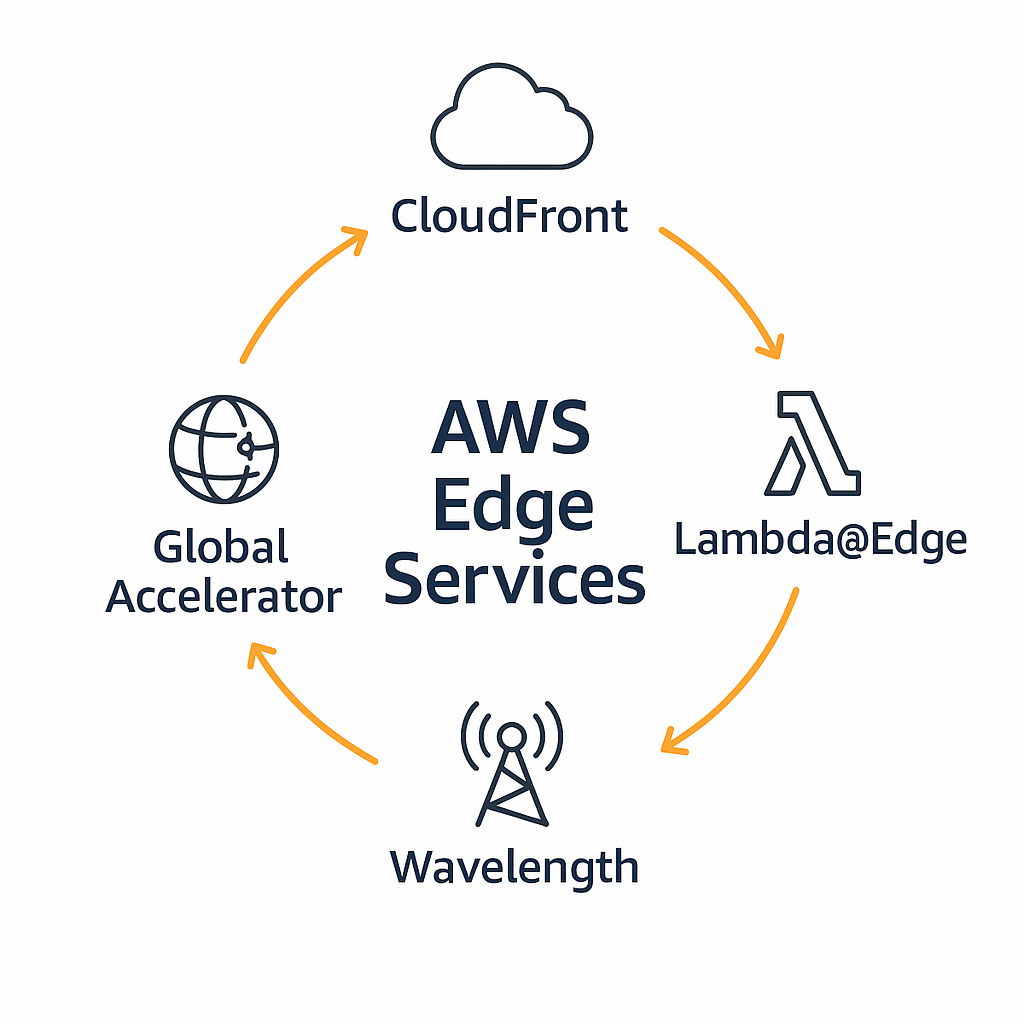
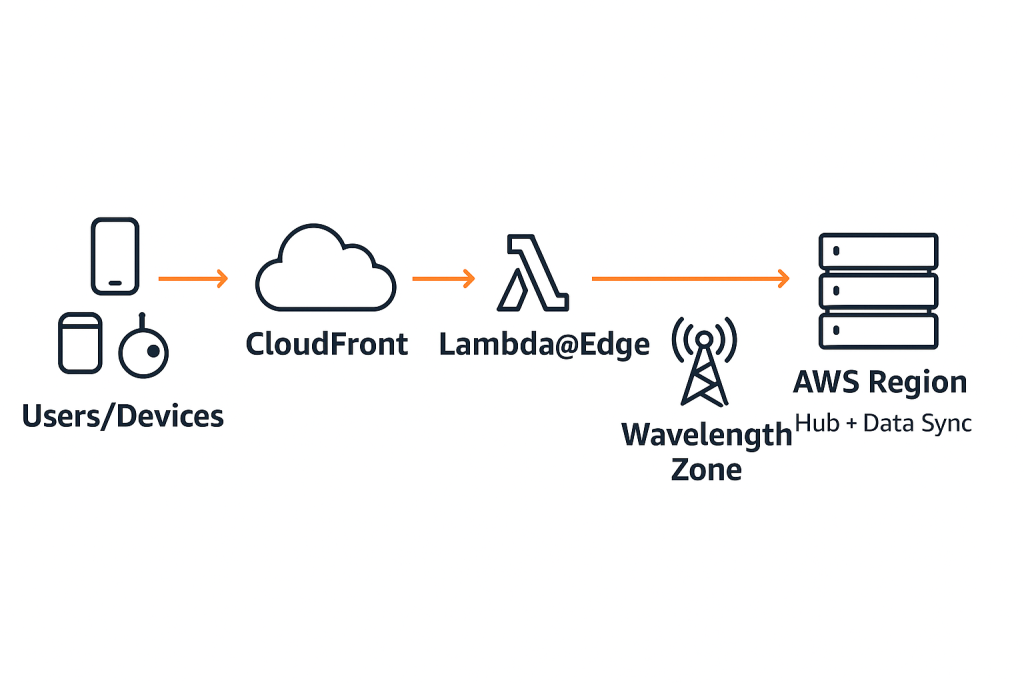
Optimal edge computing architectures leverage all three AWS services in complementary roles. The multi-tier approach positions CloudFront as the global content delivery layer, Lambda@Edge as the regional compute layer for complex logic, and Wavelength as the ultra-low latency compute layer for real-time applications.
This architecture enables bidirectional synchronisation using DynamoDB Global Tables, cross-region data replication, and intelligent workload placement based on user proximity and network topology. Edge Discovery APIs facilitate dynamic endpoint selection based on real-time network conditions, whilst automated service registration through EventBridge and Lambda enables responsive architecture adaptation.
Hub and Spoke Architectural Patterns
The hub and spoke model positions central AWS Regions as primary data stores and control planes whilst edge locations maintain local compute and temporary storage. This architecture supports data sovereignty requirements whilst maintaining global application consistency.
Content delivery optimisation through multi-level caching hierarchies maximises cache hit ratios whilst minimising origin requests. Origin Shield provides an additional caching layer, whilst intelligent TTL configuration balances content freshness with performance.
Implementation Best Practices
Deployment Patterns and Configuration
CloudFront distribution with Lambda@Edge integration requires careful attention to regional requirements and versioning constraints. Lambda@Edge functions must be created in us-east-1, published as numbered versions, and associated with specific CloudFront behaviours through the distribution configuration.
Wavelength zone deployment requires coordination with mobile carriers for service plans and careful network configuration. The process involves opting into Wavelength zones, creating VPC extensions, configuring carrier gateways, and launching instances with carrier IP addresses for mobile connectivity optimisation.
Monitoring and Troubleshooting Strategies
Lambda@Edge monitoring presents unique challenges due to distributed execution across regions. CloudWatch logs appear in the region closest to execution, requiring cross-region log aggregation for comprehensive analysis. CloudWatch Insights queries enable unified log analysis across multiple regions with structured JSON logging for improved searchability.
Error handling patterns must account for the distributed nature of edge execution and potential network connectivity issues. Graceful fallback strategies ensure application availability during edge service degradation, whilst circuit breaker patterns prevent cascading failures in complex edge architectures.
Cost Optimisation and Resource Management
Strategic Cost Management
CloudFront cost optimisation focuses on cache hit ratio improvement, appropriate price class selection, and efficient use of Lambda@Edge triggers. CloudFront Functions provide 98.5% cost savings compared to Lambda@Edge for lightweight operations, whilst proper cache policy configuration reduces origin data transfer costs.
Wavelength pricing considerations include 25-50% cost premiums over regional resources, justified by ultra-low latency requirements. Instance rightsizing, auto-scaling implementation, and intelligent workload placement help optimise costs whilst maintaining performance targets.
Monitoring and Budgeting
AWS Cost Explorer and billing alarms provide proactive cost management capabilities. Reserved capacity planning for predictable workloads and Savings Plans application can significantly reduce operational costs for sustained edge computing deployments.
Performance monitoring requires tracking metrics across all service tiers. CloudFront provides request counts, byte transfers, origin latency, and error rates. Lambda@Edge metrics include invocation counts, duration, errors, and throttles distributed across execution regions.
Competitive Advantages and Future Outlook
Market Positioning
AWS maintains significant competitive advantages through comprehensive service integration, global infrastructure scale, and mature developer ecosystem. The 700+ CloudFront edge locations exceed Azure’s 118 POPs and Google’s approximately 90 locations, whilst Wavelength’s telecom partnerships provide unique ultra-low latency capabilities unavailable from other cloud providers.
The global edge computing market projects growth from £18.6 billion in 2024 to £258 billion by 2033, representing a 33% compound annual growth rate. Manufacturing represents the largest current segment at 42% of edge spending, whilst healthcare shows the fastest growth trajectory through 2033.
Technology Evolution Roadmap
AWS continues expanding edge capabilities through AI/ML integration, 5G Standalone network support, and enhanced container orchestration. The roadmap includes expanded instance types in Wavelength zones, additional telecom partnerships for global coverage, and deeper integration with emerging technologies like 6G network architectures.
Developer experience improvements focus on simplified deployment workflows, enhanced debugging capabilities, and expanded language runtime support. The trend toward infrastructure as code and GitOps workflows drives continued improvements in automation and operational tooling.
Making Architectural Decisions
Service Selection Criteria
Service selection should consider latency requirements, complexity needs, scale demands, integration requirements, and cost sensitivity. Applications requiring sub-1ms latency favour CloudFront Functions, whilst complex workflows benefit from Lambda@Edge capabilities, and real-time applications requiring sub-10ms latency justify Wavelength deployment costs.
Future-proofing strategies should include multi-cloud edge redundancy planning, 5G integration roadmaps, AI/ML edge deployment preparation, and hybrid cloud-edge architecture development. Organisations should invest in edge computing skills development, security framework adaptation, and performance optimisation expertise to capitalise on emerging opportunities.
Conclusion and Next Steps
AWS edge computing services provide the most comprehensive platform available for building ultra-low latency applications at global scale. The integration of CloudFront’s global content delivery network, Lambda@Edge’s serverless compute capabilities, and Wavelength’s 5G-integrated infrastructure enables new categories of applications previously impossible due to network constraints.
Success in edge computing requires careful architectural planning, performance optimisation, cost management, and operational excellence. Organisations should begin by identifying use cases that benefit from reduced latency, evaluating current application architectures for edge computing opportunities, and developing skills in distributed systems design and edge computing technologies.
The combination of proven infrastructure scale, comprehensive service integration, and continuous innovation makes AWS the leading choice for organisations building the next generation of edge-powered applications. As the edge computing market continues its explosive growth, AWS’s architectural advantages and ecosystem maturity provide the foundation for sustained competitive differentiation and business value creation.
Useful Links
- AWS CloudFront Developer Guide – Comprehensive documentation covering all CloudFront features and configuration options
- Lambda@Edge Best Practices – Official AWS guidance on optimising Lambda@Edge performance
- AWS Wavelength Documentation – Complete guide to deploying applications in Wavelength zones
- CloudFront Functions vs Lambda@Edge Comparison – Detailed comparison of edge computing options
- AWS Edge Computing Architecture Patterns – Reference architectures and design patterns for edge computing
- AWS Wavelength Customer Case Studies – Real-world implementations and success stories
- Edge Computing Market Analysis – Industry trends and growth projections
- CloudFront Embedded POPs Announcement – Latest infrastructure improvements
- AWS Cost Optimisation for Edge Services – Pricing models and cost optimisation strategies
- 5G Edge Discovery Architectures – Advanced Wavelength deployment patterns