

AI isn’t replacing cloud engineers earning £80,000-£150,000+ in the UK market. It’s creating a stark division between those who master AI augmentation and those who don’t. Research from SPG Resourcing reveals AI-skilled cloud professionals command a 23% salary premium over traditional counterparts, with senior AI platform engineers in London reaching £130,000 or more. While 90% of Fortune 100 companies have deployed GitHub Copilot and enterprise developers complete tasks 55% faster with AI assistance, the most valuable professionals aren’t the fastest coders but those combining deep cloud expertise with AI fluency, judgment, and strategic thinking.
The market signals are unmistakable yet nuanced. Junior tech hiring has decreased 25% year-over-year, with entry-level software developer employment for 22-25 year olds declining nearly 20% from 2022 peaks. Salesforce announced “no new engineers” hiring for 2025, citing AI productivity gains. Yet simultaneously, Platform Engineer job postings nearly doubled in Q1 2025, Cloud Architect positions are projected to grow 13% through 2033, and Gartner predicts 80% of software engineering organisations will establish platform teams by 2026. The traditional junior-to-senior progression ladder isn’t disappearing, it’s being fundamentally restructured with AI as the catalyst.
The professionals who thrive won’t be those who code fastest or generate the most infrastructure scripts. Success belongs to engineers who validate AI outputs, catch security vulnerabilities in generated code, make architecture decisions requiring business context, and lead teams through this transformation. GitHub Research found 29.1% of AI-generated Python code contains potential security weaknesses, whilst GitClear’s analysis shows AI code has a 41% higher churn rate, being frequently revised or replaced. This gap between AI capability and AI reliability creates sustained demand for experienced engineers who understand both the power and the limitations. This guide maps exactly how to position yourself in the high-value 30% of work AI cannot touch whilst commanding the salary premiums that come with it.

The AI Augmentation Framework for Cloud Careers
Understanding where you sit in the AI augmentation spectrum determines your next career move. The framework has four distinct tiers, each with different risk profiles and salary trajectories for UK professionals.
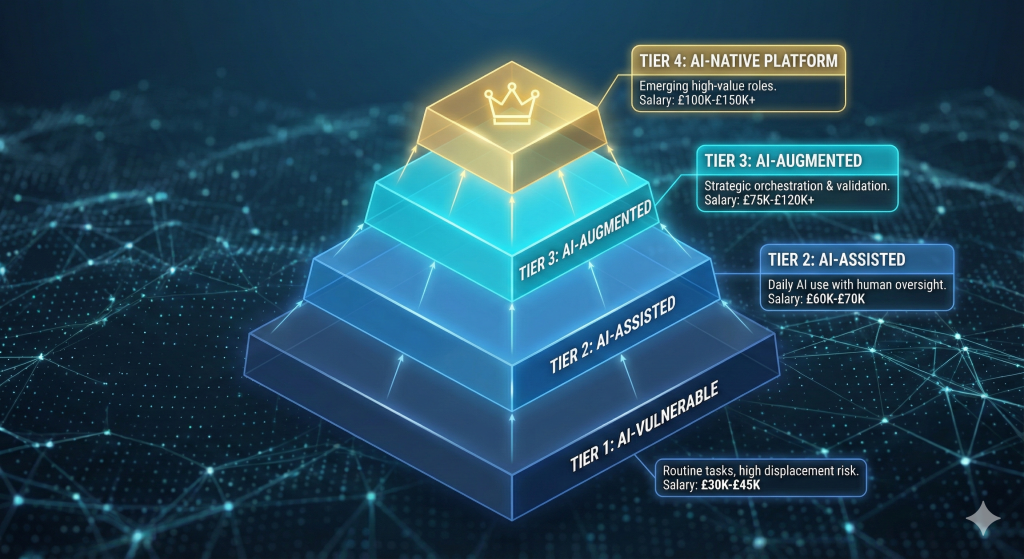
Tier 1: AI-Vulnerable Positions face the highest displacement risk. Junior Cloud Engineers performing routine provisioning, basic scripting, and standard CI/CD setup see entry-level hiring declining across 66% of global enterprises according to IDC. UK salaries remain £30,000-£45,000 for entry positions, but hiring volumes have contracted sharply. These roles centre on tasks AI now handles: boilerplate code generation, standard Terraform modules, basic monitoring setup, and repetitive documentation. The career advice here is straightforward but urgent: accelerate your progression to mid-level as rapidly as possible, typically within 18-24 months rather than the traditional 3-4 years.
Tier 2: AI-Assisted Positions represent the current UK median for cloud engineers at £67,500, with mid-level professionals earning £60,000-£70,000. These engineers use AI tools daily for code completion, documentation, and testing but provide essential human oversight. The risk is moderate because whilst AI writes approximately 50% of code at organisations like Microsoft, validation remains critical. Mid-level engineers who excel at catching edge cases, identifying security risks, and ensuring production readiness find their expertise increasingly valued. The career trajectory here involves deliberate skill building: moving from pure execution to judgment, from individual contribution to architectural influence, from tactical problem solving to strategic thinking.
Tier 3: AI-Augmented Positions command senior and staff-level salaries. Senior Cloud Engineers earn £68,750-£85,000 UK-wide and £75,000-£100,000 in London, whilst Staff and Principal engineers reach £100,000-£120,000 with top performers exceeding £150,000. These professionals leverage AI for acceleration but focus human effort on architecture decisions, security assessment, performance optimisation, and business logic that requires organisational context. Harvard research analysing 62 million LinkedIn profiles found AI adoption correlates with steep drops in junior hires whilst senior hires remain flat. The value proposition shifts from hands-on implementation to orchestration, validation, and strategic direction.
Tier 4: AI-Native Platform Roles represent the emerging high-value positions. AI Platform Engineers managing infrastructure for LLM workloads earn £65,000-£100,000+, MLOps Engineers handling CI/CD for machine learning models command £60,000-£85,000, and LLMOps Engineers focusing on large language model deployment reach £65,000-£100,000+. Platform Engineers with AI focus, designing internal developer platforms that accelerate team velocity, earn £70,000-£120,000. These roles didn’t exist three years ago but now represent some of the fastest-growing positions in the UK cloud market. Gartner predicts platform engineering adoption will increase from 55% to 80% of organisations by 2026.
The framework reveals a clear pattern: as you move up tiers, AI shifts from threat to tool to differentiator. Junior engineers compete with AI. Mid-level engineers work alongside AI. Senior engineers orchestrate AI. Platform engineers build the infrastructure that makes AI productive for entire organisations.
Technical Skills Mapped to Career Outcomes
The technical skills that advance your career in an AI-augmented world differ fundamentally from pre-AI priorities. This isn’t about learning more programming languages or collecting certifications, it’s about building the judgment layer AI cannot replicate.
For professionals currently at £60,000-£80,000 seeking to reach £90,000-£110,000 within 24 months, the priority is mastering AI tool validation. This means understanding how to effectively use GitHub Copilot Business (£15/user/month) or Amazon Q Developer, but more critically, knowing when to reject their suggestions. Build expertise in prompt engineering for infrastructure as code, learning how to craft queries that generate production-ready Terraform rather than brittle prototypes. Develop security review capabilities specifically for AI-generated code, as the 29.1% vulnerability rate in AI outputs creates demand for professionals who can spot the issues. Focus on cloud-native patterns that AI struggles with: multi-account AWS architectures, Azure landing zones with proper governance, GCP hierarchical project structures. These complex, organisation-specific implementations require context AI lacks.
For engineers targeting £110,000-£140,000 senior and staff positions within 3-4 years, the emphasis shifts to architectural judgment and business alignment. This includes multi-cloud strategy decisions that balance vendor lock-in against best-of-breed capabilities, cost optimisation approaches that consider not just cloud spend but team velocity and opportunity cost, and security architecture requiring compliance interpretation for GDPR, FCA, or healthcare regulations. As our comprehensive FinOps Evolution guide explores, financial operations increasingly demands strategic thinking about cloud economics rather than simple cost cutting. Learn to translate technical decisions into business outcomes for C-suite stakeholders, quantifying infrastructure investments through ROI frameworks that executives understand. Build disaster recovery strategies that balance recovery objectives against budget constraints and risk tolerance, decisions requiring judgment about acceptable data loss and downtime that AI cannot make without human context.
For professionals pursuing £140,000+ platform engineering and architect roles, the technical focus centres on developer experience and organisational leverage. Design internal developer platforms that abstract complexity without sacrificing control, allowing teams to deploy safely at velocity. Implement platform engineering patterns: golden paths for common use cases, self-service infrastructure provisioning, embedded guardrails for security and compliance. Build the observability infrastructure that makes AI-assisted troubleshooting effective: distributed tracing, structured logging, meaningful metrics. Develop expertise in the emerging field of LLMOps: deploying large language models at scale, managing vector databases for retrieval-augmented generation, implementing AI governance frameworks. These capabilities position you at the intersection of cloud infrastructure and AI platforms, the highest-growth segment of the market. Our analysis of breaking free from legacy IT to cloud mastery shows how professionals successfully transition to these high-value roles.
The common thread across all levels is judgment. AI excels at boilerplate but fails at context. It generates code quickly but misses architectural implications. It suggests solutions without understanding organisational constraints. The engineers who build expertise in validating AI, applying business context, and making architectural trade-offs create career moats AI cannot cross.
Business Communication and Leadership Skills That Matter
Technical depth alone no longer guarantees career progression to £120,000+ roles. The differentiator between senior engineers and staff or principal engineers earning £150,000+ is business acumen and communication capability.
Executive communication transforms technical decisions into business value. Learn to frame infrastructure investments as capability enablements rather than cost centres. When proposing a £200,000 Kubernetes platform implementation, don’t lead with technical specifications. Lead with outcomes: reducing deployment time from two weeks to two hours unlocks £800,000 in developer productivity annually, decreasing incident mean time to recovery from four hours to fifteen minutes saves £1.2 million in revenue risk, enabling teams to ship features three times faster generates competitive advantage worth millions. Finance directors and CEOs make decisions based on these metrics, not on whether you’re using EKS or GKE.
Stakeholder management across non-technical teams becomes critical as you progress. Product managers need to understand why certain features take longer than expected because of architectural constraints. Sales teams require clear explanations of technical capabilities without overselling. Finance leaders need transparency on cloud spending trajectories and optimisation opportunities. Legal and compliance teams depend on accurate assessments of data residency and regulatory implications. The ability to navigate these relationships, translating between technical reality and business need, separates engineers who plateau at senior level from those progressing to staff, principal, and distinguished engineer roles at £150,000-£200,000+.
Risk communication for security and compliance demands particular skill. Executives don’t want to hear about CVE numbers and CVSS scores. They need to understand business impact: this vulnerability could result in data breach affecting 500,000 customers with GDPR fines up to £17 million, this security control reduces cyber insurance premiums by £80,000 annually, this compliance investment prevents regulatory action that shut down competitor operations for six weeks. Frame security in business terms.
Team leadership and knowledge transfer grow in importance as junior hiring declines. With fewer entry-level engineers joining teams, senior professionals must excel at developing mid-level talent. This includes mentoring engineers on architectural thinking beyond tactical problem solving, conducting effective code reviews that teach rather than just correct, documenting architectural decisions and trade-offs for organisational learning, and building team capability in AI augmentation rather than AI dependency. Organisations recognise this value: engineering managers earn £140,000-£180,000 whilst staff engineers on the individual contributor track can reach similar compensation. The choice between management and technical leadership becomes viable at senior levels.
Change management capabilities determine success in platform engineering roles. Building an internal developer platform is 20% technical implementation and 80% organisational adoption. You must create buy-in across engineering teams, demonstrate value through early wins that build momentum, train teams on new workflows without disrupting delivery, and measure adoption through meaningful metrics. The platform engineers who excel at this organisational change work command the highest salaries because they deliver business outcomes, not just technical solutions.
Your 12-Month Career Acceleration Roadmap
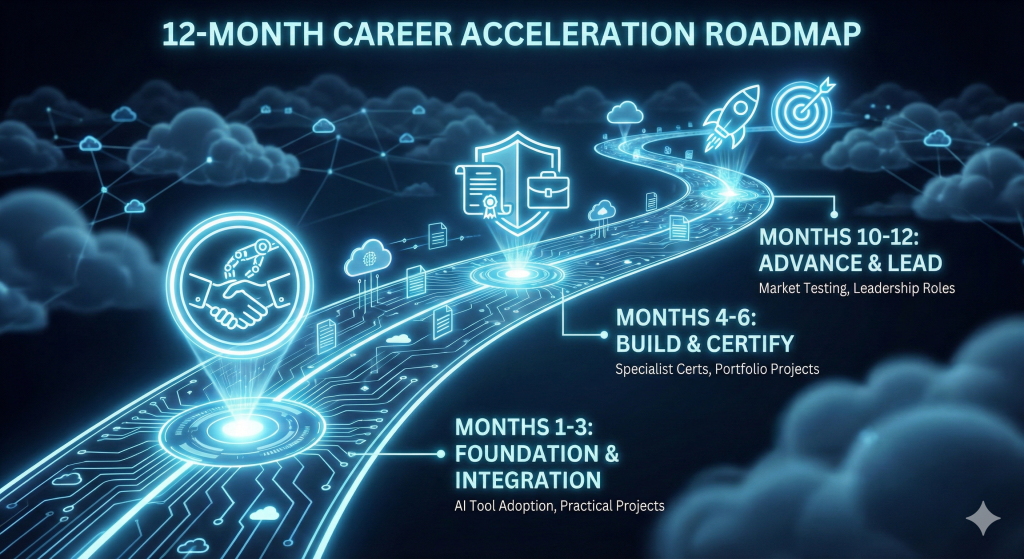
Translating this framework into action requires a structured approach with clear milestones and measurable progress. The following roadmap targets professionals currently at £60,000-£90,000 seeking to reach £90,000-£120,000+ within 12-24 months.
Months 1-3: Foundation and immediate impact. Begin with daily AI tool adoption, integrating GitHub Copilot Business or Amazon Q Developer into your workflow. The investment is minimal (£15-£20/month) but the productivity gain is measurable: aim for 30-40% faster completion of routine tasks within 30 days. Complete Azure AI Fundamentals (AI-900, approximately £99) or AWS Certified Machine Learning Foundations to establish baseline AI knowledge. Build your first practical project combining cloud infrastructure with AI: a retrieval-augmented generation pipeline using vector databases, an automated cost anomaly detection system using CloudWatch and Lambda, or infrastructure as code generation tooling with LLM assistance. Document this work on GitHub with clear README files explaining your approach and the problems solved. Update your LinkedIn profile to include new skills: MLOps, LLMOps, AIOps, platform engineering. Connect with platform engineering and FinOps communities on LinkedIn and attend one virtual meetup or conference session.
Months 4-6: Certification and portfolio building. Pursue substantive certification aligned with your career direction. AWS Certified Machine Learning Engineer Associate (approximately £120) validates cloud ML capability. Azure AI Engineer Associate (AI-102, approximately £130) demonstrates Azure-specific AI expertise. The new CNCF Certified Cloud Native Platform Engineering Associate validates the platform engineering skills Gartner predicts will dominate, though specific pricing hasn’t been announced yet. Add FinOps Certified Practitioner (£250-£650 depending on membership status and training approach) as cost optimisation becomes increasingly AI-assisted, building on principles we’ve explored in our guide on adding FinOps skills to your engineering toolkit for a potential £10,000-£30,000 salary boost. Expand your portfolio with three projects demonstrating AI-human collaboration: infrastructure automation showing AI-generated code with human validation and security review, cost optimisation dashboard with AI anomaly detection and human decision-making, or MLOps pipeline for model deployment with proper CI/CD and monitoring. Begin documenting your work through technical blog posts or LinkedIn articles, establishing thought leadership.
Months 7-9: Advanced positioning and networking. Complete specialist certification: AWS Machine Learning Specialty or Google Professional Machine Learning Engineer (approximately £160 each) for deep technical credibility. Alternatively, pursue advanced platform engineering skills through CKAD or CKA certification (£300 exam fee) combined with platform engineering training. Begin speaking at local meetups or company brown bag sessions about AI augmentation in cloud engineering, sharing lessons learned from your portfolio projects. This visibility builds your professional brand. Interview for roles one level above your current position, even if you’re not ready to move, to understand market expectations and salary ranges. Target companies known for strong engineering cultures: FinTech firms like Revolut or Monzo, cloud-native startups, consultancies like Thoughtworks or Equal Experts. These interviews provide valuable feedback on skill gaps and market positioning.
Months 10-12: Market testing and optimization. Update your CV emphasising AI augmentation capabilities, quantified business outcomes from your projects, and leadership or mentoring experience. Apply strategically to 5-10 roles matching your target salary range (£90,000-£120,000+ depending on current level). Expect interview processes to include technical assessments specifically around AI: using Copilot in pair programming exercises, discussing how you validate AI-generated code for security and production readiness, and explaining trade-offs in AI-assisted architecture decisions. Negotiate offers using your certifications, portfolio, and market research as leverage. The 23% AI skills premium provides justification for above-midpoint offers. Consider contract or consulting opportunities if permanent roles don’t materialise immediately: UK cloud contractors with AI skills command £500-£800 daily rates, translating to £120,000-£180,000+ annually.
Throughout this 12-month period, maintain focus on the 70-20-10 learning model we’ve detailed in our comprehensive guide to cloud learning: 70% hands-on project work, 20% learning from others through mentorship and community engagement, and 10% formal training through courses and certifications. This approach builds practical capability faster than pure certification collecting whilst demonstrating real-world problem solving to employers.
Measuring Success and Career Progress
Tracking your advancement through clear metrics ensures you’re moving toward your salary and responsibility goals rather than simply accumulating skills.
Technical capability metrics include AI tool proficiency measured by time savings: tracking reduction in routine task completion time using GitHub Copilot or similar tools with a target of 30-50% faster completion within 90 days. Monitor your code quality improvements: measuring defect rates in AI-generated versus human-written code with a goal of maintaining or improving quality whilst accelerating velocity. Assess portfolio project completion: targeting 3-5 substantial projects demonstrating AI-human collaboration within 12 months. Track certification achievement: completing 2-3 relevant certifications (AI-focused cloud certifications plus platform engineering or FinOps) within your target timeframe.
Career advancement metrics provide the clearest signal of progress. Monitor your salary progression: aiming for 15-25% increase year-over-year through promotion or role change, with 23% representing the documented AI skills premium. Track your responsibility expansion: measuring team size influenced, budget managed, or architectural decisions owned. Assess your title progression: targeting advancement from mid-level to senior within 18-24 months, senior to staff within 3-4 years. Measure your market position: tracking inbound recruiter interest and interview conversion rates, which typically increase as your AI platform expertise becomes visible through portfolio and network.
Business impact metrics demonstrate the value you create beyond pure technical execution. Measure cost optimisation delivered: quantifying cloud spending reductions or efficiency improvements from your initiatives with targets of 10-30% waste elimination in first year. Track velocity improvements: measuring reduction in deployment time, incident resolution time, or feature delivery cycles directly attributable to your platform work. Assess revenue enablement: identifying where your infrastructure improvements unlocked new product capabilities or market opportunities. Calculate risk mitigation: quantifying security improvements, compliance achievements, or disaster recovery capabilities that reduce business risk.
Market validation metrics confirm you’re positioning correctly for your target roles. Monitor your LinkedIn profile views and connection growth: aiming for 100+ relevant connections in platform engineering and FinOps communities within six months. Track conference speaking or content publication: targeting 2-3 speaking engagements or published articles demonstrating thought leadership. Measure interview activity: interviewing for at least 3-5 roles annually even when not actively job seeking to calibrate market value. Assess offer competitiveness: ensuring any job offers received are at or above the 23% AI skills premium relative to your current compensation.
Set quarterly reviews of these metrics, adjusting your learning and networking strategy based on what’s working. If portfolio projects aren’t translating to interview interest, the issue may be positioning or visibility rather than technical capability. If certifications aren’t improving offer quality, the market may value demonstrable experience over credentials in your specific segment. Use the data to iterate.
Common Career Pitfalls in the AI Era
Understanding where other engineers fail helps you avoid the same mistakes whilst building career resilience.
Over-indexing on AI certifications without demonstrable experience represents the most common error. Three AI certifications without portfolio projects proving practical application won’t advance your career. Employers want evidence you can actually use AI tools effectively, not just pass exams. The balance should be 70% project work demonstrating capability and 30% formal credentials validating knowledge. Build portfolio projects that showcase judgment: showing where you overrode AI suggestions, explaining security issues you caught in generated code, documenting architectural decisions AI couldn’t make.
Neglecting business communication whilst deepening technical skills creates a career ceiling around £90,000-£110,000. Engineers who can’t translate technical work into business value plateau at senior level, unable to progress to staff or principal roles commanding £150,000+. Invest in executive communication skills: practice framing infrastructure investments as ROI propositions, learn to present at board level using business metrics rather than technical jargon, develop stakeholder management capabilities across finance, legal, and product organisations. The engineers earning £150,000+ typically spend 40% of their time on communication and alignment rather than pure technical work.
Avoiding AI tools due to resistance or fear accelerates career obsolescence. Some experienced engineers resist AI assistance, viewing it as threat rather than tool. This stance becomes increasingly untenable as organisations standardise on AI-augmented workflows. By 2027, Gartner predicts 50% of software engineering organisations will use intelligence platforms to measure developer productivity, with AI augmentation a key metric. Refusing to adapt means falling behind peers who embrace these tools. The alternative to AI augmentation isn’t protecting your job, it’s making yourself less valuable than engineers who combine experience with AI leverage.
Staying in comfort zone without pushing toward platform engineering limits career growth as traditional DevOps roles face automation. Continuing to focus purely on CI/CD pipeline maintenance, basic monitoring, and standard provisioning positions you in the moderate-to-high risk category where 70% of traditional DevOps workflows could be automated by 2026. Deliberately stretch toward platform engineering: volunteering for internal developer platform initiatives, taking on developer experience improvement projects, learning backstage.io or similar platform tools. The engineers who wait until DevOps automation forces career change will find themselves competing for platform roles from a position of weakness.
Neglecting professional network and personal brand in favour of pure technical work diminishes career options. When redundancies occur, well-networked engineers land roles quickly whilst isolated technical experts struggle. When opportunities arise, connected professionals hear about them early whilst others find out only through public job postings. Invest 10% of your professional time in networking: attending cloud and platform engineering meetups, contributing to open source projects, writing technical blog posts, speaking at conferences or company events. This investment pays compounding returns throughout your career, particularly during transitions.
Investment Analysis and Expected Returns

Understanding the financial equation helps justify the time and money invested in AI augmentation skills.
Certification investment ranges from modest to substantial depending on your chosen path. Azure AI Fundamentals (AI-900) costs approximately £99 with 20-30 study hours required, delivering foundational knowledge. AWS Certified Machine Learning Engineer Associate runs approximately £120 with 40-60 study hours, providing intermediate credential. Specialist certifications like AWS ML Specialty or Google Professional Machine Learning Engineer cost approximately £160 each with 60-100 study hours, offering advanced positioning. Platform engineering certifications like CKAD cost £300 with 80-120 study hours. FinOps Certified Practitioner ranges from £250-£650 depending on membership and training approach, requiring 30-50 study hours. Total certification investment over 12 months might reach £600-£1,200 and 200-350 study hours.
Training and tool investment adds incremental cost. GitHub Copilot Business at £15/user/month costs £180 annually. Online courses for MLOps, LLMOps, or platform engineering typically range £50-£300 each, with 2-3 courses recommended. Conference attendance for networking runs £200-£800 per event including travel. Books and resources add £100-£200 annually. Total non-certification training investment runs approximately £800-£1,800 annually.
Time investment represents the largest cost, particularly for working professionals. Allocating 10-15 hours weekly to skill development, portfolio building, and networking totals 500-750 hours annually. At your current hourly rate (£60,000 salary ≈ £30/hour, £90,000 salary ≈ £45/hour), this represents £15,000-£33,750 in opportunity cost. However, this calculation understates the value because this time investment compounds: the portfolio projects become interview material for years, the certifications remain valid for 2-3 years, and the network connections generate opportunities throughout your career.
Expected return on investment over 12-24 months justifies this commitment. The 23% AI skills premium on a £70,000 current salary delivers £16,100 annual increase to £86,100. On a £90,000 base, the premium adds £20,700 to reach £110,700. Progression from mid-level to senior engineer (£70,000 to £90,000) provides £20,000 increase. Advancement from senior to staff engineer (£90,000 to £120,000) delivers £30,000 bump. The typical career trajectory with AI augmentation skills accelerates these progressions by 12-18 months compared to traditional path, representing £20,000-£30,000 in earlier earnings.
Payback period demonstrates rapid return. With total first-year investment of £2,400-£4,000 (certifications, tools, courses, conferences) plus 500-750 hours time investment, a salary increase from £70,000 to £86,000 delivers payback within 2-3 months of the new role. The 12-18 month acceleration in career progression provides an additional £20,000-£30,000 earlier earnings that wouldn’t have materialised on traditional timeline. ROI exceeds 500-800% in the first 24 months, making this one of the highest-return career investments available.
Risk mitigation value provides less quantifiable but equally important return. In redundancy scenarios, AI-augmented engineers with strong portfolios and networks land roles 40-60% faster than peers lacking these assets. In promotion decisions, demonstrated AI platform capabilities differentiate you from competitors for limited senior and staff positions. In salary negotiations, documented AI skills and portfolio projects provide leverage for above-midpoint offers. This career resilience compounds over decades, protecting against technological disruption and economic downturns whilst positioning you for high-growth opportunities.
Your Next Steps This Month
Career transformation requires immediate action, not just planning. These tactical next steps move you from intention to progress.
Within the next seven days, set up your AI augmentation environment. Sign up for GitHub Copilot free trial or Amazon Q Developer individual tier to test functionality. Install the appropriate IDE extensions and configure them for your primary development environment. Spend 2-3 hours learning effective prompting: how to write queries that generate production-quality infrastructure code rather than brittle prototypes. Practice on a small project: generating Terraform modules, automating AWS cost reporting, or building CI/CD pipeline configurations. Document your experience: what works well, what fails, where AI suggestions require significant human correction.
Within the next two weeks, create your AI augmentation portfolio foundation. Set up a GitHub repository specifically for showcasing AI-human collaboration projects. Write a comprehensive README explaining your approach to working with AI tools: how you validate outputs, when you override suggestions, what security review process you follow. Choose your first portfolio project from these options: RAG pipeline for infrastructure documentation search, cost anomaly detection system using CloudWatch and Lambda, Terraform module generator with validation logic, or MLOps pipeline for model deployment with proper CI/CD. Commit to completing this project within 30 days, documenting your process and outcomes.
Within the next thirty days, begin formal skill development. Select and register for your first AI-related certification based on your cloud platform: Azure AI Fundamentals, AWS ML Foundations, or similar. Create a study schedule allocating 5-7 hours weekly, targeting completion within 60-90 days. Join two relevant online communities: CNCF Slack workspace for platform engineering discussions and FinOps Foundation community for cloud economics expertise. Introduce yourself in these communities, sharing your background and learning goals. Attend at least one virtual meetup or webinar on AI in cloud engineering or platform engineering topics.
Within the next sixty days, establish your professional brand. Update your LinkedIn profile with specific AI skills: MLOps, LLMOps, AIOps, platform engineering, AI-assisted infrastructure automation. Write your first LinkedIn post or blog article about your AI augmentation experience: lessons learned, productivity gains measured, pitfalls encountered. Connect with 20-30 professionals in platform engineering and AI platform roles, personalising connection requests. Reach out to one senior engineer or architect in your network for a 30-minute informational interview about their career path and advice on AI augmentation.
Within the next ninety days, validate your market position. Update your CV emphasising AI capabilities and quantified outcomes from your portfolio work. Apply to 3-5 stretch roles paying £10,000-£20,000 above your current salary to calibrate market expectations. Use these interviews as learning experiences even if you’re not ready to move: what questions get asked, what skills are emphasised, what salary ranges are offered. Based on interview feedback, adjust your skill development focus. If security review capability is emphasised, prioritise learning application security. If cost optimisation dominates conversations, pursue FinOps skills. Let the market guide your investment.
The cloud engineers who act on this roadmap within the next quarter will position themselves in the high-value tier earning £100,000-£150,000+ whilst peers who delay remain vulnerable to AI automation of traditional DevOps roles. The technology transformation is already underway, accelerating rather than slowing. Your career trajectory over the next five years depends on decisions you make this month, not next year.
Useful Links
AI Tools and Documentation
- GitHub Copilot – Official documentation and pricing for GitHub’s AI pair programmer
- Amazon Q Developer – AWS’s AI coding assistant (formerly CodeWhisperer)
- Google Cloud Gemini Code Assist – Google’s AI-powered development assistant
Certification Resources
- AWS Machine Learning Certifications – AWS ML Engineer Associate certification details
- Microsoft Azure AI Certifications – Azure AI Engineer Associate (AI-102) information
- CNCF Platform Engineering Certification – New Certified Cloud Native Platform Engineering Associate
UK Salary Research
- IT Jobs Watch – UK IT salary data and job market trends by skill and location
- Glassdoor UK Salaries – Real-time UK salary data from employee reports
Industry Research
- Gartner Technology Trends 2026 – Strategic technology predictions including AI impact
- FinOps Foundation – Cloud financial management community and certification resources