
Fully remote cloud engineering roles in the UK have halved since their pandemic peak, yet demand from engineers has never been higher. Remote job postings fell from 8.7% of all UK vacancies at their 2020-21 high to just 4.3% by early 2025, while jobseeker searches for remote roles surged 140% over the same period. The gap between what engineers want and what employers offer has never been wider. Yet the engineers landing remote cloud roles today are doing so deliberately, not by chance, and the compensation available to those who succeed ranges from strong to exceptional, with US-remote contracts capable of doubling UK market rates for senior practitioners.
Most cloud professionals respond to this landscape in one of two ways. They either default to whatever remote flexibility their current employer offers and accept it gradually eroding, or they treat the entire market as hostile and stop looking. Neither approach is strategic. The engineers earning £80,000-£150,000+ while working fully remotely in 2026 did something different: they understood where genuine remote opportunity exists in the cloud hiring market, positioned themselves specifically for it, and built careers that compound over time rather than drift with employer sentiment.
This guide covers all three dimensions of the remote cloud career: how to read the salary market honestly, how to land a genuinely remote role rather than a hybrid one that slides back to three days on-site, and how to build a long-term career that doesn’t stall just because you’re not in the room.
The Salary Picture: Remote Doesn’t Mean Cheaper for Senior Cloud Roles
The most persistent myth about remote cloud work is that it comes with a pay penalty. The data from 2025-2026 tells a more nuanced story. For senior cloud engineers, a systematic remote discount largely does not exist, and in some situations, remote access to London-headquartered employers actively lifts regional engineers’ earnings above their local market.
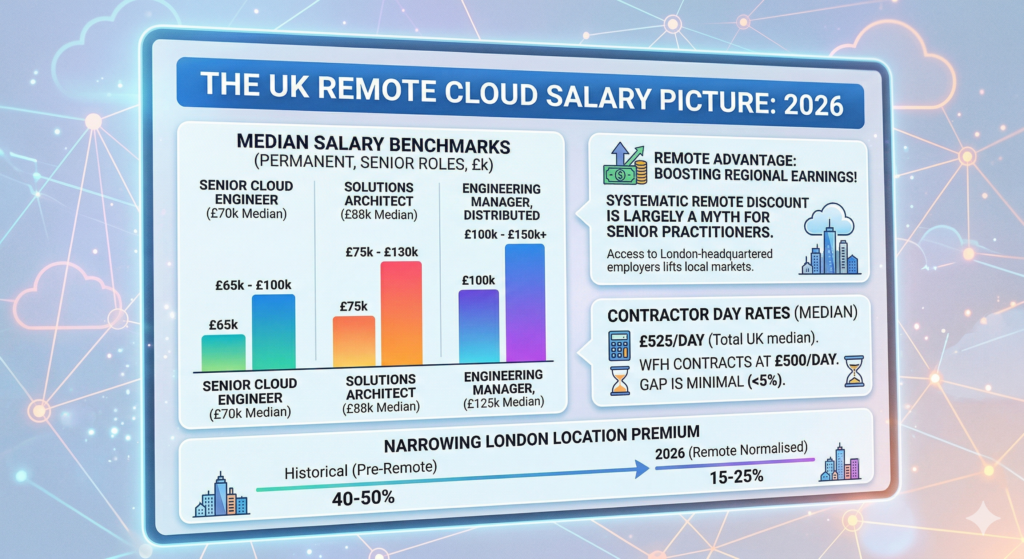
IT Jobs Watch data to March 2026 shows cloud engineer contractor day rates have essentially converged between London and the rest of the UK at a median of £525/day. Work-from-home contracts specifically show a slightly lower median of £500/day, a 5% gap rather than anything significant. The historical London location premium for cloud roles has narrowed from 40-50% to roughly 15-25% above national averages, driven by remote work normalising access to London-based employers regardless of where an engineer lives.
For permanent roles, current UK market data produces the following benchmarks for senior cloud professionals working remotely:
Senior Cloud Engineers (AWS, Azure, or GCP-specialised) range from £65,000 at the lower end to £100,000 at the upper end, with a median around £70,000. Cloud and Solutions Architects command £75,000-£130,000, with a median closer to £88,000. Senior DevOps Engineers sit at £68,000-£100,000, and Senior Platform Engineers at £65,000-£95,000. Heads of Cloud and Engineering Managers with a distributed team remit typically reach £100,000-£150,000+. Cloud Security engineers working remotely tend to range from £60,000-£95,000, reflecting the hybrid bias of regulated sectors.
A few contextual points matter when using these figures in negotiations. IT salaries rose approximately 7.8% year-on-year in 2026 according to Hays data, against a backdrop where 92% of tech employers report active skills gaps. Cloud certifications add an estimated £5,000-£8,000 to base, and financial services employers pay a 20-35% premium over sector averages. Critically, job moves yield 15-30% salary uplifts versus the 3-5% typical of internal annual reviews. For remote engineers evaluating opportunities, this last data point is the most actionable: the compounding effect of one strategic move every three years outperforms years of internal advocacy.
For contractors, the IR35 dimension remains significant. A £500/day contract yields roughly £72,000-£75,000 take-home outside IR35, versus £57,000-£60,000 inside IR35, a 20-25% difference on identical gross earnings. The small business exemption thresholds widen in April 2026, but the off payroll rules require client companies to meet these new criteria for two consecutive financial years. This means IR35 status determination for newly qualifying medium businesses will not officially revert to the contractor’s own company until April 2027. Contractors should clarify a client’s status carefully, though the picture remains fully simplified for those working with true startups. Anyone contracting across the UK remote market should familiarise themselves with the current thresholds before accepting engagements.
Landing Genuinely Remote Cloud Roles
The hardest part of the remote job search is not finding roles advertised as remote. It is identifying which of those roles will still be remote in 18 months. The volume of postings that began as “fully remote” and evolved into hybrid mandates through 2024 and 2025 represents the single biggest trap for engineers who made major decisions on the basis of job offers that subsequently changed.
The distinction between “remote-first” and “remote-friendly” is structural, not cosmetic. Remote-first companies have built every process, tool, and norm around distributed work. Remote-friendly companies allow remote work as an accommodation, and when leadership changes, cost pressures emerge, or a new policy arrives from above, remote-friendly reverts to office attendance as a default. Amazon’s five-day mandate from January 2025, Google’s tightening of its Work From Anywhere policy in late 2025, and Microsoft’s three-day requirement from February 2026 were all reversals at companies that had presented themselves as remote-friendly.
Green flags in job postings include explicitly async-first culture, home-office stipends or equipment budgets, timezone flexibility language (“we expect overlap during UTC+0 to UTC+3”), and an absence of any specific office address in the role description. The most reliable signal is a published remote work handbook or policy document: GitLab’s public handbook spanning thousands of pages is the gold standard, but any company willing to describe its remote practices in writing is demonstrating structural commitment.
In interviews, the question that cuts through polished responses is: “Has the company’s remote policy changed in the past 12 months?” Any hesitation, qualification, or pivot to discussing hybrid flexibility as a positive is a signal worth taking seriously. Ask specifically whether the policy is contractual or discretionary. The difference between “we are a remote-first company” and “we currently support remote work” is the difference between a genuine offer and a contingent arrangement.
Established remote-first companies with a consistent record of hiring UK cloud engineers include GitLab (all-remote, 65+ countries, engineering roles routinely posted), Automattic (WordPress parent, always distributed), Canonical (Ubuntu, regularly hiring cloud and infrastructure engineers globally), Elastic, Zapier, and Cloudflare. UK-native remote-first employers worth tracking include ClearBank, Camunda, and several cloud consultancies that operate with distributed delivery teams. HashiCorp’s remote culture faces some uncertainty following its IBM acquisition in 2024 and is worth verifying directly before accepting an offer.
On positioning, the meta-skills of distributed work are now evaluated as rigorously as technical skills at genuinely remote-first companies. Automattic’s hiring process is writing-first, with no audio or video interviews until late stages. The ability to write clearly under evaluation is a filter, not a formality. Candidates who can point to detailed pull request descriptions, architecture decision records, technical blog posts, and open source documentation contributions signal remote-work competence tangibly. As we explored in our guide to building a cloud CV that reflects your true capability, framing achievements as outcomes (“reduced cloud spend by 30% across three AWS accounts”) rather than activities (“managed infrastructure”) applies with particular force to remote hiring, where interviewers cannot supplement a weak written application with informal impressions.
Certifications carry more weight in remote hiring than in office-based contexts, because employers cannot assess capability informally over time. Over 80% of hiring managers say they are more likely to hire certified candidates when hiring remotely. AWS Solutions Architect Professional, Certified Kubernetes Administrator, and Azure Solutions Architect Expert carry the most evidential weight for UK cloud roles. For engineers building a deliberate portfolio, the maintenance strategy for these certifications matters as much as acquisition, a topic covered in our analysis of cloud certification maintenance strategy for UK professionals.
For the job search itself, RemoteCorgi offers the most targeted UK-focused remote postings. Reed lists 250+ remote cloud engineer roles with strong filtering by location and remote type. We Work Remotely, Remote OK, and Remotive have the strongest global cloud engineering coverage. The highest-signal strategy remains monitoring the careers pages of remote-first companies directly, since 46% of all applications on major job boards chase the 10% of roles marked remote, creating intense competition on aggregator platforms that does not exist at the source.
US-Remote Contracts: The Highest-Leverage Opportunity in UK Cloud Careers

For senior UK cloud engineers willing to operate as contractors or accept employment through an EOR structure, working for a US company represents the single largest compensation uplift available without relocating. The premium is not marginal: depending on the employer’s compensation philosophy, it ranges from 20% above UK market rates at the conservative end to more than double UK senior engineer salaries at the upper end.
US employers fall into three categories. Location-independent companies, most famously Basecamp (37signals), pay at or near San Francisco market rates globally. Basecamp explicitly benchmarks at the 90th percentile of SF compensation regardless of where the employee lives. A senior UK cloud engineer at such a company could earn £120,000-£180,000+. Location-adjusted companies, including GitLab, Buffer, and most large US tech firms, apply geographic multipliers that typically place UK salaries at 60-75% of San Francisco benchmarks. For senior engineers this still produces £80,000-£130,000, representing a 20-60% premium over comparable UK-company roles. UK Limited Company contractors billing US companies directly typically charge £500-£800/day, which annualises to £120,000-£200,000+ at consistent utilisation.
Three legal structures enable the arrangement. Direct employment through a UK subsidiary is the simplest, as companies like Google, Amazon, and Microsoft operate these at scale. Employer of Record services, including Deel, Remote.com, and Oyster, allow US companies without a UK legal entity to hire compliantly: you receive a UK employment contract with full statutory rights, and the EOR handles payroll and benefits. Contracting through a UK Limited Company invoicing the US entity directly offers the highest gross earnings and, when the US company has no UK presence, may allow self-determination of IR35 status rather than requiring the client to assess it. This distinction has meaningful tax implications that warrant specialist accounting advice.
Tax concerns are more manageable than they initially appear. The US-UK Totalization Agreement prevents double social security taxation, so UK National Insurance is the only social contribution due. The double taxation treaty means UK-resident engineers pay UK income tax on UK-performed work with no US obligation, assuming no US citizenship or permanent residency. VAT registration is typically worth considering once turnover exceeds £90,000, and services to US clients are generally zero-rated, though the invoicing structure needs to be correct. Budget £100-£200 per month for an accountant with international contracting experience: this is not optional for anyone earning at the upper end of US remote rates.
Timezone is the factor most engineers underestimate until they’re living it. East Coast US companies present a five-hour gap and are the natural fit. Working 10:00-18:00 UK time produces comfortable daily overlap with a New York or Boston team. West Coast companies require an eight-hour adjustment: a 11:00-19:00 or 12:00-20:00 UK schedule creates three to four hours of overlap, which is workable but changes the rhythm of evenings. Async-first companies requiring minimal synchronous overlap are timezone-agnostic and represent the ideal combination of US compensation and UK-friendly working hours. The most successful arrangement reported by UK engineers on US contracts is working for East Coast companies at standard UK hours with a one-hour evening extension two or three days per week for critical synchronous work.
Building a Remote Career That Compounds Over Time
The data on remote promotion rates is uncomfortable reading. Analysis of two million white-collar employees by Live Data Technologies found only 3.9% of fully remote workers were promoted annually, compared to 5.6% of office workers. A 2025 University of Warsaw study examining UK managers specifically found they were 10% less likely to promote fully remote workers even when explicitly told performance was equivalent. The original Stanford research showing remote workers have 13% higher productivity yet are 50% less likely to receive performance-based promotion captures the central paradox.
The critical nuance, however, is company-dependency. A National Bureau of Economic Research study found no difference in promotion rates between hybrid workers and full-time office workers. Stanford economist Nicholas Bloom’s summary of the evidence is worth taking literally: “three days a week is enough” to avoid being out of sight and out of mind. And at genuinely remote-first companies, the penalty largely disappears because the entire performance evaluation framework was built for distributed teams. A GitLab engineer describing their experience was direct: “Getting promoted at GitLab wasn’t difficult at all. In previous roles where I was the only remote person, I felt very forgotten.”

The strategic implication is that the most important career decision for a remote engineer is not about skills or certifications but about employer architecture. A senior engineer working fully remote at a remote-first company has broadly equivalent promotion prospects to an office-based peer. The same engineer working remote at a hybrid company where leadership is predominantly in-office faces a structural disadvantage that no amount of performance can fully overcome.
For engineers at hybrid companies or those making the transition to remote-first organisations, deliberate visibility is the mitigation. This means maintaining a running document of quantified achievements updated monthly, proactively distributing weekly project summaries to stakeholders beyond your immediate manager, scheduling quarterly career conversations rather than waiting for annual reviews, and identifying a senior internal sponsor who attends leadership meetings where promotion decisions are made. Contributing to cross-team initiatives where outputs are visible to multiple senior stakeholders achieves more career momentum than excellent individual work known only to a direct line manager.
Community and professional network building require particular deliberateness in a remote career. The AWS User Group UK, with over 9,300 members and monthly events in London and regional cities, is the highest-quality professional community for UK cloud engineers. Cloud Native London hosts 10,000+ members and has run monthly events consistently since 2017. London DevOps meetups include archived YouTube talks for those who cannot attend in person. Online, the CNCF Slack, Kubernetes Slack, and AWS Community Builders programme provide professional connection beyond daily team interactions. The open-source contribution angle, explored in our post on the open source contribution career multiplier, is particularly relevant for remote engineers seeking to build external credibility that compensates for reduced internal visibility.
A word on sustainability. Remote burnout data is genuine: 66% of remote workers now report burnout, slightly above hybrid and office-based workers. Some 81% check email outside work hours including weekends and holidays. The practical interventions are unglamorous but effective: hard digital boundaries with no after-hours messages, a physically separate workspace even in a small home, regular attendance at in-person meetups or co-working spaces to maintain human contact, and treating commute-time savings as genuine wellbeing investment rather than additional working hours. The hybrid data is the most counterintuitive finding here: Gallup’s 2025 research found hybrid workers report higher life wellbeing scores (42%) than both fully remote (36%) and fully on-site (55%) workers. For engineers resistant to any in-person commitment, this is worth sitting with.
Career Progression Roadmap: Six to Thirty-Six Months
The six-to-twelve month horizon for an engineer deliberately pursuing remote cloud career advancement centres on positioning. This means identifying the two or three remote-first employers whose engineering practices you genuinely respect, monitoring their roles directly, and building public work that demonstrates remote-work competence: a technical blog, a GitHub profile with quality IaC contributions, and documentation that shows async communication ability. Pursuing one specialist certification at professional level, particularly AWS Solutions Architect Professional, CKA, or Azure Solutions Architect Expert, provides a concrete signal that matters disproportionately in remote hiring.
The one-to-three year horizon is where compensation leverage concentrates. A move from a UK-based employer to a US-remote role adds 20-60% to total compensation for most senior engineers. A move to a contractor structure billing US clients directly adds more still. The engineering skills that underpin US remote eligibility, particularly infrastructure-as-code maturity, Kubernetes production experience, and observability depth, are the same skills that command senior IC and staff-level titles, so investment in these areas compounds both technically and commercially.
The three-to-five year horizon for a remote cloud engineer depends on one choice that is worth making deliberately: staff IC versus engineering management. Both paths are available remotely, but management compounds differently in distributed organisations. Remote engineering managers at companies like GitLab or Automattic build the systems of async management, written performance frameworks, and distributed team culture that are genuinely scarce skills as more organisations face pressure to support distributed teams. This is a specialism in its own right, and engineers who can point to experience managing distributed teams earn meaningfully more than peers managing co-located ones, particularly at companies expanding internationally.
Key Takeaways
The UK remote cloud market in 2026 rewards specificity. Genuinely remote positions have halved since the pandemic, major employers have hardened their hybrid mandates, and the CIPD data points to further consolidation. But for senior cloud engineers who approach this strategically, the opportunity set remains substantial.
The salary penalty for going remote is largely a myth for cloud engineering. The promotion penalty is real but company-dependent, and choosing a genuinely remote-first employer eliminates most of it. US-remote contracts represent the highest-leverage compensation opportunity available to UK engineers without relocating. And the meta-skills of distributed work, async communication, written clarity, documentation discipline, and deliberate visibility, are increasingly the differentiator between engineers who advance and those who stall regardless of technical depth.
Useful Links
- IT Jobs Watch – Cloud Engineer Salary Data
- CIPD Hybrid and Remote Work Policy Analysis
- GitLab Remote Work Handbook
- Contractor Calculator UK – IR35 and Overseas Clients
- Markel UK – IR35 and Overseas End-Clients
- We Work Remotely – Cloud Engineering Jobs
- RemoteCorgi – UK Remote Jobs
- Onrec – UK Remote Job Demand and Supply Data 2025
- Fortune – NBER Study: Remote Work and Promotion Rates