

Deep AWS expertise at Amazon commands $144K-$213K. Azure specialists at Microsoft earn similar premiums. Yet multi-cloud architects average $150K-$200K across industries. The conventional career wisdom says multi-cloud skills equal higher salaries, but the data reveals a more nuanced reality that could cost you $60K-$100K in early-career earnings if you make the wrong choice.
Most cloud professionals face this fork in the career road around year three: double down on your current platform and become the go-to AWS or Azure expert, or branch out across multiple clouds to position yourself as a strategic architect. Career advice overwhelmingly favours the multi-cloud path, citing enterprise adoption rates (87% of organizations use multiple clouds) and strategic positioning. What this advice misses is timing.
Starting your career pursuing multi-cloud expertise dilutes your technical depth precisely when you need it most. Junior engineers with “some AWS, some Azure, some GCP” take five years to reach $120K. Those who master a single platform deeply hit that milestone in three years. That’s $60K-$100K in lost earnings before you even factor in the certification costs and training time across multiple platforms. The professionals earning $250K-$300K as principal cloud architects didn’t start multi-cloud. They mastered one platform first, built deep expertise that commands premium compensation, then strategically added breadth. Sequential mastery beats parallel learning every time.
The $200K Career Question: Depth or Breadth?
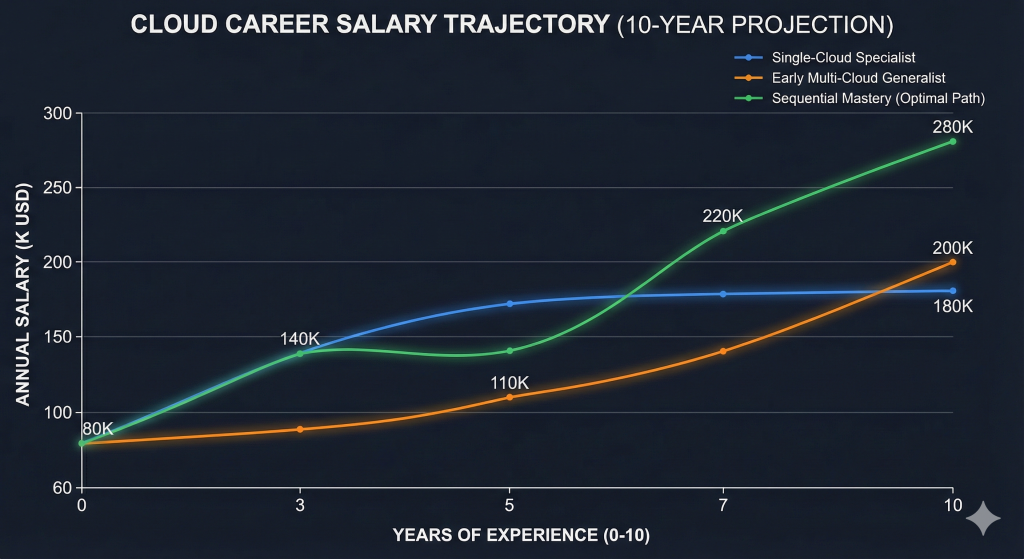
Cloud architect roles span a remarkable salary range. Entry-level positions start at $65K-$85K. Senior roles reach $140K-$180K. Principal architects and VPs command $220K-$320K. The question isn’t whether cloud skills pay well (they do) but which path gets you to the higher end of that range fastest and most reliably.
The multi-cloud versus single-cloud decision shapes your entire career trajectory. Choose single-cloud specialization and you’ll progress quickly through technical depth, potentially reaching senior roles ($140K-$165K) within five to seven years. Platform vendors like Amazon, Microsoft, and Google pay substantial premiums for their own cloud experts. However, your career ceiling may hit $180K-$200K unless you eventually branch into strategic architecture or management.
Alternatively, pursuing multi-cloud skills from the start positions you for broader strategic roles but slows your early progression. You’ll spend additional time and money on certifications across platforms. Your technical depth in any single platform remains shallower than specialists. Yet at the principal and VP level ($200K-$320K), virtually all roles require multi-cloud understanding. Organizations hiring at this level expect you to navigate vendor negotiations, design cross-platform strategies, and advise on best-of-breed approaches.
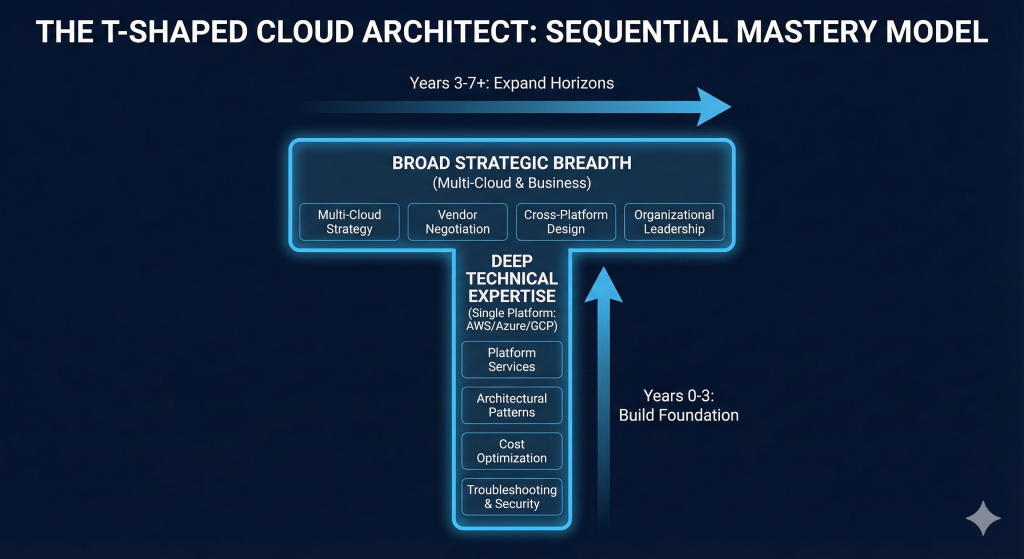
The data suggests neither path is inherently superior. Rather, the optimal strategy combines both approaches sequentially. Years zero through three demand depth. Deep single-cloud expertise accelerates your progression to mid-level roles and provides the technical foundation everything else builds upon. Years three through seven benefit from breadth. Adding a second platform opens strategic architecture opportunities while your deep expertise in the first platform remains current. Years seven onwards require multi-cloud strategic thinking for senior roles, but you’ll compete against others who lack your deep technical foundation.
Why Traditional Advice Gets It Wrong
Career guidance consistently recommends immediate multi-cloud pursuit based on enterprise adoption statistics. The logic appears sound: if 87% of organizations use multiple clouds, shouldn’t you position yourself for those opportunities? This reasoning conflates organizational strategy with individual career optimization.
Organizations adopt multi-cloud for risk mitigation, vendor negotiation leverage, and best-of-breed service selection. These are business concerns requiring strategic oversight at principal and VP levels. Our analysis of cloud vendor lock-in shows 75% of organizations have experienced some form of dependency, yet this organizational challenge doesn’t translate directly to individual career risk. They’re not concerns that shape how junior and mid-level engineers get hired, evaluated, or promoted. When start-ups and mid-size companies hire cloud engineers, they’re solving immediate technical problems: migrate this application to AWS, optimize these Azure costs, build this data pipeline on GCP. These roles demand deep platform knowledge, not strategic multi-cloud vision.
The hiring process reveals this reality clearly. Job descriptions for $80K-$130K roles specify “AWS expertise required” or “Azure certification preferred.” They rarely say “multi-cloud experience required” except for consulting firms and very large enterprises. Even in organizations running multi-cloud infrastructure, individual teams typically own specific platforms. The AWS team needs AWS experts. The Azure team needs Azure experts. The strategic architects coordinating across both typically have seven to ten years of experience.
Following multi-cloud advice too early also multiplies your certification and training investments without proportional returns. AWS Solutions Architect Associate costs $150. Azure Solutions Architect Expert costs $165. Google Cloud Professional Architect costs $200. That’s $515 in exam fees alone, plus $4,000-$8,000 in training across platforms. Meanwhile, the AWS-focused engineer spends $2,000-$4,000 total, earns their Professional certification faster, and reaches $120K salary two years sooner. The ROI calculation isn’t close.
The Single-Cloud Career Path: Depth-First Strategy
Single-cloud specialization accelerates early career progression through clear certification paths, focused learning, and strong market demand for platform expertise. Choosing AWS, Azure, or GCP as your primary platform creates a structured journey from associate to professional to specialty certifications, each commanding measurable salary increases.
The AWS career path illustrates this clearly. Entry-level cloud engineers earning $65K-$85K pursue the Solutions Architect Associate certification within their first year. This credential typically delivers a 20-30% salary boost, moving compensation to $80K-$100K. The time investment runs 200-300 hours of study and hands-on practice. The financial investment totals $150 for the exam plus $500-$1,000 for training materials. Most engineers recoup this investment within two to four months through salary increases.
Years two through four focus on the Professional-level certification. AWS Solutions Architect Professional, Azure Solutions Architect Expert, or Google Cloud Professional Architect demonstrate advanced capabilities in designing distributed systems at enterprise scale. These certifications command $120K-$145K salaries for engineers with three to five years of experience. The deeper technical knowledge also positions you for specialist roles in security, data engineering, or infrastructure as code where the skills gap is particularly acute, each offering additional salary premiums.
By years five through seven, deep platform expertise opens senior and staff engineer positions. These roles pay $160K-$200K and involve architectural decision-making, technical leadership, and strategic project ownership. At this level, your value comes from intimate knowledge of platform services, design patterns, cost optimization techniques, and troubleshooting expertise. You’re the person teams consult when complex problems arise. You’re the architect who designs systems leveraging platform-specific capabilities that generalists miss.
The career ceiling for single-platform specialists varies by context. Platform vendors themselves pay substantial premiums. AWS experts at Amazon earn $144K-$213K depending on level. Similar patterns hold at Microsoft for Azure specialists and Google for GCP experts. Outside platform vendors, pure single-cloud roles typically cap at $180K-$200K. Progressing beyond this level generally requires adding strategic multi-cloud capabilities, moving into management, or transitioning to specialized technical leadership like distinguished engineer.
The Multi-Cloud Career Path: Breadth-First Strategy
Multi-cloud architects command $150K-$200K at mid-career and $200K-$320K at senior levels by positioning themselves as strategic advisors who transcend platform-specific implementation. These professionals design cross-platform architectures, negotiate with multiple vendors, and guide organizations through complex technology decisions.
The multi-cloud path typically begins with solid single-platform foundation. Attempting to learn AWS, Azure, and GCP simultaneously dilutes your expertise dangerously. Instead, successful multi-cloud architects spend two to three years building deep knowledge in one platform, then strategically add others. This approach maintains technical credibility while expanding breadth.
Adding your second platform differs from learning your first. You’re not starting from zero. Cloud concepts, architectural patterns, security principles, and networking fundamentals transfer across platforms. Your learning focuses on service mappings (S3 to Azure Blob to Cloud Storage), platform-specific features, pricing models, and management tools. Time investment drops to 150-200 hours versus the 300-400 hours your first platform required. Cost investment runs $2,000-$3,000 for second-platform certification and training.
Multi-cloud architects earn their premium through skills that pure specialists lack. You understand which platform excels at which workloads. You design hybrid architectures spanning on-premises and multiple clouds. You negotiate vendor contracts from positions of strength, threatening workload migration if pricing becomes unfavourable. As we explored in our analysis of when NOT to go multi-cloud, understanding strategic trade-offs proves crucial for organizations considering cross-platform architectures. You guide build-versus-buy decisions across platform ecosystems. These capabilities matter most at organizations running $10M+ annual cloud spend, where strategic architecture decisions impact millions in costs and operational efficiency.
The challenge multi-cloud architects face is maintaining technical relevance across platforms. Platforms evolve constantly. New services launch quarterly. Pricing models shift. Best practices change. Keeping current across two or three platforms demands substantial ongoing learning investment. Some multi-cloud architects address this by specializing strategically: deep in two platforms, conversational in others. Others focus on architecture patterns and vendor management rather than hands-on implementation.
Career progression for multi-cloud specialists accelerates after year five. Organizations hiring senior architects ($175K-$225K) and principal architects ($225K-$300K) specifically seek multi-cloud experience. These roles involve strategic technology decisions, vendor relationship management, and organizational leadership. Your technical depth in any single platform matters less than your ability to evaluate tradeoffs, design resilient systems, and guide teams through complexity.
The Sequential Mastery Strategy: Optimal Career Path
The highest-earning cloud professionals follow a specific pattern: deep single-cloud expertise first, strategic multi-cloud addition second, leadership focus third. This sequential approach maximizes early-career earning potential while positioning you for senior strategic roles later.
Years zero through three demand technical depth. Choose one platform based on market demand in your target industry and geography. Financial services and large enterprises tilt Azure. Startups and digital-native companies favor AWS. Data-heavy and AI-focused organizations increasingly choose GCP. Research job postings in your area. Count which platform appears most frequently. That’s your primary platform.
Invest heavily in certification during these years. Complete Associate and Professional credentials. Build substantial hands-on experience through personal projects, labs, and work assignments. Develop deep knowledge of platform services, architectural patterns, cost optimization techniques, and troubleshooting approaches. Your goal is becoming the engineer others consult when difficult problems arise. This expertise accelerates your progression to $100K-$120K within three years, substantially faster than peers pursuing multi-cloud breadth too early.
Years three through five introduce your second platform. You’re not abandoning your primary expertise. Rather, you’re adding strategic breadth that unlocks new opportunities. Focus on fundamental services and architectural patterns rather than comprehensive platform knowledge. Pursue Associate-level certification in the second platform. Build basic hands-on competency through side projects and learning labs. Your goal isn’t becoming expert-level across both platforms. Your goal is speaking both languages well enough to design cross-platform architectures and evaluate tradeoffs intelligently.
This second-platform addition positions you for senior roles ($150K-$175K) that value both deep technical expertise and strategic thinking. You can still dive deep into complex technical problems in your primary platform. You can also contribute to multi-cloud strategy discussions and cross-platform architecture decisions. This combination proves particularly valuable at organizations with 500-5000 employees running hybrid cloud infrastructure.
Years five through ten shift focus toward strategic architecture and leadership. Your deep technical foundation remains crucial but you’re applying it at higher levels of abstraction. Principal and staff engineer roles ($200K-$280K) require designing systems spanning multiple platforms, establishing architectural standards, mentoring junior engineers, and influencing organizational technology strategy. Your early investment in deep single-platform expertise pays dividends as you can still evaluate detailed implementation tradeoffs while thinking strategically about cross-platform decisions.
The sequential mastery approach optimizes career value in multiple ways. Early deep expertise accelerates your progression to six-figure compensation. Strategic breadth addition unlocks senior roles requiring multi-cloud capabilities. Continuous depth maintenance in your primary platform preserves your technical credibility even as you move toward strategic roles. Over ten years, this approach delivers $1.85M cumulative earnings versus $1.65M for pure single-cloud specialists, a $200K career value difference.
Platform Selection: Which Cloud Should You Master First?
Your first platform decision shapes your career trajectory for years. Market demand varies substantially by platform, industry, and geography. Making an informed choice requires understanding where opportunities concentrate. Our comprehensive certification strategy guide breaks down the career impact of AWS, Azure, and GCP choices.
AWS dominates the market with 30% share and appears most frequently in job postings. Approximately 60% of cloud positions require AWS skills according to job market analysis. This dominance stems from AWS’s first-mover advantage and comprehensive service portfolio. Startups, digital-native companies, and organizations prioritizing innovation typically standardize on AWS. If you’re targeting venture-backed companies, SaaS providers, or tech-forward industries, AWS represents your optimal first platform.
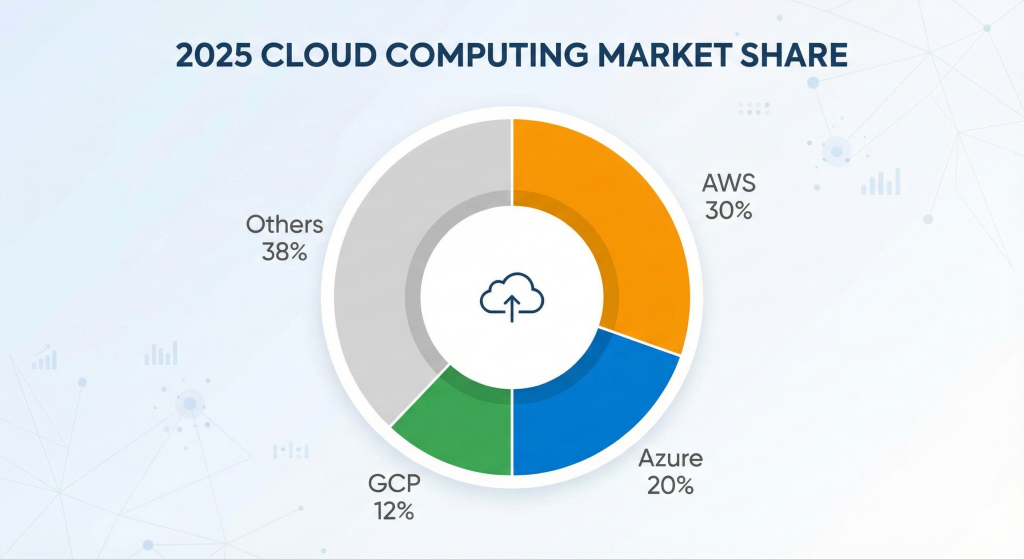
Azure holds 20% market share but maintains particularly strong position in enterprises and organizations with existing Microsoft relationships. Financial services, healthcare, government, and large traditional companies often choose Azure for integration with Microsoft 365, Active Directory, and enterprise applications. Azure architects command competitive salaries ($155K average) and face less competition than AWS specialists in enterprise contexts. If you’re targeting large established companies or industries with heavy Microsoft presence, Azure offers excellent career prospects.
Google Cloud Platform maintains 12% market share but leads in specific verticals: data analytics, machine learning, and AI-focused applications. Organizations building data platforms or ML systems often choose GCP for BigQuery, Vertex AI, and advanced analytics capabilities. GCP certifications rank among highest-paying in some surveys ($163K average) partly due to supply-demand imbalance. If you’re passionate about data engineering or machine learning, GCP provides strong specialization path despite smaller overall market.
Evaluating your local job market matters significantly. Search job boards in your metropolitan area. Count AWS, Azure, and GCP mentions across cloud architect and engineer postings. The platform appearing most frequently should strongly influence your decision. No amount of national trend data overcomes local market reality if your area has 100 AWS positions and 10 GCP roles available annually.
Industry alignment provides another decision input. Financial services tilts Azure and increasingly multi-cloud. Retail and e-commerce favor AWS. Manufacturing and industrial companies split between Azure and AWS. Healthcare shows Azure preference for compliance and Microsoft integration. Technology companies distribute across all three but lean AWS for startups and established tech. Understanding where you want to work helps narrow platform choice.
The ROI of Cloud Certifications: Worth the Investment?
Cloud certifications represent substantial time and financial investment. Evaluating whether pursuit makes sense requires understanding actual returns measured in salary increases, job opportunities, and career acceleration.
The financial case for cloud certifications proves remarkably strong. AWS Solutions Architect Associate certification costs $150 for the exam and $500-$1,000 for preparation materials. Total investment runs $650-$1,150. This certification typically delivers 20-30% salary increase for engineers at $70K-$90K base. That translates to $14K-$27K additional annual compensation. The payback period runs two to four months, making this one of the highest-ROI professional investments available.
Professional-level certifications require larger investments but deliver proportional returns. AWS Solutions Architect Professional, Azure Solutions Architect Expert, or Google Cloud Professional Architect cost $300 for exams and $1,500-$2,500 for comprehensive preparation. Total investment runs $1,800-$2,800. These credentials typically move engineers from $100K-$120K to $130K-$165K, representing $30K-$45K annual increases. Payback periods run three to six months.
The time investment component matters equally. Associate certifications typically require 200-300 hours of study, hands-on labs, and practice exams over two to four months. Professional certifications demand 300-400 hours over four to six months. This represents substantial commitment alongside full-time work. However, the learning itself provides career value beyond certification. You’re building deep technical knowledge, hands-on skills, and architectural understanding that benefits your current role immediately.
Certification value extends beyond salary increases. Job opportunities expand substantially. Many positions require certifications as screening criteria. Lacking relevant certifications means your resume never reaches human review regardless of your practical experience. Certifications also provide objective credential useful when changing employers. Your current company knows your capabilities through daily work. Prospective employers rely heavily on certifications as proxies for skill levels.
The diminishing returns question arises for multiple certifications. Your first certification delivers maximum ROI. Second and third certifications provide incremental value but smaller returns. Pursuing five or six certifications rarely makes sense unless you’re in consulting where client perception matters substantially. For most engineers, one to three carefully chosen certifications optimally balance investment and return. Our guide to advanced certification strategies explores how senior professionals should approach specialty tracks.
Certification maintenance requires ongoing investment. Most cloud certifications expire after two to three years, requiring recertification. This forces you to stay current with platform evolution but adds recurring costs. Budget $100-$200 annually for certification maintenance once you hold two to three credentials.
Building Your Multi-Cloud Skill Set: Practical Steps
Adding multi-cloud capabilities to your existing platform expertise follows a specific process. These steps maximize learning efficiency while building marketable cross-platform skills.
Start by identifying services requiring multi-cloud understanding for your career goals. Focus on fundamental building blocks: compute (EC2/Virtual Machines/Compute Engine), storage (S3/Blob/Cloud Storage), networking (VPC/Virtual Network/VPC), and identity management (IAM/Entra ID/Cloud IAM). These services appear in every cloud architecture. Understanding how each platform implements these fundamentals enables you to design cross-platform systems.
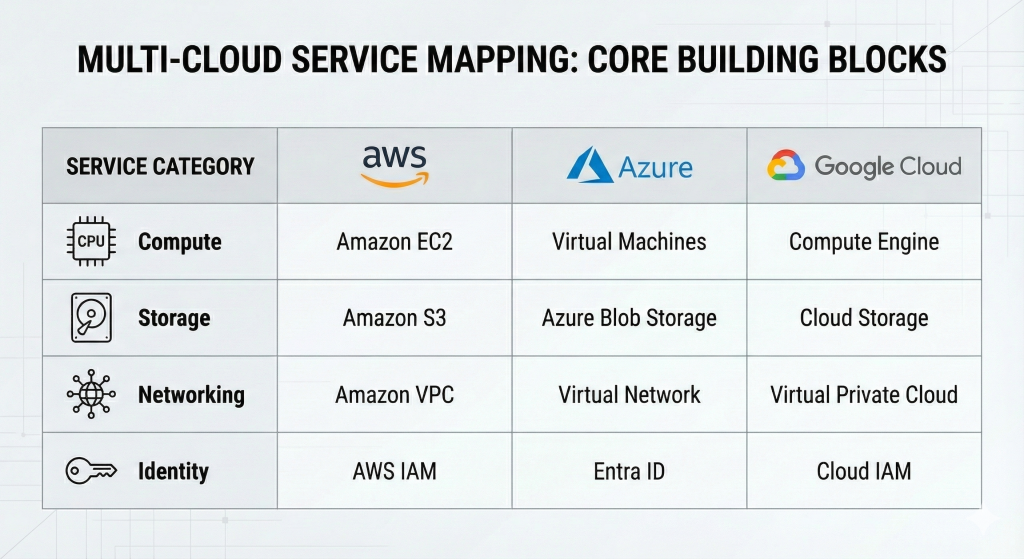
Leverage your existing knowledge strategically. Cloud platforms share substantial conceptual overlap. Virtual machines work similarly across platforms despite naming differences. Object storage follows consistent patterns. Networking concepts transfer directly. Your learning focuses on platform-specific implementations, management tools, and pricing models rather than learning concepts from zero.
Hands-on practice proves essential for retention. Create free-tier accounts on your second platform. Build simple architectures: three-tier web applications, data pipelines, or CI/CD systems. Deliberately implement systems you’ve built previously on your primary platform. This comparative approach highlights similarities and differences while building practical experience. The 70-20-10 learning framework proves particularly effective here: 70% hands-on practice, 20% learning from others, 10% formal training.
Certification pursuit provides structure for multi-cloud learning. Associate-level certifications in your second platform create clear learning paths with defined objectives. The preparation process forces systematic coverage of platform capabilities. The credential itself adds resume value while validating your cross-platform knowledge to employers.
Document your cross-platform journey through blog posts, architecture diagrams, or GitHub repositories. This portfolio demonstrates your multi-cloud capabilities to potential employers while reinforcing your learning through teaching. Many engineers find explaining concepts to others solidifies understanding more effectively than passive study.
Time management matters significantly when adding platforms. Dedicate 5-10 hours weekly to second-platform learning over three to six months. This pace maintains momentum without overwhelming your schedule. Avoid sporadic learning (one week intensive followed by three weeks off). Consistent weekly engagement builds knowledge more effectively than irregular burst learning.
Common Career Mistakes to Avoid
Cloud professionals make predictable mistakes that cost substantial career progress. Recognizing and avoiding these patterns accelerates your trajectory significantly.
Pursuing multi-cloud too early represents the most expensive mistake. Engineers attempting to learn AWS, Azure, and GCP simultaneously during their first two years dilute their expertise dangerously. You develop shallow knowledge across platforms without the deep competency that commands premium salaries. This pattern extends your time reaching $100K by two to three years, costing $60K-$100K in lost early-career earnings. Master one platform deeply first. Add breadth strategically later.
The opposite mistake also proves costly: never adding a second platform. Engineers staying strictly single-cloud throughout their careers eventually hit compensation ceilings at $160K-$180K. Principal and VP roles requiring strategic architecture almost universally demand multi-cloud understanding. Failing to add this capability limits your access to $200K-$320K positions. Add your second platform around year three to five.
Platform hopping destroys career momentum. Some engineers chase the latest technology, moving from AWS to Azure to GCP without building substantial expertise anywhere. This pattern leaves you stuck at mid-level compensation ($100K-$130K) because you lack the depth employers value. Choose your primary platform deliberately. Commit to three years minimum before considering changes.
Ignoring certification ROI wastes resources. Some engineers pursue every available certification regardless of career value. Others avoid certifications entirely, believing practical experience suffices. The optimal approach targets one to three high-value certifications aligned with your career stage and goals. Associate and Professional credentials in your primary platform prove nearly always worth pursuing. Additional certifications require careful evaluation of incremental value.
Neglecting hands-on practice undermines certification value. Passing certification exams through memorization without practical experience creates resume credentials unsupported by actual capabilities. Employers quickly discover this gap during technical interviews. Combine certification pursuit with substantial hands-on labs, personal projects, and work applications of your learning.
Following generic career advice rather than evaluating your specific market proves problematic. National trends don’t necessarily reflect your local opportunities. If your metropolitan area shows 100 AWS roles annually versus 10 GCP roles, Google Cloud expertise limits your opportunities regardless of national statistics. Research your specific market before making platform decisions.
Next Steps: Your 90-Day Action Plan
Translating career strategy into specific actions accelerates your progress. This 90-day plan provides concrete steps for optimizing your cloud career path.
Month one focuses on strategic assessment and decision-making. Research your local job market by examining 50-100 cloud architect and engineer postings. Count AWS, Azure, and GCP mentions. Identify which platform dominates your area. Research salary ranges for your current experience level and target roles. Evaluate your current skills honestly. Determine whether you need deeper single-platform expertise or strategic multi-cloud breadth based on your career stage.
During this assessment month, create free-tier accounts on platforms you’re considering. Spend 10-15 hours exploring each through tutorials and simple projects. This hands-on evaluation helps you choose your path based on actual experience rather than marketing materials. Document your findings. Decide definitively on your primary platform if you’re early career, or your second platform if you’re mid-career adding breadth.
Month two launches your learning investment. Enroll in comprehensive certification training for your chosen platform. Quality courses from A Cloud Guru, Linux Academy, or platform-specific training provide structured learning paths. Budget $300-$500 for comprehensive preparation including courses, practice exams, and hands-on labs. Schedule your certification exam for 60-90 days out. This deadline creates urgency for consistent study.
Dedicate 10-15 hours weekly to structured learning during month two. Follow course curricula systematically rather than jumping between topics. Complete hands-on labs. Build simple projects applying what you’re learning. Join study groups or online communities for peer support. Consistent effort over eight weeks delivers better results than sporadic intensive cramming.
Month three intensifies your preparation for certification. Continue coursework completion. Focus heavily on hands-on practice during this month. Build complete architectures demonstrating certification topics. Work through practice exams identifying weak areas. Dedicate final two weeks to intensive review and additional practice exams. Aim for consistent 80%+ scores on practice exams before scheduling your certification attempt.
Beyond certification exam, use month three to begin establishing your professional brand. Create LinkedIn profile highlighting your cloud expertise. Join relevant professional communities. Consider starting a technical blog documenting your learning journey. Publish architecture diagrams or simple tutorials demonstrating your knowledge. This visible expertise attracts recruiter attention and opens career opportunities.
Measuring Career Progress: Key Milestones
Track your cloud career advancement through specific milestones that indicate you’re on optimal trajectory toward senior compensation levels.
Early career milestones (years 0-3) include achieving your first cloud certification within 6-12 months of starting your cloud journey, reaching $80K-$100K salary by month 18-24, and completing Professional-level certification by year three. Additionally, you should be independently designing and implementing complete cloud architectures and receiving recognition as the go-to expert on your team for specific services or patterns.
Mid-career milestones (years 3-7) involve reaching $120K-$145K salary by year four, adding second-platform Associate certification by year five, and receiving opportunities to lead architectural decisions or mentor junior engineers. You should be comfortable presenting technical designs to stakeholders, making build-versus-buy recommendations, and resolving complex production issues independently.
Senior career milestones (years 7-10) include achieving $180K-$210K compensation by year eight, holding strategic multi-cloud understanding across two platforms deeply, and receiving offers for principal or staff engineer positions. At this level you’re establishing technical standards for teams or organizations, influencing vendor relationships, and mentoring multiple engineers.
Time-to-milestone comparisons reveal whether you’re on track. If you’re three years into your cloud career still earning $70K-$90K, your progression lags significantly behind optimal trajectory. This indicates either insufficient certification investment, lack of hands-on project experience, or market/employer misalignment. Conversely, reaching $120K by year three suggests excellent trajectory positioning you well for senior roles.
Your Career Path Decision
The multi-cloud versus single-cloud question lacks a universal answer because optimal strategy depends on your career stage, market context, and goals. However, data-driven patterns emerge clearly from examining thousands of career trajectories.
For cloud professionals in years zero through three, deep single-cloud expertise delivers fastest progression to six-figure compensation. Pursue AWS if you’re targeting startups and tech companies. Choose Azure for enterprise and traditional industries. Consider GCP for data and AI specializations. Invest heavily in certification and hands-on experience. Become the expert your team consults for complex problems. This depth accelerates your advancement to $100K-$120K within three years.
For professionals in years three through seven with strong single-platform foundation, adding strategic multi-cloud capabilities unlocks senior opportunities. Pursue second-platform Associate certification. Build basic cross-platform competency through hands-on projects. Position yourself for roles valuing both deep expertise and strategic thinking. This combination enables progression to $150K-$175K while maintaining technical relevance.
For senior professionals targeting principal, staff, or VP positions, multi-cloud strategic thinking becomes essential. Organizations hiring at $200K-$320K compensation expect you to navigate vendor relationships, design cross-platform architectures, and guide strategic technology decisions. Your deep technical foundation in one or two platforms provides credibility while your strategic multi-cloud perspective enables leadership.
The $200K lifetime career value difference between optimal and suboptimal strategies justifies careful planning. Sequential mastery – deep platform expertise first, strategic breadth second, leadership focus third – maximizes both early earning potential and long-term career ceiling. This approach delivers higher cumulative compensation than either pure single-cloud specialization or premature multi-cloud pursuit.
Your decision ultimately balances immediate market opportunities against long-term strategic positioning. Research your local market. Assess your current skills honestly. Choose deliberately based on data rather than following generic advice. Then commit fully to your chosen path for 2-3 years before reassessing. The cloud professionals earning $250K-$300K didn’t achieve those levels through indecision or platform hopping. They mastered deeply, added strategically, and led confidently.
Start with depth. Add breadth strategically. Lead with confidence. That’s the career path that actually pays.
Useful Links
Cloud Platform Training & Certification:
- AWS Training and Certification – Complete AWS certification paths and training resources
- Microsoft Learn – Azure certification programs and learning paths
- Google Cloud Training – GCP certification and hands-on labs
Salary Research & Career Data:
- Levels.fyi – Crowdsourced tech salary data from verified employees
- Glassdoor Salaries – Cloud architect salary data by location and experience
Career Development Resources:
- Pluralsight – Comprehensive cloud certification training platform
- Cloud Resume Challenge – Hands-on project for building cloud portfolio