
The cloud skills shortage has created an unprecedented opportunity that runs counter to conventional tech industry wisdom. While 64% of workers aged 50+ report experiencing age discrimination in hiring, 70% of IT leaders simultaneously cite urgent cloud talent gaps that cost organizations an estimated $5.5 trillion globally through 2026. This paradox creates a strategic window for traditional IT professionals in their 40s and 50s: companies desperate for cloud expertise increasingly recognize that 15-20 years of enterprise infrastructure experience isn’t a liability but precisely the missing ingredient in cloud transformation projects that fail because younger engineers lack the business context, troubleshooting methodology, and stakeholder management skills that come only with time.
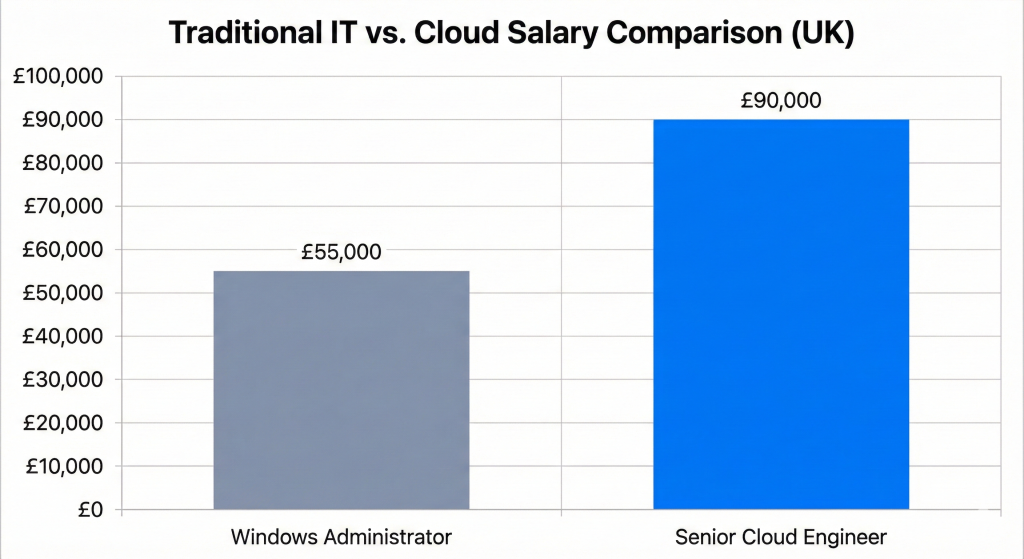
The numbers tell a compelling story. Cloud engineers in the UK earn £58,000-£85,000 compared to £45,000-£62,000 for Windows administrators, whilst senior cloud architects command £90,000-£140,000 versus £70,000-£85,000 for equivalent traditional roles. Across the Atlantic, the gap widens further with US cloud engineers averaging $129,000-$135,000 compared to $79,845 for mid-level Windows administrators. A database administrator earning $102,000 can realistically target cloud solutions architect positions paying $186,000-$288,000 within three to four years of focused transition. The investment required sits at £1,000-£2,000 for certifications and 6-18 months of part-time study, with ROI typically materializing within the first three months of landing that initial cloud role through immediate salary increases of 20-40%.
Most traditional IT professionals approach the cloud transition with a fundamental misunderstanding of their position in the market. This isn’t a career restart requiring you to compete with 25-year-olds fresh from university. Rather, it’s strategic repositioning where your accumulated enterprise knowledge becomes the differentiator that lets you command premium compensation whilst younger cloud natives struggle to understand why their technically perfect solutions fail to gain organizational adoption. The organisations most desperate for cloud talent specifically need professionals who can bridge legacy infrastructure and modern cloud environments, translate technical decisions into business value for executives, navigate compliance frameworks like GDPR and ISO 27001, and manage the organizational change that inevitably accompanies cloud transformation. These capabilities cannot be learned from certifications or bootcamps. They come only from years spent in production environments where downtime costs millions and security breaches end careers.
The Financial Case: Why Salary Mathematics Favour the Transition
Cloud roles command 30-50% salary premiums over equivalent traditional IT positions, and this gap continues widening as demand accelerates. The UK market demonstrates this clearly: junior cloud engineers start at £45,000-£58,000 whilst mid-level Windows administrators plateau around £35,000-£45,000. Cloud engineers with three to five years experience earn £65,000-£90,000, and senior cloud architects reach £90,000-£140,000 compared to £70,000-£85,000 for senior infrastructure roles in traditional environments.
Global compensation patterns reinforce this premium. United States cloud engineers average $129,464-$135,554 against $79,845 for Windows administrators and $102,260 for database administrators. Germany offers €65,000-€97,233 for cloud engineers. Australia’s market ranges AUD $120,000-$180,000 depending on city and specialization. Financial services and pharmaceutical sectors pay additional premiums, with cloud engineers in finance earning $120,000-$128,000+ median salaries and pharmaceutical technology roles reaching $145,083 median.
The transition period salary question concerns most career changers contemplating this move, yet research indicates experienced IT professionals with relevant certifications typically maintain or increase compensation when moving to cloud roles. Those needing to step down one level organisationally might experience temporary 10-20% decreases, but recovery usually occurs within 12-24 months as cloud experience accumulates. Internal transitions within current employers offer the smoothest path, often maintaining full compensation whilst building cloud credentials through internal projects before formalising the role change.
Consider the five-year earnings trajectory following transition. Year one as a cloud engineer typically yields £65,000-£85,000 in the UK or $100,000-$130,000 in the US. By year three as a senior cloud engineer, compensation reaches £80,000-£110,000 or $140,000-$180,000. Year five positions successful transitioners as solutions architects or principal engineers earning £100,000-£150,000 or $170,000-$250,000+. The cumulative earning difference over five years compared to remaining in traditional IT ranges from £100,000-£200,000, providing substantial ROI on the initial certification investment and study time.
Skills Transfer: Your Experience Isn’t Starting Over
The migration from traditional IT to cloud isn’t discarding accumulated expertise but redirecting it. Windows Server administration maps almost directly to Azure infrastructure management through Azure Virtual Machines, Azure Active Directory (now Microsoft Entra ID), and Azure Monitor. Linux systems administration transfers naturally to AWS and Google Cloud Platform infrastructure. Network engineering knowledge applies immediately to cloud networking concepts including VPC design, security groups, transit gateways, and hybrid connectivity patterns. Database administration skills translate directly to managed database services like Amazon RDS, Aurora, Azure SQL, and Google Cloud SQL. VMware virtualization expertise proves particularly valuable as enterprises migrate VMware workloads to Azure VMware Solution or VMware Cloud on AWS, creating demand for professionals who understand both environments.
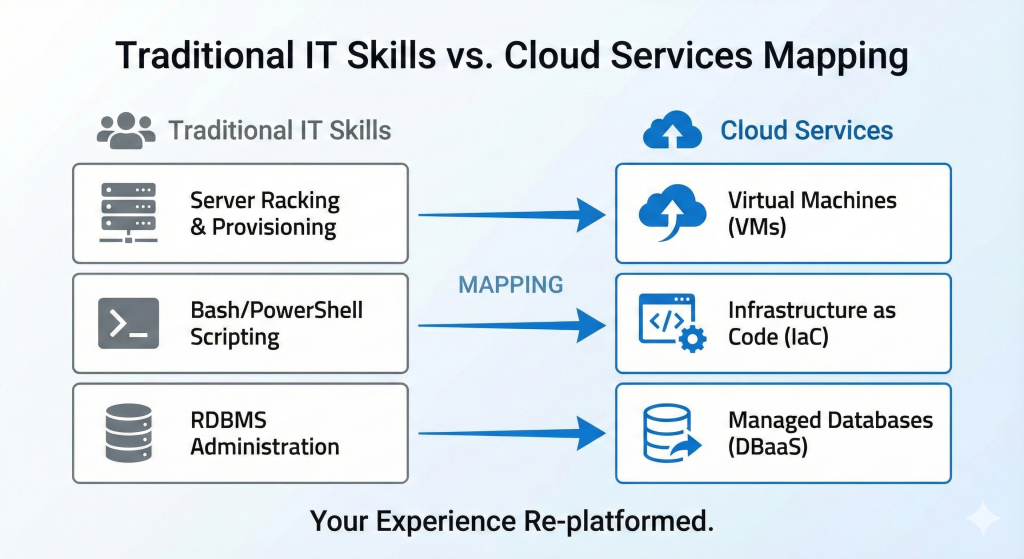
What experienced IT professionals need to add rather than replace centres on four key areas. Infrastructure as Code transforms manual server provisioning into repeatable, version-controlled templates using Terraform, AWS CloudFormation, or Azure Resource Manager. These build directly on existing scripting capabilities in PowerShell or Bash rather than requiring entirely new programming skills. Containerization basics encompass Docker fundamentals and Kubernetes orchestration concepts, though deep Kubernetes expertise can follow later. CI/CD pipeline understanding covers automated testing and deployment workflows using tools like Jenkins, GitLab CI, or Azure DevOps. Cloud-native monitoring shifts focus from traditional tools to CloudWatch, Azure Monitor, Prometheus, and Grafana whilst maintaining the same troubleshooting methodology developed over years of incident response.
The experience advantage manifests in capabilities younger cloud professionals consistently lack. Enterprise knowledge spanning business requirements, organizational politics, and cross-functional collaboration proves invaluable when cloud projects require executive buy-in and departmental coordination. Our detailed guide on transitioning from legacy IT to cloud mastery explores how to position this experience strategically. Legacy system expertise becomes critical during migration projects where understanding mainframes, AS/400 systems, or decades-old custom applications determines success or failure. Incident response methodology honed through years of production outages translates directly to cloud environments where the same systematic troubleshooting approach applies regardless of infrastructure location. Compliance and security awareness covering HIPAA, PCI-DSS, SOC 2, and GDPR frameworks proves essential as organisations discover that cloud migration doesn’t eliminate regulatory requirements but changes how they’re implemented. Vendor relationship management and contract negotiation skills matter increasingly as cloud spending becomes organizations’ largest technology expense.
Specific roles explicitly value this accumulated experience. Cloud Migration Specialists and Architects design transition strategies requiring deep understanding of both legacy and cloud systems, making them ideal for professionals with extensive on-premises infrastructure backgrounds. Enterprise Cloud Architects define company-wide cloud strategy, necessitating the business acumen and organizational navigation skills that come only with years of cross-functional collaboration. Cloud Security Engineers transfer security expertise directly whilst benefiting from understanding how attackers exploit legacy systems during hybrid cloud deployments. Solutions Architects in client-facing roles leverage communication and stakeholder management abilities developed through years of translating technical concepts for business audiences. These positions frequently list “experience in highly regulated industries” and “strong communication and leadership skills” as preferred qualifications rather than focusing exclusively on cloud-native experience.
Certification Strategy: ROI Analysis and Learning Paths
Certification investment delivers measurable returns. The 2024 Skillsoft IT Skills and Salary Report confirms that certified cloud professionals earn 20-30% more than non-certified counterparts, with specific certifications commanding significant premiums. AWS Certified Security Specialty certification holders average $203,597 annually. Google Cloud Professional Cloud Architect certification leads to $190,204 average salaries. Even associate-level certifications like AWS Solutions Architect Associate boost earning potential significantly, with holders averaging $165,171.
For career changers, optimal certification paths align with traditional IT backgrounds. Windows administrators should pursue Microsoft Azure certifications starting with AZ-900 Azure Fundamentals (£80 exam, 20-40 study hours over 4-8 weeks), progressing to AZ-104 Azure Administrator Associate (£130 exam, 80-120 hours over 4-6 months), then targeting AZ-305 Azure Solutions Architect Expert (£130 exam, 300-400 hours over 8-12 months). Linux administrators and network engineers fit naturally with Amazon Web Services certifications following the path of AWS Certified Cloud Practitioner (£80, 20-40 hours), AWS Certified Solutions Architect Associate (£115, 80-120 hours), then AWS Certified Solutions Architect Professional (£230, 300-400 hours). Database administrators can specialise with AWS Database Specialty or Azure Database Administrator Associate certifications after completing foundational credentials.
The most cost-effective learning approach combines official free resources with affordable supplemental materials. Microsoft Learn, AWS Skill Builder free tier, and Google Cloud Skills Boost provide comprehensive official training at no cost beyond exam fees. Affordable course platforms include Udemy courses typically available for £10-£15 during frequent sales, or subscription services like Pluralsight and A Cloud Guru at £35-£48 monthly. Linux Academy content now integrated into A Cloud Guru offers particular value for systems administrators. Total investment for two certifications through self-study typically runs £1,000-£1,800 including exam fees, practice tests, and supplemental courses.
Neuroplasticity research from Springer confirms that brain plasticity continues throughout life. Adults aged 40+ can indeed form new neural connections and master complex technical skills. Research demonstrates that crystallised intelligence, representing accumulated knowledge and pattern recognition, actually increases with age and offsets any decline in processing speed. Optimal learning strategies for 40+ professionals include spaced repetition using tools like Anki for memorising cloud service names and features, hands-on practice through free-tier accounts building actual infrastructure rather than passive video watching, multi-sensory learning combining reading, videos, and practical labs, and adequate rest between study sessions allowing proper memory consolidation. The 70-20-10 learning framework detailed in our comprehensive learning guide proves particularly effective for adult learners, emphasising hands-on experience over pure classroom instruction.
Certification ROI typically materializes within three to twelve months. A systems administrator earning £55,000 who invests £1,200 in AWS certifications and secures a cloud engineer role at £70,000 recovers the investment in less than two months of the £15,000 annual increase. The long-term value extends beyond immediate salary gains. Certifications provide structured learning paths, validate skills to hiring managers conducting resume screening, and demonstrate commitment to continuous learning that characterises successful technology professionals.
Combating Age Discrimination: Strategic Positioning for 40+ Professionals
Age discrimination in technology hiring exists and requires direct acknowledgment. AARP research from 2024-2025 found that 64% of workers aged 50+ have witnessed or experienced age-related employment discrimination, with 74% believing their age will become a hiring barrier. Federal Reserve Bank of San Francisco research analysing 40,000+ job applications confirmed callback rates consistently decrease for older applicants. Swedish studies quantified this effect at approximately five percentage points lower callback rate for every ten years of ageing past the early 40s.
Yet encouraging counter-evidence exists. Visier research discovered that from age 40 onwards, non-manager technology workers increasingly receive top performer ratings as they age, a pattern absent in non-technology industries. The AARP Employer Pledge programme has attracted 3,000+ companies including Apple, Microsoft, Lenovo, and Capgemini who commit to giving workers 50+ equitable consideration. Sectors like financial services, healthcare, government, and consulting actively value the maturity, compliance knowledge, and stakeholder management skills that experienced professionals provide.
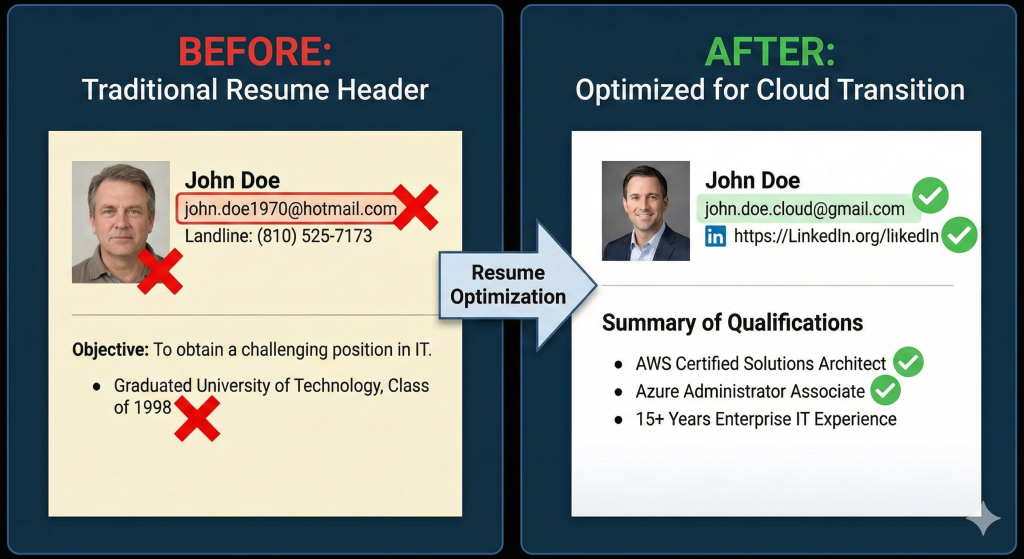
Resume optimisation represents the first line of defence against age bias. Remove graduation dates from education sections and limit work history to the most recent 10-15 years of relevant experience. Earlier career accomplishments can appear in a brief “Additional Experience” section without dates. Use modern email addresses from Gmail or Outlook rather than AOL or Hotmail addresses that signal older demographics. Contemporary resume formats emphasising skills and achievements rather than strict chronological order help focus attention on capabilities rather than tenure. Include cloud-specific keywords extracted from target job descriptions, ensuring your application passes automated screening systems. Maintain an active LinkedIn profile with a professional photograph, detailed skill endorsements, and recommendations from colleagues.
Frame your career transition as strategic evolution rather than desperate restart. Effective narratives include “Expanding my 15 years of enterprise infrastructure expertise into cloud-native environments to help organizations bridge legacy systems and modern platforms” or “Combining deep Windows Server and Active Directory knowledge with Azure cloud architecture to deliver hybrid solutions that organizations actually need.” Lead with quantified outcomes from prior roles such as “Reduced system downtime 47% through proactive monitoring implementation” or “Managed infrastructure supporting 5,000+ users across eight global offices.” Demonstrate continuous learning through recent certifications dated within the past 12-18 months and GitHub repositories showing active hands-on practice.
Target industries and employers receptive to experienced professionals. Financial services, healthcare, government, and utilities consistently value maturity, compliance knowledge, and risk management awareness over pure technical speed. The 3,000+ companies signing the AARP Employer Pledge have publicly committed to age-diverse hiring. Federal government roles offer additional pathways with 60+ registered apprenticeship programmes across federal agencies and increasing emphasis on skills-based hiring. Managed Service Providers, numbering 100,000+ in the United States alone, increasingly recognise certifications over degrees and value the client relationship skills that experienced professionals bring.
Contracting provides an alternative entry path that circumvents some age-related hiring bias. AWS cloud consultants average £55-£75 hourly (£85,000-£130,000 annually) in the UK or $65-$135 per hour in the US, with senior consultants commanding $100-$350 hourly rates. Contracting builds diverse portfolio experience across multiple organizations and technology stacks, avoids some office politics, and frequently converts to permanent positions after demonstrating value. The trade-offs include no benefits, income variability between contracts, and self-employment administrative overhead. For experienced professionals with financial stability, contracting can accelerate cloud career development whilst providing flexibility during the transition period.
First Cloud Role Strategy: Realistic Targets and Timeline Expectations
Experienced IT professionals should target specific job titles that acknowledge the learning curve whilst avoiding “junior” designations that undervalue accumulated expertise. Cloud Support Engineer or Cloud Support Specialist positions provide excellent entry points, offering exposure to diverse cloud services whilst leveraging troubleshooting skills developed over years of helpdesk and systems administration work. Cloud Administrator roles focus on day-to-day management of existing cloud infrastructure, mapping directly to traditional systems administration responsibilities. Cloud Operations Engineer positions emphasise monitoring, incident response, and operational excellence, playing to strengths developed through years of keeping production systems running. Associate Cloud Engineer titles at companies like Google explicitly target professionals transitioning into cloud whilst maintaining professional-level expectations. DevOps Engineer roles, particularly at organizations early in DevOps adoption, value process improvement and automation skills that experienced IT professionals naturally possess.
Salary expectations for first cloud roles vary by geography and specific position. UK market rates for entry-level Cloud Engineers range £45,000-£65,000, with Cloud Support Engineers earning £35,000-£55,000 initially but reaching £80,000-£110,000 at senior levels. Cloud Administrator positions offer £50,000-£70,000 typically. United States compensation runs higher with entry Cloud Engineers earning $90,000-$115,000, Cloud Support Engineers ranging $50,000-$70,000 at entry level (though Amazon cloud support roles reach $128,000-$172,000), and Cloud Administrators earning $82,000 median with ranges from $50,000-$110,000 depending on location and organization size.
Avoid applying directly for Solutions Architect positions despite your extensive IT background. These roles inherently require years of cloud experience across multiple projects, platforms, and use cases. Hiring managers reviewing Solutions Architect applications expect demonstrated cloud implementation experience that cannot come from certifications alone. Attempting to skip intermediate roles typically results in repeated rejections that damage confidence and waste valuable job search time. Better to secure a Cloud Engineer role, gain 12-24 months of hands-on cloud experience, then pursue architect positions from a position of demonstrated cloud competency.
Team dynamics often include reporting to managers significantly younger than yourself. Research from Skillcrush demonstrates that skills like memory consolidation, language abilities, decision-making, and social-emotional intelligence actually strengthen with age. Professional maturity, communication skills, and project management abilities prove genuinely valuable in collaborative environments. Approach younger managers with the same professionalism you’d expect from junior colleagues, recognising that technical expertise and management capability develop independently. Many successful technology professionals find reporting to younger managers refreshing after years of hierarchical corporate environments, appreciating managers focused on results rather than politics.
Common mistakes during transition include chasing too many technologies simultaneously rather than achieving depth in one cloud platform first. As the proverb warns, “the person who chases two rabbits catches neither.” Focus on AWS or Azure initially, reaching Solutions Architect Associate level competency, before expanding to additional platforms. Additional pitfalls include focusing exclusively on certifications whilst neglecting hands-on practice, neglecting professional networking in favour of pure technical skill development, applying for senior architect roles too early in your cloud journey, and underestimating realistic transition timelines. Plan for minimum 12-18 months from beginning study to landing your first cloud role, with internal transitions often proving faster than external job searches.
Your 12-18 Month Transition Roadmap
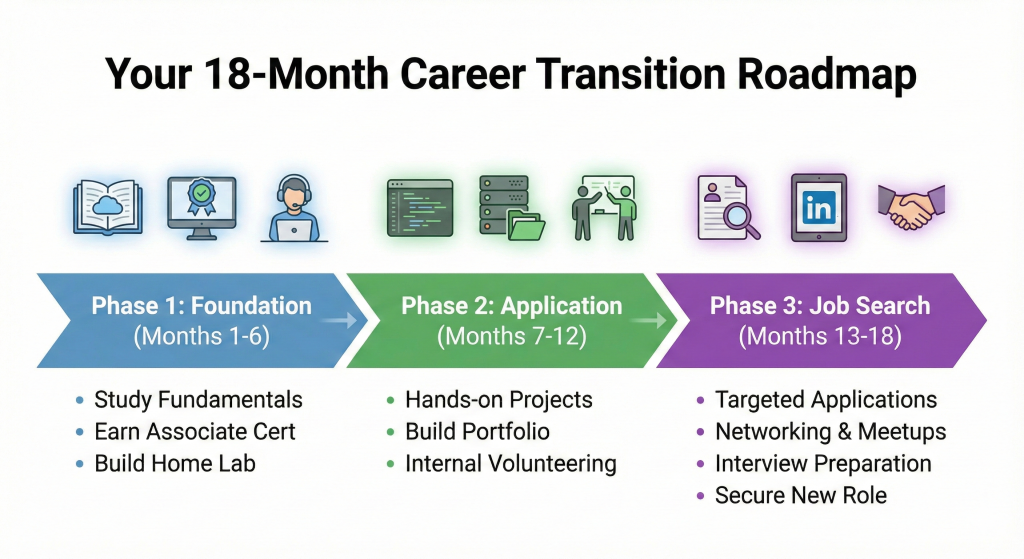
Month 1-2 focuses on foundation and direction. Choose your primary cloud platform based on your traditional IT background: Azure for Windows administrators, AWS for Linux/network engineers, and either platform for database administrators. Complete the foundational certification (AWS Cloud Practitioner or AZ-900 Azure Fundamentals) within 4-6 weeks using free official resources. Simultaneously create your free-tier cloud account and begin hands-on experimentation building basic infrastructure. Join online communities including Reddit’s r/AWSCertifications or r/AzureCertifications, relevant Discord servers, and LinkedIn groups for your chosen platform. Update your LinkedIn profile highlighting your cloud learning journey and begin connecting with cloud professionals.
Months 3-6 target associate-level certification. Study 10-15 hours weekly for AWS Solutions Architect Associate or AZ-104 Azure Administrator whilst maintaining your current role. Build hands-on labs covering virtual machines, storage, networking, and security fundamentals. Document your learning through a technical blog or GitHub repository demonstrating practical implementations. Consider essential cloud skills for 2025 to ensure you’re developing the most in-demand capabilities. Take the associate certification exam by month six. Begin attending local cloud user groups or virtual meetups to expand your professional network beyond online forums.

Months 7-9 emphasise practical application and portfolio development. Identify cloud-related projects within your current organisation, volunteering to assist with AWS or Azure initiatives even if outside your official role. Build 3-4 portfolio projects demonstrating real-world scenarios: migrate a simple application to the cloud, implement infrastructure as code using Terraform or CloudFormation, create a CI/CD pipeline, and design a multi-tier architecture with security best practices. Contribute to open-source cloud projects or documentation to demonstrate community engagement. Update your resume to highlight cloud certifications, hands-on projects, and any cloud work performed within your current role.
Months 10-12 launch your active job search. Target Cloud Support Engineer, Cloud Administrator, or Cloud Operations Engineer roles avoiding architect positions requiring years of cloud experience. Prepare for technical interviews by practising common cloud architecture questions, system design scenarios, and troubleshooting methodology walkthroughs. Leverage your network through LinkedIn, cloud meetup connections, and professional associations. Consider internal transfers within your current organisation first, as employers often provide the smoothest transition path with lowest risk. Apply to 10-15 carefully selected positions weekly rather than mass-applying to hundreds, customising each application to match specific role requirements.
Months 13-18 provide buffer for the job search process and potential additional skill development. If interviews reveal specific skill gaps, address them through targeted learning or additional certifications. Consider contract positions if permanent roles prove elusive, recognising that contract experience builds your cloud resume quickly. Prepare financially for potential salary negotiation, researching typical compensation for your target role, location, and experience level. Once you secure an offer, understand that your first cloud role is a stepping stone. Plan to gain 12-18 months of solid experience before targeting more senior positions or specialisations.
Part-time versus full-time study approaches trade timeline for financial security. The 12-18 month roadmap assumes part-time study whilst maintaining current employment, providing financial stability throughout the transition. Full-time intensive study through career breaks or bootcamps can compress timeline to 4-6 months but requires substantial savings or family support. Intensive bootcamps cost £8,000-£15,000 for 12-16 week programmes, delivering accelerated learning at significant financial investment and risk. University certificate programmes require approximately one year and cost £3,000-£8,000 but provide structured curriculum and academic credentials. For most professionals aged 40+ with mortgages and family responsibilities, the part-time approach whilst employed offers optimal risk-reward balance despite extended timeline.
Success Metrics: Measuring Progress Throughout Your Transition
Track your advancement through concrete milestones rather than subjective feelings. Technical metrics during the learning phase include certifications completed with target dates (foundational by month two, associate by month six, professional within 18 months), hands-on projects completed including documented infrastructure deployments in GitHub repositories, and cloud service proficiency demonstrated through ability to architect solutions using 15-20 core services independently. Aim to deploy at least one complete application to the cloud every month during months 3-12, building your portfolio whilst reinforcing certification knowledge through practical application.
Career advancement metrics include applications submitted tracking quantity and quality of tailored applications, interview callbacks monitoring your resume effectiveness (target 10-15% callback rate), technical interview progression assessing your ability to advance past initial screenings, and offer quality comparing compensation and role responsibility. Document feedback from unsuccessful interviews, identifying patterns that signal specific skill gaps requiring attention. Target securing at least two serious interviews within your first month of active job searching, adjusting your approach if callbacks remain consistently low.
Financial metrics validate the business case for transition. Monitor investment tracking including certification fees, training costs, and time invested at an hourly rate equivalent to your current salary. Calculate expected ROI based on target first cloud role salary versus current compensation. Track actual results including offer salary compared to previous role, time to recover initial investment, and cumulative earning difference over five years compared to remaining in traditional IT. The compelling financial case should show investment recovery within 3-12 months and cumulative five-year benefit of £100,000-£200,000 or more.
Professional development indicators include network growth measured by relevant LinkedIn connections, cloud meetup attendance, and mentorship relationships developed; community contributions through technical blog posts, Stack Overflow answers, or open-source contributions; and industry recognition beginning with speaking at local meetups, presenting at work, or publishing technical content read by others. These softer metrics predict long-term career success beyond the initial transition, as building a cloud career requires ongoing professional development and community engagement.
Expect approximately six months to feel fully comfortable in your first cloud role. Imposter syndrome affects 70% of people at some point and 58% of technology employees specifically. This feeling is normal, shared by career changers and new graduates alike. Combat it by documenting your achievements and positive feedback, seeking formal or informal mentorship, joining support communities where others share similar experiences, and recognising that continuous learning defines technology careers regardless of seniority. The learning curve never truly ends in cloud computing given the rapid pace of service releases and evolving best practices.
Common Career Pitfalls and How to Avoid Them
Certification obsession without hands-on practice represents the most common failure mode. Professionals collect multiple certifications believing credentials alone will secure cloud roles, yet struggle during technical interviews requiring practical knowledge. The solution lies in balancing certification study with hands-on labs, building real infrastructure in free-tier accounts, contributing to open-source projects, and documenting your work publicly through GitHub or technical blogs. Employers care more about what you can build than what exams you’ve passed, though certifications open doors by passing automated resume screening.
Isolation during the transition period leads to missed opportunities and prolonged job searches. Technology careers have always depended partially on professional networks, and cloud computing continues this pattern. Join cloud user groups in your area, attend AWS Summits or Azure conferences when possible, engage actively in online communities beyond lurking, and reach out to cloud professionals for informational interviews or mentorship. Many successful career changers credit their first cloud role to a connection made at a meetup or through LinkedIn rather than cold applications through job boards.
Waiting too long to start the job search causes unnecessary delays. Some professionals study endlessly, pursuing multiple certifications before applying to positions, fearing they’re not “ready enough.” The reality is you’re ready to begin applying once you hold an associate-level certification and can demonstrate 3-4 portfolio projects. Companies expect to train new cloud engineers on their specific infrastructure, tools, and processes. They’re hiring for foundational competency and learning potential, not complete expertise. Begin your job search by month 10 of the 12-18 month roadmap even if you feel underprepared.
Neglecting the business side of cloud computing proves particularly damaging for experienced professionals. Pure technical focus on services and features misses the strategic value that distinguishes senior roles from junior engineers. Study cloud cost optimisation principles detailed in our FinOps evolution guide, understand how to build business cases for cloud adoption, learn to translate technical architectures into business value for executives, and develop strategic thinking about when cloud solutions fit organisational needs versus when they don’t. These business skills, combined with your technical cloud competency and accumulated IT experience, create the unique value proposition that justifies premium compensation.
Financial unpreparedness forces rushed decisions or abandons transitions prematurely. Build emergency savings covering 6-12 months of expenses before making significant career changes. Understand that job searches often take longer than expected, particularly for career changers without existing cloud experience. Explore employer tuition reimbursement before paying for certifications personally. Consider income-share agreement bootcamps if intensive study appeals but upfront costs create barriers. The most successful transitions occur when financial pressure doesn’t force premature compromises on role quality or compensation.
Next Steps: Your Action Plan for This Month
Begin immediately regardless of where you are in your traditional IT career. Week one: choose your primary cloud platform based on your current background, create your free-tier account, and complete the first section of your foundational certification course. Week two: join three online communities relevant to your chosen platform, connect with 10 cloud professionals on LinkedIn, and build your first simple cloud resource (virtual machine or storage bucket). Week three: identify one cloud-related project within your current organisation that you could volunteer to assist with, update your LinkedIn profile highlighting your cloud learning journey, and complete 25% of your foundational certification study. Week four: build your second hands-on lab, document it on GitHub, schedule your foundational certification exam for 4-6 weeks from now, and research local cloud user groups or virtual meetups to attend.
The broader transition timeline requires sustained effort over 12-18 months, but immediate action establishes momentum that carries you through the inevitable challenges. Technology careers reward those who start learning before feeling ready, recognising that confidence follows competence rather than preceding it. Your accumulated enterprise experience represents genuine competitive advantage in a market desperate for professionals who can bridge legacy infrastructure and cloud platforms. The investment required sits within reach: £1,000-£2,000 and 10-15 hours weekly for 12-18 months. The return on that investment materialises through 30-50% salary increases, access to a £1+ trillion global market growing at 19-21% annually, and roles that explicitly value the business acumen, troubleshooting methodology, and professional maturity that define successful 40+ career changers.
Your traditional IT career hasn’t prepared you for a cloud role despite being told technology moves too fast for career changes at 40+. Rather, it’s positioned you perfectly for organisations that need exactly what you offer: technical depth, business context, and organizational navigation skills that cannot be taught through certifications or bootcamps. The question isn’t whether you can make this transition. The question is whether you can afford not to as cloud computing becomes the default infrastructure model and traditional IT roles steadily contract.