
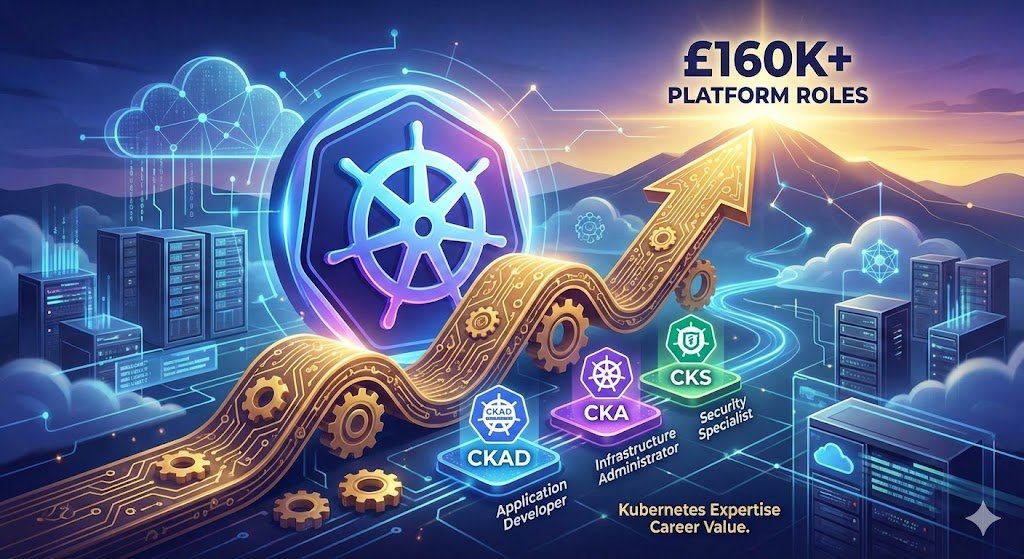
Platform engineering roles commanding £72,500-£160,000+ aren’t just about technical skills; they’re about strategic positioning with the right certifications at the right career stages. Kubernetes expertise sits at the centre of this career explosion, with the global Kubernetes market surging from $1.8 billion in 2022 to a projected $11.78 billion by 2032. For UK professionals, this translates to clear career progression: entry-level Kubernetes engineers earning £54,000 can reach £160,000+ platform engineering roles within 5-7 years through strategic certification investment and hands-on experience.
The certification path matters enormously. Certified Kubernetes Administrator (CKA), Certified Kubernetes Application Developer (CKAD), and Certified Kubernetes Security Specialist (CKS) credentials delivered 5-15% salary increases to certified professionals globally, with payback periods of just 2-3 months on certification investment. As 91% of Kubernetes deployments occur in enterprises with 1,000+ employees, these certifications provide the HR filter bypass that moves CVs from “maybe” to “interview” piles. The combination of explosive market growth, enterprise adoption, and credential scarcity creates exceptional career opportunities for professionals who invest strategically in Kubernetes expertise.
The Kubernetes Certification Framework: Strategic Career Investment
The Linux Foundation and Cloud Native Computing Foundation (CNCF) have created a structured certification pathway that validates hands-on Kubernetes expertise at different career stages, setting these credentials apart from traditional IT certifications. Rather than multiple-choice exams testing theoretical knowledge, all three major Kubernetes certifications are performance-based assessments requiring candidates to solve real-world problems in live Kubernetes environments. You’ll have two hours to demonstrate your ability to actually configure, deploy, troubleshoot, and secure Kubernetes workloads, not just recognise the correct answer from a list of options.
The financial investment remains consistent across all three certifications. As of February 2025, each exam costs $445 (approximately £345) and includes two exam attempts, providing a safety net if your first attempt falls short. Your registration also grants access to exam simulator environments via Killer.sh, allowing you to practice in conditions that closely mirror the actual exam. The certifications remain valid for two years, after which you’ll need to re-certify to maintain the credential. All exams currently use Kubernetes v1.34, with regular updates maintaining alignment with current releases within 4-8 weeks of new version launches.
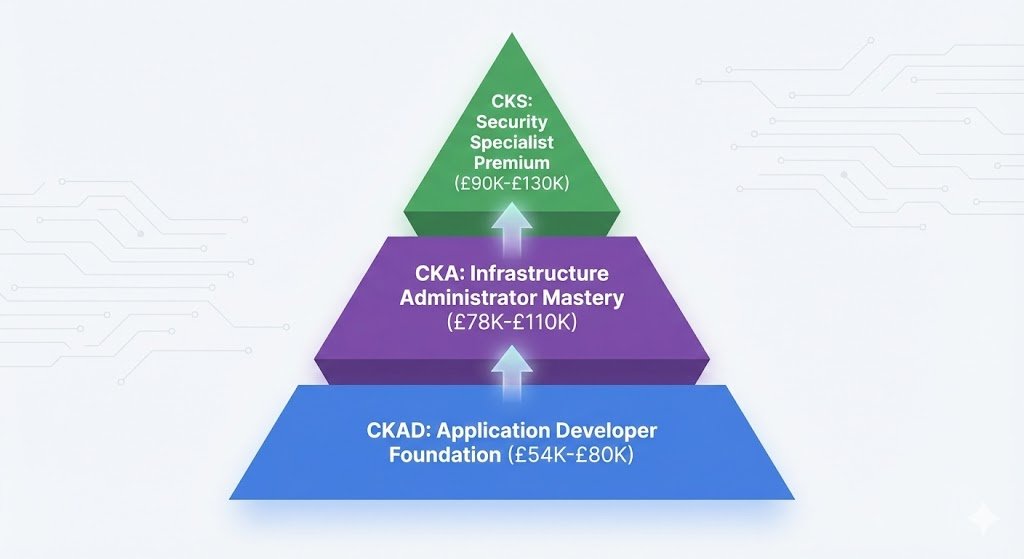
CKAD: Application Developer Foundation (£54K-£80K)
The Certified Kubernetes Application Developer certification serves as your entry point into validated Kubernetes expertise, targeting developers and DevOps engineers focused on designing, building, and deploying cloud-native applications. This certification validates your ability to define application resources, use Kubernetes core primitives effectively, and manage complete application lifecycles from deployment through monitoring and troubleshooting.
The exam structure reflects real-world application development scenarios. You’ll spend 20% of your time on application design and build tasks, another 20% on deployment strategies, 15% demonstrating observability and maintenance capabilities, 25% on environment configuration and security, and the final 20% on services and networking. The exam consists of 15-20 hands-on tasks, and you’ll need to achieve 66% to pass. The exam assumes you already understand container runtimes like Docker and have exposure to microservice architecture concepts, though you don’t need to be an expert in either area.
CKAD positions you for roles like Kubernetes Developer, DevOps Engineer with container focus, or Cloud Application Engineer. UK professionals with CKAD certification typically earn between £54,000 and £80,000, though this range varies significantly based on experience and location. London commands 13-20% premiums over national averages, pushing entry-level CKAD-certified engineers toward £62,000-£95,000 ranges. Even outside London, combining CKAD certification with 12-18 months of hands-on experience typically positions you in the £65,000-£75,000 range.
The time investment proves manageable for most working professionals. Candidates typically require 40-60 study hours spread over 6-8 weeks, which translates to roughly an hour daily during weekdays plus a few hours on weekends. Pass rates hover around 70% for engineers with existing container and Kubernetes exposure, meaning your chances improve significantly if you’ve already deployed applications to Kubernetes in development or staging environments. The financial return justifies the investment quickly. If CKAD certification delivers even a conservative £3,000-£5,000 annual salary increase, the certification pays for itself within 2-3 months.
CKA: Infrastructure Administrator Mastery (£78K-£110K)
The Certified Kubernetes Administrator certification represents a significant career elevation from application focus to infrastructure management and operations. Where CKAD demonstrates you can deploy applications effectively, CKA validates your ability to install, configure, operate, and troubleshoot production-grade Kubernetes clusters. These are the skills that separate senior engineers from mid-level practitioners, and the market recognises this distinction with substantial salary premiums.
The exam domains reflect cluster-level responsibilities that platform engineers and infrastructure specialists handle daily. You’ll spend 25% of exam time on cluster architecture, installation, and configuration tasks like preparing infrastructure for cluster deployment or managing complete cluster lifecycles. Workloads and scheduling constitute 15% of the exam, covering autoscaling, rolling updates, and pod admission configurations. Services and networking demands 20% of your time, including ingress traffic management and various service types. Storage accounts for 10% with persistent volume and storage class configurations. The remaining 30% focuses on troubleshooting, which reflects the reality that production Kubernetes environments require constant problem-solving and diagnostic expertise.
The exam structure mirrors CKAD with performance-based tasks, two-hour duration, and 66% passing threshold, but the focus shifts entirely to cluster-level operations rather than application deployment. You’ll work at the infrastructure layer, making decisions that affect every application and development team using your clusters.
CKA certification positions you as the gold standard for Platform Engineers, Cloud Infrastructure Engineers, Site Reliability Engineers, and Kubernetes Cluster Administrators. UK median salaries for CKA-certified professionals reach £78,000-£80,000, with senior positions commanding £97,000+ based on experience and responsibility scope. London roles regularly exceed £110,000, particularly in financial services or enterprise technology companies where Kubernetes infrastructure supports business-critical operations.
The certification assumes you’ve moved beyond theoretical knowledge. Whilst no formal prerequisites exist, successful CKA candidates typically bring 1-2 years of hands-on Kubernetes production experience, strong Linux administration skills, and deep understanding of containerisation technologies. You’ll need to know how systems fail, how networks route traffic, and how storage systems behave under load. Study time averages 60-80 hours over 8-12 weeks, reflecting the broader scope and deeper technical requirements compared to CKAD.
The financial return on CKA investment proves exceptional. At £345 exam cost plus £200-£400 for quality training materials from providers like KodeKloud or Linux Foundation, your total investment approaches £545-£745. However, CKA credentials typically deliver £8,000-£15,000 annual salary increases through either internal promotions or external opportunities. This means payback within 4-6 weeks and returns exceeding 1,100-2,000% over the certification’s two-year validity period. Few professional investments deliver comparable returns on such modest capital and time commitments.
CKS: Security Specialist Premium (£90K-£130K)
The Certified Kubernetes Security Specialist represents the pinnacle of Kubernetes certification for security-focused professionals, and market demand for this expertise has exploded. With 113% year-over-year growth in registrations, CKS addresses the critical security skills gap that enterprises face as they deploy increasingly sensitive workloads on Kubernetes infrastructure. This certification requires holding a valid CKA certificate as a prerequisite, building security expertise on top of administrative foundations that ensure you understand the infrastructure you’re securing.
The exam structure reflects comprehensive security responsibilities across the entire Kubernetes stack. Cluster setup constitutes 10% of exam time, focusing on secure initial configurations and certificate authority management. Cluster hardening takes 15%, covering CIS benchmark compliance, service account restrictions, and admission controller configurations. System hardening also accounts for 15%, including host operating system security, network segmentation, and vulnerability management. Minimising microservice vulnerabilities commands 20% of exam time, examining container security, image scanning, and runtime protection. Supply chain security represents another 20%, covering image provenance, signed artifacts, and secure build pipelines. The final 20% addresses monitoring, logging, and runtime security with tools like Falco and audit logging configurations. The exam demands 67% to pass, slightly higher than CKA or CKAD, reflecting the advanced security expertise requirements.
CKS certification opens specialised roles that command significant salary premiums. DevSecOps Engineers, Kubernetes Security Engineers, Cloud Security Architects, and Senior Platform Engineers with security focus typically earn between £90,000 and £130,000 in UK markets. Security-focused roles command 20-40% premiums over standard platform engineering positions because organisations recognise that security breaches can cost millions whilst security expertise remains scarce. The combination of CKA and CKS credentials signals you understand both infrastructure operations and security implications, making you valuable for organisations handling regulated workloads or sensitive customer data.
The path to CKS requires patience and substantial experience. Beyond the mandatory CKA certification, successful candidates typically need 6-12 months of production Kubernetes experience specifically focused on security implementations. You should understand security principles deeply, not just Kubernetes-specific configurations. Familiarity with security tools like Falco for runtime protection, Trivy for vulnerability scanning, and Open Policy Agent for admission control proves essential. Study time ranges 50-70 hours over 6-10 weeks, concentrating on security-specific configurations that may not arise in standard platform engineering work.
The market positioning for CKS holders proves exceptional. With the container security market valued at $1.2 billion in 2022 and projected 27.6% compound annual growth reaching $10.7 billion by 2031, CKS positions you at the intersection of two explosive markets: Kubernetes adoption and cloud security. Organisations struggling to secure their Kubernetes infrastructure pay premium salaries for the combined CKA+CKS expertise that remains relatively rare in the talent market. Your total investment of £545-£645 for exam and training typically delivers £10,000-£20,000 annual salary increases through security role positioning, creating payback periods of 2-5 weeks and returns exceeding 3,000-6,100% over two years.
Career Progression Roadmap: £54K to £160K+ in 5-7 Years
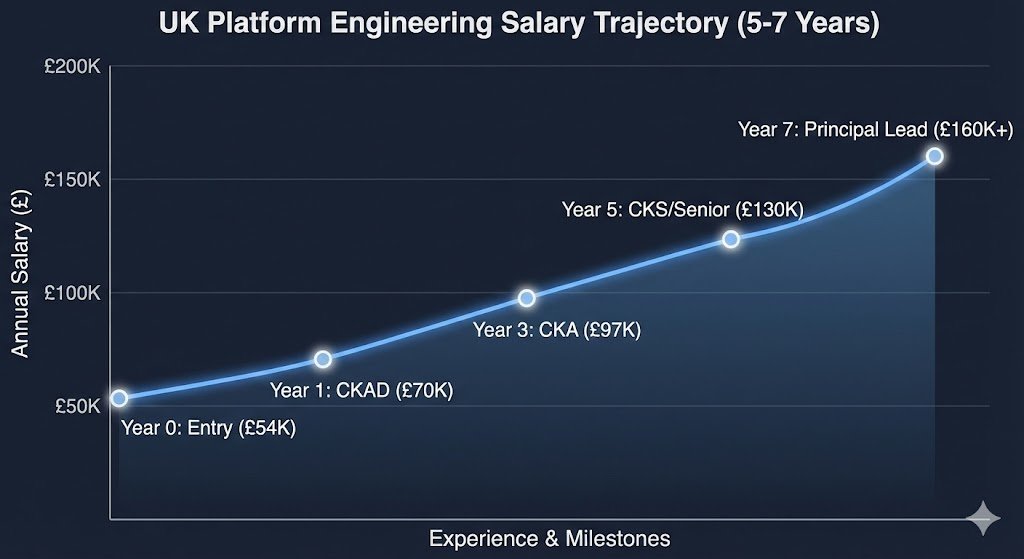
Strategic Kubernetes certification investment unlocks predictable career progression when combined with hands-on experience, portfolio development, and business acumen. The path from entry-level cloud engineer to six-figure platform engineering leader follows distinct phases, each building on the previous stage whilst expanding your technical scope and business impact.
Year 0-1: Foundation Building (£45K-£60K)
Your journey typically begins as a Junior DevOps Engineer, Cloud Support Engineer, or Infrastructure Engineer with basic container knowledge but limited Kubernetes experience. You understand Docker conceptually, perhaps you’ve run containers locally, but you haven’t managed production Kubernetes workloads or dealt with the complexity of multi-node clusters serving real users. This foundation year focuses on transforming theoretical knowledge into hands-on competence.
Start by building practical Kubernetes experience through environments you control completely. Set up home lab projects using Minikube, kind, or free-tier cloud resources from AWS, Azure, or GCP. Deploy real applications, not just “hello world” containers. Build a three-tier web application with database, backend API, and frontend, then add monitoring with Prometheus and Grafana. Contribute to open source projects that use Kubernetes, even if your contributions start with documentation improvements or bug reports. Volunteer for Kubernetes-related tasks at work, particularly managing non-critical workloads where failure provides learning opportunities without business consequences.
Your certification target for this stage is CKAD, requiring approximately £345 investment and 6-8 weeks of focused study. This certification validates that you can deploy, configure, and troubleshoot applications on Kubernetes, positioning you for your first true Kubernetes-focused role. Deploy 3-5 portfolio projects demonstrating application deployment, configuration management, and basic monitoring. Document these projects on GitHub with clear README files explaining what you built, why you made specific architectural decisions, and what you learned from challenges encountered.
The outcome after 12-18 months positions you for Kubernetes Developer or Junior DevOps Engineer roles at £54,000-£70,000. CKAD certification typically delivers £5,000-£8,000 salary increases if you’re already employed, or positions you for £10,000-£15,000 jumps when changing employers. Your GitHub portfolio, combined with CKAD validation, creates compelling evidence that you’re beyond entry-level container work and ready for production Kubernetes responsibilities.
Year 1-3: Administration Expertise (£78K-£97K)
Moving from application deployment to cluster administration represents a significant career shift. You transition from asking “How do I deploy my application?” to answering “How do I build a platform where teams can deploy reliably?” Your focus expands from individual workloads to infrastructure serving entire engineering organisations.
During this phase, you’ll gain production cluster administration experience managing multi-node clusters with high availability configurations and comprehensive disaster recovery capabilities. You’ll master Infrastructure as Code tools like Terraform for cluster provisioning, Helm for application package management, and Kustomize for environment-specific configurations. Implementing monitoring, logging, and observability solutions becomes second nature as you deploy Prometheus for metrics, Grafana for visualisation, and ELK stack for centralised logging. You’ll manage cloud-managed Kubernetes services like EKS, AKS, or GKE across staging and production environments, understanding how managed services differ from self-hosted clusters and when each approach makes sense.
Your certification target is CKA, requiring £345 investment and 8-12 weeks of study time. Unlike CKAD, CKA preparation benefits enormously from production experience. The troubleshooting scenarios, networking configurations, and storage management tasks reflect real operational challenges you’ll encounter daily as a platform engineer. Study during this phase reinforces lessons learned through production incidents and architectural decisions.
Contributing to platform initiatives elevates your visibility within your organisation. Build CI/CD pipelines that other teams use for deployments. Create golden path templates that standardise how applications get deployed, monitored, and secured. Write internal documentation explaining platform capabilities and best practices. These contributions demonstrate leadership potential beyond individual technical execution.
The outcome positions you as a Platform Engineer, Senior DevOps Engineer, or Cloud Infrastructure Engineer at £78,000-£97,000. CKA credentials typically enable 15-25% salary increases through internal promotions or external opportunities. London roles reach £88,000-£110,000, reflecting both the credential value and the higher cost of living. At this stage, you’re no longer learning Kubernetes; you’re teaching others, making architectural decisions, and solving complex production challenges that don’t have obvious solutions in documentation.
Year 3-5: Security Specialisation or Platform Leadership (£90K-£130K)
This career stage requires a strategic decision: security specialisation through the DevSecOps track or platform leadership toward Staff Engineer roles. Both paths command similar compensation but require different skill development and suit different professional preferences.
If you choose security specialisation, you’ll implement comprehensive security controls including Role-Based Access Control (RBAC), Pod Security Standards, Network Policies, and Open Policy Agent for admission control. You’ll deploy security tooling like Falco for runtime protection, Trivy for vulnerability scanning, and cert-manager for automated certificate management. Achieving compliance certifications like SOC 2 or ISO 27001 becomes part of your role, as does leading security incident response when threats materialise. Your certification target is CKS, requiring £345 investment and 6-10 weeks of study time, though you must maintain a valid CKA certificate throughout. Your career positioning becomes Senior Platform Engineer with security focus, commanding £90,000-£130,000 depending on industry and location.
If you choose platform leadership, you’ll design and build Internal Developer Platforms using tools like Backstage, Port, or Humanitec that abstract Kubernetes complexity behind developer-friendly interfaces. You’ll implement multi-cluster, multi-region architectures with service mesh technologies like Istio or Linkerd providing advanced traffic management and observability. Driving platform engineering initiatives becomes your primary focus: enabling developer self-service, creating golden paths that teams actually want to use, and treating the platform as a product with internal customers. Mentoring junior engineers and leading technical documentation efforts demonstrates your readiness for staff-level influence. Presenting at meetups or conferences on Kubernetes topics builds industry recognition. Your career positioning becomes Staff Platform Engineer, commanding £92,000-£132,000 with London roles exceeding £110,000-£140,000.
Both paths require expanding beyond pure technical execution into business communication and strategic thinking. You’ll write business cases justifying platform investments, present to leadership about infrastructure strategy, and translate technical decisions into business value. The technical skills remain essential, but leadership skills determine whether you stagnate or progress toward principal-level positions.
Year 5-7: Principal/Staff Engineer Territory (£130K-£180K+)
Reaching Principal Platform Engineer or Distinguished Engineer levels requires demonstrating organisation-wide impact beyond team-level contributions. You’re no longer evaluated primarily on your individual technical output but on how effectively you multiply the capabilities of entire engineering organisations through platform strategy, mentorship, and technical leadership.
Your responsibilities expand to driving organisation-wide platform strategy including standardisation across business units, governance that enables rather than restricts innovation, and cost optimisation at scales where percentage improvements translate to hundreds of thousands in annual savings. Leading technical architecture decisions affecting multiple teams and business units becomes routine as you balance competing priorities and ensure technical decisions align with business objectives. Building and managing platform engineering teams of 5-15 engineers requires developing management skills even if you remain on the individual contributor track, since technical leadership demands understanding how to grow other engineers’ capabilities.
Establishing FinOps practices positions you as business partner rather than cost centre. You’ll implement cost allocation systems that make cloud spending transparent, create optimisation recommendations backed by data, and produce budget forecasts executives can use for strategic planning. Creating technical strategy documents and influencing executive decision-making means you’re in rooms where million-pound decisions get made, and your voice carries weight because you’ve established credibility through years of successful delivery.
Contributing to open source projects or maintaining internal platforms used across your organisation builds both internal and external recognition. Speaking at conferences, writing technical blog posts, and maintaining active presence in cloud native communities creates the visibility that leads to principal-level opportunities. Developing business communication skills proves essential as you present to C-suite executives, write business cases that secure multi-million pound platform investments, and conduct ROI analyses that justify infrastructure modernisation.
The outcome positions you as Principal Platform Engineer earning £130,000-£180,000+, Distinguished Engineer, or VP of Platform Engineering. Principal roles in London financial services or enterprise technology companies reach £160,000-£220,000 base salary, with total compensation including bonuses and equity exceeding £200,000-£250,000 at senior levels. At this stage, your value lies not in configuring Kubernetes clusters but in shaping how entire organisations build and deliver software through platform capabilities you’ve championed and delivered.
Technical Skills Mapped to Career Outcomes
Kubernetes certifications validate core competencies, but career progression requires expanding your technical toolkit strategically at each stage. Understanding which skills unlock specific salary bands helps you invest learning time where it generates maximum career return. The progression isn’t random; it follows predictable patterns as you move from application deployment to infrastructure management to strategic platform leadership.
Entry Level: CKAD Foundations (£54K-£70K)
Entry-level Kubernetes roles require solid grasp of core Kubernetes primitives and how applications actually run in production environments. You’ll need complete comfort with pod lifecycle management including Deployments for stateless applications, StatefulSets for applications requiring stable network identities or persistent storage, DaemonSets for node-level services, and Jobs for batch processing. Configuration management through ConfigMaps for application settings, Secrets for sensitive data, and environment variables for runtime configuration becomes second nature. Resource management including requests and limits for CPU and memory, along with namespace-level quotas, ensures your applications don’t consume all cluster resources. Service discovery through Services, Ingress controllers, and DNS enables your applications to find and communicate with dependencies reliably. Basic observability through logs, metrics, and health probes means you can detect and diagnose application issues before they affect users.
These core Kubernetes skills don’t exist in isolation. You’ll need surrounding competencies that make you effective in real development environments. Docker or containerd expertise for building images, understanding layer caching, and managing private registries proves essential since Kubernetes orchestrates containers rather than creating them. YAML and JSON fluency for writing and troubleshooting manifests becomes critical as you debug why deployments aren’t working as expected. Basic Linux knowledge including filesystem navigation, process management, and fundamental networking concepts helps you understand what’s happening inside containers. Git version control mastery including branching strategies, pull requests, and code review processes integrates your Kubernetes work into broader development workflows. CI/CD concepts using Jenkins, GitLab CI, or GitHub Actions basics allows you to automate the deployment of applications you’ve containerised.
Building a portfolio that demonstrates these skills proves more valuable than certifications alone. Deploy a multi-tier application with frontend, backend, and database components, showing you understand how services communicate and how state gets managed. Create an automated deployment pipeline that triggers on Git commits, demonstrating you can integrate Kubernetes with broader software delivery workflows. Build a health monitoring dashboard using Prometheus and Grafana that shows real application metrics, proving you think about observability from the start. Demonstrate rolling updates with zero downtime, showing you understand how Kubernetes manages application lifecycle without disrupting users.
CKAD certification with 2-3 years of adjacent experience typically positions you for £54,000-£70,000 roles depending on location and company size. Add strong GitHub portfolios and you move toward the upper end of this range. London’s premium pushes these figures to £62,000-£85,000 for comparable experience levels.
Mid-Level: CKA Administration (£78K-£97K)
Advancing from application deployment to cluster operations requires dramatically expanding your technical scope. Cluster operations expertise begins with installation using kubeadm for bare-metal or VM-based clusters, kops for AWS-specific installations, or understanding how cloud-managed services like EKS, AKS, and GKE abstract installation complexity. Networking becomes far more complex as you work with CNI plugins like Calico or Cilium that provide pod-to-pod communication, implement NetworkPolicies for security segmentation, and troubleshoot DNS issues that affect service discovery. Storage management through CSI drivers, StorageClasses for different performance tiers, persistent volumes for stateful applications, and backup and restore procedures ensures data survives pod restarts and cluster failures. RBAC implementation including Roles, ClusterRoles, and ServiceAccounts plus security contexts for pod-level permissions protects clusters from both external threats and internal mistakes. Cluster lifecycle management including upgrades without downtime, node maintenance procedures, and etcd operations for cluster state becomes routine.
Infrastructure as Code mastery separates mid-level from senior engineers. Terraform expertise for provisioning AWS EKS, Azure AKS, or GCP GKE infrastructure allows you to treat clusters as code rather than manual cloud console configuration. Helm chart development, dependency management between charts, and release strategies for applications enables packaging complex applications with all their dependencies. Kustomize proficiency for creating overlays targeting different environments means you maintain one base configuration with environment-specific variations rather than duplicating manifests. GitOps implementations using ArgoCD or Flux for declarative deployments connects your Kubernetes state directly to Git repositories, making deployments auditable and reversible.
Platform tooling knowledge demonstrates you’re thinking about production operations, not just getting workloads running. Monitoring through Prometheus Operator, Thanos for long-term storage, and sophisticated alert management means you detect problems before users report them. Logging via EFK or ELK stack, Loki for Kubernetes-native logging, and centralised log aggregation enables troubleshooting distributed systems. Service mesh introduction with Istio or Linkerd for traffic management and observability enhancements positions you for advanced architectures. Cost management using Kubecost, cloud provider native tools, and resource optimisation strategies shows you understand Kubernetes expenses at scale.
CKA certification combined with 2-3 years of production cluster experience positions you for Platform Engineer roles at £78,000-£85,000. Adding Terraform and Helm expertise pushes you toward £85,000-£97,000 as you demonstrate complete infrastructure-as-code capability. London roles command £88,000-£110,000 for comparable experience, with financial services and enterprise technology companies paying premium rates for production Kubernetes expertise.
Senior Level: CKS Security + Platform (£90K-£130K)
Senior-level compensation requires security hardening expertise that most mid-level engineers lack. Cluster hardening following CIS benchmarks, implementing security auditing, and enforcing Pod Security Standards addresses vulnerabilities that basic RBAC doesn’t cover. Network security through comprehensive NetworkPolicies, service mesh mutual TLS, and egress traffic control prevents lateral movement during security incidents. Image security using vulnerability scanning tools like Trivy or Grype, requiring signed images, and deploying admission controllers that reject non-compliant workloads stops attacks before they reach your clusters. Runtime security with Falco rules for detecting anomalous behaviour, intrusion detection systems, and incident response procedures means you catch attacks in progress. Secrets management through Vault integration, external secrets operators, and encryption at rest protects sensitive data even if attackers access etcd. Compliance automation using OPA for policy enforcement, comprehensive audit logging, and automated compliance reporting demonstrates you handle regulated workloads appropriately.
Platform engineering expertise separates infrastructure management from strategic platform leadership. Building Internal Developer Platforms using Backstage service catalogues and golden path templates that teams actually want to use represents a significant capability leap. Multi-cluster management including federation patterns and centralised management planes shows you operate at organisational scale. Disaster recovery including multi-region architectures, backup strategies with Velero, and defined RTO/RPO targets proves you’ve planned for worst-case scenarios. Performance optimisation through resource right-sizing, autoscaling strategies, and conscious cost-performance trade-offs demonstrates business awareness. Developing custom operators that extend Kubernetes with business-specific automation shows deep Kubernetes expertise applied to unique organisational requirements.
Business skills become equally important as technical depth. Implementing cost optimisation strategies using reserved instances, spot instances, and resource efficiency measures shows you understand cloud economics. Stakeholder communication that translates technical decisions into business value connects your work to executive priorities. Risk assessment through security posture reporting and SLA/SLO definition quantifies platform reliability. Vendor evaluation comparing platforms, conducting ROI analysis, and leading proof-of-concept projects demonstrates strategic thinking beyond implementation.
CKS certification combined with security expertise commands £90,000-£110,000 salaries. Adding platform engineering experience pushes compensation toward £110,000-£130,000 as you demonstrate both security depth and platform breadth. DevSecOps roles in financial services reach £120,000-£140,000, reflecting both the security premium and regulatory requirements. London positions for senior security engineers regularly exceed £125,000-£150,000 at major enterprises and financial institutions.
Principal/Staff Level: Strategic Leadership (£130K-£180K+)
Principal-level compensation requires demonstrating impact far beyond technical execution. Organisational architecture capabilities including platform strategy with multi-year roadmaps, technology selection frameworks that guide dozens of teams, cross-team standards through shared libraries and platform capabilities, developer experience optimisation, FinOps leadership with cost allocation models and budget forecasting, and security governance through policy frameworks and compliance programmes separate staff engineers from senior engineers. You’re shaping how entire organisations work, not just managing infrastructure.
Technical leadership manifests differently at principal levels. Architecture decision records that document and socialise major technical decisions create organisational memory and align teams. Performance at scale including managing thousands of workloads across multi-region deployments solves problems most engineers never encounter. Disaster recovery planning including business continuity strategies, chaos engineering for resilience testing, and comprehensive testing demonstrates you plan for scenarios others haven’t considered. Open source contributions that establish company presence and help recruit through visibility extend your impact beyond your organisation. Mentorship programmes for developing junior engineers and knowledge transfer systems multiply your capabilities through others.
Executive communication becomes a core competency rather than occasional requirement. Business case development including ROI models and total cost of ownership analysis justifies multi-million pound infrastructure investments. Risk management reporting on security posture, operational risks, and mitigation strategies informs executive decision-making. Strategic planning that aligns platform roadmaps with business objectives ensures technology serves rather than constrains business needs. Budget management for multi-million pound infrastructure budgets and cloud spend optimisation operates at CFO-level visibility. Hiring and team building including growing platform teams, defining career ladders, and creating paths for other engineers to reach principal level demonstrates organisational maturity.
Principal Platform Engineer roles requiring 8-10 years of experience, all three Kubernetes certifications (or equivalent expertise), and demonstrated organisational impact command £130,000-£180,000+ depending on company size and sector. Financial services firms, enterprise technology companies, and major consultancies pay premium rates for principal-level expertise. London Principal Engineers at major enterprises earn £160,000-£220,000 total compensation including base salary, bonuses, and equity, with some positions exceeding £250,000 at the most senior levels or at high-growth technology companies.
Certification Strategy and ROI Analysis
Strategic certification timing maximises both career impact and financial return. Pursuing certifications too early wastes money on failed exam attempts and creates credentials you can’t leverage effectively. Waiting too long delays salary increases and career progression unnecessarily. Understanding the optimal timing for each certification helps you invest at moments when you’re positioned to pass exams and immediately apply validated skills in higher-paying roles.
CKAD First: Developer Foundation
The optimal timing for CKAD falls 6-12 months into your first DevOps or Cloud role, once you’ve deployed applications to Kubernetes in development or staging environments. You don’t need production experience yet, but you should have enough hands-on exposure that Kubernetes concepts feel familiar rather than completely foreign. If you’re still struggling with basic concepts like what pods are or how services work, invest more time in practical experience before attempting certification.
Your study approach should mirror real-world Kubernetes work, which means emphasising hands-on practice over passive learning. Allocate roughly 70% of your study time to running through 50-100 practice scenarios from killer.sh, KodeKloud, or Linux Foundation training platforms. These platforms simulate the actual exam environment, teaching you to work under time pressure whilst solving realistic problems. Spend about 20% of study time mastering the official Kubernetes documentation at kubernetes.io/docs, learning to navigate quickly and find answers efficiently during the exam when you’re allowed to reference documentation. The remaining 10% of time goes to conceptual understanding through video courses that provide context and explain why Kubernetes works the way it does, but remember that watching videos doesn’t build the muscle memory you need for performance-based exams.
The time investment remains manageable for working professionals. Most candidates need 40-60 hours of study spread over 6-8 weeks, which translates to 1-2 hours of daily practice during weekdays plus heavier weekend sessions. Focus intensifies during the final week with 2-3 full exam simulations under time pressure, helping you identify weak areas and optimise your speed. Schedule your exam during a low-stress work period, avoiding major project deadlines or personal commitments that might compromise your focus.
The financial return on CKAD certification proves exceptional. Your total investment includes £345 for the exam plus £150-£300 for quality training resources, bringing total cost to £495-£645. This modest investment typically delivers £5,000-£8,000 annual salary increases within 12 months through either internal promotion or external job changes. The payback period ranges from just 4-8 weeks, after which the certification delivers pure profit. Over the certification’s two-year validity period, you’ll gain £10,000-£16,000 in additional earnings from a £645 investment, representing returns of 1,450-2,400%.
The career value extends beyond immediate salary increases. CKAD certification helps you bypass HR filters, appearing in 30-40% of Kubernetes-focused job descriptions as either required or strongly preferred. Passing the exam builds interview confidence since you’ve demonstrated skills publicly through a vendor-neutral, hands-on assessment. The certification also provides crucial foundation for CKA, as roughly 60% of content overlaps between the two exams, accelerating your preparation for the more advanced administrator credential.
CKA Second: Administration Expertise
The optimal timing for CKA falls 18-30 months into your DevOps or Platform career, after you’ve managed production Kubernetes workloads for 6-12 months. Unlike CKAD where development environment experience suffices, CKA preparation benefits enormously from production operations experience. The troubleshooting scenarios, networking configurations, and storage management tasks reflect real operational challenges you encounter managing production clusters. Attempting CKA before accumulating this experience means you’ll struggle with scenarios that experienced administrators handle routinely.
Your study approach should leverage production experience accumulated since CKAD. Dedicate roughly 60% of study time applying lessons learned from actual cluster management challenges, reflecting on incidents you’ve resolved and architectural decisions you’ve made or observed. Spend 30% of time in lab environments building multi-node clusters, simulating failures, and practicing troubleshooting workflows that mirror production scenarios. The remaining 10% focuses on exam-specific preparation including speed optimisation, documentation navigation efficiency, and time management under pressure. The troubleshooting emphasis at 30% of exam content means you need rapid diagnostic skills that only develop through repeated practice.
The time investment increases compared to CKAD, reflecting CKA’s broader scope and deeper technical requirements. Plan for 60-80 hours of study over 8-12 weeks, focusing heavily on troubleshooting scenarios and cluster operations that don’t arise in application development work. Complete 3-4 full exam simulations with time pressure during your final two weeks, identifying gaps and practising until cluster operations feel natural rather than requiring conscious thought.
The financial return on CKA certification exceeds CKAD since it positions you for platform engineering roles rather than application deployment positions. Your total investment ranges from £545-£745 including exam fees and training materials. This investment typically delivers £8,000-£15,000 annual salary increases through promotion to Platform Engineer or Senior DevOps Engineer roles, either internally or through external opportunities. The payback period contracts to just 3-7 weeks, after which you’re capturing pure incremental earnings. Over two years, CKA certification generates £16,000-£30,000 in additional earnings from a £745 investment, representing returns of 2,050-4,000%.
The career positioning value proves even more significant than the direct salary impact. CKA certification appears as “required” qualification for many senior platform roles, creating an absolute barrier to consideration without the credential. The certification establishes credibility with technical peers who recognise that passing CKA requires genuine cluster-level competence rather than just passing a multiple-choice test. CKA also serves as the mandatory prerequisite for CKS certification, making it an essential stepping stone if you’re considering security specialisation.
CKS Third: Security Specialisation
The optimal timing for CKS falls 3-5 years into your career, after holding CKA certification for 6-12 months and working extensively with production security requirements. CKS represents the pinnacle of Kubernetes certification depth, focusing on security expertise that most platform engineers lack. The certification requires maintaining a valid CKA certificate throughout, so letting your CKA expire before pursuing CKS forces you to re-certify CKA first.
Your study approach emphasises practical security implementations over theoretical security principles. Allocate roughly 50% of study time to security-focused projects in production or lab environments, actually deploying Falco for runtime detection, implementing admission controllers with OPA, and configuring comprehensive network policies. Spend 30% of time on vulnerability research, understanding common Kubernetes attacks like container escapes, compromised images, or privilege escalation, and learning how security tools detect and prevent these attacks. The remaining 20% goes to exam preparation focusing on speed and accuracy with security tools under time pressure, as the exam demands 67% to pass compared to 66% for CKA and CKAD.
The time investment remains substantial at 50-70 hours over 6-10 weeks, though you’ll leverage CKA foundations extensively. Focus particularly on security tool proficiency with Falco for runtime monitoring, Trivy for vulnerability scanning, OPA for policy enforcement, and Vault integration for secrets management. Complete 2-3 exam simulations focusing specifically on security scenarios, as the security-specific tasks require familiarity with tools you might not use daily in non-security-focused platform roles.
The financial return on CKS certification proves exceptional due to security specialist scarcity. Your total investment of £545-£645 for exam and training typically delivers £10,000-£20,000 annual salary increases as you transition to security-focused platform engineering or DevSecOps roles. The security premium reflects both supply scarcity (far fewer professionals hold CKS than CKA or CKAD) and demand intensity (organisations desperately need security expertise for regulated workloads). Payback periods contract to just 2-5 weeks, with two-year returns reaching £20,000-£40,000 on a £645 investment, representing returns of 3,000-6,100%.
The career positioning for CKS holders creates distinct advantages in the job market. Security specialist roles command 20-40% premiums over comparable platform engineering positions without security focus. CKS adoption remains significantly lower than CKA or CKAD, making the credential rarer and more valuable. Security directly impacts business risk at executive levels, creating visibility and influence opportunities that pure infrastructure roles rarely provide.
Total Investment and Career ROI
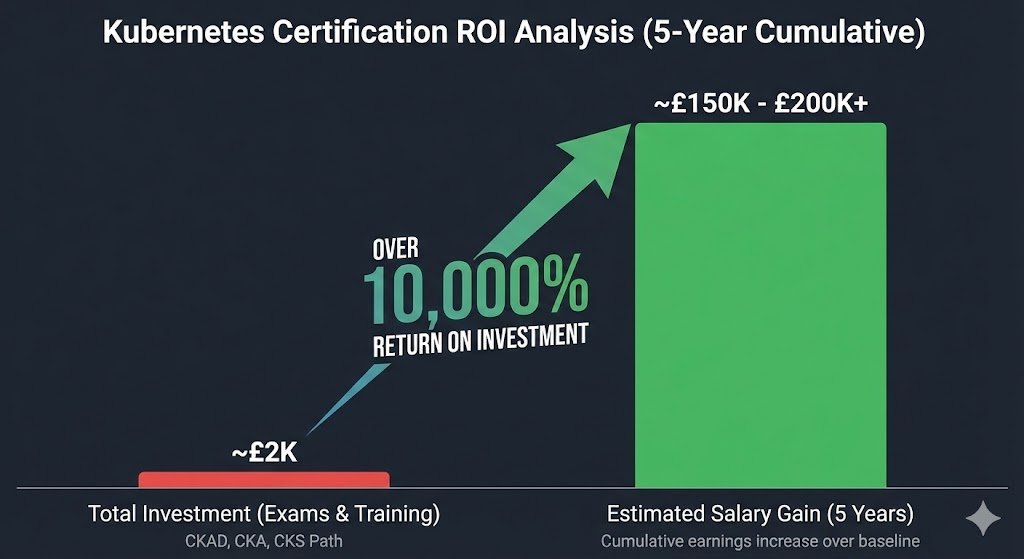
Viewing the complete three-certification pathway reveals exceptional returns on modest investment. Your total investment reaches £1,635-£2,035 for all three exam fees plus training materials. Your total time commitment spans 150-210 study hours distributed across 2-4 years as you pursue certifications at optimal career stages. The expected salary progression from £54,000 at CKAD through £78,000 after CKA to £110,000+ combining CKS with senior platform experience generates £56,000 in additional annual earnings by year five compared to your starting point. The five-year cumulative return reaches £150,000-£200,000 in increased lifetime earnings from a two thousand pound investment.
Comparing Kubernetes certifications to alternative professional development investments highlights the exceptional value. A Master’s degree requires £15,000-£30,000 in tuition costs, 1-2 years of full or part-time study, and typically delivers 5-8% salary increases upon completion. Kubernetes certifications cost one-tenth as much, require one-tenth the time, and deliver 100%+ career value increases when pursued strategically. Few professional investments deliver comparable returns on such modest capital and time commitments, particularly for cloud infrastructure professionals where Kubernetes expertise directly enables platform engineering careers commanding six-figure compensation.
Platform Engineering Career Explosion
Platform engineering represents the fastest-growing segment within cloud infrastructure, with the global market surging from $1.8 billion in 2023 to a projected $12.2 billion by 2032 at 23.7% CAGR. This explosive growth directly translates to salary premiums and abundant opportunities for Kubernetes-skilled professionals.
What Platform Engineers Do
Platform engineering focuses on building Internal Developer Platforms (IDPs) that provide self-service infrastructure capabilities to development teams. Rather than ticket-driven “ops” teams manually provisioning resources, platform engineers create automated, standardised, and secure paths for developers to deploy and manage applications independently.
Core responsibilities:
- Designing and maintaining Kubernetes-based platforms serving hundreds of developers
- Creating service catalogues, golden path templates, and self-service portals
- Implementing governance, security, and compliance controls at platform level
- Optimising cloud costs through intelligent resource allocation and rightsizing
- Building observability solutions providing platform-wide visibility
- Enabling developer productivity whilst maintaining operational reliability
Why Kubernetes Expertise Commands Platform Premium
Platform engineering and Kubernetes expertise intersect perfectly. Kubernetes provides the foundational orchestration layer for modern platforms, with platform engineers extending and abstracting Kubernetes complexity through developer-friendly tooling.
UK Platform Engineer median salary reaches £72,500 – significantly above £57,000-£60,000 for general DevOps roles. Senior Platform Engineers with comprehensive Kubernetes expertise command £90,000-£120,000, with Principal Platform Engineers exceeding £130,000-£160,000.
Market demand indicators:
- 21% of Kubernetes decision-makers are platform engineers (second highest after directors/managers)
- Platform Engineering Services market growing at 23.7% CAGR through 2032
- 91% of Kubernetes deployments occur in large enterprises, where platform teams provide greatest value
- Internal Developer Platform adoption accelerating as organisations tackle “cognitive load” challenges
Platform Engineering Technology Stack
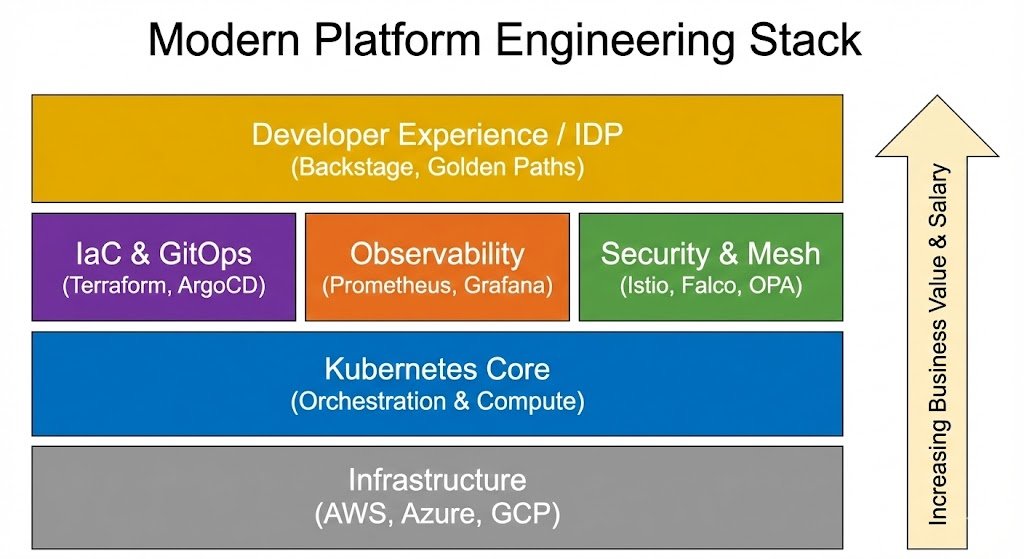
Beyond core Kubernetes certifications, platform engineers master complementary technologies:
Infrastructure Layer:
- Multi-cluster management: Rancher, Anthos, Tanzu
- Service mesh: Istio, Linkerd for traffic management and observability
- Infrastructure as Code: Terraform, Pulumi, Crossplane for Kubernetes-native provisioning
Developer Experience:
- Backstage: Spotify’s open source IDP framework
- Port, Humanitec: commercial IDP platforms
- Golden path templates: standardised application frameworks
Observability and Operations:
- Prometheus, Thanos for metrics at scale
- Grafana, Loki for logging and visualisation
- OpenTelemetry for distributed tracing
- Velero for backup and disaster recovery
Security and Compliance:
- OPA (Open Policy Agent) for policy enforcement
- Falco for runtime security monitoring
- Vault integration for secrets management
- Service mesh mTLS and certificate automation
Career trajectory: Kubernetes-certified professionals transition to platform engineering roles by demonstrating ability to build developer-facing abstractions, not just manage infrastructure. The combination of CKA (infrastructure), CKAD (application perspective), and platform tooling expertise positions you ideally for £90,000-£130,000 platform roles.
Implementation Strategy: Your First 90 Days
Translating certification plans into career advancement requires deliberate action. Here’s the practical implementation roadmap:
Weeks 1-4: Assessment and Planning
Skills gap analysis:
- Audit current Kubernetes knowledge against CKAD/CKA/CKS domains
- Identify weak areas requiring focused study
- Assess hands-on environment availability (work, home lab, cloud credits)
Resource acquisition:
- Budget £500-£800 for certification + training over 12 months
- Secure employer sponsorship if available (many organisations fund certifications)
- Purchase training resources: KodeKloud, A Cloud Guru, or Linux Foundation courses
- Register for CNCF community and local Kubernetes meetups
Time allocation:
- Commit 1-2 hours daily for study (weekday evenings)
- Reserve 3-4 hours weekend time for intensive practice
- Block calendar for 8-12 week certification push
Weeks 5-12: CKAD Preparation
Hands-on practice (70% of time):
- Complete 50-100 practice scenarios covering all CKAD domains
- Use killer.sh exam simulator extensively (2 attempts included with exam registration)
- Build portfolio projects demonstrating application deployment expertise
- Contribute to open source projects requiring Kubernetes knowledge
Documentation mastery (20% of time):
- Navigate kubernetes.io/docs rapidly for common tasks
- Create personal reference guide for frequent operations
- Practice finding information under time pressure
- Memorise kubectl commands and shortcuts
Exam preparation (10% of time):
- Take 2-3 full exam simulations in final two weeks
- Analyse failure points and remediate gaps
- Optimise speed and accuracy under pressure
- Schedule exam during low-stress work period
Months 4-6: Career Positioning and CKAD Application
Resume and LinkedIn optimisation:
- Add CKAD certification with credential verification
- Showcase portfolio projects with GitHub links
- Quantify achievements: “Reduced deployment time 40% through Kubernetes migration”
- Request recommendations from colleagues highlighting Kubernetes work
Networking and visibility:
- Present at local Kubernetes meetups on certification experience
- Write blog posts or LinkedIn articles sharing learnings
- Engage in Kubernetes Slack channels and Stack Overflow
- Attend KubeCon or regional Kubernetes conferences
Job market exploration:
- Research Platform Engineer, DevOps Engineer, Kubernetes Developer roles
- Identify target companies with strong Kubernetes adoption
- Conduct informational interviews with professionals in target roles
- Assess market salary ranges for CKAD-certified professionals in your region
Months 7-12: CKA Preparation
Production experience accumulation:
- Volunteer for Kubernetes infrastructure projects at current employer
- Implement monitoring, logging, or security improvements in production clusters
- Document cluster architecture and operational runbooks
- Lead incident response and troubleshooting efforts
Study and certification:
- Follow similar pattern to CKAD: 70% hands-on, 20% documentation, 10% exam prep
- Focus on cluster operations, networking, storage, and troubleshooting
- Complete 60-80 hours study over 8-12 weeks
- Leverage production experience to contextualise exam scenarios
Career advancement:
- Internal promotion discussion: “CKA certification + production cluster management positions me for Platform Engineer role at £78,000-£85,000”
- External opportunity assessment: interview for Senior DevOps or Platform Engineer positions
- Salary negotiation: use market data and certification value to justify 15-25% increase
Year 2: Platform Engineering Focus
Technical skill expansion:
- Master Infrastructure as Code: Terraform for EKS/AKS/GKE provisioning
- Implement Internal Developer Platform components: Backstage, service catalog
- Learn service mesh: Istio or Linkerd for production traffic management
- Develop FinOps expertise: cost optimisation, budgeting, showback reporting
Business acumen development:
- Take courses on technical leadership, stakeholder management, executive communication
- Participate in architecture decision-making processes
- Write business cases and ROI analyses for platform initiatives
- Mentor junior engineers and document best practices
CKS timing decision:
- If moving toward security focus: pursue CKS in year 2-3 after CKA
- If pursuing pure platform engineering: defer CKS until security becomes priority
Measuring Success: Career Metrics That Matter
Track these indicators to validate your Kubernetes certification investment:
Technical Metrics
Certification milestones:
- CKAD achieved within 6-12 months of first Kubernetes role
- CKA earned within 18-30 months of DevOps career
- CKS completed within 36-60 months if pursuing security track
Hands-on experience:
- Managed production Kubernetes clusters serving 10+ development teams
- Implemented automated deployment pipelines reducing release time 50%+
- Led disaster recovery exercises with RTO < 1 hour
- Contributed to 3-5 open source projects in Kubernetes ecosystem
Platform impact:
- Reduced developer onboarding time from days to hours through self-service platform
- Achieved 99.9%+ uptime SLA for platform services
- Decreased cloud infrastructure costs 20-40% through optimisation initiatives
- Implemented security controls achieving SOC 2 or ISO 27001 compliance
Career Advancement Metrics
Salary progression:
- Year 0: £45,000-£54,000 (Junior DevOps Engineer)
- Year 1 (CKAD): £54,000-£70,000 (Kubernetes Developer, +15-30%)
- Year 2-3 (CKA): £78,000-£97,000 (Platform Engineer, +20-40%)
- Year 3-5 (CKS + Senior role): £90,000-£130,000 (Senior Platform Engineer, +15-35%)
- Year 5-7 (Principal): £130,000-£180,000+ (Principal Platform Engineer, +40-60%)
Role progression:
- Progression from execution to leadership: IC contributor → technical lead → staff engineer
- Increasing scope: single team → multiple teams → organisation-wide platform
- Growing influence: implementing features → architectural decisions → strategic planning
Market value indicators:
- Quality of inbound recruiter interest: volume, seniority, salary ranges
- Interview-to-offer conversion rate: 40-60% for well-matched opportunities
- Offer competitiveness: multiple competing offers, above-market compensation packages
- Industry recognition: conference speaking invitations, open source maintainer status
Business Impact Metrics
Cost optimisation:
- £50,000-£500,000 annual cloud cost savings through rightsizing and optimisation
- 30-50% reduction in incident-related downtime costs
- 2-3x developer productivity improvement through platform self-service
Security and compliance:
- Zero critical security incidents in production Kubernetes environments
- 90%+ compliance audit pass rate for platform controls
- <24 hour remediation time for identified vulnerabilities
Platform adoption:
- 80%+ developer satisfaction scores for platform experience
- 100+ applications deployed through self-service platform
- <1 day average time from code commit to production deployment
Common Pitfalls and How to Avoid Them
Certification Without Experience
Pitfall: Pursuing certifications without adequate hands-on Kubernetes experience leads to failed exams, wasted money, and inability to apply knowledge in production.
Solution: Build 3-6 months hands-on experience before CKAD, 12-18 months before CKA, and 24-36 months before CKS. Use home labs, contribute to open source, or volunteer for Kubernetes projects at work to gain practical experience before certification attempts.
Over-indexing on Certifications
Pitfall: Collecting certifications without building production expertise or demonstrating business impact creates “paper certification” perception and limited career advancement.
Solution: Balance certifications (20% of career development time) with hands-on projects (60%) and business skills (20%). For every certification earned, deliver 2-3 production projects demonstrating practical application of certified knowledge.
Neglecting Business Communication
Pitfall: Focusing exclusively on technical skills without developing stakeholder communication, business case development, and strategic thinking capabilities limits advancement to Staff/Principal levels.
Solution: Dedicate 20-30% of professional development time to business skills after establishing technical foundation. Practice translating technical decisions to business value, writing business cases, and presenting to non-technical stakeholders.
Poor Networking and Visibility
Pitfall: Remaining invisible within organisation and industry limits opportunities, salary growth, and career advancement regardless of certification credentials.
Solution: Present at meetups, write blog posts, engage in Slack channels, attend conferences, and build relationships with senior engineers. Visibility creates opportunities that certifications alone cannot provide.
Waiting for Perfect Timing
Pitfall: Delaying certification attempts waiting for “enough” experience results in missed opportunities and slower career progression.
Solution: Pursue CKAD within 6-12 months of first Kubernetes exposure. Accept that you’ll learn significantly during exam preparation. The certification itself validates competence and creates urgency for skill development.
Certification Expiration Neglect
Pitfall: Allowing certifications to expire without renewal damages credibility and wastes initial investment.
Solution: Schedule renewal exams 3-6 months before expiration. Take advantage of the two-year validity period to stay current with Kubernetes evolution whilst building additional expertise.
Alternative Paths and Complementary Certifications
Kubernetes certifications provide the strongest ROI for platform engineering careers, but complementary credentials enhance positioning:
Cloud Provider Certifications
AWS:
- AWS Certified Solutions Architect – Associate: £140-160 exam, demonstrates AWS service knowledge alongside Kubernetes
- AWS Certified DevOps Engineer – Professional: £230 exam, validates CI/CD and infrastructure automation
Azure:
- Azure Administrator Associate (AZ-104): £130 exam, covers Azure infrastructure management
- Azure Solutions Architect Expert (AZ-305): £130 exam, demonstrates enterprise architecture capabilities
GCP:
- Professional Cloud Architect: £150 exam, validates Google Cloud platform expertise
When to pursue: After CKA/CKAD, if working heavily with specific cloud provider’s managed Kubernetes (EKS/AKS/GKE). Cloud certifications complement but don’t replace Kubernetes expertise.
Security Certifications
Certified Information Systems Security Professional (CISSP): £550 exam, globally recognised security credential complementing CKS for DevSecOps careers commanding £110,000-£150,000.
Certified Ethical Hacker (CEH): £900 exam + training, validates offensive security skills supporting Kubernetes security roles.
FinOps Certification
FinOps Certified Practitioner: £225 exam, demonstrates cloud cost management expertise increasingly required for senior platform roles managing multi-million pound infrastructure budgets.
Next Steps: Your Action Plan
Transform Kubernetes certification knowledge into career advancement through these concrete actions:
This Week
- [ ] Audit current Kubernetes knowledge against CKAD domains
- [ ] Budget £500-£800 for certification + training investment
- [ ] Set up home lab environment using Minikube, kind, or cloud provider free tiers
- [ ] Register for CNCF account and join Kubernetes Slack workspace
- [ ] Identify 1-2 colleagues or mentors already holding Kubernetes certifications
This Month
- [ ] Enroll in KodeKloud, A Cloud Guru, or Linux Foundation CKAD course
- [ ] Complete 10-15 hands-on practice scenarios per week
- [ ] Deploy first portfolio project: multi-tier application on Kubernetes
- [ ] Attend local Kubernetes meetup or watch KubeCon session recordings
- [ ] Schedule target CKAD exam date 8-10 weeks out
This Quarter
- [ ] Complete CKAD certification exam
- [ ] Update CV and LinkedIn with certification and portfolio projects
- [ ] Write blog post or LinkedIn article on certification experience
- [ ] Research Platform Engineer job postings identifying target companies
- [ ] Conduct salary research for CKAD-certified roles in your region
This Year
- [ ] Begin CKA preparation after 3-6 months production Kubernetes experience
- [ ] Complete CKA certification
- [ ] Lead Kubernetes infrastructure project at current employer or in open source
- [ ] Present at meetup on Kubernetes operations or platform engineering
- [ ] Negotiate salary increase or pursue Platform Engineer role at £78,000-£97,000
Years 2-5
- [ ] Pursue CKS certification if moving toward security specialisation
- [ ] Develop platform engineering expertise: IDP design, FinOps, multi-cluster management
- [ ] Build business communication and leadership skills
- [ ] Target Staff/Principal Platform Engineer roles at £130,000-£160,000+
- [ ] Establish industry presence through speaking, writing, or open source maintenance
The Kubernetes certification pathway – CKAD to CKA to CKS – provides the most direct route to £160,000+ platform engineering roles in the UK market. With total investment under £2,000 and 150-210 study hours spread across 2-4 years, the ROI exceeds 10,000% for professionals executing strategic certification timing alongside hands-on experience and business skill development.
Market dynamics favour Kubernetes expertise through 2032, with platform engineering roles growing at 24% CAGR and security specialist demand surging 27.6% annually. UK professionals pursuing this certification pathway position themselves at the centre of cloud infrastructure’s most explosive career opportunity.
Start your certification journey this week. The £90,000-£160,000 platform engineering roles aren’t waiting for perfect timing – they’re hiring certified professionals who demonstrate production competence today.
Useful Links
- Linux Foundation CKA Certification – Official CKA certification details, exam registration, and preparation resources
- CNCF CKAD Certification – Official CKAD certification information and exam domains
- Kubernetes Security Specialist (CKS) – CKS certification requirements and security focus areas
- Kubernetes Documentation – Official Kubernetes docs essential for exam preparation and daily work
- KodeKloud Kubernetes Training – Hands-on labs and practice scenarios for all three certifications
- Killer.sh Exam Simulator – Realistic exam environment simulation included with certification registration
- IT Jobs Watch UK Salaries – Current UK salary data for Kubernetes and platform engineering roles
- Kubernetes Community Slack – Active community for questions, networking, and knowledge sharing
- Cloud Native Computing Foundation – CNCF projects, events, and Kubernetes ecosystem developments