The AWS Well-Architected Framework stands as the most widely adopted cloud architecture methodology globally, guiding infrastructure decisions for organisations managing billions in cloud spend. Yet many enterprises struggle to move beyond the framework’s conceptual guidance to make concrete architectural choices that balance security, cost, performance, and reliability. This comprehensive guide translates each pillar into specific infrastructure decisions, featuring real case studies demonstrating measurable outcomes.
The Enterprise Architecture Challenge
Enterprise cloud infrastructure has evolved from simple lift-and-shift migrations to complex, multi-region deployments supporting mission-critical workloads. Organisations now manage thousands of workloads across distributed teams, with cloud spending reaching £723.4 billion globally in 2025. The challenge isn’t understanding cloud fundamentals—it’s making architectural decisions that balance competing requirements whilst maintaining governance at scale.
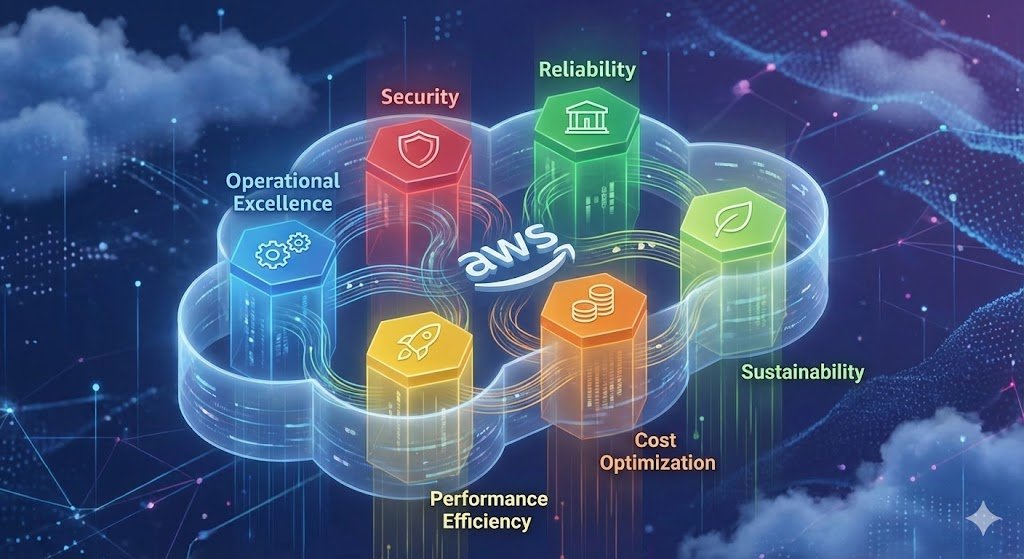
The AWS Well-Architected Framework addresses this complexity through six foundational pillars: Operational Excellence, Security, Reliability, Performance Efficiency, Cost Optimization, and Sustainability. Each pillar represents trade-offs that architects must navigate. A financial services platform prioritising reliability may accept higher costs for multi-region active-active deployment. A development environment might optimise for cost by relaxing availability requirements. Understanding these trade-offs separates theoretical framework knowledge from production-ready architecture.
Research demonstrates significant value in structured architecture reviews. Burns & McDonnell achieved 50% reduction in mean time to resolution and saved 30% of their AWS bill in the first week after implementing Well-Architected recommendations. Claim Technology mitigated 81.6% of high-level risks through systematic review. These outcomes emerge not from following generic best practices but from applying framework principles to specific business contexts.
Evolution of Enterprise Cloud Architecture
The AWS Well-Architected Framework emerged in 2015 from patterns identified across thousands of customer deployments. Initially focused on five pillars, AWS added the Sustainability pillar in 2022, recognising environmental impact as a critical architectural consideration. This evolution reflects broader industry maturity—early cloud adopters prioritised migration speed, whilst mature organisations now optimise for total cost of ownership, operational efficiency, and environmental sustainability.
Modern enterprises face architectural complexity that early cloud adopters never encountered. Hybrid and multi-cloud deployments require consistent governance across environments. Regulatory compliance demands data residency controls and audit trails. DevOps practices necessitate automated deployment pipelines with security gates. The framework has evolved to address these realities through domain-specific lenses covering machine learning, serverless, IoT, financial services, and industry-specific scenarios.
Yet misconceptions persist. Many organisations treat Well-Architected reviews as one-time audits rather than continuous improvement processes. Teams conflate the framework with AWS-specific services instead of recognising it as cloud-agnostic architectural principles that happen to have AWS implementation examples. Most critically, architects focus on individual pillars in isolation rather than understanding how pillars interact and create architectural trade-offs requiring business context to resolve.
The real conversation in enterprise architecture centres on trade-off management. Security measures impact performance. Reliability increases cost. Performance optimisation can complicate operational excellence. The framework’s value lies not in prescriptive answers but in structured thinking about these trade-offs within your specific business context.
Pillar-by-Pillar Infrastructure Decisions
Operational Excellence: Automating Everything That Moves
Operational excellence focuses on running and monitoring systems to deliver business value whilst continuously improving processes. For enterprises, this translates into specific infrastructure decisions around automation, observability, and change management.
Infrastructure as Code Architecture: Production-ready operational excellence requires treating infrastructure as software. Organisations implement Infrastructure as Code (IaC) using tools like AWS CloudFormation, Terraform, or AWS CDK. The architectural decision isn’t whether to use IaC but how to structure it for team collaboration and environment promotion.
Leading enterprises adopt modular IaC patterns with reusable components. A typical structure includes:
- Foundation modules: VPC, networking, IAM baseline
- Service modules: RDS, ECS clusters, Lambda patterns
- Application stacks: Composed modules with environment-specific parameters
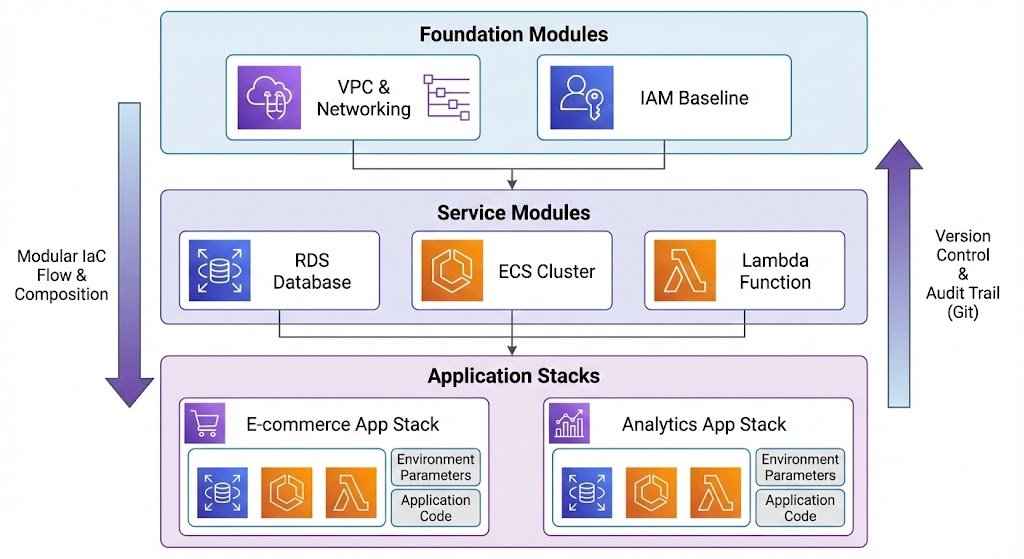
This modularity enables teams to deploy standardised infrastructure whilst maintaining flexibility for application-specific requirements. Version control through Git provides audit trails and enables rollback capabilities essential for compliance and risk management.
Observability Infrastructure: Operational excellence demands comprehensive observability—not just monitoring but understanding system behaviour through logs, metrics, and traces. Enterprises implement unified observability platforms combining AWS CloudWatch, X-Ray, and third-party tools like Datadog or New Relic.
The architectural decision centres on data aggregation strategy. Centralised logging to Amazon S3 or CloudWatch Logs Insights enables cross-account analysis essential for enterprise governance. Distributed tracing through X-Ray reveals performance bottlenecks across microservices. Custom CloudWatch dashboards provide business-specific views of technical metrics.
Cabinet implemented comprehensive observability through custom CloudWatch dashboards enabling real-time performance tracking and automated alerts prioritised by business impact. This transformed cloud operations into a data-driven ecosystem improving governance and scalability.
Runbook Automation: Operational incidents in enterprise environments require standardised response procedures. AWS Systems Manager Automation provides runbook execution for common operational tasks—patching, backup verification, disaster recovery testing. The architectural choice involves balancing automation scope against risk tolerance.
Production systems benefit from automated remediation for well-understood scenarios whilst maintaining human approval gates for high-risk changes. Verdant Web Technologies documented and automated their CI/CD pipeline through Well-Architected implementation, introducing infrastructure as code patterns that reduced deployment errors and shortened release cycles.
Security: Defence in Depth at Enterprise Scale
Security represents the pillar enterprises typically prioritise over all others. AWS Well-Architected security translates into layered defence strategies addressing identity management, data protection, infrastructure security, and detection capabilities.
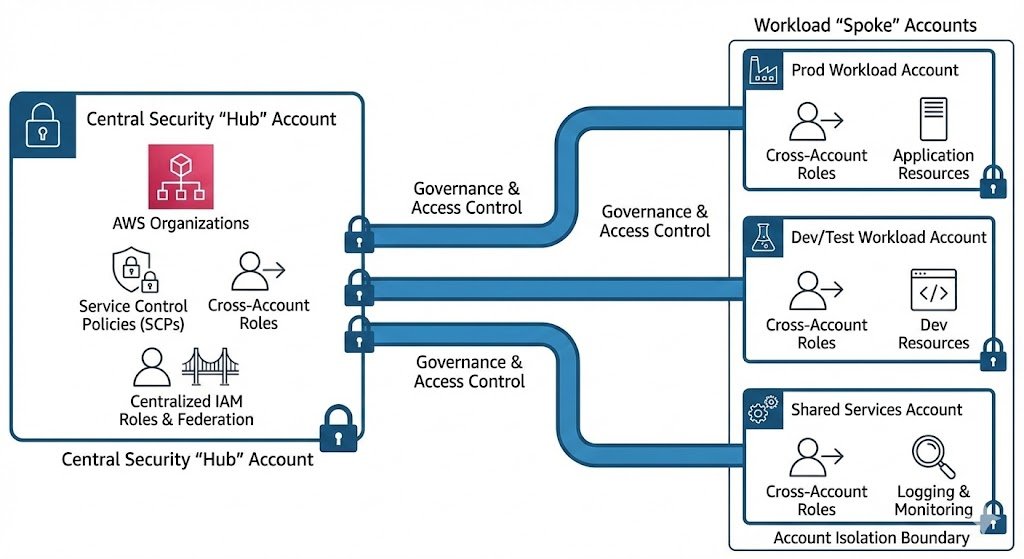
Identity and Access Management Architecture: Enterprise IAM strategies require balancing security with operational efficiency. The framework advocates least-privilege access, but implementation requires architectural decisions around identity federation, role assumption patterns, and service account management.
Production-ready security implements:
- AWS SSO integration with corporate identity providers (Okta, Azure AD) for centralised authentication
- Cross-account IAM roles following spoke-hub models enabling centralised security whilst maintaining account isolation
- Service Control Policies (SCPs) at AWS Organizations level enforcing baseline security posture
- Temporary credentials through IAM roles rather than long-lived access keys
Tricentis Flood achieved SOC 2 compliance through implementing AWS GuardDuty for threat detection and detailed network logging, providing enhanced forensic capability whilst meeting regulatory requirements. This demonstrates security architecture enabling compliance outcomes required for enterprise service providers.
Data Protection Strategy: Encryption decisions impact performance, cost, and operational complexity. The framework mandates encryption at rest and in transit, but enterprises must choose between AWS-managed keys (KMS), customer-managed keys, or CloudHSM for regulatory requirements.
Financial services organisations typically implement customer-managed KMS keys with automated rotation and granular access controls. This enables compliance with data sovereignty requirements whilst maintaining operational efficiency through AWS integration. Less-regulated industries often adopt AWS-managed encryption, trading control for operational simplicity.
Network Security Architecture: Zero-trust networking requires specific infrastructure decisions. Enterprises implement network segmentation through VPC design, security groups, Network ACLs, and AWS PrivateLink for service access without internet exposure.
Burns & McDonnell’s Well-Architected implementation included separation of production and staging environments into distinct VPCs, implementing zero-trust security through robust security groups. This architectural choice prevented security breaches propagating across environments whilst enabling development team velocity.
Reliability: Engineering for Failure
Reliability pillar addresses the system’s ability to recover from infrastructure or service failures whilst meeting availability requirements. Enterprise reliability decisions involve trade-offs between cost, complexity, and business continuity requirements.
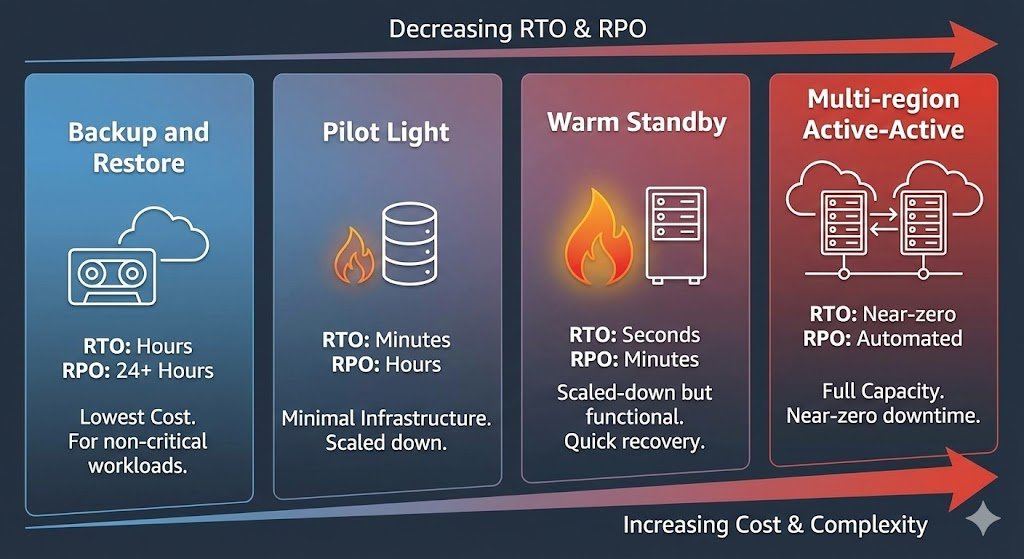
Multi-Region Architecture Decisions: Disaster recovery strategy represents the most significant reliability decision. The framework presents four patterns with increasing cost and complexity:
- Backup and restore (RPO: hours, RTO: 24+ hours): Lowest cost, suitable for non-critical workloads
- Pilot light (RPO: minutes, RTO: hours): Minimal infrastructure running in secondary region
- Warm standby (RPO: seconds, RTO: minutes): Scaled-down but functional environment in secondary region
- Multi-region active-active (RPO: near-zero, RTO: automated): Full capacity in multiple regions
Financial services platforms processing transactions worth millions per minute implement active-active patterns accepting 100-200% infrastructure costs for near-zero downtime. Development environments typically use backup and restore, optimising for cost over availability.
Tricentis Flood distributed compute and storage across AWS availability zones and regions, ensuring system availability even if an entire AWS data centre or region becomes disabled. This architectural decision directly supported their enterprise customer commitments requiring 99.95% availability.
Auto-Scaling and Self-Healing: Reliability at scale requires infrastructure that responds to failures automatically. AWS Auto Scaling Groups, ECS Service Auto Scaling, and Lambda’s inherent scaling provide self-healing capabilities. The architectural decision centres on scaling metrics—CPU utilisation for compute-bound workloads, queue depth for asynchronous processing, or custom CloudWatch metrics for business-specific thresholds.
Leading enterprises implement predictive scaling using machine learning to anticipate demand patterns, pre-emptively scaling resources before load increases. This reduces latency spikes whilst optimising cost through right-sized capacity.
Performance Efficiency: Right-Sizing at Scale
Performance efficiency addresses using computing resources efficiently to meet requirements whilst adapting to changing demands. Enterprise performance decisions balance application responsiveness against infrastructure cost.
Compute Selection Patterns: AWS offers 500+ instance types optimised for different workloads. The framework guides instance selection but enterprises need decision frameworks matching workload characteristics to compute options:
- General purpose (T3, M5): Web applications, development environments
- Compute optimised (C5, C6i): Batch processing, high-performance computing
- Memory optimised (R5, X1e): In-memory databases, real-time analytics
- Accelerated computing (P4, Inf1): Machine learning training and inference
- Storage optimised (I3, D2): Data warehousing, distributed file systems
TableAir reduced AWS-related overheads by 10% through infrastructure upgrades identified in Well-Architected review, demonstrating performance efficiency translating directly to cost optimisation.
Serverless Architecture Decisions: AWS Lambda, Fargate, and API Gateway enable serverless patterns eliminating infrastructure management. The architectural trade-off involves cold start latency, stateless design constraints, and execution duration limits against operational simplicity and cost efficiency for variable workloads.
Enterprises implement hybrid patterns—serverless for APIs and event processing, containers for long-running processes, traditional compute for stateful applications. This maximises efficiency whilst accommodating diverse workload characteristics.
Cost Optimization: FinOps at Enterprise Scale
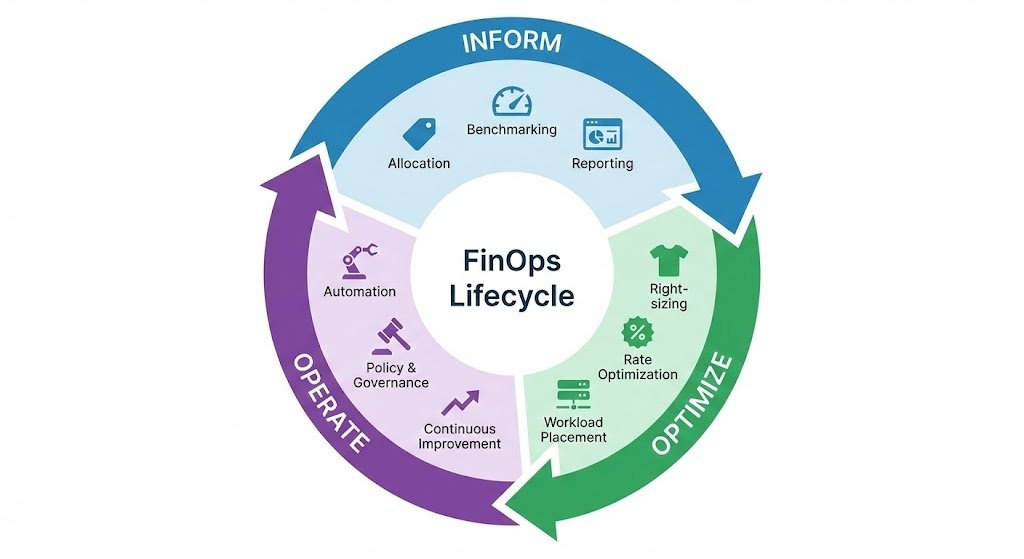
Cost optimization involves running systems to deliver business value at the lowest price point. For enterprises managing millions in annual cloud spend, this pillar translates into FinOps practices establishing cost accountability and continuous optimization.
Reserved Capacity Strategy: AWS offers Reserved Instances and Savings Plans reducing costs 30-70% compared to On-Demand pricing. The architectural decision involves commitment term (1 or 3 years), payment options (all upfront, partial, no upfront), and flexibility (instance family, region, tenancy).
Sophisticated enterprises implement capacity planning analysing historical utilisation patterns through AWS Cost Explorer, purchasing reserved capacity for baseline workloads whilst maintaining on-demand flexibility for variable demand. This hybrid approach balances commitment risk against cost optimisation opportunity.
Burns & McDonnell saved 30% of their AWS bill in the first week by implementing right-sizing recommendations from their Well-Architected review, demonstrating immediate ROI from structured cost analysis.
Resource Lifecycle Management: Cost optimization requires decommissioning unused resources and stopping resources during idle periods. Enterprise environments accumulate “zombie resources”—unattached EBS volumes, stopped instances, orphaned snapshots—that continue incurring charges without delivering value.
Automated resource tagging combined with AWS Config rules enables cost allocation and automated cleanup. Development environments scheduled through AWS Instance Scheduler reduce compute costs 60-70% by stopping non-production resources outside business hours.
The AWS Well-Architected Cost Optimization pillar serves as the foundation for mature FinOps practices. For comprehensive guidance on evolving cost management from reactive spend control to strategic value creation, see our FinOps Evolution guide.
Sustainability: Environmental Impact as Architectural Concern
The Sustainability pillar, introduced in 2022, addresses minimising environmental impact of cloud workloads. This represents AWS’s commitment to 100% renewable energy and helps enterprises meet their own sustainability targets.
Region Selection for Carbon Efficiency: AWS publishes carbon intensity data for regions, enabling architecture decisions optimising for environmental impact. The framework encourages selecting regions powered by renewable energy when regulatory and latency requirements permit.
Enterprises implement multi-region architectures can route workloads to regions with lower carbon intensity during off-peak periods. This balances performance requirements against sustainability goals, demonstrating how technical architecture enables corporate environmental commitments.
Resource Efficiency Patterns: Sustainability intersects with cost optimization—efficient resource usage reduces both environmental impact and expenditure. Right-sizing instances, implementing auto-scaling, and adopting serverless patterns all improve sustainability metrics whilst reducing costs.
The Sustainability pillar encourages lifecycle analysis—data retention policies minimising storage of unnecessary data, automated tiering moving infrequently accessed data to lower-power storage classes, and eventual deletion of obsolete data.
Implementation Approaches: From Assessment to Production
The Well-Architected Review Process
Conducting systematic architecture reviews requires structured methodology. The AWS Well-Architected Tool in the AWS Management Console provides a questionnaire-based assessment generating reports identifying high-risk issues and improvement opportunities.
Review Scope Definition: Enterprise reviews typically focus on critical workloads—customer-facing applications, revenue-generating platforms, compliance-sensitive systems. Attempting to review all workloads simultaneously overwhelms teams. Leading organisations prioritise reviewing 3-5 high-value workloads quarterly, building review capacity whilst delivering measurable improvements.
Natura engaged AWS Professional Services for an 8-week collaborative review involving 15 team members analysing each platform module. This investment produced robust recommendations prioritised by business impact, demonstrating the commitment required for meaningful architecture assessment.
Cross-Functional Collaboration: Effective reviews require perspectives beyond infrastructure teams. Application developers understand workload characteristics and performance requirements. Security teams identify compliance risks. Finance teams provide context on budget constraints. Business stakeholders articulate availability requirements and acceptable downtime windows.
Cabinet’s Well-Architected review achieved success through strong engagement from developers, architects, and infrastructure engineers working together to generate solutions delivering positive impact on consultant experience. This cross-functional approach ensures technical recommendations align with business outcomes.
Remediation Planning and Execution
Well-Architected reviews generate prioritised improvement recommendations. The framework categorises findings by risk level—high-risk issues (HRIs) requiring immediate attention, medium-risk improvements offering significant value, and low-risk optimisations for future consideration.
Phased Remediation Strategy: Attempting to implement all recommendations simultaneously overwhelms engineering capacity. Enterprises adopt phased approaches addressing high-risk security issues immediately whilst scheduling cost optimizations and performance improvements across quarters.
Claim Technology achieved 81.6% risk mitigation by systematically working through prioritised recommendations. This phased approach delivered security improvements, performance gains, and cost reductions whilst maintaining development velocity on business features.
Continuous Improvement Culture: The framework emphasises architecture as an ongoing practice rather than one-time exercise. Leading enterprises establish quarterly review cadences reassessing workloads as business requirements evolve and AWS introduces new capabilities. This continuous improvement approach prevents architectural drift and captures optimization opportunities from AWS innovation.
For organisations embarking on cloud architecture transformation, understanding the business value and strategic implications proves as important as technical implementation. Our Cloud Computing for Business Leaders guide provides executive context for architectural investments.
Real-World Enterprise Outcomes
Burns & McDonnell: Governance Framework Transformation
Burns & McDonnell, an engineering and architecture firm with 1898 & Co. digital solutions subdivision, engaged the Well-Architected Framework to enhance cloud governance. Principal Cloud Architect Jason Cradit sought to move beyond treating cloud services like on-premises infrastructure, enabling innovation without security breaches or cost inefficiencies.
Implementing the framework with Trend Micro Cloud One Conformity, Burns & McDonnell received comprehensive analysis against 800+ best practices within 20 minutes rather than days. The organisation achieved:
- 30% immediate cost reduction in the first week through rapid remediation
- 50% reduction in mean time to resolution using automated remediation workflows
- Enhanced security posture through continuous monitoring against Well-Architected principles
- Developer productivity gains through guardrails enabling innovation without fear of creating inefficiencies
The case demonstrates rapid value from structured architecture review—Burns & McDonnell recouped their Well-Architected investment in days through immediate cost savings whilst establishing governance foundations supporting long-term growth.
Tricentis Flood: SOC 2 Compliance Through Architecture
Tricentis Flood, a distributed cloud load testing platform, required SOC 2 compliance as a service provider. Cprime conducted a comprehensive Well-Architected Review examining security, reliability, and operational excellence.
Implementation outcomes included:
- SOC 2 compliance achieved through documented architecture and security controls
- Enhanced threat detection via AWS GuardDuty implementation providing continuous monitoring
- Multi-region resilience distributing compute and storage across availability zones and regions
- Improved forensic capability through detailed network logging and CloudTrail integration
- Automated security responses reducing incident response time from hours to minutes
Tricentis demonstrates how Well-Architected reviews support regulatory compliance—not through checkbox audits but through fundamental architecture improvements addressing security, reliability, and operational requirements simultaneously.
Verdant Web Technologies: Pipeline Growth Through Architecture
Verdant Web Technologies struggled with international expansion and enterprise credibility. Five Talent implemented Well-Architected Framework review identifying 23 risk exposures resolved over four months.
Business impact included:
- 50% reduction in client due diligence time through documented Well-Architected architecture
- Shortened sales cycles with enterprise prospects confident in architecture maturity
- Improved return on capital investments through optimised infrastructure spend
- New product innovation enabled by reliable, scalable architecture foundation
- Enhanced operational excellence through documented, automated CI/CD pipelines
Verdant’s case highlights how architecture maturity impacts business outcomes beyond technical metrics—faster sales cycles, enterprise customer acquisition, and capital efficiency demonstrating Well-Architected principles enabling business strategy.
Cost Analysis and Return on Investment
Implementation Investment
Well-Architected Framework adoption requires investment in assessment, remediation, and ongoing review processes. Typical enterprise implementation costs include:
Initial Assessment (4-8 weeks):
- Internal team time: 40-80 hours across architects, developers, security specialists
- AWS Partner engagement: £15,000-£40,000 for comprehensive review depending on workload complexity
- Tooling costs: AWS Well-Architected Tool is free; third-party automation tools range £5,000-£20,000 annually
Remediation Implementation (3-6 months):
- Engineering resources: 200-500 hours addressing high and medium-risk findings
- Infrastructure changes: Variable depending on recommendations; multi-region deployments may increase short-term costs 20-40%
- Training and documentation: 40-80 hours developing runbooks and team enablement
Ongoing Review Programme:
- Quarterly assessments: 20-40 hours per workload
- Continuous improvement: 10-15% of engineering capacity allocated to architectural improvements
Measurable Returns
Research and case studies demonstrate substantial ROI from structured architecture programmes:
Cost Optimization Returns:
- Burns & McDonnell: 30% cost reduction in first week, recouping assessment investment immediately
- TableAir: 10% ongoing cost reduction through infrastructure efficiency improvements
- AWS billing credits: Up to £5,000 per workload for implementing recommendations within 30 days
Operational Efficiency Gains:
- Burns & McDonnell: 50% faster issue resolution through automated remediation workflows
- Claim Technology: 81.6% high-risk issue mitigation improving system stability
- Verdant: 50% reduction in client due diligence through documented architecture
Business Impact:
- Shorter sales cycles with enterprise customers requiring architecture maturity
- Regulatory compliance achieved through systematic security and reliability improvements
- Developer productivity gains through automated processes and clear architectural patterns
Typical ROI Timeline:
- Month 1-3: Initial cost savings from rightsizing and resource cleanup
- Month 4-6: Operational efficiency improvements reducing incident response time
- Month 7-12: Business impact from improved reliability, faster feature delivery, enterprise customer acquisition
- Year 2+: Compound benefits from continuous improvement culture and architectural excellence
Forrester research on cloud governance programmes demonstrates ROI of up to 4.8x within three years, with benefits spanning reduced operational costs, improved developer productivity, and decreased security incident impact.
Decision Framework: Choosing Architectural Patterns
The Well-Architected Framework provides principles but enterprises require decision frameworks translating principles into specific architectural choices.
When to Implement Multi-Region Active-Active
Choose this pattern when:
- Revenue impact of downtime exceeds £10,000+ per hour
- Customer SLAs require 99.95%+ availability
- Regulatory requirements mandate geographic redundancy
- User base spans multiple continents requiring low latency globally
Accept trade-offs:
- 100-200% infrastructure cost increase
- Complex data synchronisation and conflict resolution
- Significant operational complexity requiring advanced expertise
Real example: Financial services trading platform processing £50M+ daily transaction volume implemented active-active across eu-west-1 and eu-central-1, accepting 180% infrastructure costs to eliminate regional failure risk.
When to Prioritise Cost Over Reliability
Choose this pattern when:
- Non-production environments (development, testing, staging)
- Internal tools with limited user base tolerating occasional downtime
- Batch processing workloads allowing delayed execution
- Startup validation phases before product-market fit
Implement through:
- Single-AZ deployments reducing cross-AZ data transfer costs
- Instance Scheduler stopping resources outside business hours
- Spot instances for fault-tolerant workloads accepting interruption
- Backup-and-restore disaster recovery accepting extended RTO/RPO
Real example: SaaS startup development environments scheduled 9am-6pm weekdays, reducing compute costs 65% whilst maintaining developer productivity.
When to Adopt Serverless Architecture
Choose this pattern when:
- Workload exhibits variable, spiky demand patterns
- Development team size limited (startup, small team)
- Time-to-market prioritised over operational control
- Per-request cost model aligns with business model
Accept trade-offs:
- Cold start latency impacting initial request performance
- Vendor lock-in through AWS-specific services
- Debugging complexity in distributed serverless systems
- State management requiring external data stores
Real example: Document processing service handling 100-10,000 requests daily adopted Lambda + SQS, reducing operational overhead 80% whilst maintaining sub-second processing times.
Implementation Roadmap: Enterprise Adoption
Phase 1: Foundation and Assessment (Months 1-3)
Objectives:
- Conduct initial Well-Architected reviews on 2-3 critical workloads
- Establish baseline metrics for cost, performance, and availability
- Build cross-functional review teams
Key activities:
- Select pilot workloads representing diverse architecture patterns
- Train 3-5 architects on Well-Architected methodology through AWS training
- Execute formal reviews using AWS Well-Architected Tool
- Prioritise findings by business impact and implementation effort
Investment:
- 3-5 architects: 40 hours each for training and initial reviews
- AWS Partner engagement: £20,000-£30,000 for pilot reviews
- Success metrics: Complete assessment of pilot workloads, prioritised remediation backlog
Phase 2: Remediation and Quick Wins (Months 4-9)
Objectives:
- Implement high-impact improvements from Phase 1 assessments
- Demonstrate measurable value building organisational support
- Develop remediation patterns applicable across workloads
Key activities:
- Address high-risk security issues immediately (month 4)
- Implement cost optimization quick wins—rightsizing, reserved capacity, cleanup (months 4-5)
- Deploy reliability improvements—multi-AZ, auto-scaling, backup automation (months 6-7)
- Document remediation patterns in internal runbooks (months 7-9)
Expected outcomes:
- 15-30% cost reduction from optimization initiatives
- High-risk security issues mitigated
- Improved availability metrics from reliability enhancements
Phase 3: Scale and Governance (Months 10-18)
Objectives:
- Expand reviews across remaining critical workloads
- Establish governance processes integrating Well-Architected into development lifecycle
- Build organisational capability through training and documentation
Key activities:
- Review 10-15 additional workloads on quarterly cadence
- Implement architecture review gates in deployment pipelines
- Develop internal Well-Architected champions across teams
- Create custom lenses for organisation-specific requirements
- Establish FinOps practices for ongoing cost accountability
Organisational transformation:
- Architecture reviews become standard practice, not special projects
- Teams self-assess using Well-Architected principles during design phase
- Continuous improvement culture established through regular review cycles
Future Trends and Innovation
AI-Enhanced Architecture Reviews
Traditional Well-Architected reviews require significant manual effort—questionnaire completion, analysis, and recommendation prioritisation. Emerging tools leverage AI to accelerate this process. Cabinet’s case study demonstrates AI-driven Well-Architected review instantly ranking findings by business impact, enabling focus on critical improvements first.
Expect increasing automation in architecture assessment—AI analysing CloudFormation templates, Terraform configurations, and CloudTrail logs to identify Well-Architected violations automatically. This shifts reviews from periodic manual assessments to continuous, automated architecture validation integrated into CI/CD pipelines.
Sustainability as Competitive Advantage
The Sustainability pillar, introduced in 2022, will gain prominence as organisations establish environmental commitments. AWS’s path to 100% renewable energy by 2025 enables customers to inherit sustainability benefits simply through cloud adoption. However, leading enterprises will differentiate through workload-level sustainability optimisations.
Expect carbon-aware compute scheduling—routing workloads to regions with current renewable energy availability, deferring non-critical batch processing to off-peak periods when renewable energy percentage is highest. This balances business requirements against environmental impact, demonstrating technical architecture enabling corporate sustainability targets.
FinOps Integration
Cost Optimization pillar increasingly integrates with enterprise FinOps practices. AWS Cost Explorer, Budgets, and Cost Anomaly Detection provide foundational tooling, but mature organisations implement sophisticated cost allocation, showback/chargeback, and capacity planning processes.
Future developments will unify Well-Architected reviews with FinOps metrics—directly correlating architectural improvements with cost impact, quantifying reliability investments through availability SLA financial models, measuring performance efficiency through business transaction throughput. This financial lens on architecture makes Well-Architected value tangible to CFOs and business leaders.
Industry-Specific Lenses
AWS Well-Architected Lenses extend framework guidance to specific industries and technologies—Financial Services, Healthcare, Machine Learning, SaaS, IoT. Expect proliferation of industry-specific lenses addressing sector regulations, compliance requirements, and architectural patterns.
Financial services organisations already leverage Financial Services Lens addressing FCA regulations, PCI-DSS requirements, and data sovereignty constraints. Healthcare organisations apply Healthcare Lens incorporating HIPAA, GDPR-Article 9, and clinical safety requirements. These lenses translate general Well-Architected principles into sector-specific actionable guidance.
Strategic Recommendations
Start with Business Context, Not Technology
Well-Architected Framework provides architectural principles, but application requires business context. Before conducting reviews, establish clear business requirements—availability SLAs, budget constraints, regulatory obligations, performance targets. This context enables appropriate trade-off decisions balancing competing pillar requirements.
Financial services platforms may prioritise Security and Reliability over Cost Optimization, accepting higher infrastructure costs for regulatory compliance and availability guarantees. Startups often prioritise Cost Optimization and Performance Efficiency, accepting reduced reliability for non-production environments to conserve capital.
Implement Continuous Review Cadence
Architecture excellence requires ongoing practice, not one-time projects. Establish quarterly review cycles reassessing critical workloads as business requirements evolve and AWS introduces new capabilities. This continuous improvement prevents architectural drift and captures optimization opportunities from platform innovation.
Leading enterprises integrate Well-Architected thinking into design phase—architecture decision records documenting trade-offs, design reviews applying framework principles before implementation, automated checks validating adherence to architectural standards.
Build Organisational Capability
Sustainable Well-Architected adoption requires organisational capability, not just initial reviews. Invest in training architects on framework methodology, develop internal champions evangelising best practices, document organisation-specific patterns and anti-patterns learned through reviews.
Natura’s 8-week collaborative review involving 15 participants built internal capability whilst producing recommendations. This investment in team engagement ensures remediation continues beyond initial assessment, establishing architecture excellence as cultural expectation.
Measure and Communicate Value
Architecture improvements generate business value—reduced costs, improved availability, faster feature delivery, regulatory compliance. Quantify and communicate these outcomes to stakeholders establishing continued support for architecture programmes.
Burns & McDonnell’s 30% cost reduction and 50% faster issue resolution provided compelling evidence of Well-Architected value. Verdant’s 50% reduction in sales cycle due diligence demonstrated how architecture maturity impacts business outcomes beyond technical metrics.
For executives seeking to understand how cloud architecture investments deliver strategic business value, our Cloud Computing for Business Leaders guide connects technical capabilities with business outcomes.
Conclusion: From Framework to Production Excellence
The AWS Well-Architected Framework succeeds not through prescriptive rules but through structured thinking about architectural trade-offs within specific business contexts. Enterprises achieving measurable value—Burns & McDonnell’s 30% cost reduction, Tricentis’s SOC 2 compliance, Verdant’s pipeline growth—share common patterns: cross-functional collaboration, phased remediation prioritised by business impact, and continuous improvement cultures.
Translation from framework principles to production architecture requires decisions balancing Security, Reliability, Performance, Cost, Operations, and Sustainability based on workload characteristics and business requirements. Multi-region active-active for revenue-critical platforms, cost-optimised single-region for development environments, serverless for variable workloads, containers for consistent compute patterns—each represents appropriate application of Well-Architected thinking to specific contexts.
The framework’s real value emerges through systematic review processes identifying high-risk issues, quick-win optimizations, and strategic improvements. Combined with growing FinOps maturity connecting architecture decisions to financial outcomes, Well-Architected principles provide the foundation for enterprise cloud excellence.
Useful Links
- AWS Well-Architected Framework Official Documentation
- AWS Well-Architected Tool
- AWS Well-Architected Partner Program
- Sustainability Pillar Whitepaper
- AWS Architecture Centre
- AWS Well-Architected Labs (Hands-on)
- AWS Cost Explorer for Cost Optimization
- AWS Trusted Advisor
- AWS Security Hub for Security Pillar
- Gartner Cloud Infrastructure & Platform Services Research