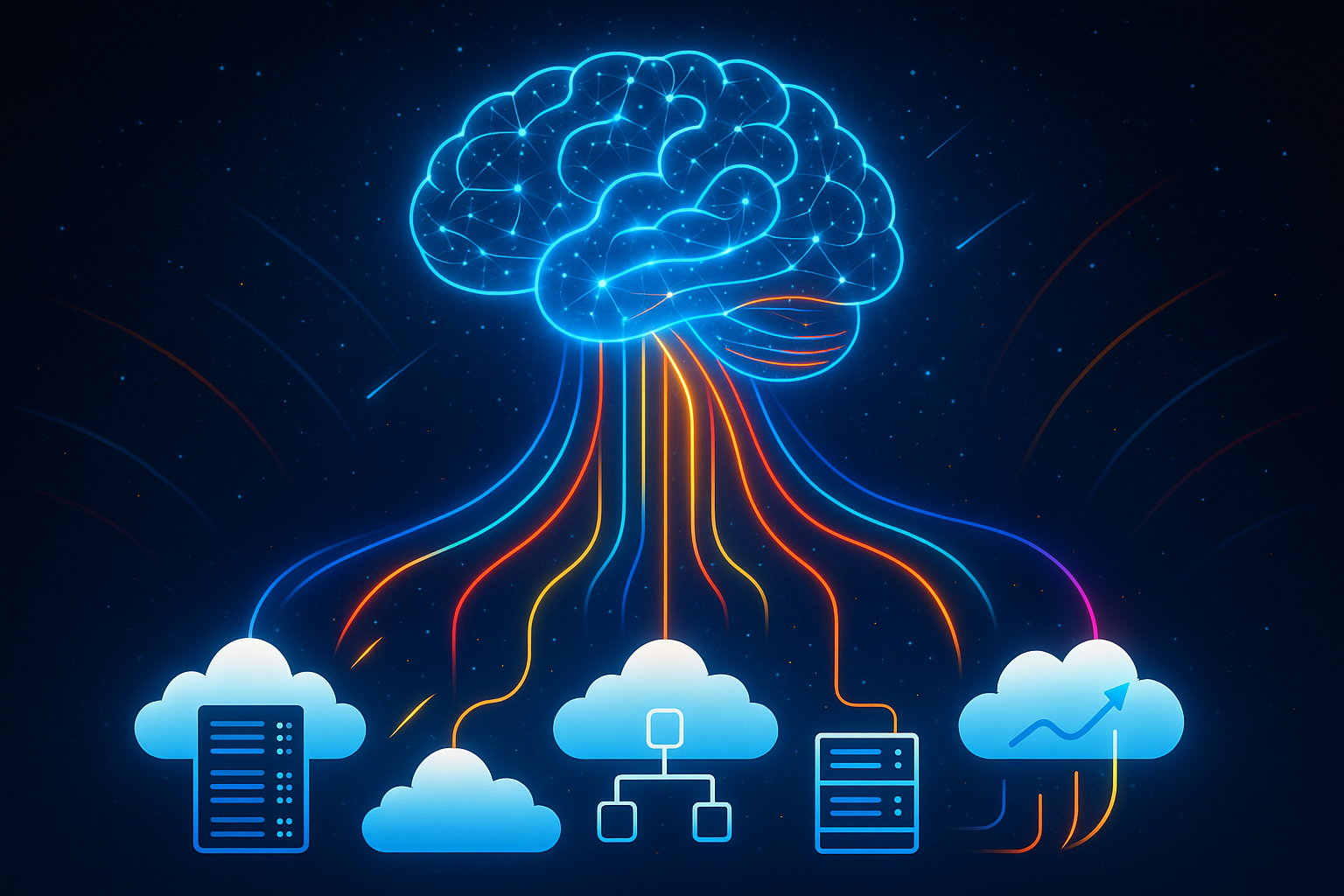
The days of reactive cloud management are rapidly drawing to a close. Whilst traditional approaches have relied on predefined rules and manual intervention, a new paradigm is emerging where artificial intelligence doesn’t merely assist with cloud operations, it orchestrates them. Welcome to the era of AI-native cloud management, where machine learning algorithms predict, prevent, and optimise infrastructure challenges before they impact business operations.
This transformation represents more than an incremental improvement; it’s a fundamental shift in how organisations approach cloud infrastructure. Rather than responding to problems after they occur, AI-native systems anticipate needs, automatically allocate resources, and continuously optimise performance without human intervention.
The Evolution from Reactive to Predictive Infrastructure
Traditional cloud management operates on a reactive model: metrics breach thresholds, alerts fire, and engineers scramble to respond. This approach, whilst functional, creates a perpetual cycle of firefighting that consumes resources and introduces latency between problem detection and resolution.
AI-native cloud management inverts this model entirely. By analysing historical patterns, current workload characteristics, and external factors, machine learning systems can forecast infrastructure needs with remarkable precision. AWS’s predictive scaling, for instance, uses machine learning models trained on billions of data points to predict expected traffic patterns, including daily and weekly cycles, enabling resources to be provisioned before demand materialises.
Consider the difference in approach: traditional auto-scaling waits for CPU utilisation to exceed 70% before adding instances, potentially leaving users waiting whilst new resources initialise. Predictive systems, however, analyse traffic patterns and scale infrastructure ahead of anticipated demand, ensuring new instances are ready to serve traffic when it arrives.
The Technical Foundation: Machine Learning at the Infrastructure Layer
Advanced Neural Network Architectures
The sophistication of modern AI-driven infrastructure management lies in its use of advanced neural network architectures specifically designed for time-series prediction and multivariate resource forecasting.
Bidirectional LSTM Networks: These networks excel at capturing temporal dependencies in both forward and backward directions, enabling them to understand complex patterns in CPU provisioning, memory utilisation, disk throughput, and network traffic simultaneously. Unlike traditional approaches that predict single metrics in isolation, these systems understand the intricate relationships between different resource types.
CNN-LSTM Hybrid Models: Research demonstrates that hybrid convolutional neural networks combined with LSTM architectures can reduce mean squared error to as low as 3.17 x 10⁻³ in workload predictions, significantly outperforming traditional statistical methods.
Reinforcement Learning for Continuous Optimisation: Rather than executing predefined rules, autonomous systems use reinforcement learning to independently learn from application behaviour, make performance-cost trade-offs, and improve continuously through real-world feedback.
Real-Time Pattern Recognition
The intelligence behind AI-native systems extends beyond simple trend analysis. Google Cloud’s predictive autoscaling uses up to three weeks of historical data to train machine learning models, with forecasts recomputed every few minutes to rapidly adapt to very recent changes in load patterns.
This granular approach enables systems to distinguish between temporary spikes and genuine trend shifts, preventing both over-provisioning during brief anomalies and under-provisioning during sustained growth periods.
Platform-Specific Implementations
Amazon Web Services: Intelligence at Scale
AWS has integrated machine learning across its optimisation stack. AWS Compute Optimizer analyses historical resource consumption patterns and provides rightsizing recommendations that can reduce costs by up to 25% whilst resolving performance issues caused by underprovisioned resources.
The platform’s approach combines multiple AI services:
- Predictive Scaling: Forecasts traffic patterns for Auto Scaling groups
- Compute Optimizer: Provides ML-driven instance rightsizing recommendations
- Cost Optimization Hub: Now integrated with Amazon Q Developer to simplify cost optimisation using expert-validated models that scale to millions of AWS resources
Microsoft Azure: Hybrid Intelligence
Azure’s AI-native approach emphasises integration across hybrid environments. Azure’s Advisor and Cost Management tools integrate with Microsoft Copilot to suggest real-time savings and resource rightsizing, whilst sustainability scoring tools help organisations measure and reduce their cloud carbon footprint.
The platform excels in:
- Hybrid Cloud Optimisation: AI-driven recommendations across on-premises and cloud resources
- Enterprise Integration: Seamless connection with existing Microsoft toolchains
- Compliance Automation: AI-powered governance frameworks for regulatory environments
Google Cloud Platform: Research-Driven Innovation
GCP leverages Google’s extensive AI research, offering cutting-edge machine learning tools rooted in the same infrastructure that powers Google Search, Maps, and Translate. The platform’s strength lies in its AI-first approach to cloud services.
Key innovations include:
- Tensor Processing Units (TPUs): Custom-designed chips for machine learning workloads that provide significant performance improvements for neural network training and inference
- Predictive Autoscaling: Advanced forecasting with minimal configuration requirements
- FOCUS 1.0 Support: New BigQuery export capabilities that align billing data with FinOps-friendly formats for better cost visibility
The Rise of Autonomous Cloud Management
Beyond Automation: True Autonomy
The distinction between automation and autonomy represents a critical evolution in cloud management philosophy. Automation executes predefined, static rules set by humans, requiring constant maintenance and creating recommendation backlogs. Autonomous systems use AI to independently learn, decide, and act without human intervention, continuously optimising based on application behaviour.
This shift enables unprecedented operational efficiency. Organisations implementing autonomous platforms report productivity increases of sixfold, with systems that enhance performance by autonomously analysing workload behaviour to identify optimal configurations, achieving latency reductions of 30-75%.
AIOps: Intelligence Meets Operations
AIOps platforms represent the practical implementation of AI-native management principles. These systems integrate AI-based tools into observability platforms, bringing greater insight and efficiencies to processes whilst reducing the cost of IT operations through ML models trained specifically for IT environments.
Modern AIOps capabilities include:
- Anomaly Detection: Automatic detection of unusual patterns with reduced mean time to detect (MTTD) through continuous monitoring
- Incident Correlation: Intelligent grouping of related alerts into single issues, reducing alert fatigue and accelerating resolution
- Predictive Analytics: Proactive alerts for issue prevention with real-time cross-team collaboration and contextual notifications
Real-World Impact: Case Studies in AI-Native Management
Enterprise-Scale Implementation
The theoretical benefits of AI-native cloud management translate into measurable business outcomes across various industries.
Financial Services: A Forrester Total Economic Impact study found that organisations implementing AI-powered model monitoring achieved 15% to 30% increases in model accuracy due to automated monitoring, whilst reducing model monitoring efforts by 35% to 50%.
Technology Platforms: KnowBe4, the world’s largest security awareness training provider, implemented autonomous optimisation and achieved cost savings of up to 50% in production and 87% in development within five months, with zero negative incidents.
Streaming Media: Netflix’s AI-Driven Transformation
Netflix’s migration to cloud-native technologies enabled the company to transform from DVD distribution to global streaming, using sophisticated machine learning algorithms to provide personalised recommendations whilst automating IT operations to reduce operational costs.
The platform’s success demonstrates how AI-native approaches enable:
- Global Scale: Serving billions of hours of content monthly
- Cost Efficiency: Automated resource management reducing operational overhead
- Performance Optimisation: Predictive scaling for traffic pattern management
Technical Deep Dive: Implementation Strategies
Multivariate Resource Prediction
Modern AI-native systems move beyond single-metric monitoring to comprehensive resource orchestration. Advanced frameworks implement multivariate time-series bidirectional LSTM models that predict CPU provisioned and usage, memory allocation, disk throughput, and network utilisation simultaneously, capturing the complex relationships between different resource types.
This holistic approach enables more accurate predictions and prevents the resource imbalances that occur when optimising individual metrics in isolation.
Predictive Scaling Algorithms
The mathematical foundation of predictive scaling combines multiple forecasting approaches:
Statistical Models: Seasonal ARIMA models provide baseline forecasting capabilities, particularly effective for regular, cyclical patterns.
Deep Learning Networks: LSTM and Bidirectional LSTM networks excel at capturing complex, non-linear patterns in workload data, whilst Online Sequential Extreme Learning Machine (OS-ELM) enables efficient online learning for dynamic environments.
Ensemble Methods: The most robust implementations combine multiple approaches, using the strengths of each model type to create more accurate and resilient predictions.
Cloud-Native AI Infrastructure
The infrastructure supporting AI-native management must itself be optimised for AI workloads. Cloud-native infrastructure provides the scalability, resilience, and flexibility required to support AI applications, with Kubernetes orchestration enabling automatic scaling based on demand, which is crucial for AI workloads with variable computational requirements.
Overcoming Implementation Challenges
Managing Model Drift and Accuracy
One of the primary challenges in AI-native cloud management involves maintaining model accuracy over time. AI model accuracy can degrade within days of deployment because production data differs from the model’s training data, potentially leading to incorrect predictions and significant risk exposure.
Effective drift management requires:
- Continuous Monitoring: Statistical tests and visual tools to compare current data distributions with training data, including Kolmogorov-Smirnov tests and Population Stability Index measurements
- Automated Retraining: Implementing MLOps practices with end-to-end automation for model management, including monitoring, retraining, and deployment based on performance threshold triggers
- Quality Data Sources: Ensuring training data remains representative of production scenarios and free from inconsistencies, errors, and biases
Complexity and Cost Considerations
Implementing AI-native cloud management introduces new operational complexities. MLOps challenges include data management issues, complex model deployment, security vulnerabilities from handling sensitive data, and compliance requirements like GDPR and CCPA.
Successful implementations address these challenges through:
- Phased Adoption: Beginning with platform-native AI tools before implementing third-party solutions
- Security by Design: Implementing strong data encryption for data at rest and in transit, using the latest encryption protocols
- Governance Frameworks: Establishing clear policies for AI model deployment and monitoring
The Business Case: Quantifying AI-Native Benefits
Cost Optimisation Outcomes
The financial benefits of AI-native cloud management extend beyond simple cost reduction. Research indicates that predictive scaling can save up to 44.9% on costs during low demand periods whilst improving resource availability by 30% during peak times, reducing both overprovisioning and underprovisioning risks.
Operational Efficiency Gains
Beyond cost savings, AI-native approaches deliver measurable operational improvements:
- Reduced Manual Intervention: Autonomous systems eliminate engineering toil whilst delivering superior results through continuous optimisation that static rules cannot achieve
- Improved Reliability: AI-driven systems enhance uptime by detecting signs of impending failures early and triggering preventative actions
- Enhanced Agility: Teams transition from reactive firefighting to strategic innovation
Industry-Specific Applications
Content Delivery Networks
CDN environments benefit significantly from AI-native management due to their highly dynamic and geographically distributed traffic patterns. Advanced prediction frameworks trained on 18 months of real traffic traces can accurately forecast seasonal effects, cache-tier interactions, and propagation delays.
Financial Services
The financial sector particularly benefits from AI-native approaches due to strict performance requirements and cost sensitivity. Financial institutions report that even a 1% improvement in model accuracy can free up millions of dollars for lending or investment.
E-commerce and Retail
Retail platforms with fluctuating demand patterns, such as those experiencing traffic surges during sales events, find predictive scaling invaluable for maintaining performance whilst controlling costs.
Platform Selection: Choosing the Right AI-Native Approach
Evaluation Criteria
When selecting AI-native cloud management solutions, organisations should consider:
Cost Control: Understanding pricing models and ensuring tools offer transparency and auto-scaling capabilities
Performance and Scalability: Look for solutions that support distributed computing, GPU acceleration, and high availability
Integration Capability: Choose solutions that align with existing technology stacks and support automation through CI/CD and DevSecOps practices
Multi-Cloud Considerations
Many organisations opt for multi-cloud strategies, leveraging the strengths of each provider for different aspects of their AI and ML workloads, as AWS offers extensive service variety, Azure provides strong Microsoft integration, and GCP excels in cutting-edge AI research tools.
Implementation Roadmap: From Traditional to AI-Native
Phase 1: Foundation Building
Data Infrastructure: Establish robust data collection and processing capabilities that can support AI model training and inference.
Monitoring Enhancement: Implement comprehensive monitoring systems that collect metrics, events, logs, and traces (MELT) to provide the data foundation for AI analysis.
Platform-Native Tools: Begin with cloud provider native AI optimisation services before investing in third-party solutions.
Phase 2: Predictive Capabilities
Pilot Projects: Start with predictive scaling for well-understood workloads with clear patterns.
Model Training: Allow sufficient time for historical data collection. Predictive systems typically require at least three days of history before generating forecasts, with accuracy improving over several weeks.
Performance Validation: Establish metrics to measure the effectiveness of predictive systems compared to reactive approaches.
Phase 3: Autonomous Operations
Advanced AI Integration: Implement autonomous platforms that can make independent optimisation decisions.
Continuous Learning: Deploy systems that use reinforcement learning to continuously optimise based on application behaviour, making performance-cost trade-offs without human intervention.
Organisational Adaptation: Transition team roles from reactive maintenance to strategic optimisation and innovation.
Addressing Common Concerns and Limitations
Model Accuracy and Reliability
Whilst AI-native systems deliver impressive results, they’re not infallible. Model accuracy can degrade within days of deployment as production data diverges from training data, potentially leading to incorrect predictions.
Mitigation strategies include:
- Automated Drift Detection: AI-powered systems that monitor for configuration and performance drift, providing proactive identification of potential issues before they impact security or compliance
- Continuous Retraining: Regular model updates using fresh data to maintain accuracy
- Hybrid Approaches: Combining AI predictions with traditional safeguards for critical systems
Complexity Management
The deployment process can be challenging due to managing various environments, versions, and dependencies, with potential mismatches between production infrastructure and training environments leading to unexpected model failures.
Best practices for complexity management:
- Containerisation: Packaging ML models into containers like Docker ensures environment consistency throughout the transition from development to production
- MLOps Implementation: Automated CI/CD pipelines specifically designed for machine learning workflows
- Gradual Rollouts: Phased deployment strategies that allow for validation and refinement
Future Trends: The Next Frontier of AI-Native Cloud Management
Quantum-Enhanced Optimisation
Quantum computing is stepping out of laboratories and into mainstream business through cloud services, with industry giants like IBM, Google, Microsoft, and Amazon democratising access to quantum capabilities that could revolutionise complex optimisation problems.
Edge-Cloud Continuum
The integration of edge computing with cloud platforms creates new opportunities for AI-native management, with 5G networks enabling low-latency communication that makes edge computing more viable for real-time AI inference.
Autonomous Ecosystem Management
Future MLOps platforms will shift toward automating more aspects of the ML lifecycle, from data preprocessing to model deployment and monitoring, with cloud providers offering MLOps platforms as fully managed services.
Practical Implementation Guidelines
Getting Started: Immediate Actions
- Assess Current State: Evaluate existing monitoring and alerting capabilities to identify gaps
- Data Preparation: Ensure applications have sufficient startup time measurement and configure appropriate initialisation periods in autoscaler settings
- Pilot Selection: Choose workloads with predictable patterns for initial AI-native implementations
Building Capabilities
Tool Selection: Consider platforms like Datadog, Dynatrace, and New Relic that offer AI-driven observability with multi-cloud integration for predictive insights.
Team Development: Invest in training for teams on AI/ML concepts relevant to infrastructure management.
Governance Establishment: Implement automated governance frameworks that can scale across multiple cloud environments efficiently whilst reducing false positives.
Success Metrics
Define clear success criteria for AI-native implementations:
- Cost Metrics: Track cost reduction percentages and resource utilisation efficiency
- Performance Indicators: Monitor latency improvements and availability increases
- Operational Metrics: Measure reduction in manual intervention and mean time to resolution
The Competitive Advantage of AI-Native Management
Organisations that successfully implement AI-native cloud management gain several competitive advantages:
Operational Excellence: Systems that anticipate and resolve performance bottlenecks before they impact users, whilst freeing IT teams from firefighting to focus on innovation.
Cost Leadership: Precise resource allocation that eliminates waste whilst maintaining performance standards.
Innovation Acceleration: Engineering teams can focus on value-creating projects rather than routine operational tasks, with platforms that reduce manual DevOps tasks and increase efficiency sixfold.
Looking Ahead: The AI-Native Future
The trajectory towards AI-native cloud management appears irreversible. With 85% of enterprises expected to adopt cloud-first strategies, and AI becoming central to cloud operations, organisations that delay adoption risk falling behind competitors who embrace intelligent automation.
The integration of AI into cloud management represents more than technological advancement. It’s an evolution in operational philosophy. Rather than reacting to problems, organisations can anticipate challenges, prevent issues, and continuously optimise performance through intelligent systems that learn and adapt.
As this technology matures, the organisations that thrive will be those that view AI not as a replacement for human expertise, but as an amplifier of human intelligence, freeing technical teams to focus on strategic innovation whilst autonomous systems handle the complexities of day-to-day infrastructure optimisation.
The question for cloud practitioners isn’t whether to adopt AI-native management, but how quickly they can implement it effectively. The future of cloud infrastructure is intelligent, autonomous, and optimised—and that future is available today.
Further Reading and Resources
Platform-Specific AI Optimization Tools
- AWS Compute Optimizer – AI-driven rightsizing recommendations that can reduce costs by up to 25%
- Google Cloud Predictive Autoscaling – Machine learning-powered scaling that creates VMs ahead of demand
- Azure Advisor – AI-powered recommendations for cost, performance, and security optimization
Autonomous Cloud Management Platforms
- Sedai Autonomous Optimization – Reinforcement learning platform achieving up to 50% cost savings in production
- New Relic Applied Intelligence – AIOps for incident management and predictive analytics
Industry Insights and Trends
- State of FinOps 2025 Report – Latest research on cloud financial management and AI integration
- Netflix Technology Blog – Real-world insights from large-scale AI and cloud operations