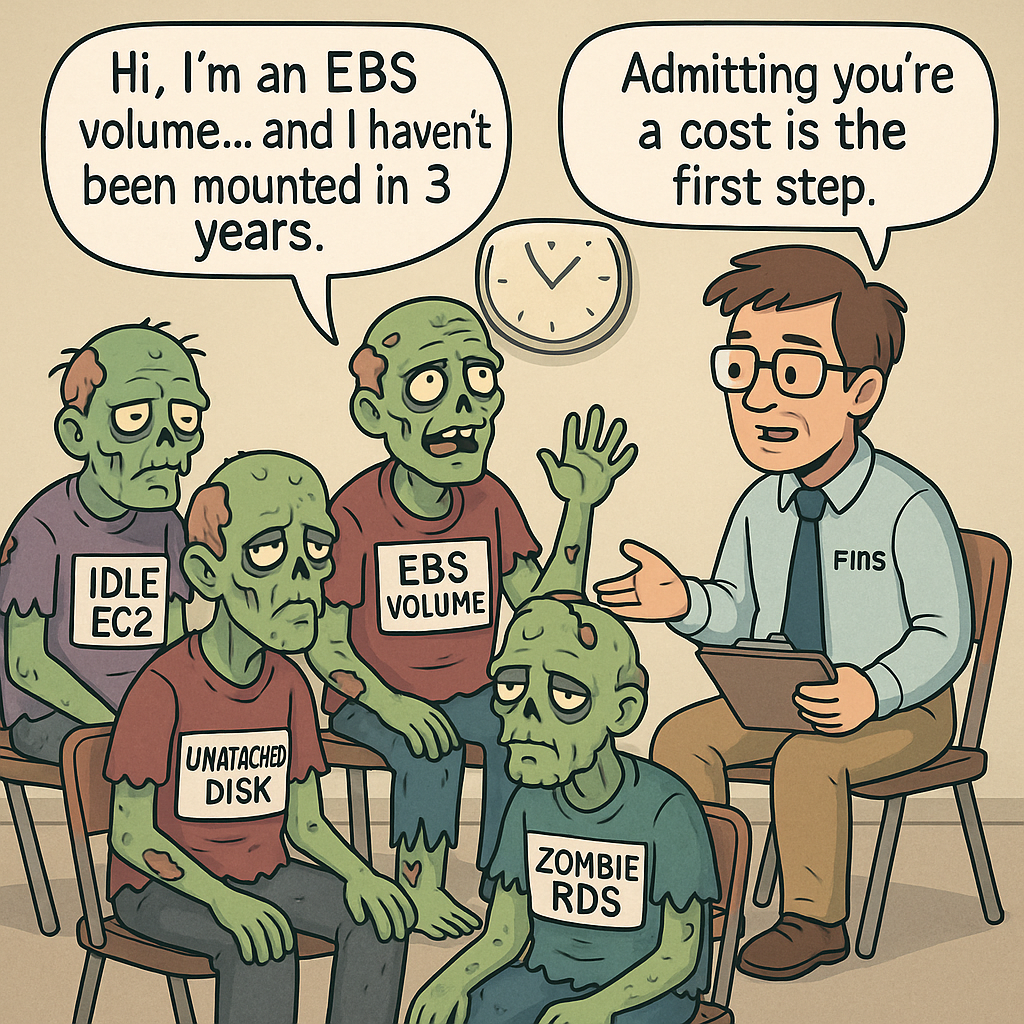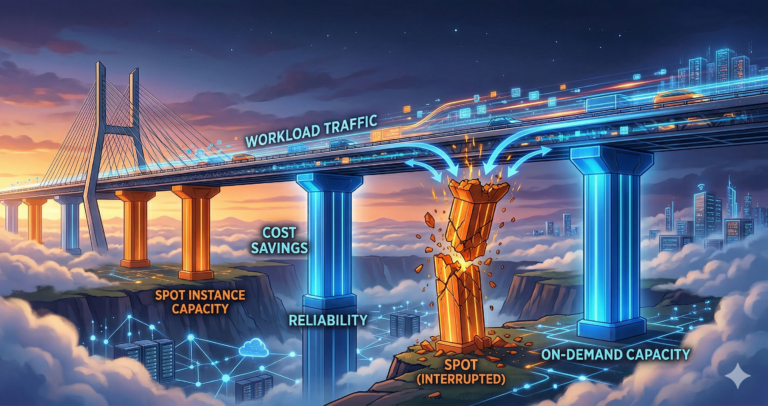

Picture this: somewhere in your cloud infrastructure, virtual machines continue humming away long after their purpose has ended, storage volumes sit unattached accumulating charges, and databases serve absolutely no one whilst generating hundreds of pounds in monthly costs. These aren’t just inefficiencies, they’re zombie resources, and they’re likely consuming far more of your budget than you realise.
Recent industry analysis from Flexera’s 2025 State of the Cloud Report reveals that organisations waste between 27% and 32% of their cloud spending on these unused resources. With global cloud expenditure projected to reach $723.4 billion in 2025, zombie resources represent approximately £156-186 billion in annual waste worldwide. For FinOps practitioners, this presents both a massive challenge and an extraordinary opportunity.
Understanding the zombie epidemic
Zombie resources are any cloud assets that no longer serve their intended purpose but continue generating costs. According to the FinOps Foundation, these are resources that “haven’t delivered any information or computing service for six months or more” whilst remaining in an available, running, or provisioned state. Think of them as the digital equivalent of leaving lights on in an empty building, except these lights can cost thousands of pounds monthly and multiply exponentially without oversight.
The anatomy of cloud zombies varies across platforms, but common patterns emerge:
AWS creates zombies through service interdependency complexity. When an EC2 instance terminates, its associated EBS volumes, security groups, and load balancers often persist independently. The platform’s default preservation behaviour, designed for data protection, requires explicit deletion actions that developers frequently overlook during rapid deployment cycles.
Azure generates zombies through architectural interdependencies. Virtual machines spawn managed disks, network interfaces, and public IP addresses that survive VM deletion. The platform’s resource group complexity can create scenarios where parent groups undergo partial cleanup, leaving dependent resources stranded and accumulating costs.
GCP breeds zombies through project-level resource fragmentation. The project-centric organisation enables resources to become forgotten across multiple organisational boundaries, particularly when teams create proof-of-concept environments that outlive their usefulness.
| Platform | Common Zombie Sources | Root Cause |
| AWS | Unused EBS after EC2 termination Lingering Security Groups Orphaned ELBs | Service interdependency and manual clean up requirements |
| Azure | Managed disks left by VM deletion Public IPs/NICs detached Partial resource group clean up | Resource group complexity and implicit dependencies |
| GCP | Forgotten POCs across projects Idle databases Long-lived test environments | Fragmented project structure and limited tagging culture |
The financial devastation hiding in plain sight
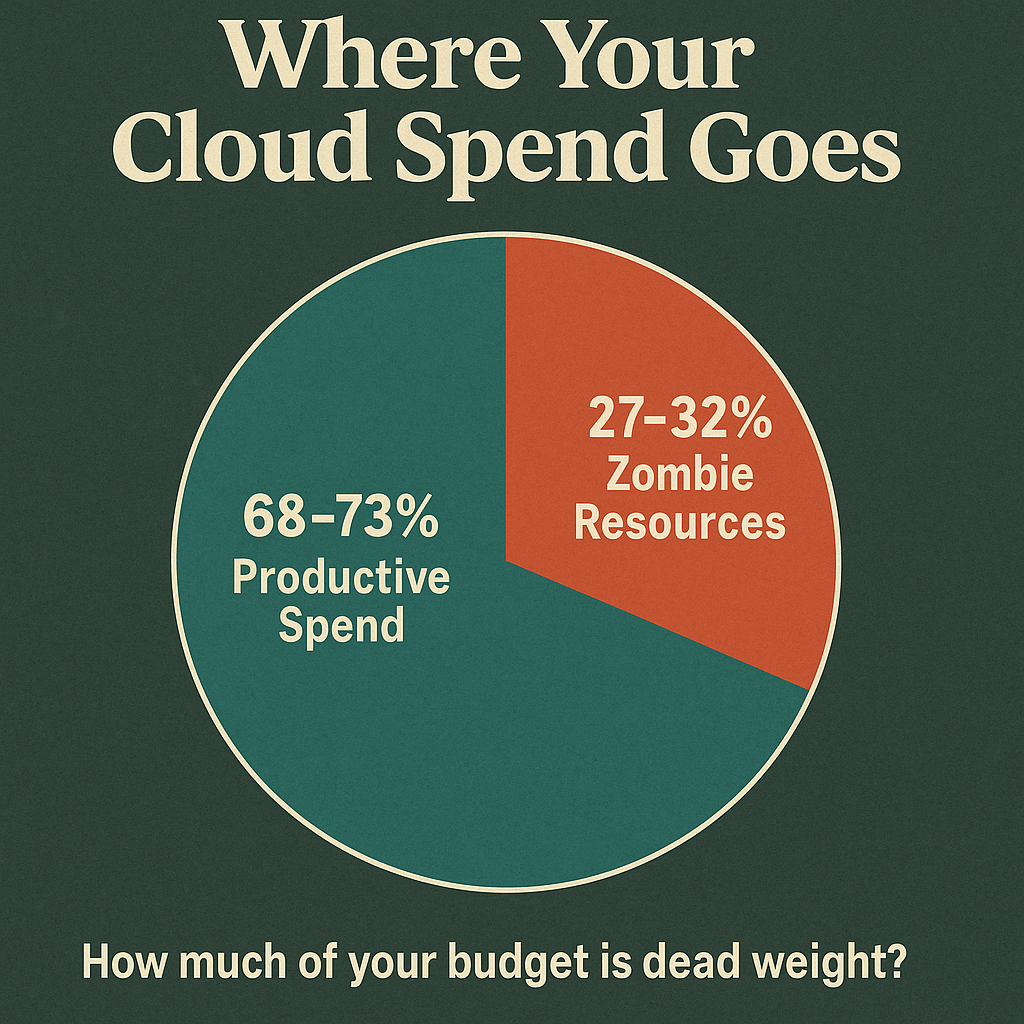
The numbers tell a sobering story. Real-world implementations demonstrate that systematic zombie elimination can achieve 20% to 64% cost reductions, with return on investment ranging from 300% to 500% in the first year.
Consider a consumer packaged goods company that reduced monthly costs from £22,254 to £7,997, a 64% reduction worth £171,084 annually through systematic zombie resource elimination. The initiative required just two months’ implementation with ongoing monitoring processes.
Similarly, Canva achieved a 46% compute cost reduction over two years whilst supporting 160 million monthly active users, demonstrating that zombie clean up enables both cost optimisation and business scaling simultaneously.
For organisations spending £10 million annually on cloud services, zombie resources typically represent £2.7-3.2 million in pure waste. Even smaller enterprises lose £216,000-432,000 annually to abandoned infrastructure that delivers zero business value.
The usual suspects: common zombie hotspots
Compute zombies
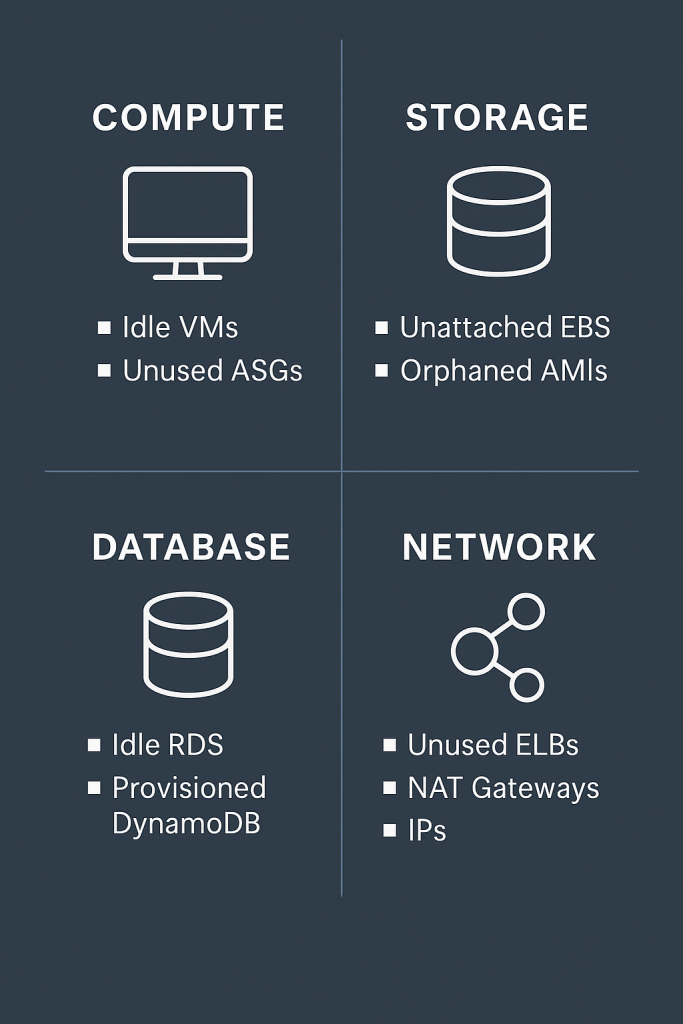
These represent the most visible and expensive category. EC2 instances left running after development work complete can cost £80-400 monthly each. Auto Scaling Groups managing no active workloads continue provisioning capacity that serves no purpose. Container instances forgotten after testing phases accumulate charges whilst delivering nothing.
Storage zombies
Unattached EBS volumes accumulate at £6-32 monthly each, often multiplying after migration projects or instance terminations. AMIs stored indefinitely in multiple regions create recurring charges that compound over time. Cloud storage objects languishing in expensive storage classes despite never being accessed represent another significant drain.
Database zombies
RDS instances costing £160-800 monthly with minimal connections exemplify this category. DynamoDB tables with provisioned capacity but zero activity continue generating charges. Managed database services across all platforms frequently become zombies when development teams forget to clean up test environments.
Network zombies
Unused load balancers cost £18-36 monthly whilst serving no traffic. NAT gateways managing no resources can generate £36-72 monthly charges. Public IP addresses sitting unassigned create small but persistent costs that accumulate across large infrastructures.
Detection strategies: finding zombies in the wild
Native cloud tools
Modern cloud platforms provide increasingly sophisticated detection capabilities. AWS Cost Explorer received significant updates in 2024, including natural language query support that enables FinOps teams to ask “show me idle EC2 instances over the past 30 days” in plain English. The enhanced daily granularity analysis provides hourly resource-level data with forecasting capabilities.
Azure Cost Management introduced parquet format exports that reduce file sizes by 40-70%, whilst Azure Advisor identifies underutilised VMs through CPU and network analysis. The platform’s Resource Graph provides Kusto Query Language capabilities for complex resource analysis across entire subscriptions.
GCP Recommender integration with FinOps Hub delivers VM rightsizing recommendations and idle resource identification. Cloud Asset Inventory maintains 35-day asset metadata history with real-time monitoring capabilities and BigQuery export functionality.
Third-party solutions
Enterprise-grade platforms like CloudHealth and CloudCheckr provide multi-cloud zombie detection with custom threshold configuration. Next-generation FinOps platforms such as CloudZero and Finout deliver AI-powered anomaly detection with automated cost allocation capabilities.
The choice between native and third-party tools often depends on organisational complexity and multi-cloud requirements. Native tools excel at platform-specific optimisation, whilst third-party solutions provide unified visibility across hybrid environments.
Custom automation approaches
Many organisations develop bespoke detection systems using cloud APIs and serverless functions. AWS Lambda-based solutions enable periodic resource scanning with tag-based lifecycle management. Azure PowerShell scripts can identify orphaned managed disks and unused public IPs through automated queries.
These custom approaches offer precise control over detection logic but require ongoing maintenance and security considerations.
| Feature | Native Tools | Third-Party Tools | Custom Automation |
| Visibility | Platform-specific (AWS, Azure, GCP only) | Unified multi-cloud view | Fully customizable across any environment |
| Cost | Included with cloud subscription | Additional licensing fees | Developer time and ongoing maintenance |
| Intelligence | Basic metrics and recommendations | AI/ML-powered anomaly detection | Manual logic, rule-based |
| Examples | Cost Explorer, Azure Advisor, GCP Recommender | CloudZero, Finout, CloudHealth, CloudCheckr | AWS Lambda, Azure PowerShell, GCP Functions |
| Ease of Setup | Easy | Moderate | Complex |
Elimination strategies: systematic zombie destruction
The four-phase methodology
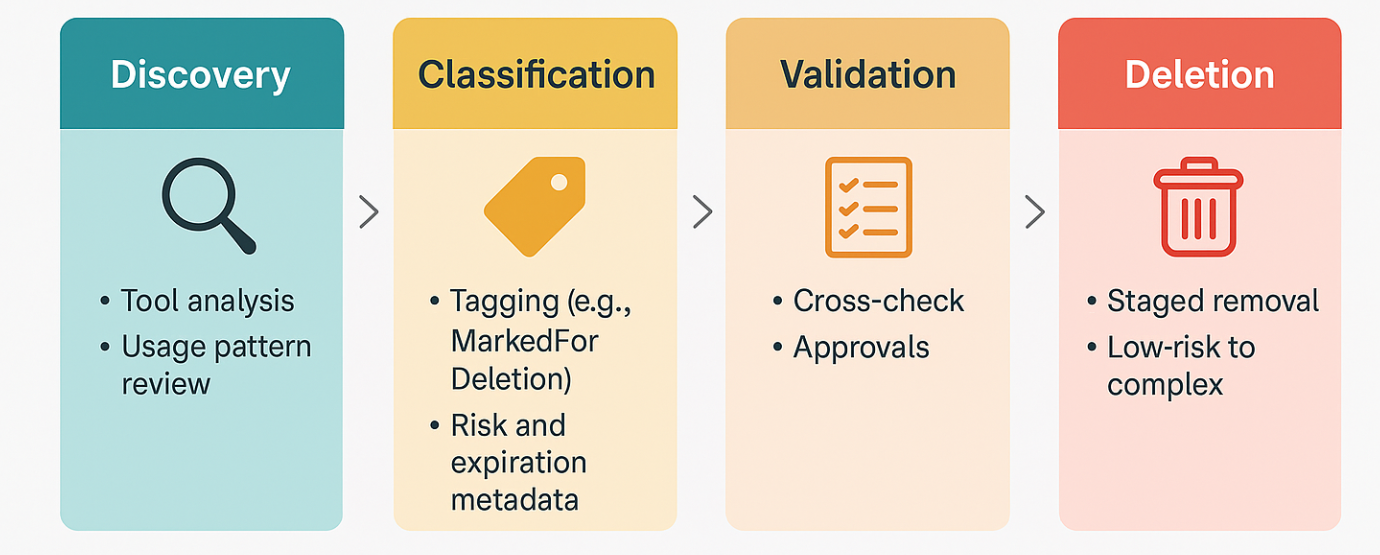
Successful zombie elimination follows a structured approach:
Discovery phase combines native tool analysis with usage pattern examination. AWS Trusted Advisor identification works alongside Cost Explorer usage analysis to create comprehensive resource inventories.
Classification phase involves resource tagging with expiration dates and risk categorisation. Resources receive “MarkedForDeletion” tags with specific expiration dates and business impact assessments.
Validation phase cross-references CloudTrail API activity with stakeholder notification workflows. This critical step prevents accidental deletion of resources that appear unused but serve important functions.
Deletion phase implements progressive elimination starting with low-risk resources like unattached EBS volumes and unused Elastic IPs, advancing to complex interdependent resources requiring coordination.
Platform-specific approaches
AWS implementations often utilise AWS Auto Cleanup, which provides production-ready automation using allow lists and time-based policies. The serverless architecture deploys Lambda functions with scheduled execution, supporting 290+ resource types through comprehensive filtering.
Azure strategies leverage Resource Manager Policies for automated decommissioning through inactivity-based deletion rules. Mandatory tagging enforcement supports resource lifecycle tracking with automated Azure Automation integration.
GCP methodologies employ tools like Safe Scrub, which generates deletion scripts instead of direct execution, providing transparency and review opportunities. ZUNA automation combines Cloud Scheduler, Pub/Sub, and Cloud Functions for fully automated clean-up.
Prevention: stopping zombies before they spawn
Organisational transformation
The most effective zombie prevention requires cultural change alongside technical controls. Gaming industry implementations of “cleanup challenges” achieve 70% resource reduction and 20% monthly cost savings through daily progress tracking and team recognition programmes.
Service ownership clarity becomes critical, documenting service names, owners, and monthly costs creates accountability that prevents resource abandonment. Regular financial improvement sprints focusing on high-impact optimisations create sustainable cost consciousness.
Governance frameworks
Comprehensive tagging strategies enable effective lifecycle management through functional tags (Application Name, Environment, Version), cost allocation tags (Cost Center, Project Code), and operational tags (Expiration Date, Utilisation Level).
Policy enforcement mechanisms include creation-time controls through mandatory tagging, runtime monitoring with automated compliance scanning, and escalation procedures that progress from notification to management involvement over defined timeframes.
Infrastructure as Code integration
Modern DevOps practices can embed zombie prevention directly into deployment pipelines. Terraform configurations can include lifecycle management rules, whilst CI/CD pipelines can enforce resource expiration policies and automated cleanup procedures.
Policy as Code implementations using AWS Lambda functions, Azure Automation Runbooks, or GCP Cloud Functions can scan for expired resources and implement gradual deletion with rollback capabilities.
Measuring success: the metrics that matter
Financial indicators
Cost Optimisation Ratio calculations of (Optimised Costs / Actual Costs) × 100 should target 15-40% improvement from baseline measurements. Zombie Resource Percentage, measured as unused resource costs divided by total cloud costs, should achieve reduction to less than 5% of total spending.

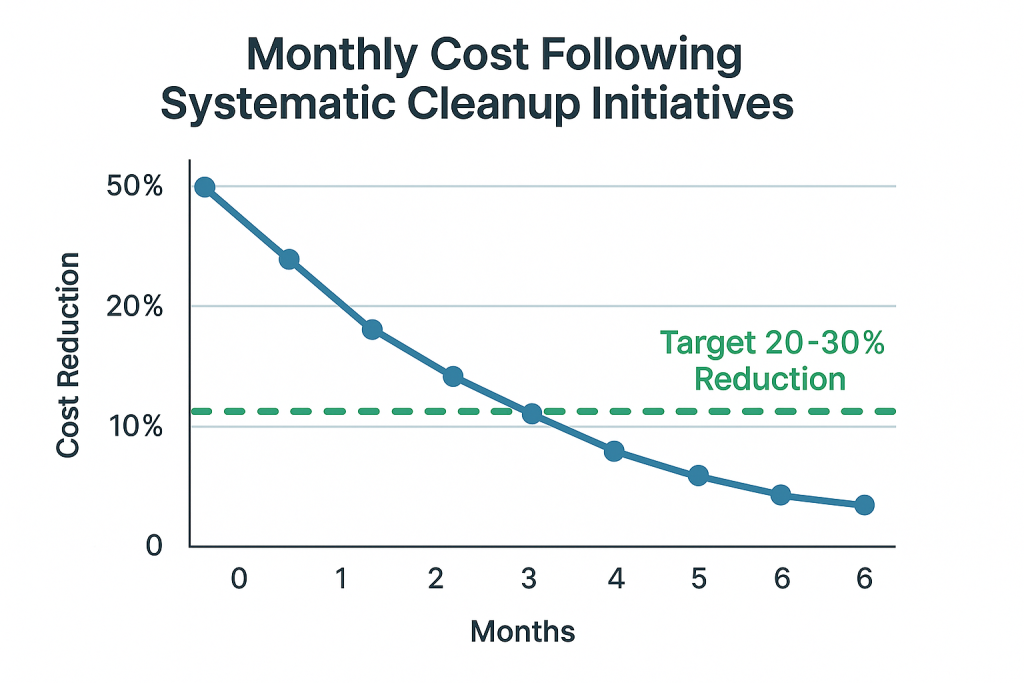
Monthly cost reduction tracking should demonstrate both absolute savings and percentage improvements, typically targeting 20-30% reduction within six months of systematic cleanup initiatives.
Operational excellence
Resource Utilisation Rates should exceed 80% average utilisation across CPU, memory, and storage resources. Tagged Resource Compliance should achieve greater than 90% proper tagging compared to industry averages of 60-70%.
Time to Detection and Remediation metrics should target less than 24 hours for zombie identification and under 48 hours for remediation through automated policies and notification workflows.
Looking ahead: the future of zombie prevention
Cloud platforms continue evolving their cost management capabilities. AWS enhanced Cost Anomaly Detection with 30% faster detection and 3x daily analysis frequency. Azure introduced enhanced FOCUS data support for standardised multi-cloud zombie identification. GCP expanded Recommender capabilities with scenario modelling for commitment planning.
Artificial intelligence integration promises even more sophisticated zombie detection through pattern recognition and predictive analytics. Machine learning models can identify resources likely to become zombies based on usage patterns and lifecycle characteristics.
The emergence of FinOps-native development practices suggests a future where zombie prevention becomes integral to software development workflows rather than reactive cleanup activities.
Your zombie elimination action plan
Start with a comprehensive audit using native cloud tools to establish baseline zombie metrics across your infrastructure. Implement basic tagging policies immediately, even simple ownership and expiration date tags can prevent most zombie accumulation.
Focus initial cleanup efforts on the highest-impact, lowest-risk resources: unattached storage volumes, unused IP addresses, and clearly abandoned development environments. These typically provide immediate cost reductions with minimal operational risk.
Establish governance processes that require resource expiration dates for development and testing environments. Implement automated scanning and notification systems that alert teams before resources become expensive zombies.
Most importantly, treat zombie elimination not as a one-time cleanup project but as an ongoing organisational capability. The organisations achieving 300-500% ROI from zombie management view it as fundamental infrastructure hygiene rather than periodic cost optimisation.
The zombie apocalypse consuming your cloud budget is entirely preventable. With systematic detection, elimination, and prevention strategies, organisations consistently transform waste into competitive advantage whilst building sustainable cloud financial management practices that scale with business growth.
The question isn’t whether you can afford to implement zombie resource management, it’s whether you can afford not to eliminate the hidden costs silently draining your cloud budget month after month.